
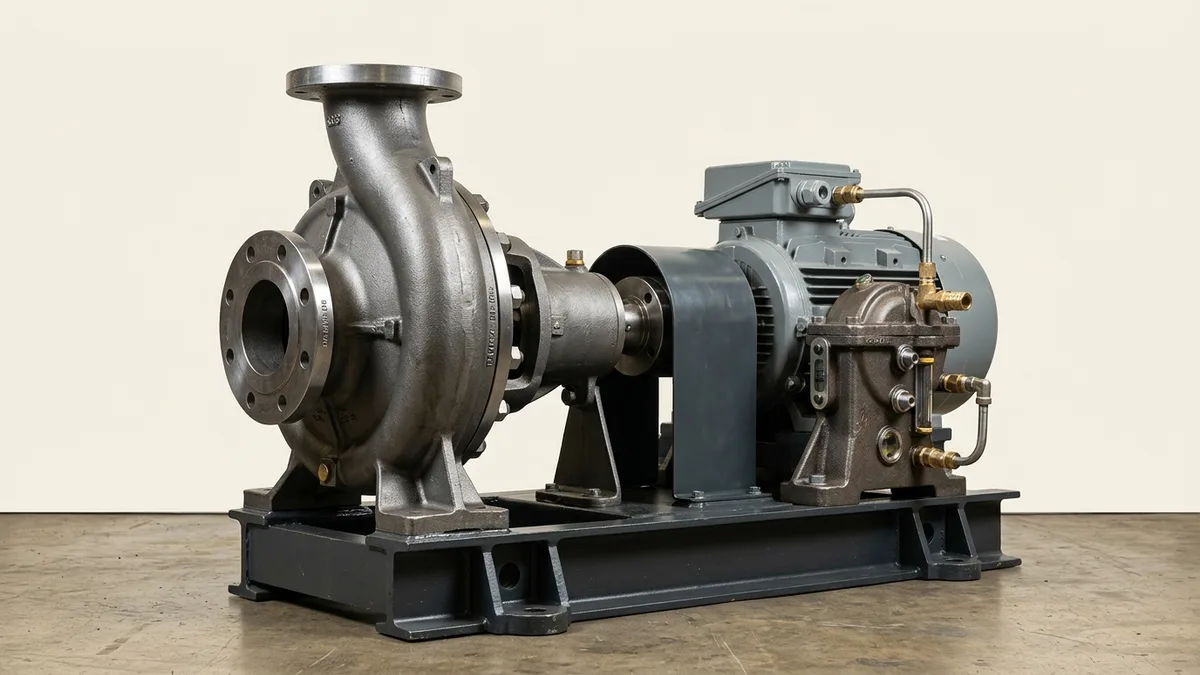
API 610 vs ISO 5199: Which Centrifugal Pump Standard Fits Your Chemical or Petrochemical Process?
A definitive rotating equipment comparison manual, mechanical standard evaluation protocol, and lifecycle cost analysis guide for process engineers, plant utility heads, and EPC procurement leads across Dahej PCPIR, Jamnagar, Vadodara, Ankleshwar, Hazira, and India.
Quick Answer
In the dynamic chemical, petrochemical, and refining corridors of Gujarat and India—spanning Dahej PCPIR, Jamnagar, Vadodara, Ankleshwar, Hazira, and Mumbai—specifying the correct rotating machinery standard is a multi-crore engineering decision. Process design teams and plant utility superintendents must regularly choose between ISO 5199 (Class II technical specifications for centrifugal chemical process pumps) and API 610 (centrifugal pumps for petroleum, petrochemical, and natural gas industries). The engineering boundary rules are clear: ISO 5199 pumps provide the most cost-effective solution for corrosive chemical transfer (0 - 14 pH), bulk acids (HCl, H_2SO_4, HNO_3), solvents, and utility waters operating at pressures up to 16 - 25 bar and temperatures up to 150°C, utilizing PFA-lined ductile iron armor or stainless alloys with back pull-out convenience conforming to ISO 2858 dimensions. Conversely, API 610 pumps (such as Type OH2 or BB2) are mandatory for hazardous, flammable hydrocarbons operating above 150°C (up to 450°C), pressures exceeding 20 bar (up to 300 bar in BB5), or where massive thermal piping nozzle loads dictate heavy-duty centerline-mounted casings, extra-heavy shaft diameters (L³/D⁴), and minimum bearing L10h fatigue life ≥ 25,000 hours.
Key Takeaways
- Evaluate Process Fluid Flammability and Temperature. Specify API 610 above 150°C or for flammable hydrocarbons; choose ISO 5199 for corrosive chemicals ≤ 150°C.
- Analyze Casing Support Kinematics. API 610 OH2 uses centerline mounting to prevent thermal misalignment; ISO 5199 uses foot mounting with ISO 2858 drop-in interchangeability.
- Compare External Nozzle Load Allowables. API 610 casings withstand 2× to 3× higher piping forces and moments than standard ISO 5199 chemical casings.
- Calculate Total Lifecycle CAPEX and OPEX. ISO 5199 pumps cost 60% - 75% less than API 610 units while delivering identical reliability on non-hydrocarbon corrosive chemical lines.
Introduction
Across Gujarat's major industrial manufacturing regions—including the Dahej Petroleum, Chemicals and Petrochemicals Investment Region (PCPIR), Jamnagar petroleum refining hub, Hazira chemical corridor, and the vast chemical industrial clusters of Ahmedabad (Vatva, Naroda), Ankleshwar, and Vapi—engineers design and operate thousands of process pumping units.
Project managers, rotating equipment engineers, and EPC consultants face a recurring specification challenge:
- The Over-Specification Trap: Automatically mandating API 610 pumps for all process lines within a chemical plant. This inflates capital expenditure by 250% - 400%, requires massive foundations to accommodate heavy API baseplates, and locks the plant into expensive proprietary metallic spares when affordable, corrosion-immune fluoropolymer lined ISO 5199 pumps would deliver superior chemical reliability.
- The Under-Specification Trap: Installing general-purpose ISO 5199 chemical pumps on high-temperature, high-pressure hydrocarbon streams (T > 180°C, P > 20 bar) to shave initial CAPEX. Thermal growth lifts foot-mounted casings, twisting shafts out of alignment, rupturing mechanical seals, and risking major plant fires.
- The Engineering Standard: Applying a rigorous, physics-driven selection methodology conforming to API 610 (11th & 12th Editions), ISO 5199, ISO 2858, IS 5120, and IS 1520 standards—evaluating temperature, pressure, fluid chemistry, nozzle forces, and seal architectures—ensures maximum process safety, complete environmental containment, and optimum return on capital.
2. Master 12-Dimensional API 610 vs ISO 5199 Engineering Matrix
Review the comprehensive 12-dimensional technical comparison between API 610 and ISO 5199 process pumps:
| Technical Dimension | ISO 5199 Standard (Chemical Process) | API 610 Standard (Refinery & Hydrocarbon) |
|---|---|---|
| Primary Industry Focus | Chemical, Pharmaceutical, Agrochemical, ETP | Petroleum Refining, Petrochemical, Oil & Gas |
| Typical Operating Temperature | -40°C to +150°C (Max 200°C with cooling) | -100°C to +450°C (Full thermal range) |
| Design Pressure Envelope | PN16 (16 bar) to PN25 (25 bar) | Class 300 to Class 2500 (50 to 300+ bar) |
| Casing Mounting Support | Foot-Mounted (ISO 2858 standardized) | Centerline-Mounted (OH2, BB2) to prevent thermal rise |
| Dimensional Standardization | 50 Standard ISO 2858 Sizes (Drop-In Swap) | Manufacturer-specific footprints (No single size standard) |
| Shaft Deflection at Seal | ≤ 0.05 mm (50 µm) at max radial load | ≤ 0.05 mm (50 µm) across entire curve |
| Minimum Bearing L10h Life | ≥ 17,500 hours (BEP) / ≥ 25,000 hr design | ≥ 25,000 hours (Continuous) / ≥ 16,000 hr max load |
| Allowable Nozzle Loads | Standard allowable forces and moments (Table 2) | 2× to 3× higher heavy piping load limits |
| Mechanical Seal Cavity | ISO 3069 / Standard Chemical Seal Chambers | Heavy-duty API 682 Cartridge Seal Chambers |
| Available Materials | PFA, PTFE, PVDF, Cast Iron, SS316, Hastelloy | Carbon Steel, 12% Cr, Duplex, Super Duplex (S-1 to D-2) |
| Dynamic Rotor Balancing | ISO 5199 Grade G2.5 (< 1.0 g\cdotmm/kg) | ISO 5199 Grade G2.5 / API 610 (< 0.67 g\cdotmm/kg) |
| Relative Capital Cost (CAPEX) | Baseline (1.0×) | 2.5× to 4.5× baseline chemical pump cost |
Interactive 5-Year Total Cost of Ownership (TCO) Simulator
Sealless Mag-Drive vs Mechanically Sealed Chemical Pump3. The Mechanical Physics, Casing Kinematics & Thermal Growth Math
Centerline vs Foot-Mounted Casing Thermal Expansion Mechanics (ΔY)
Thermal expansion of process pump casings is the primary differentiator between chemical and refinery designs:
- Foot-Mounted Thermal Rise (ISO 5199 / ISO 2858): Support feet are located at the bottom of the casing volute. Thermal expansion expands upward from the baseplate mounting pads:
- Centerline-Mounted Kinematics (API 610 OH2 & BB2): Support feet are positioned directly on the horizontal plane passing through the shaft centerline. Thermal expansion occurs symmetrically:
- Upward expansion and downward expansion balance each other around the centerline axis. - Vertical shaft centerline displacement remains ΔY_centerline ≈ 0 mm, maintaining perfect laser alignment from ambient cold startup to 450°C steady state.
Shaft Stiffness (L³ / D⁴) & Deflection at Mechanical Seal Faces
Both standards mandate that dynamic shaft deflection at the mechanical seal face must not exceed 0.05 mm (50 µm). However, the design approaches differ:
- ISO 5199 Chemical Pumps: Achieve stiffness via moderate shaft diameter (D) paired with compact overhang length (L). This optimizes casing hydraulic efficiency and lowers power consumption in moderate-pressure service.
- API 610 Process Pumps: Utilize exceptionally large shaft diameters under the sleeve (D) to withstand massive radial loads (F_radial \propto ΔP · D_imp · b_2) generated in high-head, high-pressure hydrocarbon service (P > 40 bar).
Allowable Nozzle Load Limits & Flange Stress Calculations
In chemical plants, piping is often supported near the pump using spring hangers and expansion loops, keeping external nozzle loads moderate. In large petroleum refineries, massive high-temperature process piping transfers enormous thermal forces (F_x, F_y, F_z) and bending moments (M_x, M_y, M_z) directly onto pump nozzles:
- API 610 Nozzle Envelopes: API 610 Table 5 allows up to 3× higher resultant forces and moments than ISO 5199 Table 2.
- Heavy Casing Wall Thickness: API 610 pump casings feature heavy carbon steel wall thicknesses with integrated gusseting and heavy baseplate anchoring to ensure zero internal casing distortion under extreme external piping strain.
Bearing L10h Fatigue Life & Lubrication Chamber Engineering
- ISO 5199 Standard: Mandates calculated bearing L10h fatigue life ≥ 17,500 hours at continuous BEP operation and ≥ 25,000 hours under normal design ratings, featuring constant-level oilers and oil bath lubrication.
- API 610 Standard: Mandates calculated bearing L10h fatigue life ≥ 25,000 hours continuous duty across the entire allowable operating region (from minimum continuous stable flow to run-out), and ≥ 16,000 hours under maximum allowable dynamic radial and axial loads. API 610 bearing housings incorporate oil flinger rings, replaceable labyrinth isolators (IP66), and optional water cooling jackets.
4. The 4 Critical Selection Mistakes in Chemical & Petrochemical Projects
Mistake 1: Specifying Foot-Mounted ISO 5199 Pumps on Hot Hydrocarbons (> 150°C)
- Problem: Installing foot-mounted chemical pumps on a 220°C distillation reboiler loop to save initial project cost.
- Consequence: Vertical thermal growth of +0.48 mm causes severe angular misalignment, destroying flexible couplings and causing mechanical seal blowouts within weeks.
- Solution: Mandate an API 610 Type OH2 centerline-mounted process pump with an API 682 Plan 23 seal flushing cooler.
Mistake 2: Over-Specifying API 610 on Ambient Corrosive Acid Circuits
- Problem: Specifying an API 610 metallic pump (Class A-8 or D-1) for ambient 33% HCl or 70% H_2SO_4 transfer.
- Consequence: Even expensive Super Duplex alloys corrode in hydrochloric acid within months, while the pump cost 3.5× more than a standard chemical pump.
- Solution: Specify an ISO 5199 / ISO 2858 PFA-lined ductile iron armored pump with monolithic direct-sintered silicon carbide (SSiC) seals, providing total chemical corrosion immunity at 30% of the cost.
Mistake 3: Ignoring Piping Thermal Nozzle Strain on ISO 5199 Flanges
- Problem: Connecting long, un-anchored hot process pipes directly to an ISO 5199 chemical pump without expansion loops.
- Consequence: Thermal piping growth exerts excessive bending moments on the casing, deflecting the shaft and causing internal impeller rubbing.
- Solution: Perform piping stress analysis to ensure nozzle loads stay within ISO 5199 Table 2 limits, or upgrade to an API 610 heavy-casing pump.
Mistake 4: Mismatching API 682 Seal Plans with Chemical Process Chambers
- Problem: Installing an API Plan 53B pressurized dual seal system with high-viscosity mineral barrier oil on a water-based dye chemical pump.
- Consequence: Barrier oil contamination of the dye product and excessive parasitic seal drag.
- Solution: Use an ISO 5199 standard seal chamber with an API Plan 52 unpressurized water buffer pot or Plan 11 internal recirculation.
5. Sanitary Materials of Construction & Cleanroom Standards
Solid Isostatic PTFE & Transfer-Molded PFA Wet Ends (ISO 5199)
- Armored Fluoropolymer Pumps: 100% virgin isostatic solid PTFE or transfer-molded PFA lined ductile iron armored pumps (4.5 - 6.0 mm wall thickness) conforming to ISO 2858 dimensions for aggressive acids and chlorination processes (0 - 14 pH).
API 610 Material Classes: S-1, S-6, C-6, A-8, D-1, D-2
- API Process Metallurgy: Carbon steel (S-1), 12% Cr stainless steel (S-6/C-6), SS316L (A-8), Duplex SS UNS S31803 (D-1), and Super Duplex UNS S32750 (D-2) investment castings for high-pressure hydrocarbons and sour crude.
Carbon-Steel Armored Ductile Iron (GGG 40) Casings
- Armored Casings: High-tensile Ductile Iron (GGG 40 / EN-GJS-400-18) armored casing envelopes conforming to ISO 2858 nozzle load ratings, designed to absorb heavy industrial piping moments.
Monolithic Direct-Sintered Silicon Carbide (SSiC) Seals
- API 682 Cartridge Mechanical Seals: Pre-set cartridge single or double mechanical seals featuring monolithic direct-sintered SSiC vs SSiC faces with Kalrez (FFKM) secondary elastomers.
6. Step-by-Step API 610 vs ISO 5199 Duty Selection SOPs
Execute these structured engineering SOPs when evaluating pump specifications for process projects:
Phase 1: Process Fluid Hazard, Vapor Pressure & Flammability Audit SOP
- Fluid Properties: Record fluid chemical composition, toxicity, flammability, specific gravity (SG), dynamic viscosity, vapor pressure (P_v), and auto-ignition temperature.
- Fluid Gate Rule:
- Flammable Hydrocarbon -> Proceed to Phase 2 for API 610 evaluation. - Non-Flammable Corrosive Chemical (0 - 14 pH) -> Proceed to Phase 2 for ISO 5199 evaluation.
Phase 2: Operating Temperature & Casing Mounting Sizing SOP
- Temperature Threshold:
- T ≤ 150°C -> Foot-Mounted Casing (ISO 5199 / ISO 2858) is fully compliant and recommended. - T > 150°C (up to 450°C) -> Centerline-Mounted Casing (API 610 Type OH2 or BB2) is mandatory.
Phase 3: Design Pressure, Hydraulic Staging & Frame Selection SOP
- Design Pressure Threshold:
- P ≤ 16 bar (or 25 bar with PN25 flange rating) -> Single-Stage ISO 5199 Chemical Pump. - P > 25 bar (up to 50 bar) -> Single-Stage Centerline API 610 Type OH2 or BB2. - P > 50 bar (up to 300 bar) -> Multistage Between-Bearings API 610 Type BB3 or BB5.
Phase 4: Piping Stress & Allowable Nozzle Load Audit SOP
- Piping Stress Review: Audit calculated piping thermal expansion forces (F_res) and bending moments (M_res) at pump nozzles.
- Nozzle Load Gate:
- Within ISO 5199 Table 2 -> Select ISO 5199 pump with standard baseplate. - Exceeds ISO 5199 Table 2 -> Select API 610 pump with heavy structural steel baseplate and anchor bolting.
Phase 5: Mechanical Seal Chamber & API 682 Flushing Plan Selection SOP
- Seal Cavity Audit: Select ISO 3069 cavity for standard chemical seals or API 682 enlarged chamber for heavy cartridge seals.
- Piping Plan Selection: Match API 682 Plan 11, Plan 23, Plan 52, or Plan 53B to fluid vapor pressure and emission limits.
Phase 6: Total Lifecycle CAPEX vs OPEX Financial Evaluation SOP
- Financial Analysis: Calculate total 15-year lifecycle cost including initial pump purchase, motor cost, civil foundation size, electrical power consumption, spare parts pricing, and MTBF overhaul frequency.
- Selection Sign-Off: Approve the lowest lifecycle cost standard that fully satisfies all safety and process containment rules.
7. Worked Gujarat Chemical, Petrochemical & Refinery Case Studies
Case 1: Dahej PCPIR Petrochemical Hydrocarbon Feed Pump Specification Audit
- Plant Context: A petrochemical aromatics extraction plant in Dahej PCPIR specifying feed pumps for hot mixed xylenes (175°C, 14 bar, flammable).
- Project Dilemma: EPC contractor initially proposed standard ISO 5199 chemical pumps to reduce project equipment budget.
- Technical Evaluation: Teflow engineering team audited thermal growth kinematics; calculated that a foot-mounted ISO 5199 casing would expand vertically by +0.32 mm at 175°C, exceeding allowable coupling alignment limits by 300%.
- Corrective Action: Replaced specification with API 610 Type OH2 centerline-mounted pumps with API Plan 23 mechanical seal coolers.
- Outcome: Zero thermal vibration; trouble-free operation across 26 consecutive operating months with zero seal leaks.
Case 2: Ankleshwar GIDC Specialty Chemical Plant ISO 5199 Pump Retrofit
- Plant Context: An agrochemical active intermediate plant in Ankleshwar GIDC transferring 30% HCl at 45°C and 4 bar.
- Project Dilemma: Client considered specifying expensive Hastelloy C-276 API 610 pumps (Rs 18 lakhs per unit).
- Technical Evaluation: Teflow engineers demonstrated that an ISO 5199 / ISO 2858 PFA-lined ductile iron armored pump (Rs 4.8 lakhs) provided superior chemical corrosion resistance at 27% of the capital cost.
- Corrective Action: Installed Teflow ISO 2858 PFA-lined pumps with direct-sintered SSiC seals.
- Outcome: Saved Rs 52.8 lakhs in initial project CAPEX across 4 pumping skids; continuous trouble-free service over 24 consecutive operating months.
Case 3: Hazira Refinery Heavy Gas Oil Transfer Pump Selection Evaluation
- Plant Context: A refinery processing unit in Hazira transferring heavy gas oil (320°C, 38 bar).
- Problem: Single-stage overhung pumps suffered severe shaft deflection under high differential pressure.
- Action Plan: Engineered an API 610 Type BB2 radially split between-bearings pump with 12% Cr stainless steel trim and Plan 53B dual pressurized seals.
- Outcome: Shaft deflection reduced to < 0.015 mm; MTBF extended beyond 36 months.
Case 4: Vadodara Petrochemical Complex Cooling Water Booster Standard Fix
- Plant Context: A utility block in Vadodara pumping 1200 m³/h cooling water (35°C, 5.5 bar).
- Problem: EPC bid included expensive API 610 BB1 pumps for clean cooling water.
- Action Plan: Demonstrated that heavy-duty ISO 5199 end-suction pumps with ductile iron casings met all hydraulic and L10h bearing life requirements (> 30,000 hours).
- Outcome: Project equipment cost reduced by 55% (Rs 28 lakhs savings) with zero compromise on reliability.
Case 5: Vapi GIDC Pesticide Active Intermediate Bromine Transfer Sizing
- Plant Context: A specialty active synthesis plant in Vapi GIDC pumping liquid bromine (SG = 3.12, highly toxic and corrosive).
- Problem: Metallic pumps suffered severe pitting within 30 days.
- Action Plan: Installed Teflow ISO 5199 magnetic drive solid PTFE lined pumps conforming to API 685 / ISO 5199 sealless standards.
- Outcome: Zero emissions; total fluid containment across 22 consecutive operating months.
Case 6: Jamnagar Refinery Petrochemical Offsites Demineralized Water Feed
- Plant Context: A refinery utility offsite unit in Jamnagar pumping high-purity DM water into a 45 bar distribution header.
- Problem: Low-conductivity DM water caused corrosion in carbon steel pump casings.
- Action Plan: Installed an API 610 Type BB4 ring-section multistage pump with 316L stainless steel casing and diffusers.
- Outcome: Complete corrosion resistance; delivered pressure stabilized at 45 bar with zero leakage over 24 consecutive operating months.
8. Step-by-Step Standards Selection Flowchart Decision Matrix
Follow this structured engineering guide when determining whether API 610 or ISO 5199 applies to your pump duty:
| Process Operating Condition | Primary Hydraulic / Mechanical Risk | Required Pump Engineering Standard |
|---|---|---|
| Corrosive Acid / Chemical (T ≤ 150°C, P ≤ 16 bar) | Extreme chemical corrosion (0 - 14 pH) | ISO 5199 / ISO 2858 PFA or PTFE Lined Armored |
| Clean Chemical / Solvent (T ≤ 150°C, P ≤ 25 bar) | Moderate pressure, chemical containment | ISO 5199 Stainless Steel / Hastelloy Process Pump |
| Flammable Hydrocarbon (T > 150°C, P ≤ 50 bar) | Thermal expansion & vertical shaft rise | API 610 Type OH2 (Centerline Overhung) |
| High-Pressure Hydrocarbon (P > 35 bar, T > 200°C) | High radial shaft deflection & heavy load | API 610 Type BB2 (Between Bearings Radially Split) |
| Heavy External Piping Loads (> 2× ISO) | Casing distortion & shaft binding | API 610 Heavy Armored Casing Architecture |
| Ultra-High Head Boiler Feed (P > 150 bar) | Supercritical pressure & thermal shock | API 610 Type BB5 (Double-Casing Barrel Multistage) |
9. Comprehensive Master Process Pump Specification Quality Checklist
Execute this quality verification protocol when reviewing engineering requisitions and pump data sheets:
Process Pump Standards Specification & Quality (FAT) Protocol
10. Summary & Pump Engineering Support in Gujarat & India
Balancing the heavy-duty mechanical reliability of API 610 refinery process pumps (Types OH2, BB2, BB5) against the cost-effective, corrosion-immune fluid containment of ISO 5199 and ISO 2858 solid PTFE and molded PFA lined process pumps across Dahej PCPIR, Jamnagar, Hazira, Vadodara, Ankleshwar, and Vapi—by evaluating operating temperature, pressure, fluid flammability, and piping nozzle forces conforming to API 610, API 682, ISO 5199, ISO 2858, IS 5120, and IS 1520 standards—is the proven engineering standard for industrial reliability.
Partnering directly with an established Gujarat rotating machinery manufacturer provides process design engineers, plant utility heads, and EPC procurement managers with immediate technical access to pump hydraulic selection software, ISO 5199 to API 610 conversions, precision CNC machining, dynamic balancing machines, and genuine spares dispatched directly from our Ahmedabad factory. Our technical engineers provide comprehensive engineering audits, hydraulic sizing proposals, and complete pump rebuilds.
Teflow Pumps operates a specialized chemical and industrial machinery manufacturing facility in Ahmedabad, providing engineered PFA-lined process pumps, solid PTFE pumps, high-pressure multistage pumps, precision mechanical seals, dynamic rotor balancing, laser alignment, and genuine rotating equipment spares across Gujarat and India conforming to ISO 5199, ISO 2858, IS 5120, and API 685 standards.
- Direct Technical & Emergency Helpline: +91 98251 62709
- WhatsApp Technical Desk: Share process fluid data sheets, operating temperature (°C), design pressure (bar), flow rate (m³/h), or current pump requisitions to wa.me/919825162709 for immediate technical review, standards compliance verification, and formal quotation.
- Request an On-Site Process Pump Audit & Standards Selection Survey: Contact our senior rotating equipment engineers for plant pump surveys, standards selection proposals, and formal quotation. Our engineering team conducts comprehensive hydraulic evaluations, verifies API 610 vs ISO 5199 criteria, provides custom pump integration, and tests overhauled rotating equipment to ensure maximum uptime across India's chemical and petrochemical processing complexes. We provide rapid technical evaluations, on-site plant surveys, and formal quotes.