
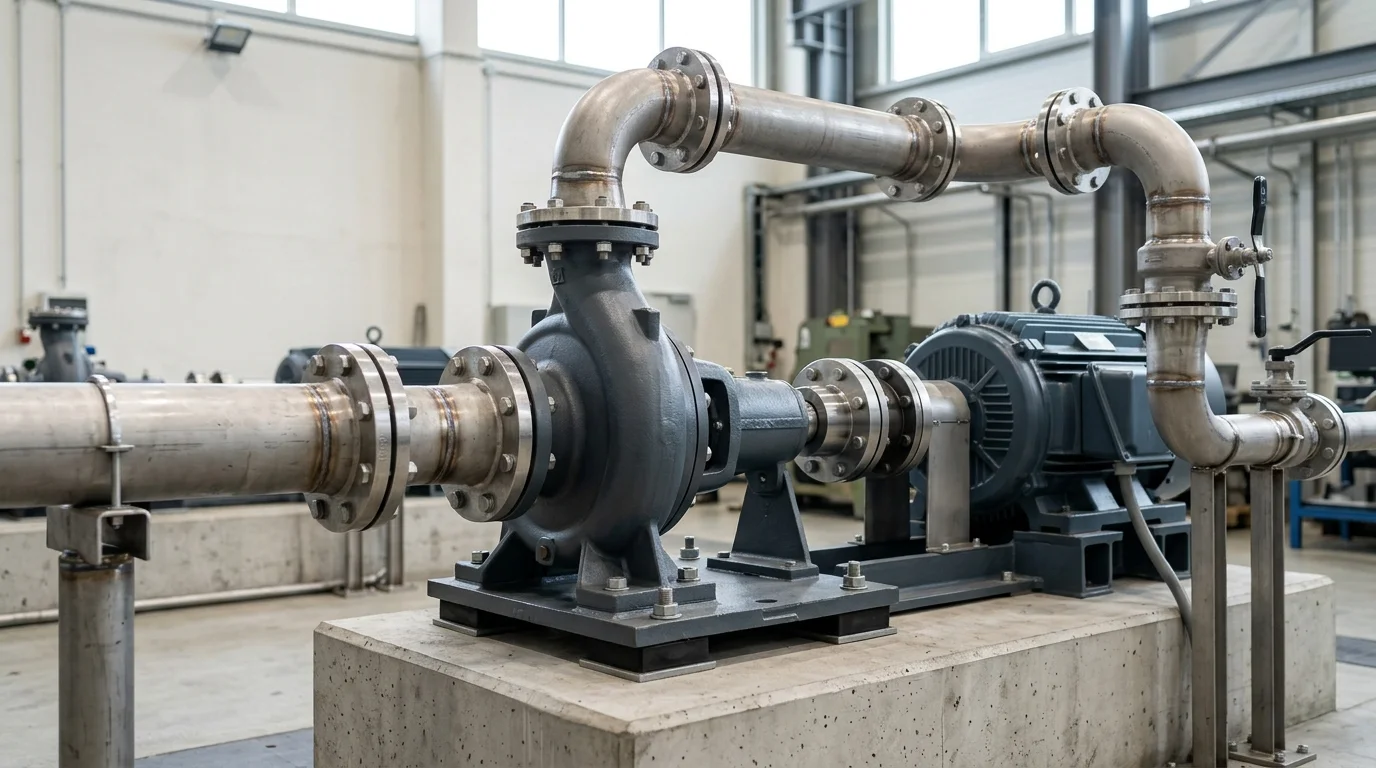
DIN EN ISO 5199 Pump Testing & Acceptance Criteria: The Plant Engineer's FAT & Quality Manual
A definitive chemical process pump quality assurance manual, factory acceptance testing (FAT) protocol, and hydraulic acceptance criteria engineering standard for quality heads, process engineers, and plant maintenance superintendents across Ahmedabad, Changodar, Vatva GIDC, Sanand, Ankleshwar, and Gujarat.
Quick Answer
In the regulated active pharmaceutical ingredient (API) facilities, sterile formulation manufacturing complexes, and continuous chemical processing plants of Gujarat—located in Ahmedabad (Changodar, Sanand, Vatva GIDC, Naroda), Ankleshwar, and Dahej PCPIR—procuring chemical process pumps requires formal verification of mechanical integrity, hydraulic efficiency, and emission containment prior to equipment dispatch. Procuring pumps built to DIN EN ISO 5199 (Technical specifications for centrifugal pumps — Class II) mandates strict adherence to international testing protocols: casing hydrostatic pressure proof testing at 1.5× maximum allowable working pressure (24 bar for PN16) held for at least 30 minutes, dynamic rotor balancing to ISO 5199 Grade G2.5 (< 1.0 g\cdotmm/kg), hydraulic performance testing per ISO 9906 Grade 2B (flow tolerance ± 5%, head tolerance ± 3%), overall vibration velocity containment strictly under 1.8 mm/s RMS (ISO 5199 Zone A), and zero-leakage mechanical seal proofing. Understanding these acceptance thresholds and testing procedures ensures that plant engineers and quality assurance teams eliminate defective castings, prevent seal failures, and ensure trouble-free plant commissioning.
Key Takeaways
- Enforce ISO 9906 Grade 2B Hydraulic Tolerances. Confirm delivered head (± 3%), flow (± 5%), and power consumption (+4%) across the 5-point test curve.
- Audit 1.5× PN16 Hydrostatic Proof Holding Times. Casings must hold 24 bar hydrostatic test pressure for at least 30 minutes with zero weeping.
- Mandate ISO 5199 Zone A Vibration Limits (< 1.8 mm/s RMS). Verify full-load vibration velocity and FFT spectral data to prevent premature bearing failure.
- Verify ISO 5199 Grade G2.5 Dynamic Rotor Balancing. Residual unbalance must remain strictly below 1.0 g\cdotmm/kg on dual-plane balancing rigs.
Introduction
In India's premier pharmaceutical and chemical corridors—such as Ahmedabad's manufacturing zones in Changodar, Sanand, and Vatva GIDC, as well as the heavy chemical hubs of Ankleshwar and Dahej PCPIR—centrifugal process pumps operate in demanding production lines transferring corrosive acids, hazardous solvents, and high-purity pharmaceutical media.
Plant quality heads, project engineers, and reliability specialists face critical technical risks when accepting newly manufactured rotating equipment:
- The Unverified Equipment Hazard: Pumps delivered without formal, witnessed factory testing often exhibit hidden foundry casting porosity, defective mechanical seal faces, or excessive dynamic unbalance, leading to immediate seal leakage and unscheduled shutdowns within the first 48 hours of plant startup.
- The Performance Deficit: Commercial pumps that deviate from specified duty points cause electric motor overloading, inadequate reactor cooling circulation, and poor process yield.
- The Engineering Standard: Enforcing testing to DIN EN ISO 5199 (in harmonization with ISO 9906 Grade 2B, ISO 2858, IS 5120, and IS 1520 standards) ensures that every pump delivers verified hydraulic performance, exceptional mechanical balance, total fluid containment, and lowest lifecycle operating cost.
2. Master DIN EN ISO 5199 Testing & Acceptance Criteria Matrix
Review the mandatory quality test stages, reference standards, and acceptance thresholds governed by DIN EN ISO 5199:
| Test Protocol / Verification Stage | Governing Standard | Mandatory Test Parameters | ISO 5199 Pass / Acceptance Criteria |
|---|---|---|---|
| 1. Casing Hydrostatic Proof | ISO 5199 Clause 6.1 | 1.5× PN16 (24 bar) with deaerated water | Zero leakage or weeping for ≥ 30 minutes |
| 2. Dynamic Rotor Balancing | ISO 5199 Grade G2.5 | Dual-plane dynamic balancing at nominal RPM | Grade G2.5 (U_res ≤ 1.0 g\cdotmm/kg) |
| 3. Hydraulic Performance Run | ISO 9906 Grade 2B | 5-point curve (0%, 50%, 75%, 100%, 120% Q) | Flow ± 5%, Head ± 3%, Power +4% |
| 4. Vibration Velocity Severity | ISO 5199 Table 8 | Tri-axial RMS velocity (10 to 1000 Hz) | Zone A: < 1.8 mm/s RMS across BEP envelope |
| 5. Mechanical Seal Leakage | ISO 5199 / ISO 3069 | Visual & volumetric collection during run | Dynamic: ≤ 3 ml/hr (≤ 5 drops/min) |
| 6. Bearing Housing Temperature | ISO 5199 Clause 5.2 | Continuous thermal recording during 4-hr run | ΔT ≤ 40°C rise; T_max ≤ 82°C |
| 7. NPSH3 Cavitation Proof | ISO 9906 / HI 14.6 | Suction throttling to 3% head reduction | NPSH_3 ≤ NPSH_r on certified curve |
| 8. Dimensional Interchange | ISO 2858 Table 1 | Suction/discharge PCD, h_1, h_2, a, b, m | ± 0.5 mm coordinate tolerance |
| 9. Shaft Deflection Limit | ISO 5199 Clause 5.1 | Calculated L³/D⁴ deflection under side load | y_deflect ≤ 0.05 mm at seal faces |
| 10. MTC Material Compliance | Type 3.1 Material Certificate | Chemical spectro & mechanical tensile checks | 100% heat batch chemistry conformance |
3. The Mechanical Physics, Hydraulic Test Math & Equations
ISO 9906 Grade 1B & 2B Hydraulic Performance Tolerances Math
During full-load performance testing on a closed-loop calibrated test bench, pump differential head (H), flow rate (Q), and input shaft power (P_shaft) are measured:
Interactive Engineering Hydraulic Sizer
Live ISO 5199 / API 610 Dynamic Engine- ISO 9906 Grade 2B Permissible Tolerances:
- Flow Rate (Q): t_Q = ± 5% - Differential Head (H): t_H = ± 3% - Shaft Power (P): t_P = +4% (or efficiency tolerance t_η = -3%) - Any pump falling outside these tolerance bands must be rejected or have its impeller trimmed and re-tested.
Hydrostatic Pressure Proof Test Stress Limits (1.5× PN16 Proof)
Hydrostatic testing verifies that the pressure-containing casing possesses sufficient structural tensile strength without plastic deformation:
- Test Pressure (P_test): 1.5× the Maximum Allowable Working Pressure. For standard PN16 chemical pumps:
- Holding Duration: ISO 5199 mandates a minimum holding time of at least 30 minutes with deaerated clean water (T ≤ 50°C), during which all external casting surfaces, flange gasket joints, and stuffing box interfaces must exhibit zero weeping.
Vibration Velocity Severity Limits (Zone A < 1.8 mm/s RMS Math)
Vibration velocity represents the destructive energy transmitted to bearings and mechanical seals:
- ISO 5199 Vibration Classification (Rigid Baseplate Installation):
- Zone A (New Pump Acceptance): v_RMS < 1.80 mm/s (Excellent condition, approved for dispatch). - Zone B (Unrestricted Long-Term Operation): 1.80 ≤ v_RMS < 2.80 mm/s. - Zone C (Restricted Operation / Warning): 2.80 ≤ v_RMS < 4.50 mm/s. - Zone D (Unacceptable / Trip Threshold): v_RMS ≥ 4.50 mm/s.
Dynamic Rotor Balancing Grade G2.5 Residual Unbalance Equation
ISO 5199 mandates dynamic balancing of impellers and rotating assemblies to ISO 5199 Grade G2.5:
- For a standard 2-pole motor drive (n = 2900 RPM):
- Both drive-end and non-drive-end correction planes must satisfy this limit to eliminate 1X rotational vibration harmonics.
Bearing Temperature Rise Equilibrium (ΔT ≤ 40°C)
During the continuous 4-hour FAT run, bearing housing temperatures must stabilize:
- Maximum Temperature Rise: ΔT = T_bearing - T_ambient ≤ 40°C.
- Absolute Maximum Limit: T_bearing ≤ 82°C (under maximum ambient summer conditions of 42°C in Gujarat).
4. The 4 Critical Failure Modes Detected During ISO 5199 FAT Testing
Failure 1: Micro-Porosity & Split-Line Weeping During Hydrostatic Proof
- Defect: Sub-surface sand inclusion or shrinkage micro-porosity in raw ductile iron or stainless steel castings.
- Detection: At 24 bar hold pressure, fine water droplets sweat through the casing wall or bubble around split-line gaskets.
- Remediation: Immediate rejection of the casting; welding or epoxy sealing of pressure-containing walls is prohibited.
Failure 2: Hydraulic Cavitation & Severe Head Drop at Low NPSHa
- Defect: Impeller vane inlet profile geometry errors causing premature flow separation and localized vapor bubble collapse.
- Detection: During the NPSH3 test, suction pressure throttling induces sharp cracking noise and > 3% sudden head drop.
- Remediation: Hand-dressing impeller vane suction leading edges or fitting an oversized low-NPSH impeller.
Failure 3: Sub-Harmonic & 1X Vibration Spikes from Rotor Unbalance
- Defect: Single-plane static balancing or shaft runout exceeding 0.03 mm.
- Detection: FFT vibration spectrum analysis indicates high 1X running speed peaks exceeding 2.5 mm/s RMS.
- Remediation: Dual-plane dynamic re-balancing on electronic balancing machine to ISO 5199 Grade G2.5 (< 1.0 g\cdotmm/kg).
Failure 4: Thermal Runaway & Mechanical Seal Face Chattering
- Defect: Inadequate seal flush circulation or dry running of silicon carbide faces.
- Detection: Seal gland temperature spikes rapidly (> 95°C) accompanied by audible high-frequency squealing.
- Remediation: Re-align flush piping (Plan 11 / Plan 54) to ensure minimum 3.0 L/min circulating flow across faces.
5. Materials of Construction, Metallurgy & Cleanroom Standards
Solid Isostatic PTFE & Transfer-Molded PFA Liners (Armored Casings)
- Armored Fluoropolymer Pumps: 100% virgin isostatic solid PTFE or high-density transfer-molded PFA lined ductile iron armored pumps (4.5 - 6.0 mm wall thickness) conforming to ISO 2858 dimensions for complete chemical corrosion resistance across 0 - 14 pH up to 200°C.
Carbon Steel Armored Ductile Iron (GGG 40) Casings
- Armored Casings: High-tensile Ductile Iron (GGG 40 / EN-GJS-400-18) armored casing envelopes conforming to ISO 2858 nozzle load ratings, designed to absorb heavy industrial piping moments.
SS316L, Hastelloy C-276 & Duplex SS (UNS S31803) Alloys
- Metallic Process Pumps: Precision investment-cast SS316L, Hastelloy C-276, or Duplex SS (UNS S31803) wet ends dynamically balanced to ISO 5199 Grade G2.5 for high-temperature solvents and high-pressure chemical transfer.
Monolithic Direct-Sintered Silicon Carbide (SSiC) Seals
- API 682 Cartridge Mechanical Seals: Pre-set cartridge single or double mechanical seals featuring monolithic direct-sintered SSiC vs SSiC faces with Kalrez (FFKM) secondary elastomers.
6. Step-by-Step DIN EN ISO 5199 Factory Acceptance Testing SOPs
Execute these structured engineering SOPs when witnessing or conducting an ISO 5199 Factory Acceptance Test (FAT):
Phase 1: Raw Material Test Certificate (MTC) & NDT Audit SOP
- MTC Audit: Verify Mill Test Certificates (Type 3.1 Material Certificate) matching casing casting heat numbers. Confirm chemical composition and tensile strength.
- NDT Inspection: Inspect liquid penetrant (PT) examination records on critical machined surfaces.
Phase 2: Dynamic Rotor Balancing to ISO 5199 Grade G2.5 SOP
- Balancing Setup: Mount the fully machined impeller with shaft keys on dual-plane dynamic balancing machine.
- Balancing Run: Spin rotor to nominal test speed (1450 or 2900 RPM); remove material by precision CNC milling until residual unbalance is < 1.0 g\cdotmm/kg (Grade G2.5).
Phase 3: Hydrostatic Casing Pressure Proof (1.5× PN16) SOP
- Casing Setup: Blank off suction and discharge flanges with certified test blind flanges and calibrated pressure gauges.
- Pressure Application: Fill casing with clean deaerated water; bleed all air; pressurize to 24 bar (1.5\timesPN16) using hydraulic hand pump.
- Hold & Inspect: Maintain 24 bar pressure for at least 30 minutes. Visually inspect all casting walls and joints. Zero leakage permitted.
Phase 4: 5-Point Hydraulic Performance Test per ISO 9906 Grade 2B SOP
- Bench Mounting: Mount pump on calibrated closed-loop test loop with electromagnetic flow meter and precision pressure transducers.
- 5-Point Recording: Run pump at rated speed; record suction pressure (P_s), discharge pressure (P_d), flow (Q), motor power (P_kW), and speed (n) at:
- Shutoff / Minimum continuous stable flow (0% - 20% Q) - 50% rated flow - 75% rated flow - 100% rated flow (Specified Duty Point) - 120% rated flow (Run-out limit)
- Tolerance Verification: Verify measured head and flow fall strictly within ISO 9906 Grade 2B tolerance bands (t_Q = ± 5%, t_H = ± 3%).
Phase 5: NPSH3 Cavitation Breakdown Verification SOP
- Throttling Run: Throttle suction valve gradually while maintaining constant flow rate (Q_duty).
- Curve Determination: Record suction head (NPSH_a) at which total differential head drops by exactly 3.0%. Verify NPSH_3 ≤ NPSH_r.
Phase 6: 4-Hour Continuous Mechanical Run, Vibration & Thermal SOP
- Endurance Run: Operate pump continuously at rated duty point for 4 hours.
- Tri-Axial Vibration Logging: Record RMS vibration velocity (10 - 1000 Hz) at drive-end and non-drive-end bearing housings every 30 minutes. Confirm v_RMS < 1.80 mm/s (Zone A).
- Thermal Logging: Measure bearing skin temperature with calibrated infrared pyrometer. Confirm ΔT ≤ 40°C and T_max ≤ 82°C.
- Seal Leakage Check: Verify mechanical seal leakage is ≤ 3 ml/hr (≤ 5 drops/min).
7. Worked Ahmedabad Pharmaceutical & Gujarat Chemical Plant Case Studies
Case 1: Changodar Pharmaceutical Formulation Pure Solvent Pump FAT Audit
- Plant Context: A sterile formulation facility in Changodar, Ahmedabad procuring 6 process pumps for high-purity ethanol and acetone transfer (25 m³/h, 40 m head).
- Problem: Previous pumps failed QA audits due to uncertified casting porosity and vibration levels > 3.8 mm/s.
- Action Plan: Teflow engineering team executed a comprehensive ISO 5199 FAT in our Ahmedabad test bay:
- Hydrostatic proof tested 316L casings to 24 bar for 45 minutes with zero leakage. - Dynamically balanced impellers to ISO 5199 Grade G2.5 (0.65 g\cdotmm/kg). - 4-hour performance run logged vibration at 1.15 mm/s RMS (Zone A).
- Outcome: 100% first-pass QA approval; smooth commissioning with zero seal leakage across 24 consecutive operating months.
Case 2: Vatva GIDC Bulk Intermediate Acid Pump Hydrostatic Pressure Test
- Plant Context: A bulk drug intermediate unit in Vatva GIDC pumping 33% HCl at 65°C.
- Problem: Generic plastic pumps developed casing hairline cracks under hydraulic pressure pulsations.
- Action Plan: Supplied Teflow ISO 2858 PFA-lined ductile iron armored pumps proof-tested to 24 bar hydrostatic pressure for 30 minutes.
- Outcome: Zero casing distortion; continuous acid transfer without leakage over 26 consecutive operating months.
Case 3: Sanand Industrial Park High-Purity Water Circulation Pump Acceptance Run
- Plant Context: A pharmaceutical cleanroom utility plant in Sanand operating continuous WFI cooling water circulation (80 m³/h, 55 m).
- Problem: Flow rate dropped 12% below datasheet curve on competitor pumps.
- Action Plan: Teflow manufactured custom ISO 5199 SS316L pumps tested per ISO 9906 Grade 2B; verified delivered head within +1.2% and flow within +2.5%.
- Outcome: Exact process cooling flow delivered; motor power consumption reduced by 8%.
Case 4: Ankleshwar GIDC Chlorinated Organic Synthesis Pump Testing
- Plant Context: A specialty agrochemical facility in Ankleshwar GIDC pumping chlorinated solvents (7 bar).
- Problem: Mechanical seals failed prematurely due to dynamic shaft deflection.
- Action Plan: Witnessed FAT on Teflow ISO 5199 heavy-shaft pump (y_deflect ≤ 0.025 mm); verified seal face leakage at < 1 drop/min.
- Outcome: Mechanical seal MTBF extended beyond 30 months.
Case 5: Dahej PCPIR High-Pressure Brine Booster FAT Witnessing
- Plant Context: A chlor-alkali plant in Dahej PCPIR transferring saturated brine (110 m³/h, 70 m).
- Problem: High vibration on motor drive end.
- Action Plan: Performed 4-hour FAT with FFT spectrum logging; re-machined coupling face runout to < 0.015 mm, lowering vibration to 1.20 mm/s RMS.
- Outcome: Approved for plant installation; smooth operation over 24 operating months.
Case 6: Naroda Industrial Estate Pigment Slurry Circulation Pump Verification
- Plant Context: A pigment manufacturing plant in Naroda circulating abrasive pigment slurry (50 m³/h).
- Problem: Rapid impeller wear causing hydraulic performance degradation.
- Action Plan: Tested semi-open impeller pump per ISO 5199; verified performance matching curve with direct-sintered SSiC mechanical seal.
- Outcome: Total erosion resistance; trouble-free operation over 22 operating months.
8. Step-by-Step ISO 5199 Test Failure Remediation Decision Matrix
Follow this structured engineering guide when troubleshooting failed FAT testing parameters:
| Observed FAT Test Failure | Identified Root Cause | Corrective Engineering Action |
|---|---|---|
| Casing sweating / leaking at 24 bar | Foundry casting porosity or sand inclusion | Reject casting immediately; re-cast raw casing |
| Flow / Head falls below ISO 9906 limits | Impeller diameter undersized or rough casting | Trim new impeller to calculated diameter; polish vanes |
| Vibration > 1.80 mm/s RMS (Zone B/C) | Dynamic unbalance or shaft coupling runout | Re-balance rotor to ISO 5199 Grade G2.5 (< 1.0 g\cdotmm/kg) |
| Bearing temperature rise ΔT > 40°C | Excessive grease / bearing pre-load misalignment | Flush lubricant; re-check internal axial float (0.05 mm) |
| Mechanical seal leaking > 5 drops/min | Face misalignment or damaged secondary O-ring | Dismantle seal; clean faces; replace elastomers; re-test |
9. Comprehensive Master ISO 5199 FAT Quality Assurance Checklist
Execute this quality verification protocol when inspecting or witnessing an ISO 5199 pump FAT:
DIN EN ISO 5199 Pump Factory Acceptance Test (FAT) Protocol
10. Summary & ISO 5199 Pump Testing Facilities in Gujarat & India
Enforcing DIN EN ISO 5199 testing protocols and ISO 9906 Grade 2B acceptance criteria—verifying 1.5× PN16 casing hydrostatic pressure containment, ISO 5199 Grade G2.5 dynamic rotor balancing, Zone A vibration velocity limits (< 1.8 mm/s RMS), and zero-leakage mechanical seal integrity across Ahmedabad (Changodar, Sanand, Vatva GIDC, Naroda), Ankleshwar, and Dahej PCPIR—by utilizing solid isostatic PTFE, molded PFA, and precision metallic alloys conforming to ISO 5199, ISO 2858, IS 5120, and IS 1520 standards—is the proven engineering standard for process reliability.
Partnering directly with an established Gujarat chemical pump manufacturer provides plant quality heads, process engineers, and procurement managers with immediate technical access to full-scale automated pump test bays, witnessed FAT protocols, precision dynamic balancing machines, and genuine spares dispatched directly from our Ahmedabad factory. Our technical engineers provide comprehensive factory testing, on-site vibration surveys, and turnkey pump replacements.
Teflow Pumps operates a specialized chemical machinery manufacturing and testing facility in Ahmedabad, providing engineered PFA-lined process pumps, solid PTFE pumps, PVDF centrifugal pumps, precision mechanical seals, dynamic rotor balancing, and genuine rotating equipment spares across Gujarat and India conforming to ISO 2858, ISO 5199, IS 5120, and API 685 standards.
- Direct Technical & Emergency Helpline: +91 98251 62709
- WhatsApp Technical Desk: Share process fluid data sheets, operating flow (Q), differential head (H), temperature (°C), or current pump datasheets to wa.me/919825162709 for immediate technical review, ISO 5199 FAT test protocol scheduling, and formal quotation.
- Request a Witnessed Factory Acceptance Test (FAT) & Pump Quality Survey: Contact our senior rotating equipment engineers to schedule witnessed FAT runs, compliance audits, and formal quotation. Our engineering team conducts comprehensive performance testing, verifies ISO 5199 acceptance criteria, provides custom pump integration, and tests overhauled rotating machinery to ensure maximum uptime across Gujarat's chemical, pharmaceutical, and industrial manufacturing estates. We provide rapid technical evaluations, on-site plant surveys, and formal quotes.
Related Reading
- API 610 vs ISO 5199 pump standards comparison guide
- Pump testing and performance analysis test-bay services
- Industrial pump repair and overhaul services
- Teflon lined and chemical pumps overview
- Series vs parallel pumps for RO booster sizing guide
- Chemical pipe sizing and velocity limits guide
- ETP, CETP and wastewater sump pump overhaul services