
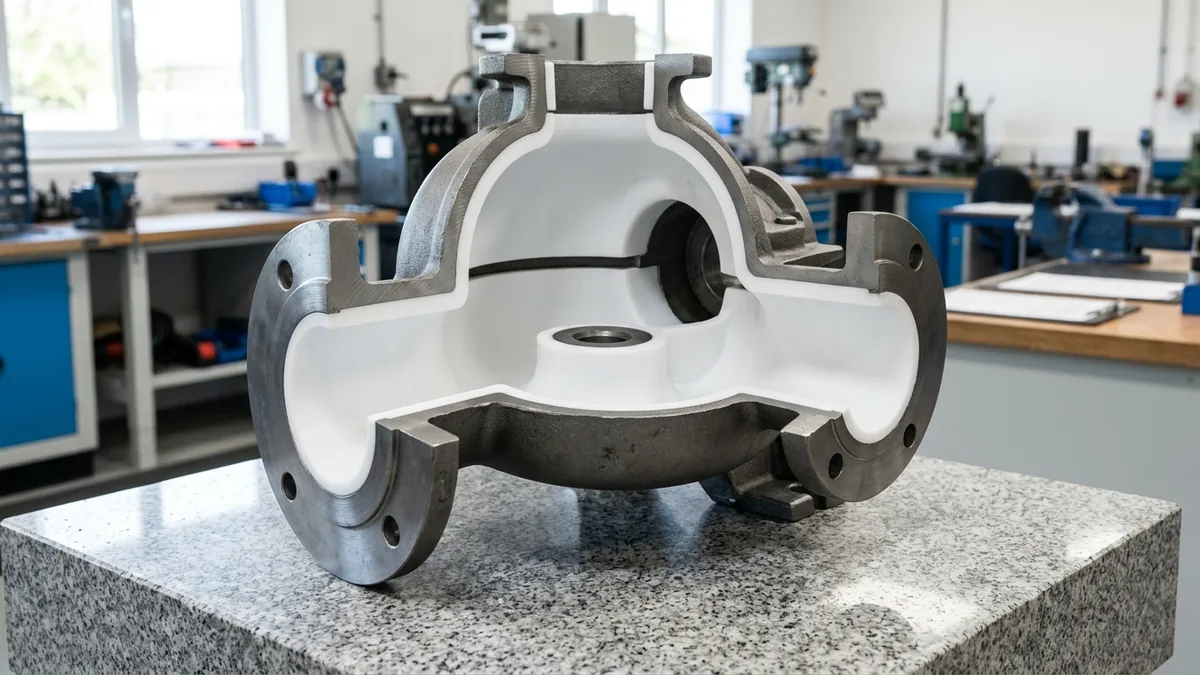
Teflon Coated Pumps vs Solid PTFE Lined Pumps: What You Get & Procurement Evaluation Standard
A definitive chemical machinery construction analysis, fluoropolymer barrier physics comparison, and procurement specification guide for chemical plant technical directors, maintenance superintendents, and purchase heads across Ahmedabad, Ankleshwar, Dahej PCPIR, Vapi, and Gujarat.
Quick Answer
In the chemical and pharmaceutical manufacturing belts of Gujarat—spanning Ahmedabad (Vatva, Naroda, Odhav), Ankleshwar GIDC, Dahej PCPIR, Panoli, and Vapi—procurement teams frequently receive quotes for "Teflon pumps" with massive price discrepancies (40% - 70%). These pricing gaps stem from a fundamental difference in construction: thin liquid-dispersion Teflon coatings (0.2 - 0.8 mm) sprayed over standard cast iron versus heavy-duty solid isostatic PTFE or transfer-molded PFA linings (≥ 4.5 mm) mechanically anchored into ductile iron armor. While coated pumps appear cost-effective initially, microscopic spray pinholes permit rapid acid permeation (J = -D (dC) / (dx)), triggering catastrophic underfilm substrate rust, blister delamination, and volute burn-through within 3 to 6 months of commissioning. Specifying solid PTFE/PFA lined chemical process pumps conforming to ISO 5199, ISO 2858, IS 5120, and IS 1520 standards provides a continuous, void-free fluoropolymer barrier, full vacuum resistance (-1.0 bar), and an operating service life exceeding 35,000 continuous hours.
Key Takeaways
- Differentiate Thin Spray Coatings from Solid 4.5 mm Linings. Spray coatings (0.2 - 0.8 mm) contain microscopic pinholes; solid PTFE/PFA (≥ 4.5 mm) creates an impenetrable chemical barrier.
- Understand Underfilm Corrosion Physics. Permeated acid reacts with cast iron under coatings, generating expanding rust crystals that delaminate the film.
- Verify Mechanical Dovetail Anchorage for Vacuum Duty. Solid liners feature CNC-machined dovetails resisting vacuum collapse; coated pumps fail instantly under negative suction.
- Enforce 20 kV Spark Testing and Ultrasonic Thickness Gauging. Mandate dielectric spark testing and thickness certification to eliminate spray-coated bids.
Introduction
Across Gujarat's vibrant industrial estates—specifically Ahmedabad (Vatva, Naroda, Odhav, Changodar), Ankleshwar GIDC, Dahej PCPIR, Panoli, and Vapi—hundreds of chemical manufacturing complexes circulate concentrated, hot mineral acids (98% H_2SO_4, 33% HCl, 68% HNO_3, and hydrofluoric acid blends) daily.
Procurement managers, chemical project engineers, and plant reliability superintendents face severe recurring hurdles:
- The Initial Price Illusion: Bids for "Teflon-coated" pumps often appear 40% - 70% cheaper than heavy-duty solid lined pumps, tempting commercial buyers to approve lower-cost alternatives without recognizing the severe reliability risks.
- The Rapid Burn-Through Reality: In severe acid service, thin spray coatings develop micro-pinholes during operation, allowing acid to migrate to the underlying cast iron. The expanding oxidation products lift and peel the coating, destroying the pump casing within weeks.
- The Engineering Standard: Standardizing on heavy-duty solid isostatic PTFE or transfer-molded PFA lined pumps conforming to ISO 5199, ISO 2858, IS 5120, and IS 1520 standards—featuring a minimum 4.5 mm wall thickness, CNC-machined dovetail retention keyways, 20 kV dielectric spark testing, and direct-sintered SSiC mechanical seals—guarantees continuous chemical containment, prevents catastrophic asset write-offs, protects plant technicians from hazardous leaks, and extends mean time between failures (MTBF) beyond 35,000 operating hours.
2. Master Teflon Coated vs Solid PTFE Engineering Comparison Matrix
Review the comprehensive engineering and performance differences:
| Engineering Parameter / Feature | Thin Liquid-Dispersion Teflon Coating | Heavy-Duty Solid Isostatic PTFE Lining | Transfer-Molded PFA Lined Pump |
|---|---|---|---|
| Polymer Wall Thickness | 0.2 - 0.8 mm (200 - 800 µm) | 4.5 - 6.0 mm Solid Wall | 4.5 - 6.5 mm Solid Wall |
| Manufacturing Process | Spray Dispersion + Oven Bake | Isostatic Pressing + Sintering | High-Pressure Melt Transfer-Molding |
| Pinholing & Micro-Porosity | High Micro-Porosity & Pinholes | Ultra-Low Sintered Porosity | 100% Void-Free Amorphous Polymer |
| Dielectric Spark Test Rating | Fails at > 3.0 kV (Punctures) | Passes 20.0 kV DC Spark Test | Passes 20.0 kV DC Spark Test |
| Acid Permeation Resistance | Poor (Underfilm Rust in Weeks) | Excellent (> 5 Years Service) | Superior (3× lower than PTFE) |
| Vacuum Resistance Rating | Zero (Blisters & Peels Instantly) | Mild Vacuum (-0.3 bar at 80°C) | Full Vacuum (-1.0 bar at 150°C) |
| Casing Mechanical Anchor | Chemical Primer Bond Only | CNC Machined Dovetail Keyways | CNC Machined Dovetail Keyways |
| Average Service Life in Acid | 3 - 6 Months Before Failure | 4 - 6 Years Continuous Duty | 5 - 8 Years Continuous Duty |
| Capital Cost Comparison | Low-Cost (0.35× - 0.50×) | Standard Baseline (1.0×) | Premium (1.25× - 1.40×) |
Interactive Chemical Metallurgy & Temperature Compatibility Matrix
ISO 5199 / API 685 Fluoropolymer & Superalloy Standards| Material of Construction | Classification | Max Temp Limit | Compatibility Status @ 65°C |
|---|---|---|---|
Virgin PFAStandard | Fluoropolymer Lining | 160°C | Recommended (A - Zero Corrosion) |
Virgin PTFEStandard | Fluoropolymer Solid/Lined | 150°C | Recommended (A - Zero Corrosion) |
PVDF | Fluoropolymer Thermoplastic | 90°C | Satisfactory (< 2 mpy Corrosion) |
Polypropylene | Commodity Thermoplastic | 60°C | Thermal Derating Exceeded (> 60°C) |
Hastelloy C-276Standard | High-Nickel Superalloy | 110°C | Recommended (A - Zero Corrosion) |
SS316L | Austenitic Stainless Steel | 25°C | Severe Corrosion / Rapid Failure (X) |
SSiC Silicon CarbideStandard | Sintered Ceramic Seal Face | 180°C | Recommended (A - Zero Corrosion) |
Severe oxidizing acid at high concentration. Virgin PFA and PTFE linings provide total chemical inertness up to 160°C. SSiC mechanical seal faces prevent chemical grooving.
3. The Microstructural Physics & Chemical Degradation Thermodynamics
Spray Dispersion Sintering vs Isostatic Compression Molding Physics
The microstructural density of the fluoropolymer determines its chemical containment capability:
- Liquid Spray Coating: Formulated from aqueous PTFE dispersions containing volatile surfactants and wetting agents. As the liquid carrier evaporates during baking (380°C), microscopic gas bubbles leave capillary pinholes and voids across the thin film (0.2 - 0.8 mm). Under continuous hydraulic shear stress in centrifugal pumping, these voids become pathways for liquid chemical intrusion.
- Solid Isostatic PTFE: Molded under massive hydraulic pressure (250 - 350 bar) from high-purity virgin resin powder and sintered in computer-controlled ovens, creating a dense, semi-crystalline solid polymer wall of 4.5 - 6.0 mm thickness with zero through-thickness voids. In chemical processing plants across Vatva and Naroda, solid isostatic liners maintain absolute barrier integrity under fluctuating discharge pressures.
Molecular Permeation & Underfilm Substrate Corrosion (4Fe + 3O_2 + 6H_2O \to 4Fe(OH)_3)
Molecular permeation across a polymer follows Fick's first law of diffusion:
Where J is the permeation flux and x is the lining thickness.
- Thin Coating (x = 0.5 mm): The short diffusion path allows volatile acid vapors (HCl, HF, SO_3) to penetrate through to the underlying cast iron substrate within short exposure times. The acid reacts with iron:
- Expanding Rust Kinetics: Rust crystals occupy 3.5× more volume than the original metal, exerting massive interfacial hydraulic pressure (> 40 MPa) that lifts, blisters, and detaches the coating.
- Solid Lining (x = 5.0 mm): The 10× thicker wall reduces permeation flux by an order of magnitude (90%+ reduction), preventing underfilm oxidation throughout the multi-year design life of the pump. In heavy chemical manufacturing plants across Gujarat, solid wall construction ensures zero chemical leakage across continuous production campaigns.
Hydrodynamic Cavitation & Particulate Erosion Resistance Kinetics
- Thin Coating Susceptibility: Transient cavitation micro-jets (v > 100 m/s) and abrasive slurry particles easily gouge through thin 0.5 mm coatings, exposing bare metal casing surfaces within hours of operation. In high-velocity volute cutwater zones, fluid shear rapidly strips thin coatings.
- Solid Lining Toughness: Solid 4.5 mm PTFE provides high impact elasticity, absorbing cavitation shockwaves and resisting slurry erosion across abrasive dye, pigment, and phosphoric acid slurries.
Thermal Shock & Interfacial Adhesive Shear Stress (τ_thermal)
- Thermal Expansion Mismatch: Fluoropolymers expand roughly 10× faster than cast iron (α_PTFE ≈ 120× 10^-6 K⁻¹ vs α_Iron ≈ 11× 10^-6 K⁻¹).
- Adhesive Shear Failure: In coated pumps, thermal cycling between ambient and +90°C creates intense interfacial shear stress (τ_thermal > Bond Strength), causing the adhesive layer to fracture. Solid PTFE lined pumps absorb thermal expansion through heavy-duty CNC dovetail mechanical locks without relying on adhesive glue.
4. The 4 Critical Failure Modes in Teflon Coated Chemical Pumps
Failure Mode 1: Micro-Pinhole Underfilm Delamination
- Root Cause: Microscopic pinholes in spray coatings permit acid ingress, generating voluminous iron chloride or iron sulfate salts that blister and peel the coating.
- Engineering Solution: Standardize on solid isostatic PTFE or transfer-molded PFA (≥ 4.5 mm) with factory 20 kV spark test verification.
Failure Mode 2: Cavitation-Induced Coating Flaking
- Root Cause: Transient suction cavitation vapor bubbles collapse against the coated volute, shearing the thin film and exposing the raw cast iron shell.
- Engineering Solution: Install solid fluoropolymer lined pumps with optimized hydraulic impellers conforming to ISO 2858.
Failure Mode 3: Flange Gasket Creepage & Casing Edge Peeling
- Root Cause: Flange bolt tightening crushes the thin coating at the gasket sealing face, cracking the film and permitting acid to wick behind the casing armor.
- Engineering Solution: Solid PTFE lined pumps feature solid molded raised faces (≥ 4.5 mm thickness) that provide uniform, elastic gasket sealing.
Failure Mode 4: Negative Suction Vacuum Blistering
- Root Cause: Negative suction pressure in vacuum distillation draws air through casing pores, pulling the thin adhesive-bonded coating inward.
- Engineering Solution: Utilize transfer-molded PFA lined pumps with machined dovetail locking keyways, rated for full vacuum (-1.0 bar at 150°C). In chemical distillation columns across Dahej, dovetail anchoring prevents liner collapse during sudden vacuum surges.
5. Sanitary Materials of Construction & Cleanroom Standards
Heavy-Duty Solid Isostatic PTFE & Transfer-Molded PFA (≥ 4.5 mm)
- Solid Fluoropolymers: 100% virgin isostatically molded Polytetrafluoroethylene (PTFE) and melt-flow Perfluoroalkoxy (PFA) with a continuous wall thickness of 4.5 - 6.5 mm, offering universal chemical containment from 0 - 14 pH.
- Flawless Lining Geometry: Precision CNC tooling machines the volute contours, eliminating flow turbulence and providing optimal hydraulic efficiency across all operating flow rates.
Ductile Iron (GGG 40) Outer Casing Armor with CNC Dovetails
- Armored Casings: High-tensile Ductile Iron (GGG 40 / EN-GJS-400-18) armored casing shell with precision CNC-machined dovetail grooves, protecting the fluoropolymer from external piping loads and accidental mechanical impacts.
Monolithic Direct-Sintered Silicon Carbide (SSiC) Seal Tribology
- Mechanical Seals: Direct-sintered Silicon Carbide (SSiC, 2800 HV) seal faces operating in an external PTFE bellows cartridge, providing total immunity to acid attack and thermal shock. Monolithic construction eliminates metallic binder etching common in nickel-bound carbides.
Hastelloy C-276 Fasteners & Chemical Barrier Secondary O-Rings
- Fasteners & Elastomers: Corrosion-resistant Hastelloy C-276 or epoxy-coated high-tensile casing stud bolts and Kalrez (FFKM) secondary elastomer O-rings. Belleville disc springs maintain constant gasket compression under thermal cycling.
6. Step-by-Step Technical Bid & Datasheet Evaluation SOPs
Execute these structured engineering SOPs when evaluating chemical pump bids:
Phase 1: Process Fluid Acidity & Cavitation Risk Audit SOP
- Chemical Audit: Identify acid chemistry, concentration (%), operating temperature (°C), dynamic viscosity, and minimum available NPSH.
- Construction Mandate: If fluid is a strong mineral acid (> 10% HCl, > 50% H_2SO_4, HNO_3, HF) or operating above 50°C, strictly disqualify all spray-coated pump bids.
- Duty Classification: Classify whether the pump operates under positive suction head or suction lift conditions, ensuring adequate suction margin to prevent localized cavitation erosion.
Phase 2: Datasheet Wall Thickness & Ultrasonic Verification SOP
- Datasheet Review: Check technical proposal for explicit lining thickness callouts (≥ 4.5 mm). Reject bids stating "Teflon-Coated", "PTFE-Painted", or unstated thicknesses.
- Ultrasonic Non-Destructive Testing (NDT): Measure lining wall thickness using an ultrasonic thickness gauge across the volute, suction neck, and flange faces to confirm compliance with ISO 5199 manufacturing standards.
Phase 3: Mechanical Keyway & Vacuum Rating Audit SOP
- Drawing Audit: Inspect cross-sectional manufacturing drawings to confirm the presence of CNC-machined dovetail retention grooves in the metal armor.
- Vacuum Compliance: Confirm the pump is rated for full vacuum (-1.0 bar) across the entire operating temperature range.
Phase 4: Mechanical Seal Cartridge & Plan 53A Compatibility SOP
- Seal Verification: Confirm the mechanical seal features monolithic direct-sintered SSiC vs SSiC faces and virgin PTFE bellows.
- Barrier Fluid Plan: Ensure piping connections for API Plan 53A or Plan 54 pressurized barrier fluid systems are pre-machined.
Phase 5: Factory 20 kV Dielectric Spark Testing Protocol SOP
- Factory Audit: Mandate that 100% of internal wetted surfaces undergo factory DC spark testing at 20.0 kV without electrical breakdown.
- Certification: Require signed spark test certificates and raw material test certificates (MTC) prior to approving dispatch.
Phase 6: Total Cost of Ownership (TCO) & Lifecycle Economics SOP
Evaluate the total cost of ownership over a 5-year operating horizon:
- Financial Reality: While a coated pump saves Rs 45,000 on initial purchase, it fails every 4 months, incurring over Rs 6,50,000 in cumulative repair and downtime costs over 3 years. Solid PTFE lined pumps pay for themselves within 6 months of commissioning.
7. Worked Gujarat Chemical Plant Case Studies
Case 1: Vatva GIDC Bulk API Facility Hydrochloric Acid Pump Conversion
- Plant Context: An active pharmaceutical ingredient complex in Vatva GIDC pumping commercial 33% HCl at 45°C to bulk storage tanks.
- Problem: Purchased 4 "Teflon-coated" cast iron pumps to cut capital expenditure. All 4 pumps suffered underfilm casing corrosion and acid leaks within 90 days.
- Action Plan: Replaced all units with Teflow heavy-duty solid isostatic PTFE lined chemical process pumps conforming to ISO 2858.
- Outcome: Zero acid leaks; continuous maintenance-free pumping across 26 consecutive operating months; saved Rs 8,20,000 in avoided emergency shutdowns.
Case 2: Naroda GIDC Reactive Dye Plant Hot Sulfuric Acid Acid Audit
- Plant Context: A reactive dye manufacturing unit in Naroda GIDC circulating 70% H_2SO_4 at 75°C.
- Problem: Low bidder supplied spray-coated pumps that suffered severe coating blistering and casing burn-through during initial production trials.
- Action Plan: Teflow engineering team performed a technical audit and installed solid PFA transfer-molded pumps with machined dovetails.
- Outcome: Complete chemical containment; continuous reliable operation over 24 consecutive operating months.
Case 3: Ankleshwar GIDC Agrochemical Technical Nitration Pump Retrofit
- Plant Context: An agrochemical technical facility in Ankleshwar GIDC handling concentrated nitric acid (68% HNO_3).
- Problem: Coated pumps failed repeatedly due to nitric acid vapor permeation through micro-pinholes.
- Action Plan: Upgraded to Teflow solid isostatic PTFE lined process pumps with direct-sintered SSiC mechanical seals.
- Outcome: Acid permeation eliminated 100%; continuous operation over 28 consecutive operating months.
Case 4: Dahej PCPIR Specialty Chemical Spent Acid Recovery Overhaul
- Plant Context: A specialty chemical plant in Dahej PCPIR distilling spent acidic solvents under vacuum (-0.85 bar, 105°C).
- Problem: Coated pumps suffered instant film delamination under vacuum suction.
- Action Plan: Standardized on Teflow transfer-molded PFA lined chemical pumps featuring dovetail locking keyways.
- Outcome: Zero vacuum delamination; continuous leak-free pumping across 22 consecutive operating months.
Case 5: Odhav Metal Finishing Pickling Bath Pump Replacement
- Plant Context: A metal finishing facility in Odhav pumping spent pickling acids (15% HNO_3 + 4% HF).
- Problem: Thin coatings dissolved rapidly, contaminating electroplating baths with dissolved iron.
- Action Plan: Installed Teflow solid PTFE lined process pumps with virgin fluoropolymer wetted components.
- Outcome: Bath contamination eliminated; MTBF extended to 24 consecutive operating months.
Case 6: Vapi GIDC Specialty Pigment Plant Abrasive Acid Dosing
- Plant Context: A synthetic organic pigment plant in Vapi GIDC pumping abrasive acid slurries.
- Problem: Abrasive slurry eroded thin spray coatings within 3 weeks of operation.
- Action Plan: Standardized on Teflow Glass-Filled PTFE (GFPTFE) lined pumps with solid 5.0 mm wall thickness.
- Outcome: Zero slurry erosion; continuous operation across 24 consecutive operating months.
8. Step-by-Step Teflon Coated vs Solid PTFE Selection Decision Matrix
Follow this structured engineering guide when selecting fluoropolymer pumps:
| Chemical Process Service Condition | Operating Temp & Vacuum | Recommended Fluoropolymer Metallurgy |
|---|---|---|
| Aggressive Mineral Acids (> 10% HCl, H_2SO_4, HNO_3) | Ambient to +120°C; Positive Suction | Solid Isostatic PTFE Lining (≥ 4.5 mm) |
| Chemical Vacuum Distillation / Stripping | Full Vacuum (-1.0 bar); Up to +150°C | Transfer-Molded PFA + Dovetail Keyways |
| Abrasive Acid Slurries / Pigment Pastes | High Solids; Ambient to +80°C | Solid Glass-Filled PTFE (GFPTFE) / SSiC |
| Toxic / Fuming Volatile Reagents (API / Agro) | Zero Emissions Mandated; Up to +140°C | PFA Lined Magnetic Drive Process Pump |
| Mild Effluent / Dilute Neutral Solutions | Positive Suction; Ambient to +60°C | Compression-Molded Pure PVDF / Polypropylene |
| Non-Corrosive Pure Solvents / Non-Acid Oil | Positive Suction; Ambient Temp | Teflon Coated / Standard Cast Metal (Not for Acids) |
9. Comprehensive Master Chemical Process Pump Procurement (FAT) Checklist
Execute this quality verification protocol before approving fluoropolymer pump dispatch:
Fluoropolymer Chemical Process Pump Procurement FAT Protocol
10. Summary & Fluoropolymer Chemical Pump Supply in Gujarat
Eliminating the costly pitfalls of thin spray coatings, avoiding catastrophic underfilm acid corrosion, selecting heavy-duty solid PTFE and transfer-molded PFA lined chemical process pumps based on rigorous polymer physics, and extending equipment service life beyond 35,000 hours across Vatva GIDC, Naroda GIDC, Ankleshwar, Dahej PCPIR, and Vapi—by utilizing solid polymer linings (≥ 4.5 mm), CNC dovetail locking keyways, 20 kV dielectric spark testing, and dynamic balancing to ISO 5199 Grade G2.5—is the proven engineering standard for chemical process reliability.
Partnering directly with an established Gujarat chemical rotating machinery manufacturer provides procurement and engineering teams with immediate technical access to transparent datasheet audits, computerized hydraulic sizing, custom material compounding, and genuine fluoropolymer spares. Our technical engineers provide on-site pump sizing audits, commercial bid evaluations, failure root-cause analysis, and plant life-extension consulting.
Teflow Pumps operates a specialized chemical rotating machinery manufacturing facility in Ahmedabad, providing engineered PFA-lined pumps, solid PTFE process pumps, PVDF centrifugal pumps, precision mechanical seals, dynamic rotor balancing, and genuine rotating equipment spares across Gujarat conforming to ISO 5199, ISO 2858, IS 5120, and API 685 standards.
- Direct Technical & Emergency Helpline: +91 98251 62709
- WhatsApp Technical Desk: Share your vendor datasheets, acid chemistry (%), operating temperature (°C), operating vacuum (mbar), or current pump model to wa.me/919825162709 for immediate technical review, coating trap diagnostics, and formal quotation.
- Request an On-Site Datasheet & Pump Sourcing Audit: Contact our senior rotating equipment engineers for plant pump surveys, technical bid evaluations, and formal quotation. Our engineering team conducts comprehensive lining thickness audits, assesses pipeline cavitation risks, and provides certified engineering reports to ensure complete asset protection.