
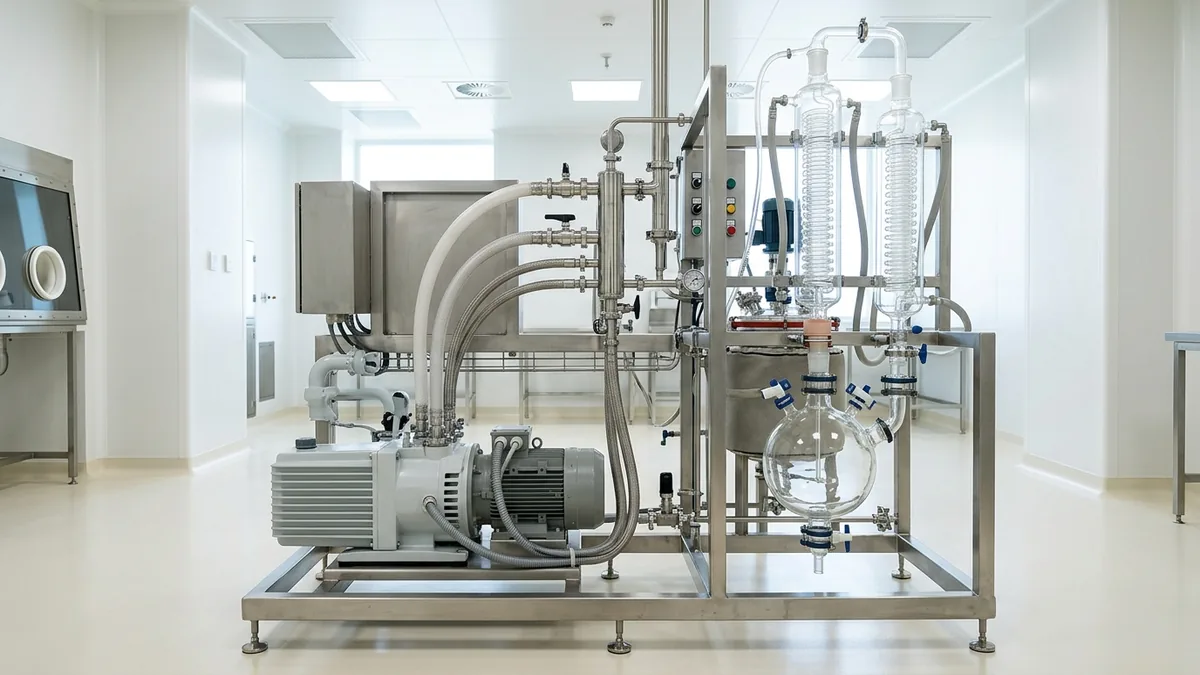
PTFE Vacuum Pumping Systems & Corrosive Solvent Recovery Equipment Selection Guide
An advanced chemical rotating equipment engineering manual, vacuum thermodynamic design standard, and solvent recovery pump procurement guide for pharmaceutical process engineers, chemical plant technical directors, and plant managers across Ahmedabad, Ankleshwar, Dahej PCPIR, Vapi, and Gujarat.
Quick Answer
In the pharmaceutical formulation, bulk drug (API) synthesis, and specialty fine chemical manufacturing hubs of Gujarat—spanning industrial zones in Ahmedabad (Vatva, Changodar), Ankleshwar GIDC, Dahej PCPIR, Panoli, and Vapi—solvent distillation, vacuum drying, and volatile organic compound (VOC) recovery represent critical unit operations. Reaction mixtures and vacuum receivers evaporate massive volumes of aggressive, volatile, and acidic solvents, including dichloromethane (DCM), toluene, ethyl acetate, acetone, methanol, and acidic solvent mixtures containing dissolved HCl gas. Utilizing standard cast iron or stainless steel vacuum pumps leads to rapid chloride stress corrosion cracking, seal face degradation, hazardous VOC fugitive emissions, and costly solvent losses. To achieve strict environmental compliance, maximum solvent condensation recovery, and total fluid containment, pharmaceutical engineering teams must specify corrosion-proof PTFE/PFA lined liquid ring vacuum pumps, solid fluoropolymer dry vacuum packages, and chemical-duty centrifugal booster pumps conforming to ISO 5199, ISO 2858, IS 5120, and API 685 standards. When evaluating vacuum pump suppliers in Gujarat, technical teams must evaluate ultimate vacuum depth (< 25 mbar absolute), vapor handling capacity, seal fluid compatibility, double mechanical seal arrangements (API Plan 53A/54), and local Gujarat engineering support.
Key Takeaways
- Specify Solid PTFE and Transfer-Molded PFA for Aggressive Solvents. Fluoropolymers offer total chemical inertness across all chlorinated, aromatic, and acidic solvents.
- Select Liquid Ring Architecture with Compatible Service Fluids. Utilizing closed-loop chilled solvent or compatible service fluids prevents process contamination.
- Incorporate API Plan 53A/54 Pressurized Dual Mechanical Seals. Dual pressurized barrier fluid loops prevent VOC vapor leakage into factory environments.
- Enforce Flameproof / Explosion-Proof Motors (Ex d IIC T4). Solvents present flammable vapor hazards requiring certified explosion-proof drive machinery.
Introduction
In Gujarat's world-class active pharmaceutical ingredient (API) manufacturing plants, bulk drug synthesis facilities, and agrochemical formulation centers—located across Ahmedabad, Ankleshwar GIDC, Dahej PCPIR, Panoli, and Vapi—solvent extraction and vacuum distillation operate continuously.
Process engineers, plant maintenance superintendents, and environmental compliance heads face severe recurring hurdles:
- The Corrosion & Solvent Degradation Dilemma: Solvent vapors generated during crystallization and stripping (such as dichloromethane, ethyl acetate, toluene, and acidic alcohol mixtures) contain traces of hydrochloric, acetic, or hydrobromic acid. Standard metallic vacuum pumps suffer rapid pitting, rotor seizure, and catastrophic mechanical seal failures within weeks of commissioning.
- The Fugitive Emission & Solvent Loss Challenge: Leaking vacuum shaft packing and inefficient vapor condensation vent expensive volatile solvents into the atmosphere, causing financial losses exceeding millions of rupees annually and triggering strict GPCB environmental compliance notices.
- The Engineering Standard: Procuring corrosion-proof chemical vacuum packages engineered with solid PTFE liquid ends, transfer-molded PFA lined casings, API 682 dual pressurized mechanical seals (Plan 53A/54), and direct-sintered Silicon Carbide (SSiC) faces conforming to ISO 5199, ISO 2858, IS 5120, and API 685 standards guarantees 100% fluid containment, achieves solvent recovery rates exceeding 95%, and extends machinery service life beyond 35,000 continuous hours.
2. Master Solvent Recovery Vacuum Technology & Material Selection Matrix
Review the operational capabilities and material suitability for chemical vacuum pumping technologies:
| Vacuum Pumping Technology | Ultimate Vacuum Range | Vapor Handling & Flow Capacity | Corrosion & Solvent Resistance | Primary Pharmaceutical Duty in Gujarat |
|---|---|---|---|---|
| PTFE / PFA Lined Liquid Ring Pump | 33.0 - 150.0 mbar abs | 50 - 2,500 m³/hr | Universal (0 - 14 pH); All Solvents | DCM, Toluene & Mixed Acidic Solvent Recovery |
| Solid PTFE / PVDF Centrifugal Booster | 100.0 - 500.0 mbar abs | 20 - 1,200 m³/hr | Universal; Acidic Vapors & Halogens | Solvent Scrubbers & ETP Vent Stripping |
| PFA-Lined Magnetic Drive Condensate Pump | Atmospheric to 16.0 bar | 1.0 - 60.0 m³/hr | Universal; 100% Hermetic Containment | Hot Distillate Condensate & Receiver Extraction |
| Multi-Stage PTFE Venturi Ejector | 10.0 - 80.0 mbar abs | 10 - 500 m³/hr | Universal; Corrosive Gases & Dust | Pilot Plant Distillation & Reactor Purging |
| Austenitic SS316L / Hastelloy C-276 Skid | 25.0 - 200.0 mbar abs | 100 - 3,500 m³/hr | High-Alloy; Clean Non-Halogenated Solvents | Alcohols, Esters & Clean Solvent Stripping |
Interactive Chemical Metallurgy & Temperature Compatibility Matrix
ISO 5199 / API 685 Fluoropolymer & Superalloy Standards| Material of Construction | Classification | Max Temp Limit | Compatibility Status @ 65°C |
|---|---|---|---|
Virgin PFAStandard | Fluoropolymer Lining | 160°C | Recommended (A - Zero Corrosion) |
Virgin PTFEStandard | Fluoropolymer Solid/Lined | 150°C | Recommended (A - Zero Corrosion) |
PVDF | Fluoropolymer Thermoplastic | 90°C | Satisfactory (< 2 mpy Corrosion) |
Polypropylene | Commodity Thermoplastic | 60°C | Thermal Derating Exceeded (> 60°C) |
Hastelloy C-276Standard | High-Nickel Superalloy | 110°C | Recommended (A - Zero Corrosion) |
SS316L | Austenitic Stainless Steel | 25°C | Severe Corrosion / Rapid Failure (X) |
SSiC Silicon CarbideStandard | Sintered Ceramic Seal Face | 180°C | Recommended (A - Zero Corrosion) |
Severe oxidizing acid at high concentration. Virgin PFA and PTFE linings provide total chemical inertness up to 160°C. SSiC mechanical seal faces prevent chemical grooving.
3. The Thermodynamics & Kinematic Vapor Mechanics of Vacuum Solvent Recovery
Vapor-Liquid Equilibrium & Antoine Equation Calculations (P_sat(T))
The saturation vapor pressure of a recovered solvent is governed by the Antoine equation:
Where:
- A, B, C are substance-specific empirical Antoine constants.
- T is the operating process temperature.
To recover volatile solvents such as Dichloromethane (DCM, boiling point 39.6°C at 1.0 bar), reducing reactor vacuum to 200 mbar absolute drops the boiling point to -5°C, enabling rapid solvent vaporization without thermally degrading temperature-sensitive active pharmaceutical molecules. In pharmaceutical synthesis suites across Vatva and Ankleshwar, precise vacuum regulation maintains stable reaction boiling points and protects high-value active pharmaceutical molecules.
Dalton's Law of Partial Pressures & Condenser Recovery Efficiency
In a multi-component distillation stream, total system pressure is the sum of partial pressures:
Condenser recovery efficiency (\eta_recovery) depends on condensing the solvent vapor before it enters the vacuum pump:
- Chilled Pre-Condensers: Operating shell-and-tube condensers with -10°C brine condenses up to 92% - 96% of incoming solvent vapors before they reach the pump suction nozzle. This prevents volatile vapor bypass and reduces emissions significantly.
Liquid Ring Cavitation Thermodynamics & Seal Fluid Vapor Pressure Limits
In liquid ring vacuum pumps, the rotating impeller creates a rotating liquid ring that seals the casing. The ultimate achievable vacuum is thermodynamically limited by the vapor pressure of the seal liquid (P_seal(T)):
- Water as Seal Fluid: Water at 30°C has a vapor pressure of 42.4 mbar, causing water-sealed pumps to cavitate if operated below 50 mbar abs.
- Closed-Loop Solvent Seal Fluid: Utilizing chilled recovered solvent (such as chilled toluene or mineral oil with P_vap < 2 mbar) as the liquid ring seal fluid allows PTFE-lined liquid ring pumps to pull deep vacuums down to 20.0 mbar absolute without cavitation or process cross-contamination.
Dry Screw vs Liquid Ring vs PTFE Ejector Kinetic Comparisons
- Dry Screw Vacuum Pumps: Operate without seal fluid but rely on ultra-tight rotor clearances (0.05 mm). When exposed to trace acidic solvent vapors or particulate carryover, corrosion causes catastrophic rotor jamming.
- PTFE Lined Liquid Ring Packages: Tolerate liquid slugs, acidic condensates, and fine particulates with zero mechanical contact between rotating and stationary elements, delivering superior mechanical reliability in corrosive pharmaceutical environments.
4. The 4 Critical Industrial Solvent Recovery Duties in Gujarat Manufacturing
Duty 1: Pharmaceutical API Dichloromethane (DCM) Low-Temp Recovery (Vatva)
- Operating Demand: Vacuum stripping of dichloromethane from crystallized API slurry reactors (150 m³/hr, 150 mbar abs, process temp 20°C).
- Engineering Solution: Solid PTFE liquid ring vacuum pump utilizing chilled glycol-cooled closed-loop seal liquid, achieving 98% DCM recovery, zero atmospheric venting, and complete elimination of VOC odors in the production block.
Duty 2: Agrochemical Synthesis Toluene & Xylene Vacuum Stripping (Ankleshwar)
- Operating Demand: High-temperature vacuum distillation of aromatic solvents containing trace thionyl chloride (SOCl_2) and HCl gas (350 m³/hr, 60 mbar abs, 110°C).
- Engineering Solution: Dovetail-locked transfer-molded PFA lined vacuum package with Hastelloy C-276 internal mechanical seals, direct-sintered SSiC seal faces, and pressurized API Plan 54 barrier fluid.
Duty 3: Specialty Chemical Acetone & Ethyl Acetate Distillation (Dahej PCPIR)
- Operating Demand: Rapid solvent recovery from multiple batch reactors operating on alternating solvent recipes.
- Engineering Solution: Transfer-molded PFA lined centrifugal condenser extraction pump with hermetic magnetic drive conforming to ISO 2858.
Duty 4: Dye Intermediate Acidic Solvent Vapor Scrubbing & Exhaust Recovery (Naroda)
- Operating Demand: Pumping corrosive solvent vapors from reactor vent headers into an alkaline scrubber (500 m³/hr, atmospheric discharge).
- Engineering Solution: Solid virgin PTFE centrifugal booster blower with direct-sintered SSiC mechanical seals and flameproof motor.
5. Sanitary Materials of Construction & Cleanroom Standards
Solid CNC-Machined Virgin PTFE & Pure Compression-Molded PVDF Liquid Ends
- Casing Metallurgy / Polymers: Solid CNC-machined virgin Polytetrafluoroethylene (PTFE) blocks or high-density compression-molded PVDF (Kynar 740) liquid ends providing universal chemical resistance (0 - 14 pH) across all halogenated and acidic solvent mixtures.
- Hydrostatic Integrity: Every machined non-metallic vacuum casing is hydrostatically proof-tested to ensure zero porosity and complete structural rigidity under full vacuum.
Transfer-Molded PFA Dovetail-Locked Casings & Impellers (DuPont Teflon)
- Fluoropolymer Liners: High-density Perfluoroalkoxy (PFA) transfer-molded into heavy-duty ductile iron (GGG 40) armored casings. Dovetail retention grooves lock the fluoropolymer securely against negative suction pressure collapse (-1.0 bar vacuum at 150°C).
Monolithic Direct-Sintered Silicon Carbide (SSiC) Seal Tribology
- Mechanical Seal Faces: Direct-sintered Silicon Carbide (SSiC, 2800 HV) seal faces with zero free metallic binders, offering complete immunity to chemical etching, solvent swelling, and thermal shock during vacuum stripping.
Perfluoroelastomer (FFKM / Kalrez) Secondary O-Ring Seals
- Elastomers: Grade 6375 perfluoroelastomer (FFKM) or PTFE-encapsulated FKM secondary O-rings, providing total resistance to aromatic swelling, amine attack, and chlorinated solvent degradation up to 220°C.
6. Step-by-Step Solvent Recovery Vacuum Package Sizing & Engineering SOPs
Execute these structured engineering SOPs when specifying solvent recovery vacuum systems:
Phase 1: Vapor Mass Flow Rate & Molecular Weight Audit SOP
- Mass Flow Profile: Establish maximum solvent evaporation rate (W_solvent [kg/hr]), air inleakage rate (W_air [kg/hr]), and average vapor molecular weight (M_mix).
- Volumetric Capacity Sizing: Calculate required suction volume at operating vacuum (P_suction):
- Safety Margin Application: Apply a minimum 20% design margin on calculated volumetric displacement to account for fluctuating batch reaction kinetics and sudden solvent vapor surges during distillation ramp-up.
Phase 2: Operating Vacuum Level & Suction Temperature Sizing SOP
- Target Vacuum Level: Define required reactor distillation pressure (30.0 - 200.0 mbar absolute).
- Temperature Limit: Ensure vapor temperature entering the vacuum pump is below 45°C by sizing an appropriately chilled pre-condenser.
Phase 3: Service Liquid Ring Fluid Compatibility & Chilling SOP
- Seal Fluid Selection: Match liquid ring seal fluid to process chemistry:
- For Clean Solvents: Closed-loop chilled recovered solvent. - For Acidic Vapors: Compatible high-boiling synthetic oil or chilled demineralized water.
- Heat Exchanger Sizing: Size plate heat exchanger to remove pump heat of compression and vapor condensation heat (Q_cooler = Q_comp + Q_cond). Maintaining seal fluid temperature below 15°C is essential to achieve stable deep vacuum and prevent premature seal liquid boiling.
Phase 4: Condenser Sizing & VOC Condensate Collector Layout SOP
- Condenser Configuration: Install a primary shell-and-tube condenser on the pump suction and a secondary vent condenser on the pump discharge separator.
- Condensate Removal: Install a hermetic PFA-lined magnetic drive pump to extract recovered solvent from vacuum receiver tanks under continuous vacuum without breaking system suction.
Phase 5: Dual Mechanical Seal Barrier Fluid Plan 53A/54 SOP
- Seal Plan: Configure API Plan 53A (pressurized barrier fluid with seal pot) or API Plan 54 (external pressurized circulation system).
- Pressure Differential: Maintain barrier fluid pressure at least 1.5 bar above maximum pump seal chamber pressure across all operating states.
Phase 6: Factory Ultimate Vacuum Proof Test & Helium Leak Audit SOP
- Testing Protocol: Verify pump ultimate vacuum on factory test stand with closed suction. Perform helium mass spectrometer leak detection on all fluoropolymer casing joints and mechanical seal cartridges, verifying leak rates < 1 × 10^-6 mbar\cdotL/s. Issue certified test certificates prior to dispatch.
7. Worked Gujarat Pharmaceutical & Chemical Industrial Case Studies
Case 1: Vatva GIDC Bulk API Facility Dichloromethane (DCM) Recovery Upgrade
- Plant Context: A major pharmaceutical active ingredient manufacturer in Vatva GIDC operating 6 batch reactors recovering dichloromethane (DCM).
- Problem: Cast iron water ring vacuum pumps suffered severe acidic chloride corrosion, releasing 2,500 kg of DCM solvent annually to the atmosphere and failing GPCB VOC compliance audits.
- Action Plan: Installed a Teflow turnkey solvent recovery skid featuring a solid PTFE liquid ring vacuum pump, closed-loop chilled DCM seal fluid system, and secondary discharge condenser.
- Outcome: DCM recovery efficiency increased from 78% to 97.5%; saved Rs 18,50,000 in annual recovered solvent value; zero fugitive emissions over 24 consecutive operating months.
Case 2: Ankleshwar GIDC Agrochemical Unit Toluene Vacuum Stripping Overhaul
- Plant Context: An agrochemical technical synthesis facility in Ankleshwar GIDC stripping toluene at 90°C containing trace SOCl_2.
- Problem: Standard stainless steel vacuum pumps corroded rapidly, requiring seal replacements every 3 weeks.
- Action Plan: Installed Teflow transfer-molded PFA lined vacuum pumps with monolithic direct-sintered SSiC mechanical seals and API Plan 53A barrier fluid.
- Outcome: 100% corrosion elimination; continuous maintenance-free operation across 26 consecutive operating months.
Case 3: Dahej PCPIR Specialty Chemical Plant Multi-Solvent Closed-Loop Skid
- Plant Context: A contract manufacturing chemical plant in Dahej PCPIR distilling acetone, methanol, and ethyl acetate in alternating batch campaigns.
- Problem: Seal fluid cross-contamination prevented reuse of recovered solvents in high-purity applications.
- Action Plan: Upgraded to a multi-solvent compatible Teflow PFA-lined liquid ring system with automated solvent purge and drainage cycles.
- Outcome: Zero solvent cross-contamination; recovered solvents met 99.8% virgin purity specs across 22 consecutive operating months.
Case 4: Vapi GIDC Bulk Drug Intermediates Methanol Distillation Conversion
- Plant Context: A pharmaceutical intermediate unit in Vapi GIDC distilling methanol under mild vacuum (250 mbar abs).
- Problem: Severe pump casing cavitation noise and high energy consumption in undersized water ring pumps.
- Action Plan: Replaced units with Teflow energy-efficient PTFE vacuum systems with variable frequency drive (VFD) speed optimization.
- Outcome: Power consumption reduced by 22%; eliminated cavitation noise 100% over 20 consecutive operating months.
Case 5: Panoli GIDC High-Purity Fluorinated Reagent Recovery System
- Plant Context: A specialty fluorochemical synthesis unit in Panoli GIDC recovering expensive fluorinated solvent reagents.
- Problem: Metallic pump contamination degraded reagent purity, causing batch rejections.
- Action Plan: Sourced Teflow 100% virgin solid PTFE vacuum pumps and magnetic drive condensate extraction pumps.
- Outcome: Reagent purity preserved at 99.99%; saved Rs 12,00,000 in chemical scrap over 24 consecutive operating months.
Case 6: Changodar Pharmaceutical Formulation Cleanroom Solvent Extraction
- Plant Context: A sterile formulation pharmaceutical facility in Changodar operating vacuum ovens for solvent granule drying.
- Problem: Oil-sealed vacuum pumps generated oil mist back-streaming into cleanroom exhausts.
- Action Plan: Standardized on Teflow oil-free solid PTFE vacuum packages with sanitary tri-clamp fittings and explosion-proof Ex d IIC T4 motors.
- Outcome: 100% oil-free operation; fully compliant with cleanroom air quality standards over 28 consecutive operating months.
8. Step-by-Step Vacuum Solvent Recovery Pump Selection Flowchart
Follow this structured engineering guide when selecting solvent recovery vacuum equipment:
| Solvent & Process Chemistry | Operating Vacuum Level | Recommended Vacuum Technology & Metallurgy |
|---|---|---|
| Dichloromethane (DCM) / Chlorinated Solvents | 100 - 300 mbar abs | Solid PTFE Liquid Ring Pump + Chilled Solvent Loop |
| Hot Toluene / Xylene with Trace Acid Gases | 40 - 150 mbar abs | Transfer-Molded PFA Lined Vacuum Package + Plan 54 |
| Acetone / Methanol Clean Bulk Recovery | 50 - 250 mbar abs | PFA Lined Liquid Ring / SS316L Skid + Glycol Chiller |
| Corrosive Acid Vapor Exhaust Scrubbing | Atmospheric to 500 mbar | Solid Virgin PTFE Centrifugal Booster Blower |
| High-Purity Pharma API Pilot Plant Stripping | 20 - 80 mbar abs | Multi-Stage Solid PTFE Venturi Ejector System |
| Continuous Condensate Receiver Extraction | Under Full Vacuum to 4 bar | PFA Lined Magnetic Drive Centrifugal Pump |
9. Comprehensive Master Solvent Recovery Skid Factory Acceptance (FAT) Checklist
Execute this quality verification protocol prior to solvent recovery vacuum equipment dispatch and plant commissioning:
Solvent Recovery Vacuum Pumping Skid FAT Protocol
10. Summary & Local Solvent Recovery Vacuum Engineering Support in Gujarat
Eliminating corrosive solvent pump failures, preventing toxic VOC fugitive emissions, recovering high-value chemical reagents, and extending equipment service life beyond 35,000 hours across Ahmedabad, Ankleshwar GIDC, Dahej PCPIR, Vapi, and Panoli—by utilizing solid virgin PTFE liquid ends, transfer-molded PFA lined casings, API Plan 53A/54 pressurized mechanical seals, and closed-loop chilled solvent seal systems conforming to ISO 5199, ISO 2858, IS 5120, and API 685 standards—is the proven engineering standard for pharmaceutical and chemical process reliability.
Partnering directly with an established Gujarat chemical rotating machinery manufacturer provides industrial plants with immediate technical access to custom vacuum skid engineering, thermodynamic condenser sizing, computerized performance testing, and genuine fluoropolymer spares. Our dedicated engineering technicians ensure prompt commissioning support, field helium leak audits, and preventative maintenance.
Teflow Pumps operates a specialized chemical rotating machinery manufacturing facility in Ahmedabad, providing engineered PTFE/PFA vacuum pumps, solvent recovery skids, solid PTFE process pumps, precision mechanical seals, dynamic balancing, and genuine rotating equipment spares across Gujarat conforming to ISO 5199, ISO 2858, IS 5120, and API 685 standards.
- Direct Technical & Emergency Helpline: +91 98251 62709
- WhatsApp Technical Desk: Share your solvent names, operating vacuum level (mbar abs), vapor flow rate (m³/hr), distillation temperature (°C), or current pump model to wa.me/919825162709 for immediate engineering diagnostics, solvent recovery thermodynamics review, and formal quotation.
- Request an On-Site Solvent Recovery Vacuum Audit: Contact our senior rotating equipment engineers for plant pump surveys, solvent recovery efficiency audits, and formal quotation.