
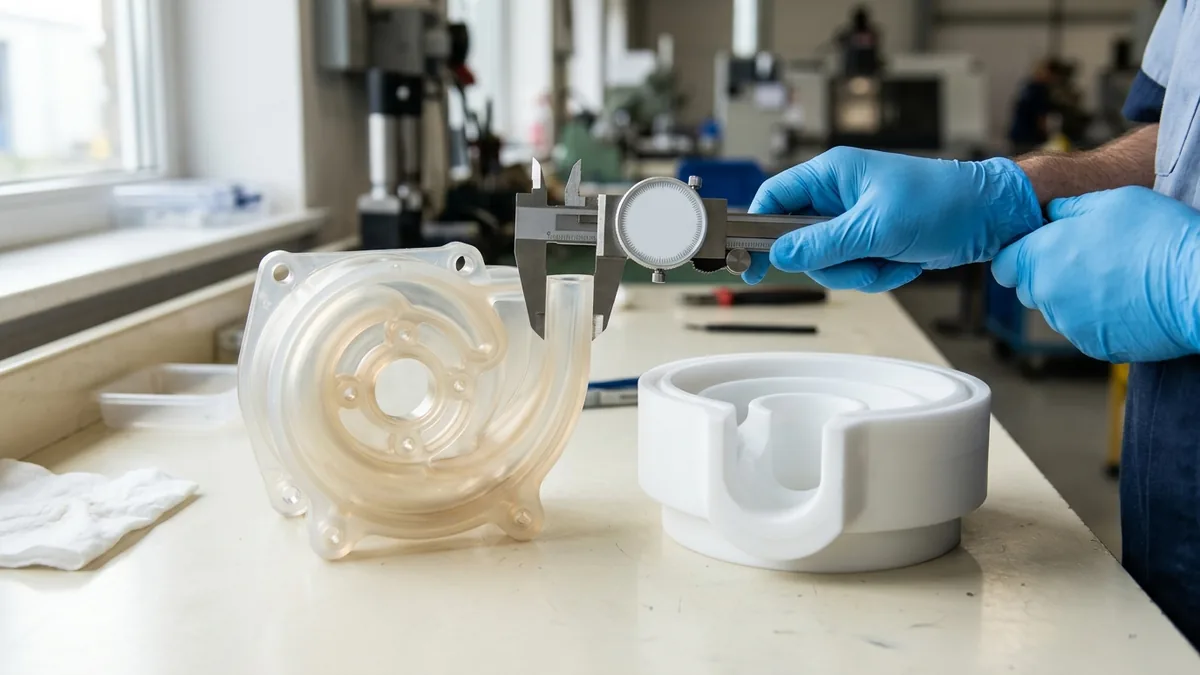
PFA Pump vs PTFE Pump: Naming Traps in Datasheets & Procurement Selection Manual
A definitive chemical pump engineering manual, fluoropolymer polymer physics comparison, and datasheet specification audit guide for procurement managers, chemical plant project engineers, and technical heads across Ahmedabad, Ankleshwar, Dahej PCPIR, Vapi, and Gujarat.
Quick Answer
In the chemical and pharmaceutical manufacturing capital of Gujarat—spanning industrial estates in Ahmedabad (Vatva, Naroda), Ankleshwar GIDC, Dahej PCPIR, Vapi GIDC, and Panoli—procurement engineers regularly review technical bids and datasheets for fluoropolymer-lined chemical process pumps. However, technical datasheets frequently utilize ambiguous terminology—such as "Teflon-Lined", "Fluoropolymer-Wetted", "PTFE-Coated", or "PTFE/PFA Lined"—without clearly distinguishing between transfer-molded PFA (Perfluoroalkoxy) and isostatically sintered PTFE (Polytetrafluoroethylene). While both materials provide universal chemical resistance (0 - 14 pH), their manufacturing methods, microscopic porosity, molecular permeation rates (J = -D (dC) / (dx)), and vacuum collapse thresholds differ drastically. Procuring an isostatic PTFE pump for severe vacuum distillation or high-temperature cyclic duties often results in premature liner blistering, vacuum collapse, and hazardous acid leaks within months of commissioning. To protect plant reliability and avoid costly mis-specifications, procurement teams must source pumps conforming to ISO 5199, ISO 2858, IS 5120, and IS 1520 standards with clear, unbundled material callouts, verified lining thicknesses (≥ 4.5 mm), and precision dovetail retention geometry.
Key Takeaways
- Differentiate Melt-Processable PFA from Sintered PTFE. Transfer-molded PFA forms a void-free, dense lining locked into casing dovetails; sintered PTFE retains micro-porosity.
- Enforce PFA for Vacuum and Rapid Thermal Cycling. PFA handles full vacuum (-1.0 bar at 150°C); loose-lined PTFE risks vacuum collapse below -0.3 bar.
- Identify and Reject Ambiguous Datasheet Naming Traps. Clarify generic terms like "Teflon-Lined" or "PTFE Coated" to verify actual resin grade and lining thickness.
- Mandate 20 kV Spark Testing and MTC Traceability. Insist on factory dielectric spark test reports and raw material test certificates before approving dispatch.
Introduction
Across Gujarat's dense chemical and pharmaceutical production clusters—centered in Ahmedabad (Vatva, Naroda, Odhav), Ankleshwar GIDC, Dahej PCPIR, Panoli, and Vapi—chemical process pumps handle aggressive acids, chlorinated solvents, and toxic reagents.
Procurement officers, commercial purchase managers, and plant project engineers face severe recurring hurdles:
- The Ambiguous Bid Dilemma: When issuing tenders for "Teflon lined pumps", procurement teams receive bids with price variations of 30% - 60%. Low-cost bidders often offer thin, loose-lined or spray-coated PTFE pumps, while higher-tier manufacturers quote heavy-duty transfer-molded PFA lined process pumps.
- The Premature Failure Penalty: Selecting a lower-priced sintered PTFE pump for severe vacuum distillation or high-temperature cyclic duties leads to vacuum collapse, liner blistering, and catastrophic acid leaks within months of commissioning, incurring millions of rupees in emergency plant downtime and environmental rectification costs.
- The Engineering Standard: Procuring fluoropolymer pumps conforming to ISO 5199, ISO 2858, IS 5120, and IS 1520 standards—featuring clearly verified transfer-molded PFA or isostatic PTFE liners (≥ 4.5 mm thickness), precision dovetail locking keyways, 20 kV dielectric spark testing, and direct-sintered SSiC mechanical seals—ensures complete process reliability, optimizes procurement expenditure, and extends pump service life beyond 35,000 continuous hours.
2. Master PFA vs PTFE Polymer Physics & Engineering Matrix
Review the chemical, mechanical, and thermal differences between PFA and PTFE pump linings:
| Engineering Property / Metric | Transfer-Molded PFA (DuPont / Daikin) | Isostatically Sintered PTFE | Thin PTFE Spray Coating |
|---|---|---|---|
| Manufacturing Method | Melt-Flow High-Pressure Injection | Cold Powder Compaction + Sintering | Liquid Spray Dispersion + Cure |
| Microstructural Porosity | Amorphous, Void-Free, Ultra-Dense | Semi-Crystalline with Micro-Voids | Micro-Porous, Thin Film |
| Lining Thickness Range | 4.5 - 6.5 mm Solid Wall | 4.5 - 6.0 mm Solid Wall | 0.2 - 0.8 mm (200 - 800 µm) |
| Maximum Operating Temp | +180°C Continuous | +150°C Continuous | +120°C Continuous |
| Vacuum Resistance Rating | Full Vacuum (-1.0 bar at 150°C) | Mild Vacuum (-0.3 bar at 80°C) | Zero Vacuum (Collapses Instantly) |
| Gas Permeation Flux (J) | Very Low (3× lower than PTFE) | Moderate (Higher on Fuming Acids) | Extreme (Rapid Underfilm Acid Attack) |
| Casing Mechanical Anchor | Machined Dovetail Locking Keyways | Machined Dovetail Locking Keyways | Adhesive Bond Only (No Mechanical Lock) |
| Capital Cost Comparison | Premium (1.25× - 1.40× vs PTFE) | Standard Baseline (1.0×) | Low-Cost (0.45× - 0.60×) |
Interactive Chemical Metallurgy & Temperature Compatibility Matrix
ISO 5199 / API 685 Fluoropolymer & Superalloy Standards| Material of Construction | Classification | Max Temp Limit | Compatibility Status @ 65°C |
|---|---|---|---|
Virgin PFAStandard | Fluoropolymer Lining | 160°C | Recommended (A - Zero Corrosion) |
Virgin PTFEStandard | Fluoropolymer Solid/Lined | 150°C | Recommended (A - Zero Corrosion) |
PVDF | Fluoropolymer Thermoplastic | 90°C | Satisfactory (< 2 mpy Corrosion) |
Polypropylene | Commodity Thermoplastic | 60°C | Thermal Derating Exceeded (> 60°C) |
Hastelloy C-276Standard | High-Nickel Superalloy | 110°C | Recommended (A - Zero Corrosion) |
SS316L | Austenitic Stainless Steel | 25°C | Severe Corrosion / Rapid Failure (X) |
SSiC Silicon CarbideStandard | Sintered Ceramic Seal Face | 180°C | Recommended (A - Zero Corrosion) |
Severe oxidizing acid at high concentration. Virgin PFA and PTFE linings provide total chemical inertness up to 160°C. SSiC mechanical seal faces prevent chemical grooving.
3. The Microstructural Polymer Chemistry & Permeation Thermodynamics
Melt-Flow Injection Dynamics of PFA vs Cold-Press Sintering of PTFE
The fundamental physical difference between PFA and PTFE lies in their polymer molecular chain mobility:
- PFA Polymer Structure: Perfluoroalkoxy (PFA) contains perfluoroalkoxy side chains that lower its melting point (305°C), making it a true melt-processable thermoplastic. During transfer-molding at 380°C under high hydraulic pressure, molten PFA flows into every intricate contour and machined dovetail groove in the ductile iron casing, creating a monolithic, void-free fluoropolymer barrier. This complete fusion eliminates internal flow turbulence and prevents micro-cavities.
- PTFE Polymer Structure: Polytetrafluoroethylene (PTFE) possesses an extremely high molecular weight (10^6 - 10^7 g/mol) and high melt viscosity, preventing standard injection molding. It must be cold-pressed into shape from resin powder and sintered at 370°C. This leaves microscopic interstitial voids between sintered powder granules.
Molecular Permeation & Gas Diffusion Kinetics (J = -D · (dC) / (dx))
Molecular permeation across fluoropolymer linings follows Fick's first law of diffusion:
Where:
- J is the molecular permeation flux rate across the fluoropolymer wall.
- D is the diffusion coefficient, which increases exponentially with operating temperature (D = D_0 e^-E_a / RT).
- (dC) / (dx) is the chemical concentration gradient across the lining thickness.
Because transfer-molded PFA is amorphous and void-free, its diffusion coefficient (D_PFA) for small volatile acid molecules (such as HCl, HF, and Cl_2) is roughly 3× lower than that of isostatic sintered PTFE. In heavy chemical manufacturing plants across Gujarat, lower permeation rates extend the operating life of the outer ductile iron casting significantly.
Vacuum Buckling Thresholds & Mechanical Dovetail Keyway Physics
In chemical distillation and evaporation systems, pumps experience transient or continuous negative suction pressures:
- Pressure Differential Inward: Atmospheric pressure pushes through casing vent holes while process vacuum pulls the liner inward.
- Dovetail Retention Force: Transfer-molded PFA mechanically locks into machined dovetail grooves (60^° undercut angles), resisting vacuum pullout forces up to -1.0 bar at +150°C. Sintered PTFE without dovetail keyways buckles inward toward the spinning impeller at vacuums deeper than -0.3 bar. In multi-stage pharmaceutical distillation units across Vatva and Ankleshwar, dovetail locking prevents liner detachment during sudden vacuum surges.
Thermal Expansion & Hoop Stress Relaxation (α_polymer \gg α_Cast Iron)
Thermoplastics expand drastically more than the outer metal casing under process heat:
- Hoop Stress Management: In transfer-molded PFA pumps, the continuous dovetail anchorage restrains thermal expansion, converting thermal elongation into controlled compressive stress. In loose-lined PTFE pumps, unanchored thermal expansion causes the plastic to bulge, distorting hydraulic clearances and causing severe impeller shroud rubbing.
4. The 4 Critical Datasheet Naming Traps & Red Flags in Procurement
Trap 1: The Generic "Teflon-Lined" Ambiguity Trap
- The Trap: Datasheets quoting "Teflon-Lined" or "Fluoropolymer-Lined" without specifying whether the material is PFA, PTFE, FEP, or ETFE. "Teflon" is a trademark covering multiple distinct polymers with widely varying thermal limits. Low-cost manufacturers exploit this ambiguity to substitute low-melting-point polymers in high-temperature applications.
- The Remedy: Mandate that vendors explicitly state the exact polymer grade: "100% Virgin Melt-Processable PFA (DuPont Teflon PFA / Daikin Neoflon PFA)" or "100% Virgin Isostatic Compression-Molded PTFE".
Trap 2: The "PTFE Coated" vs "Solid Lined" Thickness Deception
- The Trap: Low-cost vendors quoting "PTFE-Coated" pumps where a thin liquid dispersion coating (200 - 800 µm) is sprayed onto a cast iron casing. Thin coatings contain micro-pinholes that permit rapid underfilm acid corrosion within weeks.
- The Remedy: Specify a minimum solid lining thickness of 4.5 mm across all wetted surfaces, verified by ultrasonic non-destructive thickness testing.
Trap 3: Unspecified Carbon / Glass Filler vs Virgin Resin Trap
- The Trap: Datasheets quoting "Reinforced PTFE" without specifying filler chemistry. Carbon or glass fillers increase structural stiffness but create micro-channels that accelerate acid permeation in hydrofluoric or fuming nitric acid service.
- The Remedy: Mandate 100% Virgin, Unfilled PFA/PTFE for aggressive acid duties unless Glass-Filled PTFE (GFPTFE) is specifically engineered for abrasive slurry applications.
Trap 4: Concealed Loose-Lined vs Transfer-Molded Dovetail Anchoring
- The Trap: Vendors supplying loose-sleeve PTFE liners that are slipped into a smooth casing without machined dovetail grooves. Under vacuum or thermal cycling, the liner collapses inward.
- The Remedy: Require cross-sectional engineering drawings verifying CNC-machined dovetail locking keyways in the ductile iron casing shell.
5. Sanitary Materials of Construction & Cleanroom Standards
Transfer-Molded High-Density PFA (DuPont Teflon / Daikin Neoflon)
- Casing Metallurgy / Fluoropolymers: High-density Perfluoroalkoxy (PFA) transfer-molded into heavy-duty ductile iron armored casings with a solid wall thickness of 4.5 - 6.5 mm, offering universal chemical resistance up to 180°C.
- Molten Fusion Integrity: The high injection pressure forces molten PFA into every internal corner of the ductile iron armor, forming an ultra-smooth hydraulic passage that minimizes flow turbulence and maximizes pumping efficiency.
Isostatic Compression-Molded Virgin PTFE Liners (≥ 4.5 mm)
- Sintered Liners: 100% virgin isostatically molded Polytetrafluoroethylene (PTFE) with a solid wall thickness of 4.5 - 6.0 mm, delivering proven chemical resistance for continuous acid transfer duties up to 150°C.
Ductile Iron (GGG 40) Outer Casing Armor with CNC Dovetails
- Armored Casings: Heavy-duty Ductile Iron (GGG 40 / EN-GJS-400-18) armored casing shell with precision CNC-machined dovetail keyways, protecting the fluoropolymer from external piping stress and mechanical impact.
Monolithic Direct-Sintered Silicon Carbide (SSiC) Seal Tribology
- Mechanical Seals: Direct-sintered Silicon Carbide (SSiC, 2800 HV) seal faces with zero free metallic binders, operating in an external PTFE bellows cartridge, providing complete immunity to acid attack and thermal shock.
6. Step-by-Step Technical Bid & Datasheet Evaluation SOPs
Execute these structured engineering SOPs when evaluating technical bids for lined pumps:
Phase 1: Process Chemistry & Vacuum Transient Audit SOP
- Process Audit: Document exact acid chemistry, concentration (%) operating temperature (°C), and presence of negative suction pressure or vacuum transients.
- Material Rule:
- For Vacuum Service (< 0.8 bar abs) or Temp > 120°C -> Mandate Transfer-Molded PFA. - For Atmospheric Flooded Suction Acid Transfer (< 100°C) -> Approve Isostatic PTFE.
Phase 2: Datasheet Material Verification & Thickness Audit SOP
- Specification Review: Check technical bid to confirm that generic terms ("Teflon-lined") are replaced with exact resin names (PFA / PTFE).
- Thickness Verification: Verify specified lining wall thickness is ≥ 4.5 mm across the entire casing volute, backplate, and flange faces.
Phase 3: Mechanical Dovetail Locking Geometry Audit SOP
- Drawing Review: Require detailed cross-sectional manufacturing drawings showing machined dovetail grooves in the ductile iron armor.
- Vacuum Compliance: Confirm the design is rated for full vacuum (-1.0 bar) across the entire operating temperature range.
Phase 4: Mechanical Seal Plan 53A/54 & Hardware Compatibility SOP
- Seal Specification: Verify mechanical seal features direct-sintered SSiC vs SSiC faces and Kalrez (FFKM) or PTFE secondary elastomers.
- Fastener Metallurgy: Verify external casing stud bolts are high-tensile steel with corrosion-resistant coating or Hastelloy C-276.
Phase 5: Factory 20 kV Dielectric Spark Test Audit SOP
- Quality Protocol: Mandate that 100% of internal wetted fluoropolymer surfaces undergo factory high-voltage DC spark testing at 20.0 kV.
- Certification: Require signed spark test certificates and material test certificates (MTC) prior to equipment dispatch.
Phase 6: Total Cost of Ownership (TCO) & Lifecycle Valuation SOP
Evaluate the total cost of ownership over a 5-year operating horizon:
- Lifecycle Economics: While transfer-molded PFA carries a 25% - 40% initial purchase premium over isostatic PTFE, its 3× longer MTBF and immunity to vacuum collapse deliver an average 45% reduction in 5-year TCO.
7. Worked Gujarat Chemical Industry Case Studies
Case 1: Vatva GIDC Bulk API Plant Vacuum Receiver PFA Upgrade
- Plant Context: An active pharmaceutical ingredient complex in Vatva GIDC pumping acidic solvent mixtures from a vacuum drying receiver (-0.85 bar vacuum, 95°C).
- Problem: Sintered PTFE loose-lined pumps suffered repeated vacuum collapse every 2 to 3 months, tearing the liner and destroying mechanical seal faces.
- Action Plan: Procurement team rejected low-cost PTFE replacement bids and standardized on Teflow transfer-molded PFA lined chemical process pumps with dovetail keyways.
- Outcome: Zero vacuum collapse; continuous leak-free pumping across 26 consecutive operating months; saved Rs 11,50,000 in avoided batch scrap and emergency repairs.
Case 2: Naroda GIDC Reactive Dye Plant Hydrochloric Acid Bid Audit
- Plant Context: A reactive dye manufacturing facility in Naroda GIDC evaluating bids for 6 chemical transfer pumps on commercial 33% HCl.
- Problem: Low bidder quoted "Teflon-Coated" pumps with an unstated lining thickness of 0.5 mm.
- Action Plan: Teflow engineering audit identified the coating trap; plant revised tender to mandate ≥ 4.5 mm isostatic virgin PTFE lining conforming to ISO 2858.
- Outcome: Avoided catastrophic underfilm casing corrosion; installed Teflow PTFE process pumps that operated reliably for 24 consecutive operating months.
Case 3: Ankleshwar GIDC Agrochemical Technical Nitration Pump Retrofit
- Plant Context: An agrochemical technical synthesis complex in Ankleshwar GIDC pumping concentrated nitric acid (68% HNO_3, 75°C).
- Problem: Old PTFE pumps suffered rapid acid permeation and casing blistering due to sintered micro-porosity.
- Action Plan: Upgraded to Teflow transfer-molded PFA lined pumps with monolithic direct-sintered SSiC mechanical seals.
- Outcome: Gas permeation eliminated 100%; zero casing blistering over 28 consecutive operating months.
Case 4: Dahej PCPIR Specialty Chemical High-Temp Sulfuric Acid Overhaul
- Plant Context: A specialty chemical manufacturing plant in Dahej PCPIR transferring 98% H_2SO_4 at 120°C.
- Problem: High thermal expansion caused unanchored PTFE liners to rub against the impeller, overloading electric drive motors.
- Action Plan: Installed Teflow PFA lined pumps featuring CNC-machined dovetail locking keyways.
- Outcome: Motor power draw stabilized; zero liner deformation across 22 consecutive operating months.
Case 5: Panoli GIDC Fluorinated Reagent Transfer Datasheet Correction
- Plant Context: A fluorochemical synthesis plant in Panoli GIDC evaluating vendor datasheets for hydrofluoric acid blend transfer pumps.
- Problem: Bidder quoted glass-filled PTFE, which reacts chemically with hydrofluoric acid.
- Action Plan: Corrected datasheet to specify 100% virgin transfer-molded PFA with direct-sintered SSiC seal faces (zero free silicon).
- Outcome: Total chemical compatibility achieved; continuous maintenance-free operation across 24 consecutive operating months.
Case 6: Vapi GIDC Bulk Drug Intermediates Solvent Recovery Conversion
- Plant Context: A pharmaceutical intermediate manufacturer in Vapi GIDC distilling volatile organic solvents under cyclic vacuum.
- Problem: Frequent flange weeping and liner cold flow in standard PTFE lined pumps.
- Action Plan: Standardized on Teflow transfer-molded PFA process pumps with heavy-duty ductile iron armor and high-tensile fasteners.
- Outcome: Flange leaks eliminated 100%; continuous operation over 24 consecutive operating months.
8. Step-by-Step PFA vs PTFE Pump Selection Decision Flowchart
Follow this structured engineering guide when selecting fluoropolymer lined pumps:
| Chemical Process Duty & Conditions | Operating Temperature & Vacuum | Recommended Fluoropolymer Metallurgy |
|---|---|---|
| Vacuum Distillation / Stripping Duty | Full Vacuum (-1.0 bar); Up to +150°C | Transfer-Molded PFA + Dovetail Keyways |
| High-Temp Cyclic Acid Service (> 100°C) | Atmospheric to 16.0 bar; +100°C - 180°C | Transfer-Molded PFA + SSiC Mechanical Seal |
| Ambient / Flooded Suction Acid Transfer | Positive Suction; Ambient to +90°C | Isostatic Virgin PTFE (≥ 4.5 mm Thickness) |
| Toxic / Fuming Chemical Service (API / Agro) | Zero Emissions Mandated; Up to +140°C | PFA Lined Magnetic Drive Process Pump |
| Abrasive Acidic Slurry Dosing | High Solids / Particulates; Ambient to +80°C | Glass-Filled PTFE (GFPTFE) / Direct-Sintered SSiC |
| Mild Corrosive Water Treatment / Effluent | Positive Suction; Ambient to +60°C | Compression-Molded Pure PVDF / Polypropylene |
9. Comprehensive Master Chemical Process Pump Procurement (FAT) Checklist
Execute this quality verification protocol prior to fluoropolymer pump dispatch and plant commissioning:
Fluoropolymer Chemical Process Pump Procurement FAT Protocol
10. Summary & Fluoropolymer Pump Supply and Engineering in Gujarat
Eliminating datasheet ambiguity, avoiding catastrophic fluoropolymer pump mis-specifications, selecting the correct lining material (transfer-molded PFA vs isostatic PTFE) based on rigorous polymer physics, and extending equipment service life beyond 35,000 hours across Vatva GIDC, Naroda GIDC, Ankleshwar, Dahej PCPIR, and Vapi—by utilizing solid fluoropolymer linings (≥ 4.5 mm), CNC dovetail locking keyways, 20 kV dielectric spark testing, and dynamic balancing to ISO 5199 Grade G2.5—is the proven engineering standard for chemical process reliability.
Partnering directly with an established Gujarat chemical rotating machinery manufacturer provides procurement and engineering teams with immediate technical access to transparent datasheet evaluations, computerized hydraulic sizing, custom material compounding, and genuine fluoropolymer spares. Our technical engineers provide on-site pump sizing audits, commercial bid evaluations, and plant life-extension consulting.
Teflow Pumps operates a specialized chemical rotating machinery manufacturing facility in Ahmedabad, providing engineered PFA-lined pumps, solid PTFE process pumps, PVDF centrifugal pumps, precision mechanical seals, dynamic rotor balancing, and genuine rotating equipment spares across Gujarat conforming to ISO 5199, ISO 2858, IS 5120, and API 685 standards.
- Direct Technical & Emergency Helpline: +91 98251 62709
- WhatsApp Technical Desk: Share your vendor datasheets, acid chemistry (%), operating temperature (°C), operating vacuum (mbar), or current pump model to wa.me/919825162709 for immediate technical review, datasheet trap diagnostics, and formal quotation.
- Request an On-Site Datasheet & Pump Sourcing Audit: Contact our senior rotating equipment engineers for plant pump surveys, technical bid evaluations, and formal quotation.