
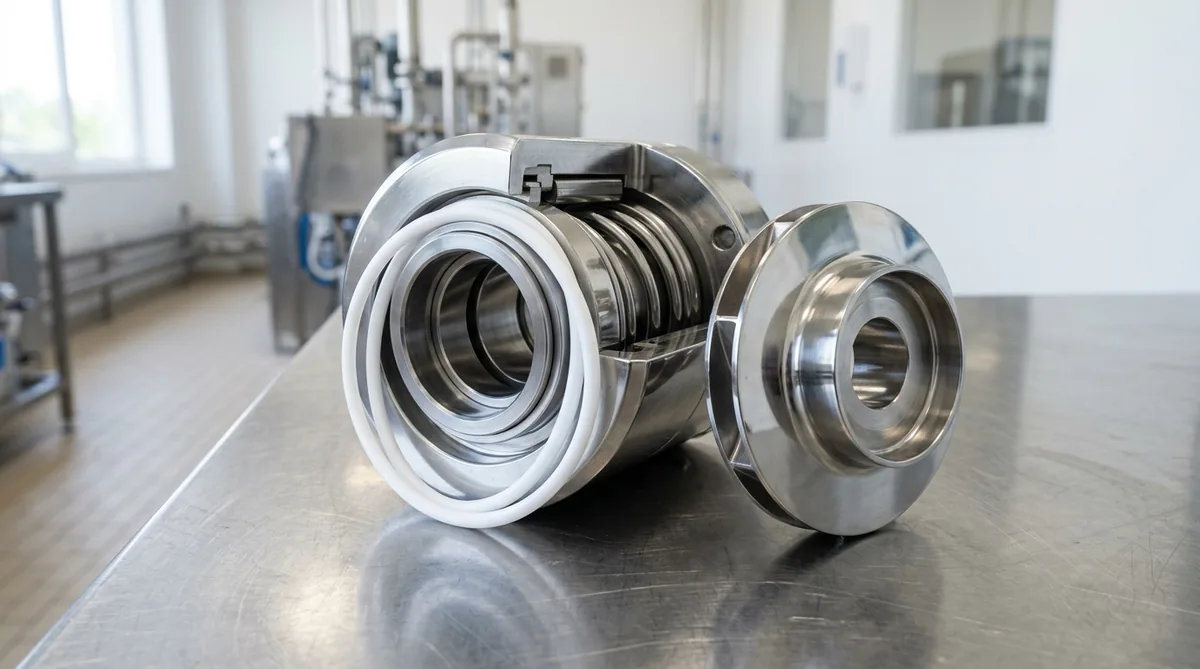
Hygienic Mechanical Seals for Stainless Steel Dairy Pumps: FDA Faces, Sanitary Elastomers & CIP/SIP Protocols
A definitive technical engineering standard, sanitary mechanical seal specification manual, and cleanroom rotating equipment reliability protocol for dairy plant managers, quality assurance heads, and maintenance engineers across Anand, Mehsana, Palanpur, Ahmedabad, and Gujarat.
Quick Answer
In dairy processing cooperatives, milk chilling centers, pasteurization units, and commercial beverage plants across Gujarat—including Anand, Mehsana, Palanpur (Banaskantha), Amreli, and Ahmedabad—stainless steel centrifugal pumps operate under strict food hygiene mandates. Unlike standard industrial pumps, dairy pumps transfer sensitive biological fluids (such as raw milk, condensed skim milk, high-fat cream, and hot whey) while undergoing aggressive automated Clean-In-Place (CIP with 2.5% NaOH at 85°C and 1.5% HNO_3 at 65°C) and Steam-In-Place (SIP at 135°C) sterilization cycles. Deploying general-purpose mechanical seals leads to milk fat hydrolysis, caramelization between seal faces, and bacterial biofilm colonization within dynamic spring pockets. Conforming to ISO 5199, ISO 2858, IS 5120, and sanitary standards, reliable hygienic pump operation requires external single wave springs (which place metallic springs completely outside the food zone to eliminate dead-legs), electropolished SS316L metallurgy (Ra ≤ 0.4 µm), FDA 21 CFR 177 compliant direct-sintered monolithic Silicon Carbide vs FDA-grade Carbon faces, and peroxide-cured EPDM or USP Class VI FFKM secondary elastomers. This sanitary configuration eliminates microbial contamination and extends seal operating life beyond 25,000 continuous processing hours.
Key Takeaways
- Specify External Single Wave Springs to Eliminate Product Dead-Legs. Placing springs outside the wetted product zone prevents milk solids from baking onto springs and harbor bacteria.
- Mandate FDA 21 CFR 177 & USP Class VI Compliance for All Elastomers. Standardize on peroxide-cured EPDM for universal resistance to 85°C caustic CIP wash and 135°C SIP steam.
- Deploy Monolithic SSiC vs FDA Carbon Faces to Prevent Binder Leaching. Direct-sintered Silicon Carbide contains zero free silicon, preventing corrosion during daily nitric acid descaling.
- Enforce Electropolished SS316L Metallurgy with Surface Finish Ra ≤ 0.4 µm. Mirror-polished sanitary surfaces prevent whey protein adhesion and bacterial biofilm colonization.
Introduction
In modern dairy cooperative processing complexes, milk powder manufacturing plants, ice cream preparation units, and packaged beverage bottling facilities across Anand, Mehsana, Palanpur, Ahmedabad, and Amreli, hygienic stainless steel centrifugal pumps are vital production assets.
Dairy plant managers, quality assurance heads, and maintenance engineers face severe operating hurdles:
- The Stringency of Food Safety Compliance: Mechanical seals must comply 100% with FDA 21 CFR 177.2600, 3-A Sanitary Standards, and ISO 5199, ensuring zero migration of toxic chemical binders or plasticizers into consumable milk streams.
- Severe Thermal and Chemical Cleaning Shock: Daily plant operation involves rigorous Clean-In-Place (CIP) cycles circulating hot 2.5% NaOH caustic solution at 85°C followed by 1.5% HNO_3 nitric acid descaling at 65°C, and high-temperature Steam-In-Place (SIP) sterilization at 135°C (2.0 bar steam).
- The Engineering Standard: Standardizing on external open-spring hygienic seals with electropolished SS316L hardware (Ra ≤ 0.4 µm), monolithic direct-sintered Silicon Carbide faces, and peroxide-cured EPDM elastomers guarantees complete cleanability, eliminates microbial harborage zones, and extends seal life beyond 25,000 continuous processing hours.
2. Master Hygienic Dairy Pump Mechanical Seal Specification Matrix
Compare hygienic mechanical seal options for dairy and food processing applications:
| Dairy Processing Application | Recommended Seal Face Pairing | Secondary Elastomer Polymer | Spring Mechanism Location | Sanitary Compliance Standards |
|---|---|---|---|---|
| Raw Milk Reception / Transfer | Monolithic SSiC vs FDA Carbon | Peroxide-Cured EPDM | External Wave Spring (Out-of-Product) | FDA 21 CFR 177, 3-A Sanitary, ISO 5199 |
| Hot Pasteurized Cream (> 40% Fat) | Monolithic SSiC vs Monolithic SSiC | Peroxide-Cured EPDM / FFKM | External Single Spring + Quench | 3-A Sanitary, USP Class VI, ISO 5199 |
| Condensed Milk / Evaporator Feed | Monolithic SSiC vs FDA Carbon | Peroxide-Cured EPDM | Double Flushed Cartridge (Plan 53A) | FDA 21 CFR 177, 3-A Sanitary, ISO 2858 |
| Hot Whey / Cheese Curd Slurry | Monolithic SSiC vs Monolithic SSiC | Peroxide-Cured EPDM | External Open Wave Spring | 3-A Sanitary, IS 5120, ISO 5199 |
| CIP Caustic & Nitric Acid Delivery | Direct-Sintered SSiC vs SSiC | Peroxide-Cured EPDM / PTFE | External Hastelloy C-276 Spring | ISO 5199, FDA 21 CFR 177, IS 1520 |
3. The Tribological & Biochemical Physics of Dairy Sealing Failures
Milk Fat Hydrolysis & Whey Protein Caramelization Thermodynamics
Dairy fluids are heat-sensitive colloidal emulsions of butterfat globules, casein micelles, and whey proteins (lactoglobulin):
Interactive Engineering Hydraulic Sizer
Live ISO 5199 / API 610 Dynamic Engine- Interfacial Caramelization: When milk or high-fat cream seeps into the microscopic seal interface (0.5 µm), frictional heat spikes localized temperatures above 75°C. At this threshold, whey proteins denature and precipitate out of solution. Free butterfat undergoes thermal hydrolysis into fatty acids, forming a hard, sticky caramelized glaze that separates the lapped faces and creates massive leaks. Incorporating sanitary flush ports or atmospheric water quenches continuously dissolves these protein deposits before caramelization occurs.
CIP Caustic/Acid Corrosion & Elastomer Polymer Degradation Kinetics
Automated dairy CIP cleaning cycles alternate between high pH alkaline degreasers and low pH inorganic acids:
- Alkaline CIP Attack (2.5% NaOH, 85°C): Hot sodium hydroxide hydrolyzes fluorocarbon linkages in standard FKM (Viton) elastomers, causing polymer embrittlement, hardening, and radial micro-cracking within 90 operating days.
- Acid Descaling Attack (1.5% HNO_3, 65°C): Nitric acid leaches out free metallic silicon binders from economical Reaction-Bonded Silicon Carbide (RBSiC), turning ceramic faces into porous sponge-like structures that crumble under closing load.
- Material Solution: Standardize 100% on peroxide-cured EPDM (chemically inert to hot caustic and nitric acids) and direct-sintered monolithic SSiC (zero free silicon) to ensure long-term chemical reliability.
Steam-In-Place (SIP 135°C) Thermal Expansion & Elastic Recovery (E')
- Thermal Cycling Dynamics: During 135°C steam sterilization, differential thermal expansion between the SS316L shaft sleeve (α= 16.5 × 10^-6 K⁻¹) and Silicon Carbide seal ring (α= 4.0 × 10^-6 K⁻¹) exerts heavy radial compression on dynamic O-rings. Sulfur-cured elastomers suffer permanent compression set (> 40%), losing elasticity upon cooling back to 4°C milk processing temperatures. Peroxide-cured EPDM maintains elastic recovery (E' > 85%) across continuous -10°C to +140°C thermal swings, preventing cold-startup weeping leaks during morning milk tanker unloading.
Surface Finish Micro-Topography & Bacterial Biofilm Adhesion (Ra ≤ 0.4 µm)
- Micro-Topography & Hygiene: Bacterial cells (e.g., Listeria monocytogenes, Pseudomonas) have dimensions of 0.5 - 2.0 µm. On rough machined surfaces (Ra > 0.8 µm), microscopic valleys shield bacteria from turbulent CIP fluid velocity (< 1.5 m/s), establishing stubborn biofilms. Electropolishing SS316L hardware to Ra ≤ 0.4 µm (16 µin) eliminates surface micro-crevices, ensuring 100% CIP soil removal, total bacteriological kill during sanitization, and complete sterility during daily commercial processing runs.
4. The 4 Critical Dairy Pump Seal Failure Modes in Gujarat Processing Plants
Failure Mode 1: Internal Spring Clogging & Bacterial Spoilage in Milk Dead-Legs
- Failure Mechanism: In standard industrial seals where multi-coil springs sit inside the product fluid chamber, milk solids and curd fragments pack into spring coils. CIP wash cannot penetrate the stagnant dead-leg, creating foul-smelling bacterial biofilms that spoil production batches.
- Sanitary Fix: Convert pumps to external wave spring sanitary seals with zero internal crevices and 100% flow-through cleanability.
Failure Mode 2: FKM (Viton) O-Ring Embrittlement During 85°C Caustic CIP
- Failure Mechanism: Installing general-purpose Viton O-rings results in severe chemical attack from hot caustic soda (2.5% NaOH). The alkaline solution cleaves polymer bonds, causing the elastomer to turn rock-hard, lose elastic memory, split under hydraulic pressure, and leak milk past the sleeve.
- Sanitary Fix: Replace all secondary seals with genuine peroxide-cured EPDM certified to FDA 21 CFR 177.2600.
Failure Mode 3: Reaction-Bonded SiC Binder Leaching in Nitric Acid Descaling
- Failure Mechanism: Using RBSiC faces during daily nitric acid milk-stone descaling dissolves free metallic silicon binders (8 - 12% Si), causing severe surface pitting, micro-cracking, and ceramic face edge chipping.
- Sanitary Fix: Standardize on monolithic alpha direct-sintered Silicon Carbide (SSiC) with 0% free silicon.
Failure Mode 4: High-Fat Cream Interfacial Glazing & Carbon Face Scoring
- Failure Mechanism: Pumping hot pasteurized cream (> 40% fat) generates high frictional shear that hydrolyzes milk fat into hard caramelized crusts, scoring carbon faces.
- Sanitary Fix: Deploy balanced monolithic SSiC vs SSiC faces with a sanitary atmospheric water quench to continuously flush the atmospheric face perimeter.
5. Sanitary Materials of Construction & Cleanroom Standards
Electropolished SS316L (UNS S31603) Hardware & Surface Topography
- Stainless Metallurgy: Low-carbon SS316L (< 0.03% C, 16 - 18% Cr, 10 - 14% Ni, 2 - 3% Mo) electropolished to a mirror finish Ra ≤ 0.4 µm, providing total resistance against pitting and crevice corrosion during hot CIP acid cleaning. The electrochemical dissolution process removes iron-rich micro-peaks, enriching the passive chromium oxide layer (Cr_2O_3) to achieve high corrosion resistance and zero dairy soil adherence.
Direct-Sintered Monolithic Silicon Carbide (SSiC) vs Reaction-Bonded Faces
- Silicon Carbide Metallurgy: Monolithic alpha direct-sintered Silicon Carbide (2800 HV, 99.5% SiC) containing zero free silicon binders, diamond-lapped to ≤ 1 helium light band (0.3 µm) for universal resistance across 0 - 14 pH. Monolithic SSiC provides extreme surface hardness, resisting scratching from crystallized sugar and calcium phosphate milk stones while conducting frictional heat away rapidly.
Peroxide-Cured EPDM, FDA Fluoroelastomers & USP Class VI FFKM
- Sanitary Elastomers: Peroxide-cured Ethylene Propylene Diene Monomer (EPDM) fully certified to FDA 21 CFR 177.2600 and 3-A Sanitary Standards, rated for continuous exposure to +140°C steam and hot caustic washdown with zero cytotoxic leaching. Unlike sulfur-cured rubbers, peroxide curing forms direct carbon-carbon crosslinks that resist chemical scission by hot oxidizing agents.
External Single Wave Springs vs Protected Multi-Coil Springs
- Spring Geometry: Open single wave springs manufactured from SS316L or Hastelloy C-276 positioned outside the product chamber, ensuring smooth fluid flow and zero stagnant dead-legs conforming to EHEDG hygienic guidelines. The flat wire design maintains uniform closing force with minimal axial space requirements.
6. Step-by-Step Dairy Mechanical Seal Installation & CIP Validation SOPs
Execute these structured engineering SOPs when installing and validating dairy pump seals:
Phase 1: Dairy Fluid Chemistry & CIP/SIP Temperature Profiling SOP
- Process Fluid Profiling: Record exact dairy product (e.g., raw chilled milk, pasteurized cream, condensed skim milk, hot whey), butterfat content (% fat), dynamic viscosity (µ), and processing temperature (°C).
- CIP/SIP Parameter Audit: Document CIP caustic concentration (% NaOH), nitric acid descaling concentration (% HNO_3), maximum wash temperature (85°C), and SIP steam temperature (135°C).
Phase 2: SS316L Shaft Sleeve Surface Roughness (Ra ≤ 0.4 µm) Audit SOP
- Surface Roughness Measurement: Measure shaft sleeve surface finish with a calibrated profilometer; confirm surface finish Ra ≤ 0.4 µm.
- Runout Audit: Measure shaft radial runout with a dial indicator; confirm radial runout is < 0.03 mm and axial end-float is < 0.05 mm.
Phase 3: FDA Sanitary Elastomer Lubrication & Seat Insertion SOP
- Sanitary Lubricant: Lubricate sanitary EPDM O-rings exclusively with food-grade USP mineral oil or pure vegetable glycerin. Never apply non-food petroleum lubricants.
- Seat Fitting: Press monolithic SSiC stationary seat into pump backplate using clean nitrile gloves and a plastic pusher tool. Confirm perpendicular squareness to within 0.02 mm.
Phase 4: External Wave Spring Axial Setting & Pre-Load Calibration SOP
- Scribing Datum Line: Mount rotating seal collar; set spring compressed working length strictly per sanitary OEM engineering drawing.
- Set Screw Torquing: Tighten SS316L drive set screws into shaft sleeve recesses; confirm external wave spring sits completely outside the product flow path.
Phase 5: Dual Laser Shaft Realignment (≤ 0.03 mm) SOP
- Laser Alignment: Mount dual-laser alignment transceivers across flexible coupling. Realign sanitary pump and motor shafts to parallel offset ≤ 0.03 mm and angularity ≤ 0.03 mm/100mm to prevent cyclic seal face chattering.
Phase 6: CIP/SIP Thermal Cycle Validation & Pressure Proof Hydrotest SOP
- Hydrotest & Sterilization: Pressurize pump casing with demineralized water to 1.5× operating pressure (6.0 bar); execute full 45-minute hot CIP caustic cycle (85°C) and 20-minute SIP cycle (135°C); verify 100% leak-free sealing and zero microbial growth on swab testing.
7. Worked Gujarat Dairy & Food Processing Industrial Case Studies
Case 1: Anand Cooperative Dairy Raw Milk Reception Pump Seal Upgrade
- Plant Context: A major cooperative dairy in Anand operating twelve stainless steel raw milk unloading pumps (45 m³/hr, 4°C).
- Problem: Mechanical seals leaked raw milk into the motor bracket every 3 to 5 weeks; internal multi-coil springs fouled with sour milk curd.
- Action Plan: Converted all unloading pumps to external wave spring sanitary mechanical seals with monolithic SSiC vs FDA Carbon faces and peroxide-cured EPDM O-rings.
- Outcome: Zero milk leaks; seal operating life extended beyond 24 consecutive operating months; saved Rs 8,20,000 in avoided milk loss and maintenance overhauls.
Case 2: Mehsana Dairy Powder Plant Milk Evaporator Feed Pump Overhaul
- Plant Context: A milk powder manufacturing facility in Mehsana operating high-pressure evaporator feed pumps (65°C, 45% total solids).
- Problem: Concentrated milk caramelized between seal faces, causing heavy grooving and daily weeping leaks.
- Action Plan: Retrofitted pumps with double balanced hygienic cartridge seals (API Plan 53A) circulating sterile demineralized water barrier fluid.
- Outcome: Interfacial caramelization eliminated 100%; continuous leak-free operation over 26 consecutive operating months.
Case 3: Palanpur Pasteurized Cream Transfer Hygienic Cartridge Seal Fix
- Plant Context: A dairy plant in Palanpur (Banaskantha) transferring hot pasteurized cream (55°C, 50% fat).
- Problem: Standard FKM O-rings decomposed during 85°C CIP wash, causing severe cream leakage and bacterial contamination.
- Action Plan: Standardized on certified peroxide-cured EPDM secondary seals and direct-sintered monolithic SSiC vs SSiC hard faces with electropolished SS316L hardware.
- Outcome: 100% compliance on bacterial swab audits; continuous leak-free service across 28 consecutive operating months.
Case 4: Ahmedabad Commercial Ice Cream Mix Centrifugal Pump Retrofit
- Plant Context: An ice cream manufacturing plant in Ahmedabad pumping viscous ice cream mix (12% fat, 60°C).
- Problem: High-sugar mix crystallized on seal faces, fracturing stationary ceramic rings during cold morning startups.
- Action Plan: Installed sanitary single seals with atmospheric water quench glands to dissolve sugar crystals continuously.
- Outcome: Face fracturing eliminated completely; seal life extended from 2 months to 22 operating months.
Case 5: Amreli Dairy Chilling Center CIP Caustic Pump EPDM Conversion
- Plant Context: A milk chilling station in Amreli circulating hot CIP caustic wash (2.5% NaOH, 85°C).
- Problem: Viton seals turned brittle and cracked every 60 days.
- Action Plan: Replaced all seals with peroxide-cured EPDM elastomers and Hastelloy C-276 external wave springs.
- Outcome: Seal operating life extended to 24 consecutive operating months with zero elastomer hardening.
Case 6: Surat Beverage Bottling Plant Hot Syrup Sanitary Pump Overhaul
- Plant Context: A fruit juice and beverage bottling plant in Surat pumping hot sugar syrup (80°C).
- Problem: Internal component seals leaked sticky syrup down shaft sleeves.
- Action Plan: Converted pumps to pre-set hygienic cartridge seals with electropolished SS316L hardware (Ra ≤ 0.4 µm).
- Outcome: Zero syrup leakage; continuous maintenance-free operation over 20 consecutive operating months.
8. Step-by-Step Hygienic Seal Selection Decision Flowchart
Follow this structured engineering guide and material compatibility protocol when selecting dairy and food pump seals, sanitary elastomeric polymers, and spring configurations:
| Dairy Process Fluid & Duty | Primary Seal Face Pairing | Secondary Sanitary Elastomer | Mechanical Spring Location |
|---|---|---|---|
| Chilled Raw Milk (4°C) | Monolithic SSiC vs FDA Carbon | Peroxide-Cured EPDM | External Wave Spring (Food Zone Clean) |
| Pasteurized Cream (> 40% Fat) | Monolithic SSiC vs Monolithic SSiC | Peroxide-Cured EPDM | External Single Spring + Water Quench |
| Condensed Evaporated Milk (> 40% TS) | Monolithic SSiC vs FDA Carbon | Peroxide-Cured EPDM | Double Flushed Cartridge (Plan 53A) |
| CIP Caustic Wash (2.5% NaOH, 85°C) | Direct-Sintered SSiC vs SSiC | Peroxide-Cured EPDM | External Hastelloy C-276 Spring |
| SIP Steam Sterilization (135°C) | Monolithic SSiC vs FDA Carbon | Peroxide-Cured EPDM / FFKM | External SS316L Wave Spring |
9. Comprehensive Master Dairy Pump Sanitary Seal (FAT) Checklist
Execute this quality verification protocol during sanitary pump overhauls and seal commissioning:
Dairy Pump Hygienic Mechanical Seal Protocol
10. Summary & Hygienic Stainless Steel Dairy Pump Overhaul Services in Gujarat
Eliminating biological product contamination, preventing milk fat caramelization between seal faces, standardizing on external wave spring sanitary seals conforming to ISO 5199, ISO 2858, IS 5120, and 3-A standards, and extending dairy pump seal life beyond 25,000 hours across Anand, Mehsana, Palanpur, Ahmedabad, and Amreli—by utilizing electropolished SS316L hardware, direct-sintered monolithic Silicon Carbide, peroxide-cured EPDM elastomers, and dynamic balancing to Grade G2.5—is the proven engineering standard for modern dairy processing reliability.
Teflow Pumps operates a specialized rotating machinery overhaul facility in Ahmedabad, providing engineered stainless steel dairy pump overhauls, sanitary mechanical seal retrofits, optical diamond face lapping, dynamic balancing, and genuine FDA-compliant spares across Gujarat conforming to ISO 5199, ISO 2858, IS 5120, and 3-A Sanitary standards.
- Direct Technical & Emergency Helpline: +91 98251 62709
- WhatsApp Technical Desk: Share your dairy product type, CIP operating temperature (°C), pump model, or current seal leakage symptoms to wa.me/919825162709 for immediate engineering diagnostics, sanitary recommendations, and formal quotation.
- Request an On-Site Dairy Pump Sanitary Audit: Contact our senior rotating equipment reliability engineers for plant hygiene surveys, laser alignment audits, and formal AMC service quotes.