
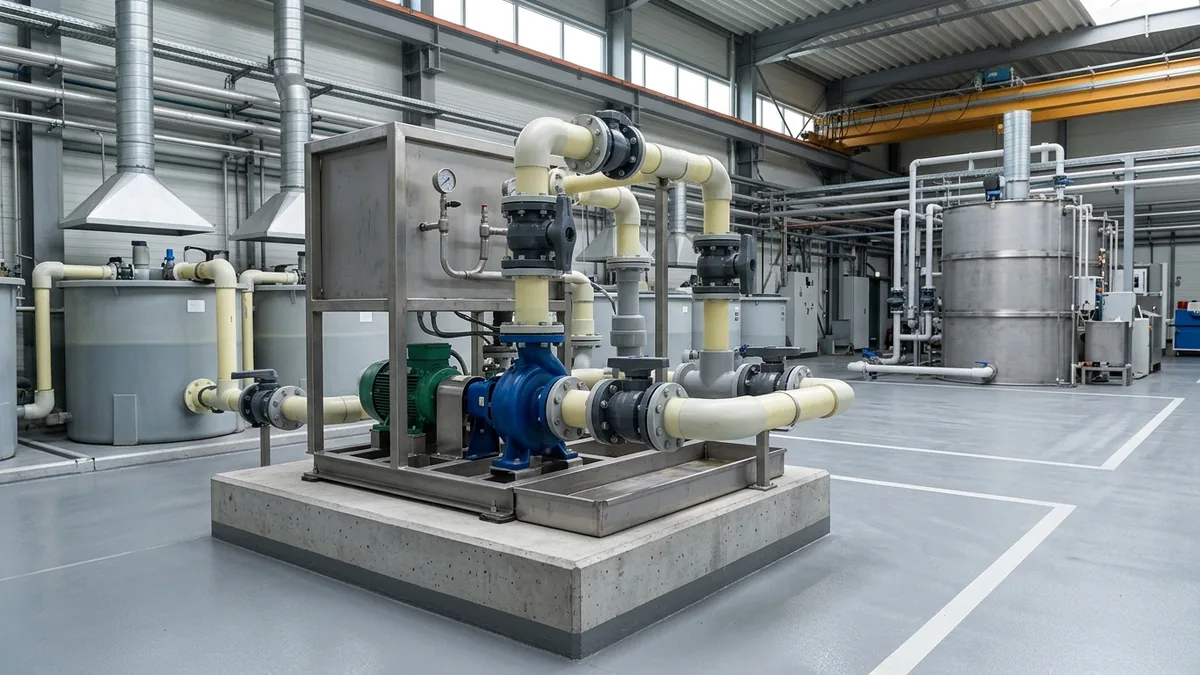
Corrosion-Proof Transfer Equipment Engineering Guide: Sanand & Changodar Chemical Clusters
A comprehensive technical equipment selection manual, polymer corrosion engineering standard, and rotating machinery sourcing guide for factory owners, plant heads, and maintenance superintendents across Sanand GIDC, Changodar, Moraiya, Bavla, and Ahmedabad Industrial Zones.
Quick Answer
In the rapidly expanding industrial corridors of West and South-West Ahmedabad—anchored by Sanand Industrial Park, Changodar GIDC, Moraiya, and Bavla—manufacturing facilities span automotive OEM paint shops, electroplating lines, chemical synthesis plants, and specialty polymer units. These operations routinely transfer highly corrosive acids, including commercial hydrochloric acid (33% HCl), sulfuric acid (70% - 98% H_2SO_4), nitric-hydrofluoric pickling mixtures (20% HNO_3 + 3% HF), and zinc phosphating baths. Pumping these aggressive chemicals with standard metallic pumps (such as cast iron or basic SS304/SS316) causes rapid failure through acidic pitting, intergranular attack, and severe seal leakage within weeks. To achieve continuous, leak-free operation, plant managers must deploy precision transfer-molded PFA lined, solid PVDF, and Glass-Filled Polypropylene (GFPP) centrifugal chemical process pumps conforming to ISO 5199, ISO 2858, IS 5120, and API 685 standards. When vetting acid pump manufacturers, industrial buyers must evaluate solid casing wall thickness (≥ 12 mm), dovetail-locked fluoropolymer liners (≥ 4.5 mm), zero-leakage magnetic drive architectures, external PTFE bellows mechanical seals with direct-sintered Silicon Carbide (SSiC) faces, and localized Ahmedabad manufacturing and repair support.
Key Takeaways
- Choose Fluoropolymers for Universal Corrosion Resistance. Transfer-molded PFA and PTFE linings resist 100% of industrial acids and aggressive solvent blends up to 180°C.
- Thermoplastics Cut Equipment Capital Costs by 40% to 60%. Injection-molded GFPP and PVDF offer complete acid immunity without expensive exotic nickel alloys.
- Select Seal-less Magnetic Drive for Toxic Pretreatment Lines. API 685 magnetic couplings isolate hazardous acid fumes, protecting factory personnel and plant equipment.
- Enforce Dovetail Keying to Eliminate Vacuum Delamination. Locking plastic liners into CNC-machined casing grooves prevents liner collapse during suction transients.
Introduction
In the vibrant industrial manufacturing centers of West Ahmedabad—encompassing Sanand GIDC, Changodar, Moraiya, and Bavla—hundreds of automotive component manufacturers, precision electroplating facilities, specialty chemical synthesis plants, and heavy engineering units operate continuously.
Factory owners, plant directors, and maintenance engineers face severe recurring operating hurdles:
- The Rapid Corrosion Dilemma: Specifying stainless steel (SS316) or fabricated steel pumps for commercial hydrochloric acid, zinc phosphating, or nitric acid passivation baths leads to aggressive pitting corrosion and casing perforation within 3 to 8 weeks, causing hazardous chemical spills and production stoppages.
- The Mechanical Fragility of Fabricated Plastic Pumps: Sourcing cheap, fabricated plastic pumps with thin unreinforced walls results in cracked flanges under piping vibration, dynamic shaft deflection, and frequent mechanical seal blowouts.
- The Engineering Standard: Procuring precision injection-molded Polypropylene (PP-H/GFPP), pure PVDF, and transfer-molded PFA chemical process pumps conforming to ISO 5199, ISO 2858, IS 5120, IS 1520, and API 685 standards—featuring solid thick-walled casings (≥ 12 mm), external PTFE bellows mechanical seals with direct-sintered SSiC faces, heavy ductile iron armor, and dynamic rotor balancing to Grade G2.5—ensures leak-free chemical transfer and extends equipment operating life beyond 35,000 hours.
2. Master Thermoplastic & Fluoropolymer Chemical Compatibility Matrix
Review the operational parameters and chemical suitability for non-metallic and high-alloy pump materials:
| Chemical Process Fluid & Concentration | Solid GFPP (30% Glass) | Pure PVDF (Kynar 740) | Transfer-Molded PFA Lined | Cast SS316 Metallic |
|---|---|---|---|---|
| Commercial Hydrochloric Acid (33% HCl) | Excellent (100% Immune; < 80°C) | Excellent (100% Immune; < 120°C) | Universal (0 - 180°C) | Severe Failure (Pitting < 1 mm/yr) |
| Sulfuric Acid (70% H_2SO_4) | Excellent up to 60°C | Excellent up to 100°C | Universal (0 - 180°C) | Moderate / Severe Intergranular Attack |
| Nitric-HF Mixed Acid (20% HNO_3 + 3% HF) | Not Recommended (Oxidizing) | Excellent up to 90°C | Universal (0 - 160°C) | Catastrophic Failure (Severe Etching) |
| Zinc Phosphating Surface Pretreatment Solution | Excellent up to 65°C | Excellent up to 95°C | Universal (0 - 150°C) | Moderate (Scaling & Erosion) |
| Caustic Soda Wash (30% NaOH) | Excellent up to 80°C | Good (Low Temp < 50°C) | Universal (0 - 150°C) | Good (Passivated) |
| Specific Gravity Range (SG) | 1.00 - 1.40 | 1.00 - 1.80 | 1.00 - 1.95 | 1.00 - 1.40 |
Interactive Chemical Metallurgy & Temperature Compatibility Matrix
ISO 5199 / API 685 Fluoropolymer & Superalloy Standards| Material of Construction | Classification | Max Temp Limit | Compatibility Status @ 65°C |
|---|---|---|---|
Virgin PFAStandard | Fluoropolymer Lining | 160°C | Recommended (A - Zero Corrosion) |
Virgin PTFEStandard | Fluoropolymer Solid/Lined | 150°C | Recommended (A - Zero Corrosion) |
PVDF | Fluoropolymer Thermoplastic | 90°C | Satisfactory (< 2 mpy Corrosion) |
Polypropylene | Commodity Thermoplastic | 60°C | Thermal Derating Exceeded (> 60°C) |
Hastelloy C-276Standard | High-Nickel Superalloy | 110°C | Recommended (A - Zero Corrosion) |
SS316L | Austenitic Stainless Steel | 25°C | Severe Corrosion / Rapid Failure (X) |
SSiC Silicon CarbideStandard | Sintered Ceramic Seal Face | 180°C | Recommended (A - Zero Corrosion) |
Severe oxidizing acid at high concentration. Virgin PFA and PTFE linings provide total chemical inertness up to 160°C. SSiC mechanical seal faces prevent chemical grooving.
3. The Corrosion Physics & Fluid Tribology of Non-Metallic Pump Materials
Pitting Corrosion Kinetics in Metallic Alloys vs Polymer C-C Inertness
Metallic alloys depend on a fragile passivating oxide layer (Cr_2O_3, thickness 2 - 4 nm) that breaks down rapidly in the presence of acidic halides:
- Halide Breakdown: In pickling and plating solutions containing chloride (Cl^-) or fluoride (F^-) ions, halide anions penetrate the chromium oxide film, creating micro-galvanic cells where iron dissolves at a rapid rate:
- Saturated Polymer Backbone: In contrast, Homopolymer Polypropylene (PP-H) and Glass-Filled Polypropylene (GFPP) consist entirely of high-molecular-weight saturated carbon-carbon (-C-C-) and carbon-hydrogen (-C-H-) covalent bonds. Because these polymers lack polar reactive sites or metallic grain boundaries, mineral acids cannot initiate chemical reactions or localized pitting. In chemical facilities across Sanand and Changodar, non-metallic pumps prevent catastrophic casing wall thinning and preserve liquid purity.
Glass-Filled Polypropylene (GFPP) Tensile Modulus & Creep Resistance
To resist internal hydraulic pressure surges up to 10.0 bar without viscoelastic deformation:
- Modulus Reinforcement: Incorporating 30% chemically coupled borosilicate glass fibers into the polypropylene matrix raises tensile yield strength from 32 MPa to 75 MPa, increases flexural modulus from 1.4 GPa to 4.2 GPa, and reduces thermal expansion by 60%, preventing casing distortion under continuous pumping temperatures up to 80°C.
- Creep Elimination: The interwoven glass fiber network absorbs continuous hoop stresses, maintaining exact volute clearances and preventing dynamic impeller rubbing over thousands of operating hours.
PVDF & PFA Fluoropolymer Thermal Stability & Fluorine Electron Density
Fluorinated polymers such as Polyvinylidene Fluoride ([-CH_2-CF_2-]_n) and Perfluoroalkoxy ([-CF_2-CF(OR_f)-]_n) provide extreme chemical resistance:
- Extreme Bond Energy: The high carbon-fluorine bond dissociation energy (485 kJ/mol) and dense electron cloud protect the carbon backbone against aggressive oxidizing acids (such as hot concentrated nitric acid and chromic acid) up to +120°C for PVDF and +180°C for PFA.
- High Chemical Inertness: The dense fluorine shield prevents surface chain scission and eliminates swelling when exposed to harsh aromatic or chlorinated solvent residues. When transferring hot pickling acids in Changodar fastener plants, pure PVDF impellers maintain precise mechanical dimensions and structural stiffness without thermal degradation.
Hydraulic Roughness Hydrodynamics & Boundary Layer Energy Savings
- Smooth Hydraulic Passages: Solid injection-molded thermoplastic casings and impellers achieve mirror-smooth surface roughness of Ra ≤ 0.4 µm (compared to Ra ≈ 6.3 µm for sand-cast stainless steel). This reduces boundary layer friction, boosting hydraulic efficiency by 4% - 7% and lowering electrical power consumption across 24-hour plant operations.
- Anti-Scaling Volute Surface: The low surface energy of thermoplastics prevents zinc phosphate scale, mineral salts, and chemical slurry from adhering to the impeller vanes. Over thousands of operating hours, pump head-capacity characteristics remain constant without progressive flow decay.
4. The 4 Critical Industrial Applications Across Sanand & Changodar Units
Application 1: Automotive Component E-Coat & Acid Pretreatment Phosphating
- Operating Demand: Circulating hot acidic zinc phosphating solutions (55°C - 65°C, 2.5 bar) containing abrasive phosphate sludge across continuous automotive dip tanks in Sanand Industrial Park.
- Engineering Solution: Solid GFPP or pure PVDF centrifugal process pumps equipped with semi-open impellers and external PTFE bellows mechanical seals with direct-sintered SSiC vs SSiC faces.
Application 2: Metal Finishing & Fastener Chemical Passivation Lines
- Operating Demand: Recirculating aggressive nitric-hydrofluoric acid dip tanks (20% HNO_3 + 3% HF) in Changodar engineering fastener plants.
- Engineering Solution: Pure PVDF (Kynar 740) or transfer-molded PFA-lined process pumps conforming to ISO 2858, providing complete chemical immunity against fluoride attack.
Application 3: Specialty Chemical Intermediate & Pigment Synthesis
- Operating Demand: Transferring commercial hydrochloric acid (33% HCl) and acidic dye slurries from reaction kettles to filter presses in Moraiya and Bavla.
- Engineering Solution: Solid GFPP end-suction chemical pumps with ductile iron outer armor and laser-balanced closed impellers conforming to ISO 5199 Grade G2.5.
Application 4: Factory Acid Waste Neutralization & Common Effluent Pumping
- Operating Demand: Pumping spent acidic rinse water (1.0 - 3.5 pH) containing metallic fines to on-site effluent neutralization pits.
- Engineering Solution: Heavy-duty GFPP centrifugal pumps with Hastelloy C-276 casing fasteners and chemical-resistant FKM secondary O-rings.
5. Sanitary Materials of Construction & Cleanroom Standards
Virgin Transfer-Molded PFA & Isostatic PTFE Linings (≥ 4.5 mm)
- Casing Lining Engineering: High-density virgin Perfluoroalkoxy (PFA, DuPont Teflon / Daikin Neoflon) transfer-molded with a solid wall thickness of 4.5 - 6.0 mm, anchored into ductile iron casings via precision dovetail grooves, rated for full vacuum at 150°C.
- 100% Spark Testing: All lined wet ends undergo high-voltage 20 kV DC spark testing to verify zero pinholes or microscopic fissures prior to factory dispatch.
Solid Pure PVDF (Kynar 740) & Glass-Filled Polypropylene (GFPP)
- Thermoplastic Metallurgy: Solid injection-molded Homopolymer Polypropylene (PP-H), 30% Glass-Filled Polypropylene (GFPP), and 100% pure PVDF (Kynar 740) offering structural rigidity and chemical inertness up to 120°C across aggressive industrial chemical duties.
Ductile Iron Outer Armor (GGG 40) & ISO 2858 Flange Dimensions
- Structural Casing Armor: Ductile Iron (GGG 40) or Grade FG 260 cast iron outer casing armor supporting plastic flanges against piping thermal expansion and nozzle moment loads conforming to ISO 5199 standards, completely eliminating flange shearing.
External PTFE Bellows Mechanical Seals with Monolithic SSiC Faces
- Mechanical Sealing: External Teflon bellows mechanical seals featuring direct-sintered Silicon Carbide (SSiC, 2800 HV) stationary and rotating rings with zero metallic parts in contact with the acid liquid. The isolated spring mechanism prevents acid vapor corrosion and eliminates spring silt compaction.
6. Step-by-Step Acid Handling Equipment Selection & Sizing SOPs
Execute these structured engineering SOPs when specifying chemical transfer equipment:
Phase 1: Chemical Medium & Thermal Limit Verification SOP
- Chemical Characterization: Document complete fluid composition, acid concentration percentage (%), fluid specific gravity (SG), and peak operating temperature (T_max).
- Material Selection Guideline:
- For 33% HCl, 70% H_2SO_4 at < 75°C: Select Solid GFPP. - For Nitric-HF, chromic acid, or temperatures up to 120°C: Select Solid PVDF. - For universal solvents, hot concentrated acids up to 180°C: Select Transfer-Molded PFA Lined.
Phase 2: Total Dynamic Head (TDH) & Specific Gravity Sizing SOP
- Hydraulic Sizing: Calculate static elevation (Z), friction head loss (h_f), and terminal pressure (P).
- Motor Power Sizing: Calculate required motor brake horsepower factoring in fluid specific gravity:
- Motor Sizing Rule: Ensure motor kilowatt rating is sized for maximum end-of-curve flow and cold-morning acid density to prevent thermal overload trips.
Phase 3: Net Positive Suction Head (NPSHa) Margin SOP
- NPSH Sizing: Calculate suction line friction losses (V_s ≤ 1.2 m/s) and supply tank liquid head.
- Verification: Confirm NPSHa - NPSHr_OEM ≥ 0.6 meters across all operating points to avoid plastic impeller cavitation erosion.
Phase 4: Magnetic Drive vs Mechanical Seal Selection SOP
- Environmental Containment Evaluation:
- For standard acidic chemical transfers: External PTFE bellows mechanical seal with direct-sintered SSiC faces. - For hazardous, toxic, fuming, or volatile acid transfers: Seal-less Magnetic Drive Pump conforming to ISO 5199 and API 685 standards.
Phase 5: Piping Strain Isolation & Expansion Joint Layout SOP
- Structural Pipe Support: Ensure all suction and discharge piping is independently supported on pipe racks. Plastic pump flanges must carry zero structural pipe weight.
- Flexible Expansion: Install virgin PTFE expansion bellows immediately adjacent to suction and discharge nozzles to isolate thermal expansion and pipe vibration.
Phase 6: Hydrostatic Pressure & Spark Testing Verification SOP
- Proof Testing: Hydrostatically pressure test every pump casing to 1.5× rated pressure (15.0 bar) for 30 minutes with water. Scan 100% of internal fluoropolymer liners with a 20 kV DC spark tester. CNC-trim thermoplastic impellers to exact duty points and dynamic balance to ISO 5199 Grade G2.5 before dispatch. Each pump is factory-tested across its full performance envelope to verify design flow and head delivery.
7. Worked Sanand & Changodar Industrial Case Studies
Case 1: Sanand Automotive Paint Shop Acid Dip Recirculation Upgrade
- Plant Context: A tier-1 automotive component paint shop in Sanand Industrial Park operating zinc phosphating and acid rinse recirculation pumps (45 m³/hr, 2.8 bar, 60°C).
- Problem: Fabricated SS316 pumps suffered severe casing pitting and mechanical seal slurry abrasion every 6 weeks.
- Action Plan: Installed Teflow solid injection-molded Glass-Filled Polypropylene (GFPP) process pumps with external PTFE bellows seals and direct-sintered SSiC faces.
- Outcome: Complete corrosion immunity achieved; zero seal leaks over 24 consecutive operating months; saved Rs 5,40,000 in annual pump replacement costs.
Case 2: Changodar Fastener Passivation Nitric-HF Acid Pump Retrofit
- Plant Context: A high-tensile fastener manufacturing plant in Changodar operating chemical passivation tanks (20% HNO_3 + 3% HF).
- Problem: Metallic pumps suffered rapid wall thinning and casing perforation within 4 weeks.
- Action Plan: Replaced units with Teflow solid compression-molded pure PVDF (Kynar 740) chemical process pumps with Hastelloy C-276 hardware.
- Outcome: Zero chemical degradation; continuous leak-free transfer across 26 consecutive operating months.
Case 3: Moraiya Specialty Polymer Chemical Transfer Pump Overhaul
- Plant Context: A specialty polymer synthesis facility in Moraiya transferring commercial 33% HCl at 65°C.
- Problem: Rotomolded plastic pumps suffered cracked flanges and shaft sleeve fretting under thermal cycling.
- Action Plan: Installed Teflow heavy-walled GFPP process pumps with ductile iron outer armor, ISO 2858 flanges, and PTFE expansion joints.
- Outcome: Zero flange cracking; continuous operation over 22 consecutive operating months.
Case 4: Bavla Industrial Estate Dye Intermediate Acid Pump Standardization
- Plant Context: A dye intermediate manufacturing unit in Bavla pumping spent sulfuric acid (40% H_2SO_4, 70°C).
- Problem: Polypropylene pumps from local fabricators warped and leaked at casing joints under elevated temperatures.
- Action Plan: Standardized on Teflow transfer-molded PFA-lined process pumps with 5.0 mm dovetail-locked liners.
- Outcome: Complete thermal stability; continuous stable pumping over 28 consecutive operating months.
Case 5: Changodar GIDC Metal Plating Waste Sump Pump Replacement
- Plant Context: An electroplating job shop in Changodar GIDC pumping spent acidic pickling effluent containing suspended metal fines.
- Problem: Frequent pump motor tripping on overload during morning startups due to uncalculated fluid specific gravity.
- Action Plan: Recalculated hydraulic parameters; installed solid GFPP pump with upsized 5.5 kW IE3 motor and semi-open impeller.
- Outcome: 100% startup reliability; zero motor overload trips over 20 consecutive operating months.
Case 6: Sanand Engineering Component Passivation Bath Pump Installation
- Plant Context: A precision engineering facility in Sanand operating an automated acid passivation line for aerospace parts.
- Problem: Mechanical seal leaks caused acid vapor corrosion on electric motor bearings.
- Action Plan: Installed Teflow seal-less magnetic drive PVDF pumps with high-purity ceramic shafts and monolithic SSiC bushings.
- Outcome: Mechanical seal leaks eliminated 100%; zero acid vapor emissions over 24 consecutive operating months.
8. Step-by-Step Corrosion-Proof Pump Selection Decision Flowchart
Follow this structured engineering guide when selecting corrosion-proof chemical pumps:
| Chemical Process Application | Operating Temp & Acid Type | Recommended Pump & Metallurgy Selection |
|---|---|---|
| Commercial Hydrochloric Acid (33% HCl) | Ambient to 65°C; Pure HCl | Solid GFPP Casing + Direct-Sintered SSiC Seal |
| Nitric-HF Passivation Dip (20% HNO_3 + 3% HF) | 40°C - 90°C; Mixed Halide Acid | Solid Pure PVDF (Kynar) Casing + FFKM O-Rings |
| Automotive Zinc Phosphating Recirculation | 45°C - 65°C; Contains Sludge | GFPP Casing + Semi-Open Impeller + External Seal |
| Toxic / Volatile Acid Chemical Transfer | Ambient to 120°C; Zero Leakage Allowed | Seal-less Magnetic Drive Process Pump (API 685) |
| Spent Acidic Effluent Sump Transfer | Ambient to 60°C; Effluent Sump | Solid Polypropylene (PP-H) End-Suction Pump |
| High-Temperature Universal Acid Process | 80°C - 180°C; Concentrated Media | Transfer-Molded PFA Lined Pump (ISO 5199) |
9. Comprehensive Master Chemical Equipment Factory Acceptance (FAT) Checklist
Execute this quality verification protocol prior to chemical pump equipment dispatch and installation:
Corrosion-Proof Chemical Pump FAT Protocol
10. Summary & Local Acid Pump Engineering Support in Ahmedabad
Eliminating corrosive pump failures, ensuring 100% chemical resistance against commercial hydrochloric, sulfuric, and mixed passivation acids conforming to ISO 5199, ISO 2858, IS 5120, and IS 1520 standards, and extending pump operating life beyond 35,000 hours across Sanand GIDC, Changodar, Moraiya, and Bavla—by utilizing precision solid injection-molded Glass-Filled Polypropylene, pure PVDF, transfer-molded PFA, and ductile iron armor—is the proven engineering standard for modern manufacturing reliability.
Partnering directly with an established Ahmedabad chemical rotating equipment manufacturer provides plant engineering teams with immediate technical access to fluid compatibility audits, custom impeller trimming, precision dynamic balancing, and genuine non-metallic spares. Our local engineering presence ensures that specialized replacement parts and technical troubleshooting are delivered directly to your plant floor.
Teflow Pumps operates a specialized chemical rotating machinery manufacturing facility in Ahmedabad, providing engineered PFA-lined pumps, solid GFPP process pumps, pure PVDF pumps, seal-less magnetic drive pumps, 20 kV dielectric spark testing, dynamic balancing, and genuine rotating equipment spares across Gujarat conforming to ISO 5199, ISO 2858, IS 5120, and API 685 standards.
- Direct Technical & Emergency Helpline: +91 98251 62709
- WhatsApp Technical Desk: Share your acid name, concentration (%), operating temperature (°C), flow/head requirements, or pump model to wa.me/919825162709 for immediate engineering diagnostics, material selection evaluation, and formal quotation.
- Request an On-Site Plant Pump Audit: Contact our senior rotating equipment engineers for plant pump surveys, material compatibility audits, and formal quotation.