
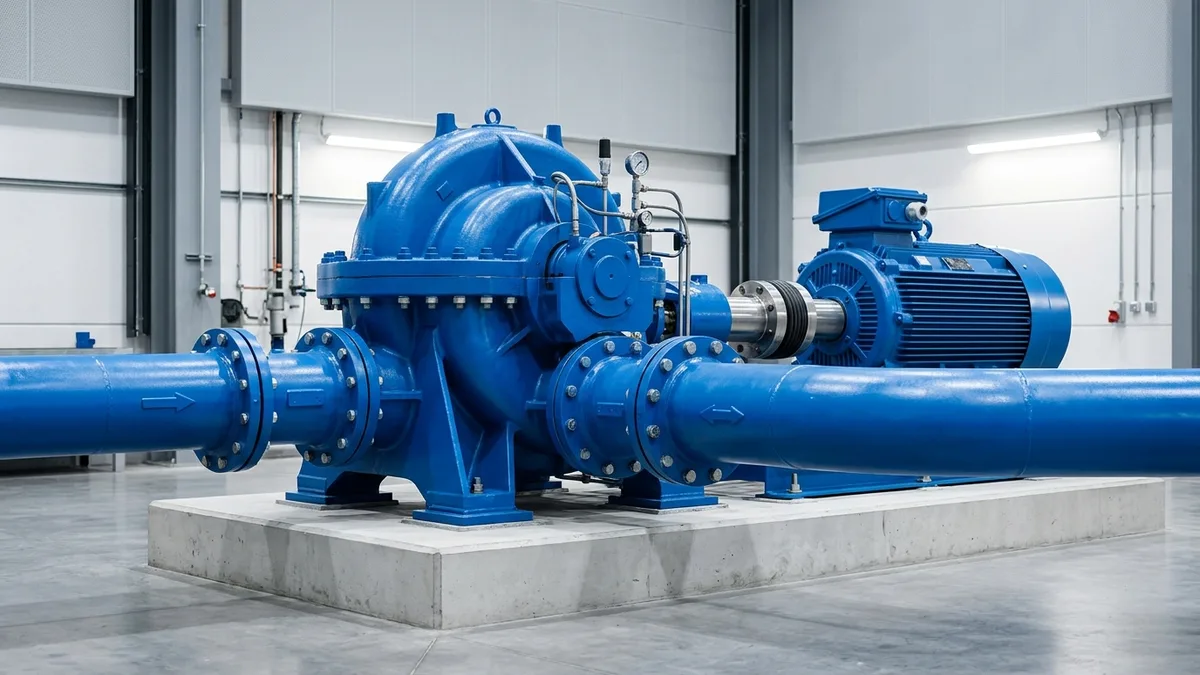
Industrial Cooling Water Pump Overhaul: Laser Alignment, Vibration Analysis & Rebuild Engineering Standard
A definitive industrial water machinery maintenance manual, laser shaft alignment protocol, and rotor dynamic balancing standard for plant maintenance superintendents, reliability engineers, and utility technicians across Surat, Sachin, Pandesara, Ahmedabad, and Gujarat.
Quick Answer
In Gujarat's power generation utilities, continuous textile processing facilities (Surat—Sachin, Pandesara), chemical complexes (Ahmedabad, Ankleshwar), and heavy petrochemical refineries (Hazira, Dahej), high-capacity centrifugal cooling water and condenser circulation pumps run continuously across uninterrupted multi-shift operations. Over months of non-stop operation, thermal baseplate movement, pipe strain, and abrasive silt erosion degrade internal mechanical tolerances, creating severe shaft misalignment (> 0.15 mm), destructive bearing vibration (> 7.5 mm/s RMS), and widened impeller wear ring clearances (> 0.80 mm) that drop pumping efficiency by 15% - 25%. Executing a professional cooling water pump overhaul requires rigorous dimensional and mechanical restoration: precision dual-laser shaft alignment (< 0.05 mm parallel offset, < 0.04 mm/100 mm angularity), dynamic rotor balancing to ISO 5199 Grade G2.5 (< 2.8 mm/s RMS), restoring wear ring diametrical clearances (0.25 - 0.45 mm), and eliminating soft-foot under pump motor baseplates conforming to ISO 5199, ISO 2858, IS 5120, and IS 1520 standards. Rebuilding cooling water pumps with precision bronze wear rings, direct-sintered SSiC mechanical seals, and vibration-damped coupling inserts restores hydraulic flow and extends mean time between overhauls beyond 40,000 continuous operating hours.
Key Takeaways
- Enforce Precision Laser Shaft Alignment Tolerances. Maintain parallel offset < 0.05 mm and angularity < 0.04 mm/100 mm to eliminate 2X vibration harmonics.
- Dynamically Balance Rotating Assemblies to ISO 5199 Grade G2.5. Balance impellers and shafts dynamically to achieve vibration velocity < 2.8 mm/s RMS.
- Restore Impeller and Casing Wear Ring Clearances. Maintain diametrical clearances within 0.25 - 0.45 mm to prevent internal recirculation slip.
- Eliminate Baseplate Soft-Foot and Correct Piping Strain. Ensure soft-foot dial indicator deflection is < 0.05 mm before final bolt torquing.
Introduction
Across Gujarat's major industrial corridors—spanning Surat (Sachin GIDC, Pandesara, Hazira), Ahmedabad (Vatva, Naroda, Odhav), Ankleshwar GIDC, and Dahej PCPIR—high-volume cooling water pumps provide essential heat rejection for chemical synthesis reactors, textile stenter chillers, power plant steam condensers, and polymer extruders.
Plant maintenance superintendents, utility engineers, and condition monitoring specialists face severe recurring hurdles:
- The Misalignment Vibration Trap: Traditional dial-indicator or straightedge alignment methods fail to account for dynamic thermal baseplate expansion (ΔT) and pipe strain. Operating with shaft misalignment (> 0.10 mm) generates severe 2X vibration harmonics, destroying mechanical seal faces and causing premature ball bearing fatigue within 3 to 6 operating months.
- The Wear Ring Recirculation Loss: Abrasive silt and scale particulates in cooling tower sumps erode internal impeller wear rings over time. When wear ring clearances widen from 0.30 mm to 0.90 mm, internal recirculating slip flow increases exponentially, dropping cooling water delivery by up to 25% and triggering plant-wide thermal tripping.
- The Engineering Standard: Implementing a comprehensive precision overhaul conforming to ISO 5199, ISO 2858, IS 5120, and IS 1520 standards—re-machining wear rings, dynamically balancing impellers to ISO 5199 Grade G2.5, correcting baseplate soft-foot, and executing dual-laser shaft alignment—restores full rated flow, lowers vibration velocity below 2.8 mm/s RMS, and extends pump service life beyond 40,000 continuous operating hours.
2. Master Cooling Water Pump Overhaul Clearance & Alignment Matrix
Review the precision engineering clearance and laser alignment tolerances across pump sizes:
| Overhaul Inspection Parameter | Small Water Pump (< 250 m³/h) | Medium Water Pump (250 - 800 m³/h) | Large Water Pump (> 800 m³/h) | Critical Utility Service |
|---|---|---|---|---|
| Laser Parallel Offset Tolerance | ≤ 0.05 mm | ≤ 0.04 mm | ≤ 0.03 mm | ≤ 0.025 mm |
| Laser Angular Misalignment | ≤ 0.05 mm/100 mm | ≤ 0.04 mm/100 mm | ≤ 0.03 mm/100 mm | ≤ 0.025 mm/100 mm |
| Baseplate Soft-Foot Deflection | ≤ 0.05 mm | ≤ 0.04 mm | ≤ 0.03 mm | ≤ 0.020 mm |
| Impeller Wear Ring Clearance | 0.25 - 0.35 mm | 0.30 - 0.45 mm | 0.40 - 0.60 mm | 0.30 - 0.40 mm |
| Rotor Dynamic Balance Grade | ISO 5199 Grade G2.5 | ISO 5199 Grade G2.5 | ISO 5199 Grade G2.5 | ISO 5199 Grade G1.0 |
| Shaft Total Radial Runout (TIR) | ≤ 0.020 mm | ≤ 0.015 mm | ≤ 0.015 mm | ≤ 0.010 mm |
| Overall Vibration Velocity (RMS) | < 2.8 mm/s (Zone A) | < 2.8 mm/s (Zone A) | < 2.8 mm/s (Zone A) | < 1.8 mm/s (Zone A) |
3. The Kinematics, Rotor Dynamics & Vibration FFT Spectra Mechanics
Laser Shaft Alignment Geometry & Thermal Growth Offsets
Shaft alignment requires co-linear positioning of the rotational centerlines of the driving motor and driven pump shaft at running temperature:
Thermal expansion shifts the motor shaft vertically during operation:
Where L_center is the vertical centerline height from the base, α is the thermal expansion coefficient of cast iron/steel (11.7 × 10^-6 /°C), and ΔT is the temperature rise of the motor casing above ambient (30 - 45°C). Cold alignment protocols must intentionally incorporate vertical thermal offset targets to achieve perfect co-linearity at normal operating temperatures.
FFT Vibration Spectra Signatures: Unbalance (1X) vs Misalignment (2X)
Fast Fourier Transform (FFT) vibration spectrum analysis isolates root mechanical faults:
- Dynamic Rotor Unbalance: Generates a dominant, sinusoidal peak at 1X running speed in the radial direction (90^° phase shift between horizontal and vertical axes).
- Angular / Parallel Misalignment: Generates strong 2X running speed peaks accompanied by high axial vibration amplitudes and a 180^° phase shift across the coupling joint.
- Mechanical Looseness: Generates sub-harmonic and multiple integer harmonics (1X, 2X, 3X, 4Xs) accompanied by high noise floor elevation.
High-Frequency Bearing Defect Frequencies (BPFO, BPFI, BSF, FTF)
Bearing race defects emit discrete kinematic frequency signatures:
Where n is the number of rolling balls, d is ball diameter, D is bearing pitch diameter, and θ is contact angle. Detecting non-synchronous BPFO (Ball Pass Frequency Outer Race) peaks enables proactive bearing replacement weeks before catastrophic cage collapse.
Wear Ring Hydrodynamic Lomakin Effect & Critical Speed Stability
- Hydrodynamic Centering Force (Lomakin Effect): The fluid annular seal across narrow wear ring clearances (0.30 mm) acts as an auxiliary hydrodynamic bearing, generating radial stiffness that raises rotor critical bending speed above operating speed.
- Worn Ring Instability: When wear ring clearances double from abrasive erosion, Lomakin centering stiffness drops by 75%, causing shaft deflection, severe low-frequency rotor whirl, and premature seal destruction.
4. The 4 Critical Failure Modes in Industrial Cooling Water Pumps
Failure Mode 1: 2X Harmonic Vibration from Angular Misalignment
- Root Cause: Traditional straightedge alignment fails to correct 3-dimensional angular slope between motor and pump shafts.
- Engineering Solution: Perform precision dual-laser alignment and torque base bolts to specified values (120 - 250 N\cdotm).
Failure Mode 2: Bearing Race Fluting & Fatigue from Piping Strain
- Root Cause: Heavy un-supported cooling tower piping forces the pump casing out of round, causing severe shaft bending and bearing race overloading.
- Engineering Solution: Disconnect piping and verify zero shaft deflection (< 0.05 mm indicator movement) during flange bolt tightening. Install flexible bellow expansion joints.
Failure Mode 3: Wear Ring Blowout & Severe Flow Recirculation
- Root Cause: Silt and scale particulates erode wear rings; clearance widens past 0.80 mm, causing high-pressure discharge liquid to bypass back to suction.
- Engineering Solution: Machine and press new leaded phosphor bronze wear rings and restore diametrical clearance to 0.25 - 0.35 mm.
Failure Mode 4: Cavitation Pitting from Suction Strainer Blockage
- Root Cause: Cooling tower debris blocks suction foot valves or strainers, dropping available NPSH_a below required NPSH_r.
- Engineering Solution: Clean suction sumps, install oversized differential-pressure monitored basket strainers, and inspect impeller eye for cavitation pitting.
Interactive Pump Failure Root-Cause Diagnostic Navigator
ISO 10816 / API 682 Step-by-Step Triage FlowClassic NPSHa starvation or thermodynamic vapor flashing at first-stage impeller eye (NPSHa < NPSHr + 1.5m).
Check suction strainer differential pressure (ΔP > 0.35 bar indicates clogging); audit deaerator/tank static height and fluid vapor pressure.
Clean suction strainer; elevate suction feed vessel or increase suction pipe diameter to lower flow velocity below 1.2 m/s; trim impeller or fit high-Nss inducer.
5. Sanitary Materials of Construction & Cleanroom Standards
High-Tensile Cast Iron & Ductile Iron Casings
- Casing Shells: Heavy-wall high-grade Cast Iron or Ductile Iron (GGG 40) split-case or end-suction volute casings possessing high structural damping capacity against hydraulic vibration and pressure pulsations.
SS316 & Leaded Phosphor Bronze (PB2 / SAE 660) Wear Rings
- Wear Rings: Renewable casing and impeller wear rings manufactured from leaded Phosphor Bronze (PB2 / SAE 660) or SS316 possessing exceptional anti-galling properties and micro-smooth sealing lands.
Direct-Sintered Silicon Carbide (SSiC) Cartridge Seals
- Shaft Sealing: Cartridge mechanical seals featuring monolithic direct-sintered SSiC vs SSiC or Tungsten Carbide faces with FKM elastomeric secondary seals, eliminating packing maintenance.
Precision-Ground Carbon Steel & Duplex Stainless Steel Shafts
- Rotor Shafts: Heat-treated high-tensile carbon steel or Duplex SS (UNS S31803) shafts, precision CNC cylindrical ground with total indicated runout (TIR) held under 0.015 mm.
6. Step-by-Step Cooling Water Pump Overhaul & Alignment SOPs
Execute these structured engineering SOPs during every industrial cooling water pump overhaul:
Phase 1: Pre-Overhaul Vibration Baseline & Thermal FFT Audit SOP
- Baseline Data: Record tri-axial vibration velocities (Horizontal, Vertical, Axial) on drive and non-drive end bearing housings.
- FFT Analysis: Identify peak spectral amplitudes (1X, 2X, 3X, high-frequency bearing defect frequencies) to guide teardown priorities.
Phase 2: Pump Teardown, Casing Inspection & Wear Ring Audit SOP
- Disassembly: Rig and remove upper casing cover, bearing housings, and rotating rotor assembly using dedicated lifting beams.
- Clearance Audit: Measure impeller wear ring outside diameter and casing wear ring inside diameter with internal/external micrometers to calculate diametrical clearance. Replace rings if clearance exceeds 0.50 mm.
Phase 3: Dynamic Rotor Balancing to ISO 5199 Grade G2.5 SOP
- Static Check: Check shaft runout between centers on a precision granite surface table (TIR ≤ 0.015 mm).
- Dynamic Balancing: Mount assembled impeller and shaft on a computerized dual-plane dynamic balancing machine. Add or remove corrective mass to achieve ISO 5199 Grade G2.5 balance residual tolerance (< 1.0 g\cdotmm/kg).
Phase 4: Baseplate Soft-Foot Correction & Pre-Torquing SOP
- Soft-Foot Audit: Mount dial indicators or laser sensors on each motor foot. Loosen one bolt at a time; if indicator deflection exceeds 0.05 mm, install precision stainless steel pre-cut shims under the foot.
- Foundation Check: Verify anchor bolt tightness and grout integrity before proceeding to shaft alignment.
Phase 5: Precision Dual-Laser Shaft Alignment SOP
- Sensor Setup: Mount dual laser emitter/detector heads across the flexible coupling. Enter machine geometric dimensions.
- Sweep & Correct: Rotate shafts through 360^° sweep. Adjust horizontal position using jacking bolts and vertical elevation using precision shims until both offset and angularity fall within tolerance (Offset < 0.04 mm, Angularity < 0.04 mm/100 mm).
Phase 6: Post-Rebuild Hydrostatic & Vibration Acceptance Test SOP
- Hydrostatic Test: Pressurize reassembled casing with water to 1.5× rated pressure (16.0 bar) for 15 minutes to verify zero gasket or seal leakage.
- Running Acceptance Test: Start motor and run pump at full load. Measure overall vibration velocity; verify overall RMS velocity is < 2.8 mm/s (ISO 5199 Zone A acceptance) and bearing temperatures stabilize below 65°C.
7. Worked Gujarat Textile, Petrochemical & Power Plant Case Studies
Case 1: Surat Textile Processing Mill Cooling Tower Pump Overhaul
- Plant Context: A large textile dyeing and processing mill in Sachin GIDC (Surat) operating two 450 m³/h cooling water circulation pumps.
- Problem: Severe 2X vibration (8.4 mm/s RMS) caused monthly mechanical seal face blowouts and motor bearing overheating.
- Action Plan: Teflow engineering team overhauled the pumps: replaced worn bronze wear rings, dynamically balanced rotors to ISO 5199 Grade G2.5, corrected 0.18 mm motor soft-foot, and executed dual-laser shaft alignment (0.03 mm offset).
- Outcome: Vibration dropped to 1.6 mm/s RMS; seal failures eliminated; continuous leak-free pumping over 24 consecutive operating months; saved Rs 8,80,000 in annual maintenance costs.
Case 2: Pandesara Polyester Synthetic Fiber Plant Circulation Pump Rebuild
- Plant Context: A continuous polyester polymerization fiber plant in Pandesara GIDC (Surat) circulating chilled cooling water (650 m³/h).
- Problem: Cooling capacity dropped by 20% during peak summer months due to excessive wear ring clearance (0.95 mm).
- Action Plan: CNC machined new SS316 wear rings with 0.30 mm diametrical clearance and overhauled pump bearings.
- Outcome: Restored full 650 m³/h design flow; polymerization reactor temperatures stabilized; continuous operation over 22 consecutive operating months.
Case 3: Hazira Petrochemical Complex Utility Cooling Pump Alignment
- Plant Context: A petrochemical manufacturing complex in Hazira operating three 1200 m³/h horizontal split-case cooling pumps.
- Problem: Severe piping strain caused casing distortion and repeated bearing cage fatigue fractures.
- Action Plan: Uncoupled piping, realigned suction/discharge headers with flexible expansion bellows, and performed precision laser alignment.
- Outcome: Bearing running temperatures dropped by 22°C; vibration levels stabilized in Zone A (1.4 mm/s RMS).
Case 4: Ahmedabad Industrial Estate Central Cooling Water Overhaul
- Plant Context: A central utility chiller plant in Naroda GIDC (Ahmedabad) serving multiple pharmaceutical units.
- Problem: 1X vibration harmonics (6.8 mm/s RMS) indicated severe dynamic impeller unbalance from cavitation erosion.
- Action Plan: Weld-repaired eroded impeller vanes, dynamic balanced rotor assembly on shop balancer to ISO 5199 Grade G2.5, and replaced bearings.
- Outcome: Vibration reduced by 78%; smooth operation across 26 consecutive operating months.
Case 5: Ankleshwar Chemical Park Condenser Water Pump Vibration Fix
- Plant Context: A chemical synthesis plant in Ankleshwar GIDC operating two cooling water pumps feeding a solvent condenser.
- Problem: Gland packing leakage flooded baseplates, corroding motor feet and causing severe soft-foot (0.22 mm).
- Action Plan: Upgraded from gland packing to Teflow cartridge mechanical seals, machined baseplate mounting pads, and shimmed motor feet.
- Outcome: Zero fluid leakage; baseplate vibration stabilized at 1.8 mm/s RMS over 24 consecutive operating months.
Case 6: Dahej PCPIR Utility Water Distribution Pump Overhaul
- Plant Context: A large industrial utility water station in Dahej PCPIR pumping river cooling water (1500 m³/h).
- Problem: Abrasive river silt widened wear ring clearances, causing severe hydraulic recirculation slip and power overload.
- Action Plan: Retrofitted leaded phosphor bronze wear rings with ceramic hard-coating and installed a dual-basket cyclonic silt separator.
- Outcome: Pump motor power consumption dropped by 14%; continuous reliable operation over 24 consecutive operating months.
8. Step-by-Step Vibration Troubleshooting Decision Matrix
Follow this structured engineering guide when troubleshooting cooling water pump vibration and hydraulic performance in Gujarat industrial plants:
| Observed Vibration / Performance Symptom | Probable Mechanical Root Cause | Recommended Overhaul Action |
|---|---|---|
| High Radial Vibration at 1X Speed | Dynamic impeller unbalance / cavitation erosion | Dynamically balance rotor assembly to ISO 5199 Grade G2.5 |
| High Radial / Axial Vibration at 2X Speed | Shaft parallel or angular misalignment | Perform precision dual-laser shaft alignment (< 0.04 mm) |
| High-Frequency Non-Harmonic Noise (BPFO) | Inner or outer bearing race spalling/fatigue | Replace bearings; inspect shaft journal fits (< 0.015 mm) |
| Reduced Flow Output (< 80% Rated) | Eroded wear rings (Q_slip recirculation) | Machine and install new bronze wear rings (0.30 mm) |
| Random High-Frequency Hash Spectrum | Suction cavitation / low NPSH_a / blocked strainer | Clean cooling tower sump and clean suction strainers |
| Vibration Drops When Motor Bolt Loosened | Baseplate soft-foot / un-even foundation contact | Measure soft-foot with dial gauge; install pre-cut shims |
9. Comprehensive Master Cooling Water Pump Overhaul & Quality (FAT) Checklist
Execute this quality verification protocol before returning an overhauled cooling water pump to plant service:
Cooling Water Pump Overhaul Quality & FAT Protocol
10. Summary & Cooling Water Pump Overhaul Engineering Support in Gujarat
Eliminating destructive 2X misalignment vibration harmonics, preventing internal wear ring recirculation slip losses, dynamically balancing rotating assemblies to ISO 5199 Grade G2.5, and extending industrial cooling water pump service life beyond 40,000 continuous hours across Surat (Sachin GIDC, Pandesara, Hazira), Ahmedabad (Vatva, Naroda, Odhav), Ankleshwar, and Dahej PCPIR—by utilizing precision dual-laser alignment, diamond-lapped mechanical seals, leaded phosphor bronze wear rings, and soft-foot elimination conforming to ISO 5199, ISO 2858, IS 5120, and IS 1520 standards—is the proven engineering standard for industrial reliability.
Partnering directly with an established Gujarat rotating machinery manufacturer provides maintenance superintendents and plant utility heads with immediate technical access to on-site laser shaft alignment, dynamic rotor balancing, wear ring CNC machining, and genuine spares. Our technical engineers provide on-site pump sizing audits, vibration FFT spectral diagnostics, and complete turnkey overhaul services.
Teflow Pumps operates a specialized chemical and industrial machinery manufacturing facility in Ahmedabad, providing engineered cooling water pump overhauls, PFA-lined process pumps, solid PTFE pumps, PVDF centrifugal pumps, precision mechanical seals, dynamic rotor balancing, and genuine rotating equipment spares across Gujarat conforming to ISO 5199, ISO 2858, IS 5120, and API 685 standards.
- Direct Technical & Emergency Helpline: +91 98251 62709
- WhatsApp Technical Desk: Share photos of vibrating pumps, pump make/model, vibration spectra, or operating capacity (m³/h) to wa.me/919825162709 for immediate technical review, vibration diagnostics, and formal quotation.
- Request an On-Site Cooling Water Pump Overhaul & Audit Survey: Contact our senior rotating equipment engineers for plant pump surveys, laser alignment proposals, and formal quotation. Our engineering team conducts comprehensive vibration spectral analysis, analyzes hydraulic slip losses, dynamic shaft deflections, and certifies overhauled assemblies to ensure maximum uptime across Gujarat's industrial processing clusters. We provide rapid technical evaluations, on-site plant surveys, precision laser alignment, and formal quotes.