
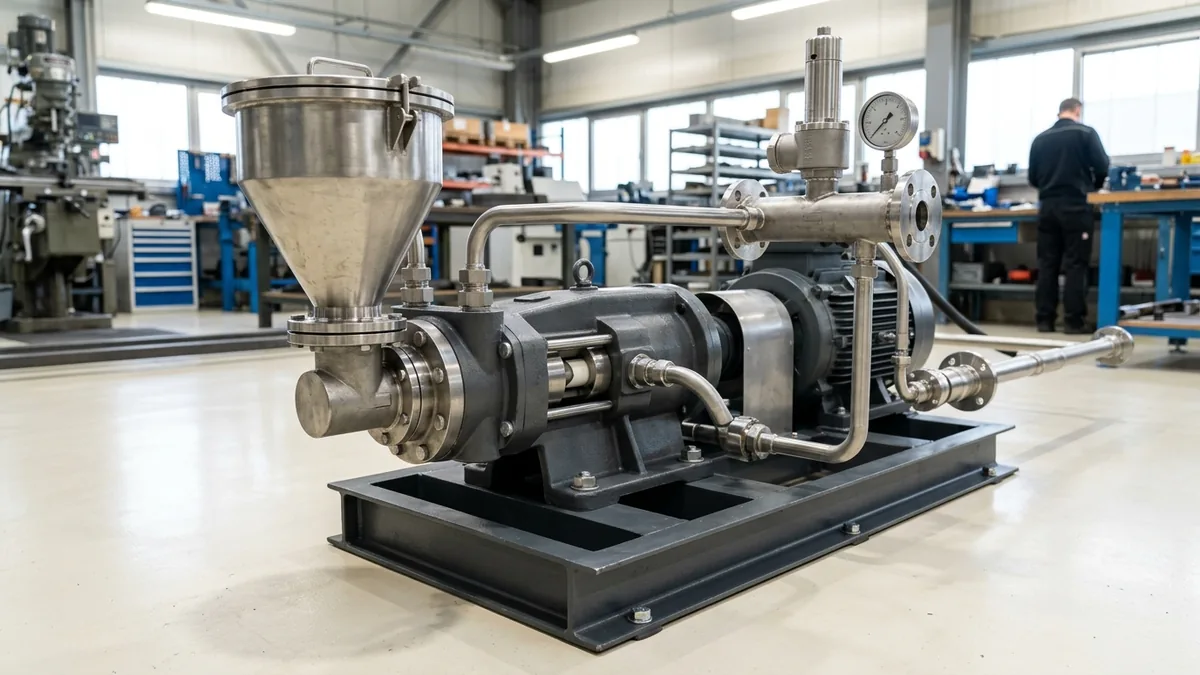
Chemical Injection & Precision Dosing Equipment Engineering Guide: Morbi & Rajkot Industrial Clusters
A definitive technical equipment selection manual, precision chemical injection engineering standard, and rotating machinery procurement guide for plant maintenance engineers, process managers, and technical heads across Morbi Ceramic Zone, Rajkot Engineering Hub, Shapar-Veraval, and Metoda GIDC.
Quick Answer
In the industrial manufacturing powerhouse of Saurashtra—centered in the Morbi ceramic cluster (producing over 70% of India's ceramic tiles and sanitaryware) and the Rajkot engineering, foundry, and diesel engine belt—continuous chemical injection and controlled volume metering are essential for process control. Chemical applications include precision injection of sodium silicate and polycarboxylate deflocculants into ceramic slip ball mills, acid and biocide metering into industrial reverse osmosis (RO) cooling towers, liquid pigment injection into tile glaze lines, and chemical resin dosing in foundry core shops. Utilizing standard continuous transfer pumps for precision injection creates volumetric drift, over-dosing, and severe chemical corrosion. To achieve strict process consistency and total fluid containment, plant engineers must procure API 675 conforming controlled-volume positive displacement chemical injection pumps, hydraulic and mechanical PTFE diaphragm dosing skids, and solid PVDF/PTFE liquid heads conforming to API 675, ISO 5199, and IS 5120 standards. When selecting a Gujarat chemical injection pump manufacturer, technical teams must evaluate steady-state dosing accuracy (≤ ± 1.0%), linear turndown ratios (10:1 to 100:1), hydraulically balanced multi-layer PTFE diaphragms with rupture detection, precision ceramic ball check valves, and rapid localized calibration and spares support.
Key Takeaways
- Enforce API 675 Compliance for Controlled Volume Dosing. Controlled-volume reciprocating pumps provide linear flow control and ± 1.0% steady-state dosing accuracy.
- Select Multi-Layer PTFE Diaphragms for Zero Chemical Leakage. Mechanically actuated and hydraulically balanced PTFE diaphragms eliminate dynamic packing seals.
- Match Liquid End Metallurgy to Chemical Aggressiveness. Use solid PTFE/PVDF for mineral acids and biocides; use SS316L or Hastelloy C-276 for high-pressure solvent resins.
- Integrate Backpressure and Pressure Relief Safety Valves. Proper system piping design prevents fluid siphoning and protects dosing heads from overpressure.
Introduction
In the major industrial clusters of Saurashtra—centered in Morbi, Rajkot, Wankaner, Shapar-Veraval, and Metoda GIDC—hundreds of large-scale ceramic tile manufacturing units, sanitaryware plants, foundries, and precision engineering workshops require continuous, micro-controlled chemical addition.
Plant maintenance engineers, chemical batch managers, and procurement heads face severe recurring hurdles:
- The Volumetric Inaccuracy Dilemma: Using basic centrifugal or low-cost peristaltic pumps for chemical dosing leads to severe flow rate fluctuations (± 15% - 25%) as discharge pressure varies, resulting in batch inconsistency, excessive chemical waste, and ceramic slip rheology failure.
- The Aggressive Chemical Corrosion Challenge: Dosing concentrated acids (98% H_2SO_4, 33% HCl), sodium hypochlorite, and abrasive deflocculants causes rapid diaphragm rupture, ball valve seat scoring, and chemical leakage on factory floors.
- The Engineering Standard: Procuring precision controlled-volume positive displacement chemical injection pumps conforming to API 675, ISO 5199, IS 5120, and IS 1520 standards—featuring linear micrometer stroke adjusters (± 1.0% steady-state accuracy), solid PTFE/PVDF heads, double ceramic check valves, and dynamic pressure relief systems—ensures exact chemical stoichiometry, lowers operational chemical consumption, and extends equipment service life beyond 35,000 hours.
2. Master Chemical Injection Pump Architecture & Head Selection Matrix
Review the operational parameters and design suitability for industrial chemical injection pumps:
| Injection Pump Head Technology | Maximum Operating Pressure | Flow Range & Turndown | Chemical Compatibility | Primary Application in Morbi / Rajkot |
|---|---|---|---|---|
| Mechanically Actuated PTFE Diaphragm | 10.0 bar | 0.5 - 500 L/hr (10:1) | Universal (0 - 14 pH); Acids / Biocides | Water Treatment, ETP Coagulant, Glaze Dosing |
| Hydraulically Balanced PTFE Diaphragm | 100.0 bar | 1.0 - 2,500 L/hr (100:1) | Universal; Abrasive Slurries & High Pressure | High-Pressure Deflocculant, Boiler Feed |
| Packed Plunger Reciprocating Pump | 350.0 bar | 5.0 - 5,000 L/hr (10:1) | Clean Solvents, Resins, Non-Crystallizing | Foundry Resin Injection, High-Pressure Chemical Feed |
| Solid PVDF (Kynar) Liquid End | 16.0 bar | 0.2 - 800 L/hr (10:1) | Concentrated HCl, HNO_3, Chlorine | Acid Dosing, Bleach Injection, RO Treatment |
| Austenitic SS316L / Hastelloy C-276 Head | 250.0 bar | 1.0 - 3,000 L/hr (20:1) | Organic Solvents, Alkaline Resins, Polymers | Foundry Core Binders, High-Temp Additives |
3. The Kinematic Fluid Mechanics & Precision Dosing Physics of API 675 Pumps
Reciprocating Plunger & Diaphragm Kinematics (Q = A · L · N · \eta_vol)
Controlled-volume positive displacement pumps deliver a fixed volume of liquid per reciprocating stroke:
Interactive Engineering Hydraulic Sizer
Live ISO 5199 / API 610 Dynamic Engine- Volumetric Efficiency (\eta_vol): High-precision API 675 dosing pumps achieve volumetric efficiencies of 92% - 97% by utilizing zero-clearance hydraulic chambers and spring-loaded double ball check valves.
- Linear Stroke Adjustment: Adjusting the effective eccentric stroke length (L_stroke) via a precision micrometer dial alters flow delivery with high linearity (± 1.0% of setpoint from 10% to 100% stroke capacity). This linear relationship allows plant operators in Morbi and Rajkot to calibrate automated electronic dosing without complex multi-variable correction curves.
Hydraulic Diaphragm Pressure Balancing & Rupture Mechanics
- Balanced Hydraulic Pressure: In mechanically actuated diaphragms, localized stress concentrates at the central connecting shaft. In hydraulically actuated diaphragm pumps, hydraulic oil behind the PTFE membrane exerts equal hydraulic pressure across the entire diaphragm surface:
- Elimination of Stress Fatigue: Equalized pressure prevents mechanical stretching, extending diaphragm operating life beyond 20,000 continuous hours while easily handling discharge pressures up to 100.0 bar. Integrated internal hydraulic relief valves bypass fluid automatically if discharge piping becomes blocked.
Inertial Acceleration Head Losses in Pulsating Suction Piping
Because positive displacement pumps accelerate and decelerate fluid during each stroke cycle, suction piping experiences cyclical inertial pressure drops:
- Cavitation Prevention Rule: The available net positive inlet pressure (NPIPa) must exceed the pump required inlet pressure (NPIPr) plus the acceleration head loss:
- Suction Dampener Engineering: Installing an elastomeric pulsation dampener close to the pump suction nozzle cuts h_a by up to 85%, eliminating suction cavitation when dosing viscous deflocculants. In high-volume ceramic tile manufacturing operations across Morbi, suction dampeners prevent liquid separation and maintain full volumetric chamber filling on high-speed stroke cycles.
Ceramic Ball Check Valve Tribology & Seating Hydrodynamics
- Direct-Seating Mechanics: Positive displacement dosing relies entirely on gravity-assisted or spring-loaded suction and discharge check valves. When the diaphragm retracts on the suction stroke, the discharge ball seats instantly, preventing backflow.
- Ultra-Hard Ceramic Spheres: High-purity Alumina Ceramic (99.5% Al_2O_3, 2000 HV) or Monolithic Silicon Carbide (SSiC, 2800 HV) check balls resist abrasive particulate scoring from ceramic slip slurries and suspended grit, preserving precise dosing accuracy over millions of continuous stroke cycles. Dual ball arrangements provide redundant sealing security against particulate entrapment.
4. The 4 Critical Industrial Applications Across Morbi & Rajkot Manufacturing
Application 1: Ceramic Slip Ball Mill Deflocculant & Dispersant Dosing (Morbi)
- Operating Demand: Continuous injection of concentrated liquid sodium silicate and polycarboxylate ether deflocculants (150 - 450 L/hr, 4.0 bar, viscosity 80 - 250 cP) into continuous ball mills across Morbi tile plants.
- Engineering Solution: Solid PTFE or PVDF diaphragm dosing pump with motorized stroke actuator (4-20 mA PLC interface) and double ceramic ball valves. Precise dosing controls slip viscosity (1.65 - 1.72 g/cm³), optimizing spray dryer fuel consumption and preventing ceramic slurry settling in storage agitation tanks.
Application 2: Automated Glaze Line Stain & Liquid Colorant Injection (Morbi)
- Operating Demand: Micro-metering of concentrated mineral color stains into ceramic glaze recirculating lines (0.5 - 25 L/hr, 3.0 bar) with zero color shade variation across production shifts.
- Engineering Solution: Solid virgin PTFE dosing head with stepper-motor driven linear stroke mechanism providing ± 0.5% flow repeatability and rapid digital recipe changeovers.
Application 3: Industrial RO & Cooling Tower Antiscalant / Biocide Metering (Rajkot)
- Operating Demand: Dosing concentrated antiscalants, sulfuric acid, and sodium hypochlorite into industrial RO membrane feed lines in Rajkot engineering plants.
- Engineering Solution: Compact PVDF diaphragm chemical injection pump with integrated foot valve, injection quill with non-return check, and PVDF tubing.
Application 4: Foundry Sand Binder & Chemical Hardener Injection (Rajkot / Shapar)
- Operating Demand: High-pressure precision injection of furan resins, p-toluene sulfonic acid (PTSA), and phenolic binders into continuous sand mixers across Rajkot foundries.
- Engineering Solution: Austenitic SS316L or Hastelloy C-276 plunger dosing pump with hardened ceramic plungers and PTFE chevron packing.
5. Sanitary Materials of Construction & Cleanroom Standards
Solid Virgin PTFE & Precision Compression-Molded PVDF Liquid Ends
- Casing Metallurgy / Polymers: Precision CNC-machined solid virgin PTFE blocks or high-density compression-molded PVDF (Kynar 740) liquid ends providing universal chemical resistance (0 - 14 pH) across aggressive mineral acids and ceramic deflocculants.
- Hydrostatic Quality Assurance: Every machined polymer head undergoes 30-minute pressure proof testing to ensure zero micro-porosity and structural dimensional stability under continuous pressure.
Austenitic SS316L, Alloy 20 & Hastelloy C-276 Dosing Heads
- High-Alloy Materials: Forged SS316L (1.4404) and cast Hastelloy C-276 (CW12MW) liquid ends rated for continuous high-pressure injection duties up to 250.0 bar in chemical synthesis and foundry applications.
High-Purity Alumina Ceramic & Monolithic SSiC Valve Balls
- Check Valve Metallurgy: Grade 25 precision-ground 99.5% Al_2O_3 ceramic and direct-sintered Silicon Carbide (SSiC) valve balls seated against precision-lapped PTFE or PVDF seats, providing bubble-tight shutoff.
Multi-Layer PTFE Diaphragm Membranes with Rupture Sensors
- Diaphragm Engineering: Dual-layer virgin PTFE composite membranes bonded to an EPDM elastomer backing. An integrated optical or pressure-switch sensor detects outer layer micro-fissures, alerting operators before process liquid can enter the pump drive.
6. Step-by-Step Chemical Injection Skid Sizing & Calibration SOPs
Execute these structured engineering SOPs when specifying chemical injection equipment:
Phase 1: Chemical Flow Range & Turndown Ratio Audit SOP
- Flow Profile: Establish minimum (Q_min), normal (Q_norm), and maximum (Q_max) chemical dosing rates.
- Turndown Verification: Ensure the required operating flow range falls between 15% and 90% of the pump's rated stroke capacity to maintain ± 1.0% linearity. For duties requiring wider flow turndown beyond 10:1, configure variable speed drive (VFD) electronic frequency control in combination with mechanical stroke adjustment.
Phase 2: Total Dynamic Pressure & Acceleration Head Sizing SOP
- Pressure Sizing: Calculate process line static pressure (P_line), discharge piping friction loss (h_f), and backpressure valve setting (P_BPV ≥ 1.5 bar).
- Total Dynamic Discharge Pressure:
Phase 3: Net Positive Inlet Pressure Required (NPIPa) Audit SOP
- Inlet Pressure Calculation: Factor in supply tank liquid level, fluid vapor pressure, suction pipe length (L_s ≤ 2.0 m), and acceleration head loss (h_a).
- Safety Margin: Confirm NPIPa ≥ NPIPr + 0.6 meters across all operating temperatures.
Phase 4: Liquid End Metallurgy & Valve Seat Selection SOP
- Metallurgy Selection Matrix:
- For Inorganic Acids / Biocides: Solid PTFE / PVDF with Ceramic Valve Balls. - For Ceramic Deflocculant Slurries: Solid PTFE Head with SSiC Check Valves. - For High-Pressure Resins / Solvents: SS316L / Hastelloy C-276 Plunger Head.
Phase 5: Stroke Length & VFD Automation Interface Layout SOP
- Automation Interface: Integrate electronic linear stroke actuators with standard 4 - 20 mA DC process signals or Modbus RS-485 for direct PLC synchronization with plant production lines.
Phase 6: Factory 3-Point Linearity & Hydrostatic Proof Test SOP
- Calibration Protocol: Calibrate dosing flow rate at 25%, 50%, 75%, and 100% stroke settings on an automated test bench. Hydrostatically test the liquid head to 1.5× rated pressure (15.0 - 150.0 bar) for 30 minutes with water. Calibration certificates verify steady-state accuracy across all operating ranges.
7. Worked Saurashtra Industrial Chemical Injection Case Studies
Case 1: Morbi Ceramic Vitrified Tile Slip Deflocculant Dosing Skid Retrofit
- Plant Context: A large vitrified tile manufacturing plant on National Highway 8A in Morbi operating 4 continuous ball mills (40 MT/hr slip output).
- Problem: Centrifugal dosing pumps suffered rapid valve seat erosion and erratic flow, causing fluctuating slip viscosity (1.62 - 1.78 g/cm³) and increasing spray dryer fuel consumption by 12%.
- Action Plan: Installed Teflow API 675 solid PTFE diaphragm chemical injection pumps with motorized stroke actuators and double ceramic ball check valves linked to the plant DCS.
- Outcome: Slip viscosity stabilized within ± 0.01 g/cm³; saved Rs 9,20,000 in annual spray dryer natural gas costs; zero diaphragm failure across 24 consecutive operating months.
Case 2: Wankaner Ceramic Sanitaryware Glaze Stain Metering Pump Upgrade
- Plant Context: A premium sanitaryware facility in Wankaner injecting cobalt blue and black glaze stains (12 L/hr, 3.5 bar).
- Problem: Peristaltic tube pumps suffered frequent tubing fatigue ruptures every 2 weeks, resulting in costly glaze contamination.
- Action Plan: Replaced units with Teflow precision PTFE micro-dosing pumps with ceramic check valves.
- Outcome: Zero glaze batch contamination; continuous leak-free injection across 22 consecutive operating months.
Case 3: Rajkot Engineering Foundry Sand Resin Chemical Hardener Overhaul
- Plant Context: An automotive ductile iron foundry in Rajkot operating continuous sand mixers for no-bake mold production.
- Problem: Standard gear pumps suffered severe shaft seal leakage when pumping furan resin and acid catalysts.
- Action Plan: Installed Teflow SS316L hydraulically actuated diaphragm injection pumps with Hastelloy C-276 check valves.
- Outcome: Chemical leaks eliminated 100%; saved Rs 4,50,000 in annual resin waste over 20 consecutive operating months.
Case 4: Shapar-Veraval Industrial Estate RO Plant Acid Dosing Conversion
- Plant Context: An industrial components manufacturing complex in Shapar-Veraval dosing concentrated hydrochloric acid (33% HCl) into an RO pretreatment plant.
- Problem: Cheap plastic dosing pumps leaked acid fumes, corroding surrounding electrical panels and cable trays.
- Action Plan: Installed Teflow solid PVDF chemical dosing pumps with integrated dual-diaphragm rupture detection and PTFE discharge quills.
- Outcome: 100% fume containment; continuous maintenance-free operation across 26 consecutive operating months.
Case 5: Metoda GIDC Electroplating Passivation Chemical Metering Upgrade
- Plant Context: A zinc-nickel electroplating facility in Metoda GIDC injecting trivalent chromium passivation chemistry.
- Problem: Volumetric drift in old plunger pumps caused inconsistent passivation layer thickness and customer rejections.
- Action Plan: Upgraded to Teflow API 675 mechanically actuated PTFE diaphragm pumps with micrometer stroke control and integrated pulse dampeners.
- Outcome: Passivation layer thickness uniformity improved by 35%; zero quality rejections across 24 consecutive operating months; saved Rs 3,80,000 in chemical consumption.
Case 6: Morbi Ceramic Waste Water ETP Coagulant Dosing Standardization
- Plant Context: A common effluent treatment plant serving ceramic units in Morbi dosing polyaluminum chloride (PAC) and polymer flocculant.
- Problem: Dosing pumps clogged frequently due to chemical crystallization on check valve seats.
- Action Plan: Standardized on Teflow heavy-duty PP diaphragm dosing skids with double ceramic ball check valves and automated water flush cycles.
- Outcome: Valve clogging eliminated 100%; continuous operation across 28 consecutive operating months; ensured full GPCB environmental compliance.
8. Step-by-Step Chemical Injection Pump Selection Flowchart
Follow this structured engineering guide when selecting chemical injection equipment:
| Chemical Process Application | Flow Rate & Line Pressure | Recommended Pump Architecture & Metallurgy |
|---|---|---|
| Ceramic Slip Deflocculant Dosing | 50 - 500 L/hr; 3 - 6 bar | Solid PTFE Diaphragm (API 675) + SSiC Check Valves |
| Glaze Line Color Stain Micro-Metering | 0.5 - 30 L/hr; 2 - 4 bar | Solid PTFE Micro-Dosing Head + Stepper Motor Actuator |
| Concentrated Acid / Bleach Dosing (RO/ETP) | 1.0 - 150 L/hr; 4 - 10 bar | Solid Pure PVDF Head + Dual Ceramic Ball Valves |
| High-Pressure Foundry Resin Injection | 10 - 500 L/hr; 10 - 50 bar | Hydraulic Diaphragm / Plunger (SS316L / Hastelloy) |
| Water Treatment Antiscalant Dosing | 0.2 - 50 L/hr; 2 - 8 bar | Compact PVDF Diaphragm Pump + Integrated Injection Quill |
| High-Viscosity Polymer Flocculant Dosing | 100 - 1,000 L/hr; 5 - 15 bar | Hydraulic PTFE Diaphragm + Spring-Loaded Ball Valves |
9. Comprehensive Master Chemical Injection Skid Factory Acceptance (FAT) Checklist
Execute this quality verification protocol prior to chemical injection equipment dispatch and plant commissioning:
Chemical Injection & Dosing Equipment FAT Protocol
10. Summary & Local Chemical Injection Engineering Support in Gujarat
Eliminating chemical dosing inaccuracies, preventing hazardous acid leaks, standardizing on API 675 conforming positive displacement diaphragm pumps, and extending equipment service life beyond 35,000 hours across Morbi Ceramic Zone, Rajkot Engineering Hub, Wankaner, and Shapar-Veraval—by utilizing precision solid PTFE liquid ends, pure PVDF, double ceramic ball check valves, and hydraulically balanced multi-layer diaphragms—is the proven engineering standard for modern manufacturing reliability.
Partnering directly with an established Gujarat rotating machinery manufacturer provides industrial plants with immediate technical access to precision chemical skid engineering, computerized flow calibration, custom VFD automation interfacing, and genuine non-metallic spares. Our dedicated Saurashtra field service engineers provide on-site calibration verification and prompt emergency maintenance support.
Teflow Pumps operates a specialized chemical rotating machinery manufacturing facility in Ahmedabad, providing engineered API 675 chemical injection pumps, motorized dosing skids, solid PTFE/PVDF process pumps, precision ceramic check valves, dynamic balancing, and genuine rotating equipment spares across Gujarat conforming to API 675, ISO 5199, ISO 2858, and IS 5120 standards.
- Direct Technical & Emergency Helpline: +91 98251 62709
- WhatsApp Technical Desk: Share your chemical name, dosing flow rate (L/hr), line pressure (bar), fluid viscosity (cP), or pump model to wa.me/919825162709 for immediate engineering diagnostics, material selection evaluation, and formal quotation.
- Request an On-Site Dosing Skid Sourcing Audit: Contact our senior rotating equipment engineers for plant pump surveys, material compatibility audits, and formal quotation.