
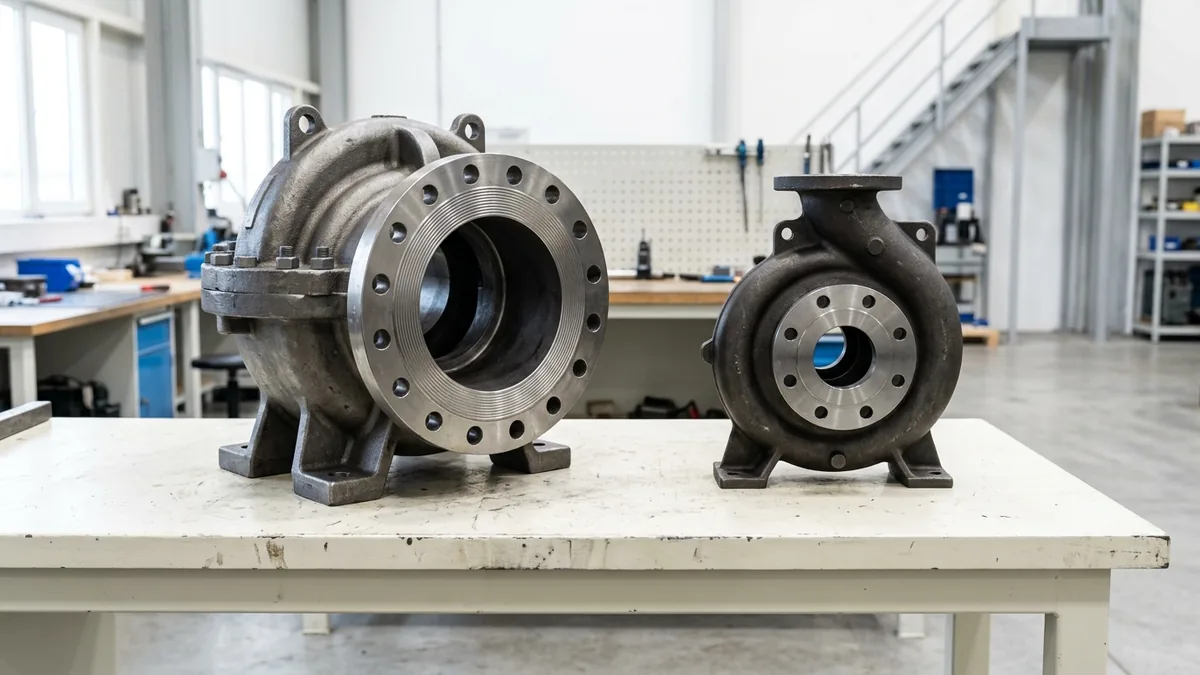
API Pumps vs Non-API Process Pumps: When Indian Industrial Plants Must Comply
A comprehensive rotating equipment standard comparison manual, statutory safety regulatory audit, and lifecycle engineering guide for procurement engineers, plant safety heads, and rotating equipment specialists across Dahej PCPIR, Jamnagar, Vadodara, Hazira, and India.
Quick Answer
In the dynamic chemical processing zones, continuous petroleum refining hubs, and bulk petrochemical complexes of Gujarat and India—stretching from Dahej PCPIR and Jamnagar to Hazira, Vadodara, and Mumbai—process engineers and procurement teams face a critical equipment selection decision: when is it mandatory to specify a heavy-duty API 610 / API 685 process pump, and when is an ISO 5199 / ISO 2858 / IS 5120 chemical process pump the technically and commercially optimal solution? While API pumps carry a 2.5× to 3.5× capital cost premium over standard chemical process pumps, Indian statutory safety guidelines—including Oil Industry Safety Directorate (OISD) rules, Petroleum and Explosives Safety Organization (PESO) regulations, and the Factories Act 1948—enforce mandatory API compliance whenever handling flammable hydrocarbons with flash points below 65°C, operating temperatures exceeding 150°C or below -4°C, discharge pressures exceeding 20 bar (2.0 MPa), or toxic, auto-igniting chemicals. For general chemical duties, non-flammable mineral acids (98% H_2SO_4, 33% HCl), alkalis, and utility water systems, precision ISO 5199 PFA-lined or stainless steel pumps deliver total fluid containment and ISO 2858 drop-in interchangeability at a fraction of the lifecycle cost.
Key Takeaways
- Understand the Mandatory Statutory Compliance Triggers. Specify API 610 when handling Class A/B hydrocarbons (T_flash < 65°C), T > 150°C, or P > 20 bar.
- Evaluate Centerline vs Foot Mounting Mechanics. API centerline mounts eliminate thermal shaft misalignment under high operating temperatures.
- Compare Allowable Nozzle Load Capacities. API casings withstand approximately 3.0× higher piping forces and moments than ISO 5199 casings.
- Calculate 20-Year Total Cost of Ownership (TCO). Balance API capital expenditure against catastrophic seal failure risk in hazardous refinery zones.
Introduction
In India's major industrial manufacturing sectors—ranging from petroleum refining complexes in Jamnagar and petrochemical corridors in Dahej PCPIR to chemical processing zones in Hazira, Vadodara, Ankleshwar, and Mumbai—fluid transfer operations involve varying degrees of operational risk.
Procurement directors, technical heads, and plant reliability engineers constantly navigate a complex engineering dilemma:
- The Capital Cost Challenge: An API 610 centrifugal process pump (such as Type OH2, BB2, or BB3) with full API 682 seal systems and Annex D baseplates costs approximately 250% to 350% more than a corresponding heavy-duty ISO 5199 / ISO 2858 chemical process pump.
- The Regulatory and Safety Imperative: Installing a standard chemical pump in a hazardous hydrocarbon processing block violates Indian statutory safety codes. A single mechanical seal rupture or casing fracture involving high-pressure light hydrocarbons can result in catastrophic vapor cloud fires, plant shutdowns, and massive regulatory penalties.
- The Engineering Standard: Making the correct selection between API 610 / API 685 (for heavy hydrocarbon and extreme thermal/pressure services) and ISO 5199 / ISO 2858 / IS 5120 (for aggressive acids, alkalis, solvents, and general industrial duties) ensures total safety compliance, maximum MTBF, and lowest 20-year total lifecycle cost.
2. Master 10-Point Technical Comparison Matrix: API vs Non-API (ISO 5199)
Review the 10 core mechanical, structural, and operational differences between API 610 and ISO 5199 pumps:
| Technical Parameter / Feature | API 610 Process Pumps (12th Edition) | ISO 5199 / ISO 2858 Chemical Pumps | Practical Plant & Safety Impact |
|---|---|---|---|
| 1. Casing Mounting Architecture | Centerline-mounted (OH2, BB2) | Foot-mounted (ISO 2858) | Centerline absorbs thermal growth up to 400°C |
| 2. Design Pressure & MAWP | Minimum 40 bar (or up to 100+ bar) | Nominal 16 bar (PN16 rating) | API handles high-pressure refinery headers |
| 3. Temperature Operating Limit | -80°C to +400°C | -40°C to +200°C | API required for hot oil, asphalt, and cryogenic LNG |
| 4. Casing Corrosion Allowance | Minimum 3.0 mm (carbon steel) | Minimum 1.5 mm (metallic) | API provides extended casing pressure lifespan |
| 5. Allowable Nozzle Loads | High (3.0× ISO 5199 Table 2 values) | Standard ISO 5199 Table 2 values | API absorbs massive thermal piping stresses |
| 6. Bearing L10h Minimum Life | ≥ 25,000 operating hours | ≥ 17,500 operating hours | API ensures > 3 years continuous run-time |
| 7. Bearing Housing Ingress | Mandatory IP66 Labyrinth Isolators | Lip seals or optional isolators | API prevents oil contamination in dusty plants |
| 8. Mechanical Seal Cavity | API 682 4th Ed Enlarged Cartridge | ISO 3069 / Standard Seal Chamber | API accommodates dual pressurized seal plans |
| 9. Shaft Deflection Limit | ≤ 0.05 mm across full envelope | ≤ 0.05 mm at nominal duty | Both standards protect seal faces from angular whip |
| 10. Capital Cost (CAPEX) | High (2.5× - 3.5× base cost) | Moderate (1.0× base cost) | ISO 5199 delivers optimal ROI for chemical acids |
Interactive 5-Year Total Cost of Ownership (TCO) Simulator
Sealless Mag-Drive vs Mechanically Sealed Chemical Pump3. Statutory Indian Regulations & Mandatory Compliance Thresholds
OISD Guidelines (Safety in Refineries & Petrochemicals)
The Oil Industry Safety Directorate (OISD) regulates rotating equipment across Indian oil, gas, and petrochemical complexes:
- OISD Mandate: Rotating equipment transferring Class A and Class B petroleum products within refinery battery limits, gas processing plants, and cross-country pipeline terminals must conform strictly to API 610 and API 682 standards.
- Safety Isolation: Pumps in continuous hydrocarbon service must feature centerline mounting, dual mechanical seals with barrier fluid containment (API Plan 52, 53B, or 54), and fire-safe construction.
PESO & Petroleum Rules 2002 (Class A, B, C Flammability Limits)
The Petroleum and Explosives Safety Organization (PESO) classifies liquid hazards by flash point (T_flash):
- Class A Petroleum (T_flash < 23°C): Gasoline, light naphtha, pentane, hexane, crude condensates. API 610 / API 685 pumps mandatory.
- Class B Petroleum (23°C ≤ T_flash < 65°C): Kerosene, diesel, mineral turpentine, xylene, toluene. API 610 mandatory within process blocks; ISO 5199 permitted in non-critical offsite loading with flameproof motors.
- Class C Petroleum (65°C ≤ T_flash < 93°C): Fuel oil, heavy gas oil, lubricating oils (T < 100°C). ISO 5199 / IS 5120 standard process pumps acceptable.
Thermodynamic Boundaries (T> 150°C, P> 20 bar, NPSH_a ≤ 1.5 m)
Even for non-hydrocarbon chemicals, operating conditions dictate pump architecture:
- Temperature Threshold: When operating temperature exceeds 150°C, foot-mounted ISO 2858 pumps experience severe thermal growth and shaft misalignment. Centerline-mounted API 610 pumps are required.
- Pressure Threshold: When discharge pressure exceeds 20 bar (2.0 MPa), standard PN16 ISO 2858 casings are structurally insufficient. API 610 (rated to 40 bar minimum) is required.
Factories Act 1948 & Environmental Protection Act VOC Mandates
- Toxic & Carcinogenic Chemicals: Under the Factories Act 1948 and Central Pollution Control Board (CPCB) VOC fugitive emission standards, transferring benzene, phenol, phosgene, or ethylene oxide requires sealless magnetic drive pumps conforming to API 685 or ISO 15783 with secondary pressure containment shells.
4. Mechanical Physics, Structural Differences & Engineering Math
Centerline Mounting vs Foot Mounting Thermal Growth Math (y_thermal = α· L · ΔT)
Thermal expansion causes upward shaft centerline displacement:
Where:
- α is the coefficient of thermal expansion (12 × 10^-6 K⁻¹ for steel).
- h_1 is the foot height to shaft center (200 mm).
- At T_operating = 250°C and T_ambient = 30°C (ΔT = 220°C):
- Foot-Mounted Distortion: In foot-mounted ISO 2858 pumps, 0.528 mm of vertical offset destroys flexible couplings and induces severe 1X and 2X vibration.
- Centerline-Mounted Symmetry: In API 610 Type OH2 pumps, casing support feet are positioned at the exact horizontal centerline of the shaft. Thermal growth expands symmetrically upward and downward, maintaining shaft centerline alignment within < 0.02 mm.
Casing Pressure Containment & Wall Thickness Calculations (1.5× MAWP Proof)
API 610 enforces heavy casing wall thickness (t) designed with high safety factors:
- API 610: Minimum corrosion allowance C_corrosion = 3.0 mm for carbon steel, with minimum test pressure 1.5× MAWP.
- ISO 5199: Minimum corrosion allowance C_corrosion = 1.5 mm, rated for PN16 pressure proofing (24 bar).
Nozzle Load Absorption & Bending Moment Vector Math
API 610 casings feature reinforced structural gussets designed to absorb 3.0× higher nozzle forces (F_res) and bending moments (M_res) than standard ISO 5199 casings without distorting internal wear ring clearances (< 0.025 mm deflection).
Shaft Stiffness Ratio (L³ / D⁴) & Seal Deflection Limits (≤ 0.05 mm)
Both API 610 and ISO 5199 strictly contain dynamic shaft deflection at the seal faces:
- Heavy Power Frame Engineering: Large-diameter shafts under the sleeve (D) paired with minimal overhang length (L) prevent angular face distortion and dry running.
Bearing Housing L10h Life Calculations (≥ 25,000 hr vs 17,500 hr)
API 610 requires radial and thrust bearing arrangements (back-to-back 40^° angular contact bearings) providing minimum basic rating life:
5. The 4 Costly Mistakes in Pump Selection for Indian Plants
Mistake 1: Over-Specifying API 610 on Non-Hazardous Acid Headers (CAPEX Trap)
- Problem: Specifying an expensive API 610 metallic pump with Hastelloy trim for a room-temperature 70% H_2SO_4 or 33% HCl transfer header.
- Financial Consequence: Paying Rs 22,00,000 for an exotic alloy API pump that still suffers acid pitting, when an ISO 5199 PFA-lined armored pump costing Rs 6,50,000 delivers 100% chemical corrosion resistance.
- Solution: Use ISO 5199 fluoropolymer-lined pumps for non-flammable corrosive mineral acids.
Mistake 2: Under-Specifying ISO 5199 on Hot Hydrocarbon Services (Safety Trap)
- Problem: Purchasing a foot-mounted ISO 2858 chemical pump for hot vacuum gas oil or diesel transfer (T = 180°C).
- Safety Consequence: Thermal growth destroys couplings; mechanical seal faces open, releasing flammable hydrocarbons that ignite on hot pump surfaces.
- Solution: Enforce mandatory API 610 Type OH2 centerline-mounted pumps whenever T > 150°C or T_flash < 65°C.
Mistake 3: Overlooking API 682 Mechanical Seal Piping Plan Requirements
- Problem: Procuring an API 610 pump without engineered seal flush piping (e.g., API Plan 11, Plan 23, or Plan 53B).
- Consequence: Mechanical seal faces overheat and fail within 72 hours of commissioning.
- Solution: Specify fully integrated API 682 seal auxiliary support skids with thermowells and pressure transmitters.
Mistake 4: Mismatching Baseplate Rigidity with Plant Piping Moments
- Problem: Mounting process pumps on lightweight, non-grouted channel baseplates in high-vibration piping loops.
- Consequence: Baseplate twists under piping expansion, causing chronic misalignment.
- Solution: Specify API 610 Annex D structural steel baseplates with full cementitious grouting.
6. Materials of Construction, Metallurgy & Fluoropolymer Liners
API Material Classes (S-1, S-6, C-6, A-8, D-1, D-2)
- S-1 Class: Carbon steel casing with cast iron trim for non-corrosive hydrocarbons.
- S-6 Class: Carbon steel casing with 12% Cr martensitic stainless steel trim for sour hydrocarbons.
- C-6 Class: 12% Cr stainless steel casing and trim for high-temperature boiler feed water.
- A-8 Class: Austenitic SS316 / SS316L for corrosive process fluids.
- D-1 & D-2 Classes: Duplex SS (UNS S31803) and Super Duplex (UNS S32750) for high-chloride crude and sea-water injection.
ISO 5199 PFA-Lined Armored Ductile Iron & Solid PTFE Casings
- Armored Fluoropolymer Pumps: 100% virgin isostatic solid PTFE or high-density transfer-molded PFA lined ductile iron armored pumps (4.5 - 6.0 mm wall thickness) conforming to ISO 2858 dimensions for complete chemical corrosion resistance across 0 - 14 pH up to 200°C.
SS316L, Hastelloy C-276 & Duplex SS (UNS S31803) Alloys
- Metallic Process Pumps: Precision investment-cast SS316L, Hastelloy C-276, or Duplex SS (UNS S31803) wet ends dynamically balanced to ISO 5199 Grade G2.5 for high-temperature solvents and high-pressure chemical transfer.
Monolithic Direct-Sintered Silicon Carbide (SSiC) Seals
- API 682 Cartridge Mechanical Seals: Pre-set cartridge single or double mechanical seals featuring monolithic direct-sintered SSiC vs SSiC faces with Kalrez (FFKM) secondary elastomers.
7. Step-by-Step API vs Non-API Engineering Evaluation SOPs
Execute these structured engineering SOPs when evaluating rotating equipment for new projects or plant revamps:
Phase 1: Process Fluid Hazard & Thermodynamic Screening SOP
- Fluid Hazard Audit: Record fluid flash point (T_flash), auto-ignition temperature, boiling point, toxicity (LD50), and corrosivity (0 - 14 pH).
- Operating Envelopes: Record operating temperature (T), suction pressure (P_s), discharge pressure (P_d), and differential head (H).
Phase 2: Statutory Indian Regulatory & OISD / PESO Audit SOP
- Regulatory Classification: Check if fluid is Class A/B Petroleum under PESO rules or located within refinery battery limits governed by OISD guidelines.
- Compliance Path: If Class A/B, T > 150°C, or P > 20 bar, designate API 610 (Mandatory). If non-flammable chemical acid or alkali, designate ISO 5199 / ISO 2858.
Phase 3: Nozzle Load & Thermal Growth Stress Calculation SOP
- Thermal Growth Calculation: Calculate shaft centerline expansion (y_thermal). If > 0.15 mm, enforce centerline mounting (API 610 Type OH2).
- Nozzle Stress Audit: Verify piping stress analysis; confirm resultant forces and moments comply with casing rating.
Phase 4: Mechanical Seal API 682 Piping Plan Selection SOP
- Seal Selection: Select API 682 Category 2 or 3 cartridge seal with appropriate flush arrangement (Plan 11, Plan 23, Plan 52, Plan 53B, or Plan 54).
Phase 5: Dynamic Rotor Balancing to ISO 5199 Grade G2.5 SOP
- Dynamic Balancing Run: Dynamically balance impeller and shaft rotor to ISO 5199 Grade G2.5 (< 1.0 g\cdotmm/kg) on dual-plane balancing machine.
Phase 6: Extended Hydrostatic Pressure Proof (1.5× MAWP) FAT SOP
- Hydrostatic Proof: Pressurize casing to 1.5× MAWP for at least 30 minutes (60 minutes for high alloys); verify zero leakage.
- Performance FAT Run: Conduct full-load performance test; verify delivered head, flow, and efficiency match nameplate curve within ± 2%, and vibration is < 1.8 mm/s RMS (ISO 5199 Zone A).
8. Worked Indian Refinery, Petrochemical & Chemical Complex Case Studies
Case 1: Dahej PCPIR Petrochemical Plant Hydrocarbon Compliance Review
- Plant Context: A continuous petrochemical unit in Dahej PCPIR transferring hot mixed xylenes (165°C, 14 bar, T_flash = 27°C).
- Problem: The EPC contractor initially proposed lower-cost foot-mounted chemical process pumps. An internal safety audit identified violation of OISD regulations and extreme thermal growth risk.
- Action Plan: Teflow engineering team supplied API 610 12th Edition Type OH2 centerline-mounted process pumps with S-6 metallurgy (12% Cr trim):
- Fitted with API 682 4th Edition dual pressurized cartridge seals (Plan 53B). - Annex D structural steel baseplates with full FEA lifting certification.
- Outcome: Zero thermal shaft misalignment; 100% statutory compliance with PESO and OISD codes; zero fugitive emissions across 26 operating months.
Case 2: Jamnagar Refinery Hot Naphtha Transfer Pump Specification Audit
- Plant Context: A refinery processing block in Jamnagar pumping light straight-run naphtha (45°C, 24 bar, T_flash < -20°C).
- Problem: High operating pressure (24 bar) exceeded standard PN16 chemical pump limits.
- Action Plan: Installed heavy-duty API 610 Type OH2 pumps with carbon steel casings proof-tested to 42 bar hydrostatic pressure.
- Outcome: Complete pressure containment; continuous leak-free operation over 36 consecutive operating months.
Case 3: Hazira Gas Processing LPG Condensate Booster Selection
- Plant Context: A gas fractionator in Hazira transferring liquefied petroleum gas (LPG) condensate (NPSH_a = 1.2 m, P = 32 bar).
- Problem: Extreme risk of cavitation and seal flashing on low NPSH light hydrocarbons.
- Action Plan: Engineered an API 610 Type VS6 vertical can multistage pump with specialized first-stage inducer and dual gas-lubricated containment seals (Plan 76).
- Outcome: Zero cavitation; reliable boosting across 24 consecutive operating months.
Case 4: Vadodara Chemical Complex Sulfuric Acid Transfer Modernization
- Plant Context: A bulk chemical manufacturer in Vadodara pumping 98% H_2SO_4 (40°C, 6 bar).
- Problem: Management considered purchasing expensive alloy API pumps (Rs 24,00,000 each).
- Action Plan: Teflow engineers demonstrated that for non-flammable sulfuric acid, Teflow ISO 2858 PFA-lined armored pumps (Rs 6,80,000) provided superior corrosion resistance and 100% drop-in interchangeability.
- Outcome: Saved over Rs 50,00,000 in plant CAPEX while achieving zero acid leaks over 24 operating months.
Case 5: Ankleshwar GIDC Chlorinated Solvent ISO 5199 Heavy-Shaft Upgrade
- Plant Context: A specialty pharmaceutical synthesis plant in Ankleshwar GIDC pumping dichloromethane (30°C, 5 bar).
- Problem: Thin-shaft commercial pumps suffered seal leakage every 60 days.
- Action Plan: Installed Teflow ISO 5199 SS316L process pumps with heavy shafts (y_deflect ≤ 0.025 mm) and direct-sintered SSiC seals.
- Outcome: Seal life extended beyond 28 consecutive operating months.
Case 6: Pan-India Fertilizer Complex Boiler Feed Water Re-Engineering
- Plant Context: A mega-scale urea fertilizer plant operating high-pressure boiler feed water pumps (140°C, 45 bar).
- Problem: Casing erosion on standard cast iron pumps.
- Action Plan: Supplied API 610 Type BB3 axially split multistage pumps with C-6 (12% Cr) metallurgy and dynamic balancing to ISO 5199 Grade G2.5.
- Outcome: Stable continuous boiler feed with vibration levels < 1.10 mm/s RMS.
9. Step-by-Step API vs Non-API Selection Decision Matrix
Follow this structured engineering guide when determining whether to specify API 610 or ISO 5199:
| Process Fluid & Operating Conditions | Mandatory Standard | Required Mechanical Architecture |
|---|---|---|
| Class A/B Hydrocarbons (T_flash < 65°C) | API 610 (Mandatory) | Centerline Mount (OH2/BB2), API 682 Dual Cartridge Seals |
| Hot Fluids (T > 150°C up to 400°C) | API 610 (Mandatory) | Centerline Mount to absorb thermal growth; API Plan 23/53 |
| High Discharge Pressure (P > 20 bar) | API 610 (Mandatory) | Heavy Wall Casing (1.5× MAWP Hydro), 3× Nozzle Loads |
| Corrosive Mineral Acids (0 - 14 pH, T ≤ 150°C) | ISO 5199 / ISO 2858 | Solid PTFE / PFA Lined Armored Ductile Iron Casings |
| Non-Flammable Solvents & Utilities (P ≤ 16 bar) | ISO 5199 / IS 5120 | SS316L / Duplex SS Metallic Back Pull-Out Pump Skids |
10. Comprehensive Master Rotating Equipment Compliance Checklist
Execute this quality verification protocol before finalizing process pump procurement specifications:
Process Pump Standards Compliance & Technical Specification Protocol
11. Summary & Pump Engineering Support in Gujarat & India
Selecting between API 610 process pumps and ISO 5199 chemical process pumps—enforcing statutory safety compliance for high-pressure flammable hydrocarbons while optimizing capital expenditure for corrosive mineral acids and industrial chemicals across Dahej PCPIR, Jamnagar, Hazira, Vadodara, Ankleshwar, and Mumbai—by evaluating operating temperature, pressure, fluid flammability, and lifecycle costs conforming to API 610, API 682, API 685, ISO 5199, ISO 2858, IS 5120, and IS 1520 standards—is the proven engineering standard for industrial reliability.
Partnering directly with an established Gujarat rotating machinery manufacturer provides process design engineers, plant safety heads, and procurement directors with immediate technical access to pump hydraulic selection software, statutory OISD/PESO compliance audits, precision CNC machining, dynamic rotor balancing facilities, and genuine spares dispatched directly from our Ahmedabad factory. Our technical engineers provide comprehensive engineering audits, hydraulic sizing proposals, and complete pump rebuilds.
Teflow Pumps operates a specialized chemical and industrial machinery manufacturing facility in Ahmedabad, providing engineered PFA-lined process pumps, solid PTFE pumps, high-pressure multistage pumps, precision mechanical seals, dynamic rotor balancing, laser alignment, and genuine rotating equipment spares across Gujarat and India conforming to ISO 5199, ISO 2858, IS 5120, and API 685 standards.
- Direct Technical & Emergency Helpline: +91 98251 62709
- WhatsApp Technical Desk: Share process fluid data sheets, operating temperature (°C), design pressure (bar), flow rate (m³/h), or current pump datasheets to wa.me/919825162709 for immediate technical review, API vs ISO 5199 compliance verification, and formal quotation.
- Request an On-Site Process Pump Compliance & Engineering Survey: Contact our senior rotating equipment engineers for plant pump surveys, compliance proposals, and formal quotation. Our engineering team conducts comprehensive hydraulic evaluations, verifies API 610 and ISO 5199 criteria, provides custom pump integration, and tests overhauled rotating equipment to ensure maximum uptime across India's petrochemical and refining complexes. We provide rapid technical evaluations, on-site plant surveys, and formal quotes.