
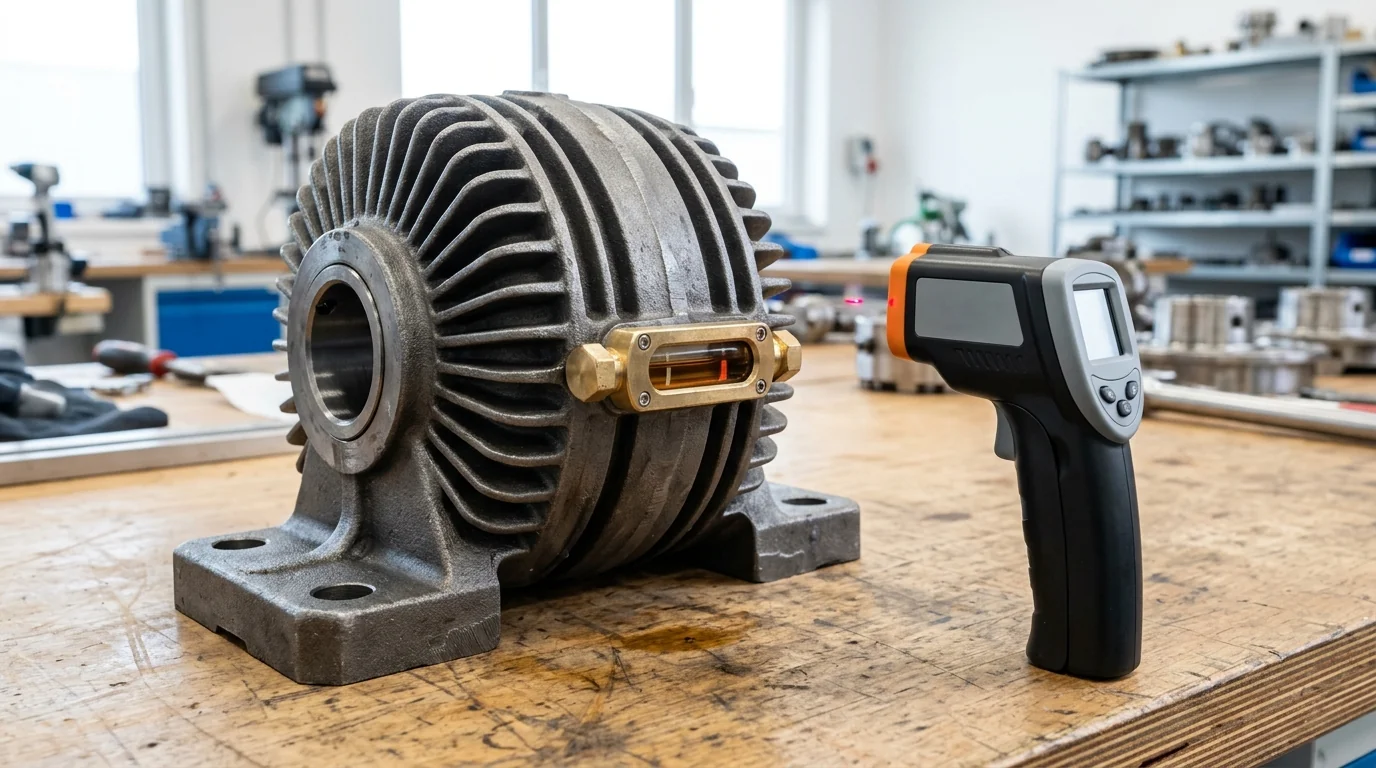
Thermic Fluid Pump Bearing Failure: Heat Soak Diagnosis, Radial Clearance Loss & High-Temperature Rebuild Guide
A definitive rotating machinery reliability manual, thermal conduction mathematical analysis, and high-temperature bearing overhaul standard for maintenance engineers, plant utility superintendents, and rotating equipment specialists across Vatva GIDC, Narol, Odhav, Surat, and Gujarat.
Quick Answer
In the continuous chemical synthesis plants, textile dyeing houses, stenter drying ranges, and multi-daylight laminate pressing facilities of Gujarat—spanning Ahmedabad (Vatva GIDC, Narol, Odhav), Surat, Ankleshwar, and Dahej—thermic fluid pumps circulate high-temperature heat transfer media at bulk temperatures between 250°C and 320°C. While the pump casing operates at full process temperature, the rotating shaft conducts massive thermal energy directly toward the drive-end and non-drive-end ball bearings. In air-cooled thermal pumps without external cooling water, this phenomenon—known as conductive heat soak—presents severe operational challenges. If maintenance technicians install standard deep groove ball bearings with standard "Normal" (CN) internal radial clearance, the rotating pump shaft heats the inner bearing ring to 130°C-160°C while the air-cooled outer ring remains at 80°C-95°C. This ΔT = 50°C-75°C temperature differential causes the inner ring to expand outward, completely consuming all internal radial clearance (C_r \rightarrow 0). The resulting metal-to-metal thermal pinching, rapid grease carbonization into abrasive black grit, rolling element skidding, and cage destruction trigger catastrophic bearing seizure within weeks. Overcoming bearing heat soak requires mathematical clearance modeling, S1 thermal ring stabilization, high-temperature synthetic polyurea grease, precision laser hot alignment, and dynamic balancing in accordance with ISO 5199, ISO 2858, and DIN 24255 standards.
Key Takeaways
- Specify C3 or C4 Internal Radial Clearance. High-temperature pumps strictly require wider internal radial clearance to compensate for inner ring thermal expansion.
- Select S1 Thermally Stabilized Bearing Rings. Standard bearings suffer irreversible metallurgical dimensional growth above 120°C; S1 rings remain stable up to 200°C.
- Use High-Temperature Synthetic Polyurea Grease. Mineral grease thickeners separate and carbonize at 120°C; synthetic polyurea maintains lubricity up to 180°C.
- Eliminate External Pipe Strain and Hot Misalignment. 2X vibration forces and axial pipe thrust accelerate bearing fatigue and micro-spalling.
Introduction
Across Gujarat's major industrial manufacturing belts—including the chemical intermediate plants of Vatva GIDC, Odhav, and Ankleshwar, the continuous textile finishing mills of Narol and Surat, and the petrochemical terminal installations of Dahej—thermic fluid pumps circulate organic heat transfer media at bulk temperatures between 250°C and 320°C.
Most industrial thermal pumps utilize an air-cooled intermediate bracket design conforming to DIN 24255 / EN 733. This design relies on external cooling fins and natural convective air dissipation to reduce shaft temperature from 300°C at the casing down to < 95°C at the bearing housing.
However, several severe failure modes frequently compromise this thermal barrier:
- The Clearance Loss Hazard: Conducted shaft heat warms the inner bearing ring to 145°C while the outer ring remains at 85°C. This temperature gradient expands the inner ring, crushing radial clearance in standard CN bearings.
- The Grease Breakdown Hazard: Standard mineral greases break down at 120°C, leaving abrasive carbon grit that scores raceways.
- The Engineering Standard: Following ISO 5199, ISO 2858, and DIN 24255 standards—installing S1 thermally stabilized C3/C4 bearings and synthetic polyurea grease—guarantees maximum bearing life.
2. Master High-Temperature Bearing Specification & Temperature Matrix
Review the standard technical specifications, radial internal clearance ratings, and temperature boundaries for high-temperature pump bearings:
| Operating Temperature Condition | Bearing Clearance Class | Thermal Heat Stabilization | Grease Type & Thickener Base | Typical Bearing Service Life |
|---|---|---|---|---|
| Ambient / Water (< 80°C) | Normal (CN: 10 - 25 µm) | Standard (SN: up to 120°C) | Lithium Mineral Base | > 40,000 operating hours |
| Thermic Oil (200°C - 280°C) | C3 Clearance (20 - 45 µm) | S1 Stabilized (up to 200°C) | Synthetic Polyurea / Ester | 20,000 - 30,000 hours |
| Thermic Oil (280°C - 350°C) | C4 Clearance (35 - 60 µm) | S1 / S2 Stabilized (200°C-250°C) | Synthetic Polyurea / Fluorinated PFPE | 15,000 - 25,000 hours |
| Incorrect Standard Bearing | Normal (CN) at 300°C | Standard (120°C limit) | Lithium Complex (130°C drop) | < 500 hours (Rapid Seizure) |
3. The Thermal Physics, Heat Soak Math & Clearance Loss Calculations
Shaft Conductive Heat Transfer Equation (q = -k · A · (dT) / (dx))
Heat conducts from the hot impeller hub (300°C) along the rotating steel pump shaft toward the bearings per Fourier's Law of Thermal Conduction:
Where:
- k_steel ≈ 45 W/m\cdotK (thermal conductivity of carbon steel shaft).
- A_shaft = [π· D_shaft²] / [4] (shaft cross-sectional area).
- (dT) / (dx) is the axial temperature gradient.
- Over a shaft length of 250 mm between seal chamber (280°C) and drive-end bearing (90°C), continuous conductive heat flux into the bearing journal exceeds 350 - 500 Watts, continuously heating the inner bearing ring.
Radial Internal Clearance Loss Math (ΔC_r = Δr_inner - Δr_outer)
As the inner ring expands more than the outer ring:
Where:
- α_steel ≈ 12.0 × 10^-6 m/m·°C.
- For a standard 6308 deep groove ball bearing (D_inner = 40 mm, D_outer = 90 mm):
- T_inner = 145°C, T_outer = 85°C, T_ambient = 30°C.
- Net Radial Clearance Reduction:
- A standard Normal (CN) bearing has only 10 - 20 µm initial radial clearance. The thermal expansion completely consumes all clearance (C_r < 0), placing the balls under intense radial preload and causing rapid surface spalling.
- Installing a C3 clearance bearing (25 - 45 µm initial clearance) maintains an optimal operating clearance of +10 to +20 µm under full thermal equilibrium.
S1 Thermal Heat Stabilization & Martensitic Microstructure Math
Standard through-hardened 100Cr6 bearing steel contains retained austenite (8% - 12%). Above 120°C, retained austenite transforms into lower-density bainite/martensite, causing irreversible volumetric expansion of the bearing rings (> 0.05 mm dimensional growth).
- S1 Heat Stabilization: Special tempering heat treatment stabilizes the microstructure, guaranteeing zero permanent dimensional growth up to 200°C.
Synthetic Grease Base Oil Viscosity Ratio (\kappa = [\nu] / [\nu_1]) at 100°C
Bearing lubrication film thickness is determined by the viscosity ratio (\kappa):
- Where \nu_1 is the required minimum kinematic viscosity to separate rolling elements.
- At 130°C inner ring temperature, standard mineral oil drops to \nu < 4 cSt (\kappa < 0.3), operating in destructive boundary metal-to-metal contact.
- Synthetic polyurea grease with high-viscosity synthetic base oil (100 - 150 cSt at 40°C) maintains \nu > 12 cSt at 130°C (\kappa > 1.2), providing full hydrodynamic elastohydrodynamic (EHL) film protection.
Bearing Defect Vibration Harmonics Math (BPFO, BPFI, BSF, FTF)
Bearing defect frequencies are calculated from bearing geometry:
- Monitoring high-frequency acceleration enveloping detects micro-spalling peaks at BPFI and BPFO weeks before physical temperature runaway occurs.
4. The 6 Primary Root Causes of Thermic Fluid Pump Bearing Failure
Cause 1: Standard Clearance (CN) Radial Thermal Binding
- Mechanism: Installing standard clearance deep groove ball bearings instead of C3 or C4 clearance.
- Damage: Inner ring expands, crushing balls against outer raceway; high frictional torque generates extreme heat (> 125°C) within 30 minutes of startup.
- Fix: Mandate C3 or C4 radial clearance for all thermic fluid pump bearings.
Cause 2: Mineral Grease Soap Separation & Carbon Grit Formation
- Mechanism: Using general-purpose lithium or calcium grease rated only for 120°C.
- Damage: Base oil separates from soap thickener; dried soap bakes into black carbon grit, scoring raceways and skidding balls.
- Fix: Clean housing thoroughly and pack with high-temperature synthetic polyurea grease.
Cause 3: Cooling Fin Dust Encrustation & Convective Heat Blockade
- Mechanism: Cotton fluff in textile mills (Narol, Surat) or chemical dust (Vatva) coats external bracket cooling fins.
- Damage: Dust layer acts as thermal insulation; convective heat dissipation drops by 70%; bearing skin temperature spikes to 120°C.
- Fix: Execute weekly dry compressed air cleaning of pump cooling fins and bracket housing.
Cause 4: Hot Laser Misalignment Imposing Cyclic 2X Radial Overload
- Mechanism: Aligning pump flat cold without compensating for +0.50 mm casing vertical growth.
- Damage: Hot running angular misalignment exerts heavy cyclic radial and axial fatigue loads on drive-end bearings.
- Fix: Apply negative vertical cold target offset and verify alignment with hot laser metrology at 280°C.
Cause 5: Axial Thermal Shaft Expansion Overloading Fixed Bearings
- Mechanism: Clamping both front and rear bearings axially without allowing floating expansion clearance.
- Damage: Shaft expands axially by +0.65 mm, pushing balls hard against raceway shoulders and overloading thrust bearings.
- Fix: Ensure non-drive-end (NDE) bearing outer ring has axial floating clearance (0.50 - 1.00 mm) inside the bearing housing bore.
Cause 6: Sudden Post-Shutdown Heat Soak from Premature Pump Stoppage
- Mechanism: Switching off circulation pump simultaneously with heater burner extinction.
- Damage: Stationary shaft conducts 700°C refractory latent heat into stationary bearings, burning grease instantly.
- Fix: Idle pump continuously for 60 to 90 minutes post-burner trip until bulk oil cools below < 80°C.
Interactive Pump Failure Root-Cause Diagnostic Navigator
ISO 10816 / API 682 Step-by-Step Triage FlowClassic NPSHa starvation or thermodynamic vapor flashing at first-stage impeller eye (NPSHa < NPSHr + 1.5m).
Check suction strainer differential pressure (ΔP > 0.35 bar indicates clogging); audit deaerator/tank static height and fluid vapor pressure.
Clean suction strainer; elevate suction feed vessel or increase suction pipe diameter to lower flow velocity below 1.2 m/s; trim impeller or fit high-Nss inducer.
5. Step-by-Step High-Temperature Bearing Overhaul & Assembly SOPs
Execute this structured engineering protocol when rebuilding high-temperature thermic fluid pump bearings:
Phase 1: Infrared Thermographic & Vibration FFT Diagnostic SOP
- Thermographic Survey: Measure bearing housing skin temperature with calibrated infrared camera; confirm temperature is < 95°C.
- Vibration FFT Logging: Measure tri-axial velocity and acceleration enveloping; inspect FFT spectra for discrete BPFO and BPFI peaks.
Phase 2: Pump Dismantling, Shaft Metrology & Journal Inspection SOP
- Back Pull-Out Extraction: Extract rotating assembly to workshop bench.
- Journal Micrometer Audit: Measure shaft bearing journal diameters (k5 / m5 fit tolerances); verify shaft runout is < 0.025 mm. Inspect housing bore for ovality (< 0.015 mm).
Phase 3: Induction Heating & C3 Bearing Mounting SOP
- Induction Heating: Heat new S1-stabilized C3 clearance bearings using a temperature-controlled induction heater to 110°C - 120°C. Zero open-flame torch heating.
- Shaft Mounting: Slide heated bearing smoothly against shaft shoulder; hold firmly until cold to prevent axial shoulder gap.
Phase 4: Synthetic Grease Packing & Fill Volume Calculation SOP
- Grease Fill Calculation: Calculate required grease volume:
- Packing Volume: Pack 30% - 40% of bearing internal cavity and 50% of housing end cover cavities with synthetic polyurea grease. Do not overfill (overfilling causes churning overheating).
Phase 5: Dynamic Rotor Balancing to ISO 5199 Grade G2.5 SOP
- Dynamic Balancing: Mount assembled impeller, shaft, and keys onto electronic dynamic balancing machine.
- Balance Certification: Achieve residual unbalance < 1.0 g\cdotmm/kg conforming to ISO 5199 Grade G2.5.
Phase 6: Laser Hot Alignment Verification & Commissioning SOP
- Cold Pre-Offset: Set electric motor shaft -0.45 mm lower or pump +0.45 mm higher using 316L stainless steel shims.
- Hot Laser Verification: Bring thermal loop to 280°C; perform hot check within 15 minutes of shutdown; confirm running concentricity ≤ 0.03 mm.
6. Materials of Construction, Metallurgy & High-Temperature Sealing
Nodular Ductile Iron (GGG 40.3) & Cast Carbon Steel (ASTM A216 WCB)
- Pressure Containment: High-temperature Nodular Ductile Iron (EN-GJS-400-18-LT / GGG 40.3) or Cast Carbon Steel (ASTM A216 WCB) casings capable of withstanding thermal shock and 16 bar working pressure up to 350°C.
High-Chrome 100Cr6 S1 Thermally Stabilized Bearing Steel
- Bearing Rings: High-purity vacuum-degassed 100Cr6 chrome alloy bearing steel subjected to S1 thermal stabilization tempering, maintaining dimensional stability up to 200°C.
Synthetic Polyurea High-Temperature Greases
- Lubricants: Fully synthetic polyurea-thickened synthetic ester/PAO greases with dropping points > 260°C, offering excellent oxidation stability and long life at 160°C continuous journal temperatures.
Monolithic Direct-Sintered Silicon Carbide (SSiC) Seal Faces
- Mechanical Seal Faces: Solid direct-sintered silicon carbide (SSiC) running against SSiC or Tungsten Carbide faces with flexible Grafoil or FFKM secondary O-rings.
7. The Maintenance Engineer's Bearing Troubleshooting Decision Matrix
Follow this structured engineering guide when diagnosing high bearing temperatures or vibration:
| Observed Bearing Symptom | Dominant Diagnostic Indicator | Confirmed Root Cause | Mandatory Corrective Engineering Action |
|---|---|---|---|
| Bearing skin temp > 115°C on startup | High initial current + High heat | Standard (CN) clearance pinching | Replace with C3 / C4 S1-stabilized bearing |
| Black hardened grit inside housing | Grease dropping point exceeded | Mineral grease soap separation | Clean housing; pack synthetic polyurea grease |
| High 2X Axial Vibration (> 5.0 mm/s) | 2× RPM harmonic peak | Hot shaft misalignment | Re-align pump skid using hot laser targets |
| High discrete high-frequency peak | BPFO or BPFI spikes | Raceway micro-spalling / fatigue | Immediate workshop replacement of bearing pack |
8. Worked Gujarat Textile, Chemical & Processing Mill Case Studies
Case 1: Vatva GIDC Chemical Synthesis Reactor Hot Oil Pump Bearing Overhaul
- Plant Context: An azo dye synthesis plant in Vatva GIDC operating a 75 m³/h, 4.2 bar thermic fluid circulation pump at 305°C.
- Problem: Drive-end bearing seized every 3 to 5 weeks; bearing housing temperature exceeded 124°C; pump motor breaker tripped.
- Root Cause: Maintenance technicians were installing standard CN clearance bearings with general-purpose lithium grease (120°C limit). Inner ring thermal expansion consumed all radial clearance, binding the balls.
- Action Plan: Teflow Pumps emergency field team:
- Overhauled pump rotating element in our Ahmedabad workshop. - Installed S1 thermally stabilized 6309 C3 deep groove ball bearings. - Packed housing with synthetic polyurea grease (35% fill volume). - Dynamically balanced impeller to ISO 5199 Grade G2.5 and laser aligned pump skid with -0.48 mm vertical cold growth target.
- Outcome: Bearing housing skin temperature stabilized at 76°C; vibration dropped to 0.82 mm/s RMS (Zone A); zero bearing failures over 22 consecutive operating months.
Case 2: Narol Continuous Textile Stenter Thermic Fluid Pump Heat Soak Fix
- Plant Context: A continuous cotton stenter drying facility in Narol operating dual 90 m³/h hot oil pumps (285°C).
- Problem: Thick cotton lint encrusted the intermediate bracket cooling fins, causing bearing temperature to spike to 118°C.
- Action Plan: Deep-cleaned bracket cooling fins, installed protective fine mesh air deflectors, and re-lubricated with synthetic grease.
- Outcome: Bearing temperature dropped by 38°C; bearing life extended from 3 months to over 24 months.
Case 3: Odhav Laminate Pressing Plant Hot Oil Pump Bearing Rebuild
- Plant Context: A decorative laminate pressing facility in Odhav operating hot oil platens at 240°C.
- Problem: Sudden bearing seizure after weekend plant shutdown.
- Action Plan: Instituted an automated 60-minute pump cool-down idling protocol post-burner trip to prevent post-shutdown heat soak.
- Outcome: Zero heat soak bearing failures over 18 operating months.
Case 4: Surat Synthetic Weaving Mill Hot Oil Circulation Recovery
- Plant Context: A polyester yarn processing mill in Surat operating dual thermic fluid pumps (270°C).
- Problem: High 2X axial vibration caused rapid bearing cage fracturing.
- Action Plan: Reset cold laser alignment target offsets to accommodate vertical casing growth and dynamically balanced rotor to Grade G2.5.
- Outcome: Vibration reduced to 0.90 mm/s RMS; bearing cage failures completely eliminated.
Case 5: Ankleshwar GIDC Specialty Chemical Reactor Thermal Loop Overhaul
- Plant Context: A pharma intermediate plant in Ankleshwar GIDC operating at 310°C.
- Problem: Overfilling grease cavities caused grease churning overheating (112°C).
- Action Plan: Cleaned housing, calibrated grease fill volume to exact 35% cavity volume using precision grease guns.
- Outcome: Bearing skin temperature dropped to 72°C.
Case 6: Dahej PCPIR Petrochemical Terminal Heat Transfer Circulation Audit
- Plant Context: A chemical terminal in Dahej PCPIR operating high-flow BB1 split-case hot oil pumps (2000 m³/h).
- Problem: High axial thrust loads damaged non-drive-end bearings during thermal expansion.
- Action Plan: Restored 1.0 mm axial floating clearance in NDE bearing housing bore.
- Outcome: Restored full axial expansion compliance; zero thrust bearing overload.
9. Comprehensive Master Thermic Fluid Pump Bearing Maintenance Checklist
Execute this maintenance verification protocol to prevent bearing failures in high-temperature service:
Thermic Fluid Pump High-Temperature Bearing Overhaul Protocol
10. Summary & Specialized Bearing Overhaul Services in Gujarat & India
Preventing and resolving high-temperature thermic fluid pump bearing failures—modeling conductive heat soak, specifying S1 thermally stabilized C3/C4 clearance bearings, packing high-temperature synthetic polyurea greases, executing precision laser hot alignment, and dynamically balancing rotating assemblies to ISO 5199 Grade G2.5 across Vatva GIDC, Narol, Odhav, Surat, Ankleshwar, and Dahej—conforming to ISO 5199, ISO 2858, and DIN 24255 standards—is the proven engineering standard for maximum reliability.
Partnering directly with an established Gujarat rotating machinery manufacturer provides chemical plant engineers, textile mill managers, and utility superintendents with immediate technical access to on-site thermographic diagnostic teams, induction bearing heaters, precision diamond mechanical seal lapping tables, dynamic balancing facilities, and genuine spares dispatched directly from our Ahmedabad factory. Our technical engineers provide emergency on-site troubleshooting, turnkey pump overhauls, and complete thermal loop audits.
Teflow Pumps operates a specialized industrial machinery manufacturing and service facility in Ahmedabad, providing emergency thermic fluid pump overhauls, high-temperature C3/C4 bearing replacements, precision laser hot alignment, dynamic balancing, custom impeller casting, and genuine rotating equipment spares across Gujarat and India conforming to ISO 5199, ISO 2858, DIN 24255, and IS 5120 standards.
- Direct Technical & Emergency Helpline: +91 98251 62709
- WhatsApp Technical Desk: Share bearing housing temperatures (°C), operating oil temperatures, pump nameplate photos, grease condition photos, or vibration spectra to wa.me/919825162709 for immediate technical review, clearance calculation, and formal quotation.
- Request an On-Site Bearing & Thermal Pump Audit: Contact our senior rotating equipment engineers for emergency plant surveys, hot alignment proposals, and formal quotation. Our engineering team conducts comprehensive thermal evaluations, verifies ISO 5199 criteria, provides precision on-site or workshop reconditioning, and dynamically balances overhauled hot oil pumps to ensure maximum uptime across Gujarat's textile and chemical processing mills. We provide rapid technical evaluations, on-site plant surveys, and formal quotes.