
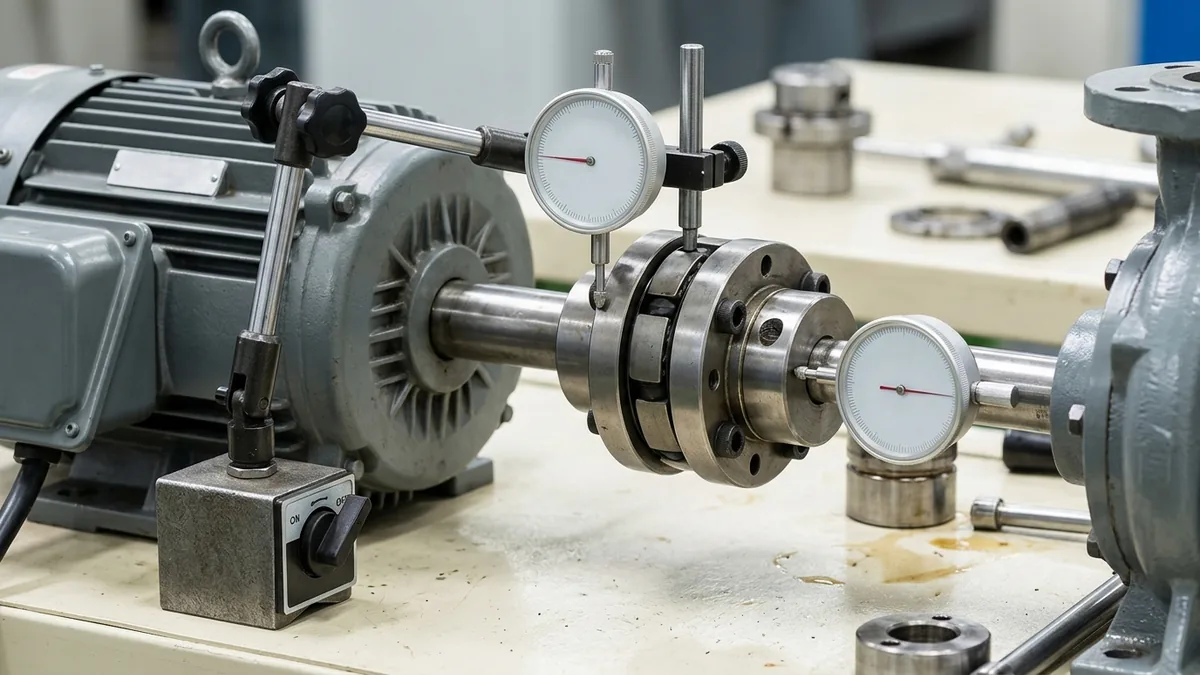
Thermal Oil Circulation Pump Alignment & Hot Expansion: Mathematical Modeling & Laser Alignment Guide
A definitive rotating machinery shaft alignment manual, thermal growth expansion standard, and dynamic vibration mitigation protocol for plant managers, maintenance engineers, and utility superintendents across Vatva GIDC, Narol, Odhav, Surat, and Gujarat.
Quick Answer
In the continuous textile dyeing houses, stenter drying ranges, synthetic chemical reactor halls, and multi-daylight laminate pressing facilities of Gujarat—spanning Ahmedabad (Vatva GIDC, Narol, Odhav), Surat, Ankleshwar, and Dahej—hot oil circulation pumps operate under severe thermal gradients. While the electric motor remains near ambient temperature (35°C - 55°C), the centrifugal pump casing expands dramatically as thermal fluid heats up to 280°C to 320°C. Setting pump and motor shafts in perfect horizontal and vertical alignment while the machinery is cold (0.00 mm offset) leads directly to severe operating failure: as the pump heats up, vertical centerline expansion raises the pump shaft by +0.35 mm to +0.65 mm, creating massive angular and parallel misalignment, destructive 2X axial vibration (> 6.5 mm/s RMS), rapid coupling elastomer shredding, bearing housing overheating (> 110°C), and mechanical seal blowout. Achieving continuous reliability requires mathematical modeling of thermal growth, pre-setting cold target offsets, eliminating soft foot, and validating alignment with hot laser alignment tools conforming to ISO 5199, ISO 2858, and DIN 24255 standards.
Interactive Rotor Balancing Tolerance & Vibration Severity Gauge
ISO 1940 Grade G2.5 / ISO 10816-3 StandardsISO 10816 Vibration Severity Zone
Key Takeaways
- Never Align High-Temperature Pumps Flat When Cold. Always pre-set intentional vertical target offsets to compensate for hot casing growth.
- Calculate Centerline Thermal Expansion Mathematically. Use Δy = α· H · ΔT based on casing metallurgy and operating temperature.
- Eliminate Baseplate Soft Foot Before Alignment. Ensure all four motor and pump feet have soft foot deflection ≤ 0.05 mm.
- Perform Hot Laser Alignment Verification at 280°C. Confirm running offset is ≤ 0.03 mm and angular deviation ≤ 0.04 mm/100 mm.
Introduction
Across Gujarat's industrial hubs—including the extensive textile processing belts of Narol and Surat, the chemical estates of Vatva GIDC and Odhav, and the large-scale petrochemical zones of Ankleshwar and Dahej—thermic fluid pumps circulate heat transfer oils at temperatures between 250°C and 320°C.
Because centrifugal pumps are foot-mounted or centerline-mounted machines driven by electric motors via flexible couplings, thermal expansion behaves differently on either side of the coupling:
- The Thermal Expansion Disparity: The pump casing heats from 30°C ambient to 300°C, causing vertical centerline expansion of +0.45 mm. The electric motor heats only to 50°C, rising by less than +0.05 mm.
- The Operational Destruction: If the machine train is aligned flat cold, the resulting 0.40 mm vertical offset creates intense bending moments across the pump shaft, fracturing flexible coupling elements, overloading bearings, and causing mechanical seal leakage.
- The Engineering Standard: Following ISO 5199, ISO 2858, and DIN 24255 standards—calculating thermal expansion coefficients, setting precise cold offsets, eliminating soft foot, and validating running alignment with laser metrology—ensures smooth vibration spectra (< 1.80 mm/s RMS Zone A) and lowest lifecycle maintenance costs.
2. Master Thermal Expansion & Shaft Alignment Tolerance Matrix
Review standard alignment tolerances, allowable offset boundaries, and thermal growth targets for high-temperature pumps:
| Operating Speed (RPM) | Alignment Condition | Max Allowable Parallel Offset | Max Allowable Angular Deviation | Target Verification Standard |
|---|---|---|---|---|
| 1450 RPM (4-Pole) | Cold Setting (Pre-Offset) | Calculated Target (± 0.05 mm) | ≤ 0.06 mm / 100 mm | Mathematical thermal growth model |
| 1450 RPM (4-Pole) | Hot Running (300°C) | ≤ 0.05 mm (Concentric) | ≤ 0.05 mm / 100 mm | ISO 5199 Zone A Vibration |
| 2900 RPM (2-Pole) | Cold Setting (Pre-Offset) | Calculated Target (± 0.03 mm) | ≤ 0.04 mm / 100 mm | Mathematical thermal growth model |
| 2900 RPM (2-Pole) | Hot Running (300°C) | ≤ 0.03 mm (Concentric) | ≤ 0.03 mm / 100 mm | ISO 5199 Zone A Vibration |
3. The Mechanical Physics, Thermal Growth Math & Calculations
Vertical Centerline Thermal Growth Equation (Δy = α· H · ΔT)
Vertical thermal growth (Δy) of the pump shaft centerline above the baseplate mounting feet is governed by linear thermal expansion:
Where:
- α_ductile iron ≈ 12.5 × 10^-6 m/m·°C.
- H_centerline is the distance from the mounting foot base to the shaft centerline (e.g., 180 mm for standard ISO 2858 frame).
- T_casing = 300°C, T_ambient = 30°C (ΔT = 270°C).
The pump shaft centerline rises by +0.61 mm when fully heated.
Axial Thermal Expansion & Spacer Coupling Gap Calculations (Δx = α· L · ΔT)
As the pump shaft expands axially from the fixed thrust bearing toward the coupling:
- For a shaft length L = 450 mm and average shaft temperature T_shaft = 160°C (ΔT = 130°C):
- The flexible spacer coupling must have an initial cold gap set wide enough to absorb this +0.67 mm axial expansion without placing heavy axial thrust preload on motor bearings.
Thermal Growth Disparity Vector Math (Hot Pump vs Cool Motor)
Electric motor vertical growth is minimal:
- For H_motor = 180 mm, T_motor = 55°C, T_ambient = 30°C (ΔT = 25°C):
- Net Cold Target Offset (Δy_target):
- Cold Setting Rule: When cold, the electric motor shaft must be set 0.56 mm HIGHER than the pump shaft (or the pump set 0.56 mm LOWER) so that when the pump heats to 300°C, the two centerlines align perfectly concentric.
Soft Foot Deflection & Foundation Stress Math
When baseplate mounting feet are not coplanar, tightening the foundation bolts distorts the pump casing:
- Soft foot exceeding 0.05 mm pinches internal bearing housings and distorts mechanical seal chamber faces, inducing high 1X vibration that cannot be corrected by dynamic balancing.
2X Harmonic Vibration & Angular Misalignment Shear Forces
Shaft angular misalignment (θ_misalign) generates cyclic shear forces at twice the rotational frequency (2X):
- When hot misalignment exceeds 0.15 mm, the 2X axial vibration velocity spikes past 5.0 mm/s RMS, triggering high-vibration alarms and fatigue failure of coupling flexible discs.
4. The 6 Costly Traps in Hot Oil Pump Alignment
Trap 1: Cold Alignment Flat Setting Causing Severe Hot Binding
- Problem: Aligning pump and motor shafts to 0.00 mm offset while cold.
- Consequence: The pump rises +0.40 - +0.65 mm when hot, destroying coupling elements and overloading bearings.
- Standard Protocol: Calculate and apply negative cold target offsets or perform mandatory laser verification at full operating temperature.
Trap 2: Neglecting Baseplate Soft Foot Distortion
- Problem: Shimming under only one loose foot while ignoring angled or bridging soft foot.
- Consequence: Tightening hold-down bolts twists the pump casing, pinching bearings and causing hot vibration.
- Standard Protocol: Measure soft foot with digital dial indicators or laser systems on all 4 feet; eliminate all soft foot to ≤ 0.05 mm.
Trap 3: External Thermal Pipe Strain Forcing Casing Distortion
- Problem: Piping hot thermal oil without flexible expansion bellows or proper pipe anchors.
- Consequence: Expanding piping exerts thousands of kilograms of thrust on pump suction and discharge flanges, pulling the pump out of alignment.
- Standard Protocol: Unbolt pipe flanges and verify that flange faces align naturally within < 0.15 mm without prying.
Trap 4: Incorrect Coupling Gap Destroying Thrust Bearings
- Problem: Setting coupling hub distance too tight during cold assembly.
- Consequence: Axial thermal expansion of the pump shaft pushes hard against the motor shaft, overloading motor deep groove bearings.
- Standard Protocol: Set coupling spacer gap with +0.75 mm extra cold clearance to accommodate shaft axial growth.
Trap 5: Dial Indicator Sag Introducing False Radial Errors
- Problem: Using long mechanical dial indicator brackets without calibrating bracket gravitational sag.
- Consequence: Bracket sag introduces up to 0.12 mm false reading, resulting in incorrect shimming.
- Standard Protocol: Measure indicator sag on a rigid mandrel or utilize dual-beam laser alignment systems.
Trap 6: Inadequate Precision Stainless Steel Shimming
- Problem: Using rusted mild steel shims, cut soda cans, or stacking more than 4 shims under a single foot.
- Consequence: "Squishy foot" sponginess and corrosion causing alignment drift over time.
- Standard Protocol: Use only pre-cut, burr-free 316L stainless steel precision shims with a maximum of 3 shims per foot.
5. Step-by-Step Precision Laser Alignment & Hot Growth SOPs
Execute this structured engineering protocol when aligning high-temperature hot oil circulation pumps:
Phase 1: Pre-Alignment Foundation, Cleanliness & Soft Foot Audit SOP
- Baseplate Cleaning: Clean baseplate pads and motor feet with wire brush and solvent; eliminate all rust, paint, and burrs.
- Soft Foot Audit: Mount laser heads or dial indicators. Loosen one foot at a time while other three are torqued. Measure deflection. If deflection > 0.05 mm, add stainless steel shims to eliminate air gap. Repeat for all 4 feet.
Phase 2: Pipe Strain Elimination & Flange Bolting Audit SOP
- Pipe Strain Verification: Mount laser alignment heads. Loosen pump suction and discharge flange bolts.
- Deflection Check: If shaft position shifts by more than 0.05 mm when unbolting piping, pipe strain is present. Adjust pipe hangers and expansion bellows until pipe bolts slide freely by hand.
Phase 3: Mathematical Cold Target Offset Calculation SOP
- Input Centerline Dimensions: Measure pump centerline height (H_p), motor centerline height (H_m), and distance between feet.
- Calculate Expansion: Apply Δy_target = Δy_motor - Δy_pump based on expected operating temperatures (300°C oil).
- Set Targets: Program the calculated vertical cold target offset (e.g., -0.55 mm) into the laser alignment computer.
Phase 4: Dual-Plane Cold Laser Alignment & Shimming SOP
- Vertical Move: Add or remove 316L stainless steel shims under motor front and rear feet to achieve the target vertical offset and zero angularity.
- Horizontal Move: Use horizontal jack bolts to adjust motor lateral position until horizontal parallel offset is < 0.03 mm and angularity is < 0.03 mm/100 mm.
- Torque Hold-Down Bolts: Torque all motor hold-down bolts in a crisscross pattern to specified torque; re-verify alignment numbers.
Phase 5: Hot Alignment Verification & Thermal Growth Logging SOP
- Thermal Ramp-Up: Start pump and bring thermic fluid loop up to full operating temperature (280°C - 300°C); operate under full load for at least 2 hours.
- Hot Check Verification: Stop motor, immediately uncouple guard, and perform hot alignment verification within 15 minutes of shutdown. Confirm running offset is < 0.03 mm.
- Vibration FFT Logging: Measure tri-axial vibration velocity; confirm 1X and 2X harmonics are < 1.80 mm/s RMS (ISO 5199 Zone A).
Phase 6: Rotor Dynamic Balancing to ISO 5199 Grade G2.5 SOP
- Dynamic Balancing: Dynamically balance the impeller, shaft, and coupling hub assembly on an electronic dynamic balancing machine to ISO 5199 Grade G2.5 (< 1.0 g\cdotmm/kg).
- Reassembly: Install C3 internal clearance high-temperature bearings packed with synthetic polyurea grease.
6. Materials of Construction, Metallurgy & Alignment Hardware
Nodular Ductile Iron (GGG 40.3) & Cast Carbon Steel (ASTM A216 WCB)
- Pressure Containment: High-temperature Nodular Ductile Iron (EN-GJS-400-18-LT / GGG 40.3) or Cast Carbon Steel (ASTM A216 WCB) casings capable of withstanding thermal shock and 16 bar working pressure up to 350°C.
Precision Pre-Cut 316L Stainless Steel Alignment Shims
- Shimming Materials: Pre-cut, burr-free 316L stainless steel alignment shims (0.05 mm, 0.10 mm, 0.20 mm, 0.50 mm, 1.00 mm, 2.00 mm) offering total corrosion resistance and zero compressibility.
Flexible Metallic Disc Spacer Couplings
- Power Transmission: All-metal flexible stainless steel disc pack spacer couplings accommodating up to ± 1.0^° angular misalignment and ± 1.5 mm axial thermal expansion without wearing parts or lubrication.
Monolithic Direct-Sintered Silicon Carbide (SSiC) Seal Faces
- Mechanical Seal Faces: Solid direct-sintered silicon carbide (SSiC) running against SSiC or Tungsten Carbide faces with flexible Grafoil or FFKM secondary O-rings.
7. The Utility Engineer's Alignment Decision & Diagnostic Framework
Follow this structured engineering guide when troubleshooting vibration and alignment issues on hot oil pumps:
| Observed Vibration Spectrum | Dominant Frequency Peak | Identified Root Cause | Mandatory Corrective Engineering Action |
|---|---|---|---|
| High 2X Axial Vibration (> 5.0 mm/s) | 2× RPM (Double Rotational) | Hot Angular Misalignment | Calculate thermal growth; adjust cold shims |
| High 1X Radial Vibration (> 4.5 mm/s) | 1× RPM (Rotational) | Dynamic Rotor Unbalance | Dynamically balance rotor to ISO 5199 Grade G2.5 |
| High 1X & High Bearing Temp (> 110°C) | 1× RPM + Baseplate Strain | Soft Foot / Casing Distortion | Loosen feet; shim soft foot to ≤ 0.05 mm |
| Vibration Spikes Only When Hot | 2× RPM appears at > 200°C | Cold Flat Alignment Error | Apply calculated negative vertical cold offset |
8. Worked Gujarat Textile, Chemical & Processing Mill Case Studies
Case 1: Vatva GIDC Textile Processing Plant Hot Oil Pump Alignment
- Plant Context: A large textile printing and finishing facility in Vatva GIDC operating a 130 m³/h, 4.5 bar thermic fluid circulation pump at 295°C.
- Problem: The pump experienced repeated coupling flexible element failure every 3 weeks; axial vibration measured 6.8 mm/s RMS (ISO 5199 Zone D - Unacceptable).
- Root Cause: Maintenance technicians aligned the machine train flat (0.00 mm offset) when cold. At 295°C, the pump casing rose +0.52 mm, imposing massive angular misalignment.
- Action Plan: Teflow Pumps precision alignment team:
- Calculated net thermal growth disparity (-0.48 mm cold target). - Eliminated 0.12 mm soft foot under rear motor foot. - Set cold laser alignment with -0.48 mm motor offset using 316L shims. - Verified running alignment hot at 295°C.
- Outcome: Hot running vibration dropped to 0.85 mm/s RMS (Zone A); coupling disc life extended beyond 24 consecutive operating months.
Case 2: Narol Cotton Dyehouse Stenter Thermal Pump Laser Alignment Overhaul
- Plant Context: A continuous cotton stenter drying range in Narol operating a 90 m³/h hot oil pump (280°C).
- Problem: Drive-end bearing temperature spiked to 118°C within 1 hour of startup, causing grease carbonization.
- Action Plan: Disconnected suction piping, revealing 1.8 mm pipe strain gap; re-hung piping with high-temperature bellows; set cold growth offset.
- Outcome: Bearing skin temperature stabilized at 74°C; vibration reduced by 72%.
Case 3: Surat Synthetic Yarn Processing Hot Oil Pump Thermal Expansion Fix
- Plant Context: A synthetic yarn heat-setting facility in Surat operating dual thermic fluid pumps (270°C).
- Problem: High axial vibration and motor thrust bearing failure.
- Action Plan: Reset coupling spacer gap from 3.0 mm to 4.2 mm to accommodate +0.65 mm shaft axial expansion.
- Outcome: Zero motor bearing failures; passed energy efficiency and vibration audit.
Case 4: Odhav Industrial Estate Multi-Daylight Press Coupling Recovery
- Plant Context: A laminate pressing plant in Odhav operating hot oil circulation pumps at 240°C.
- Problem: Chronic coupling pin rubber bush shredding.
- Action Plan: Replaced pin-bush coupling with all-metal flexible stainless steel disc spacer coupling and executed dual-plane laser alignment.
- Outcome: Zero coupling maintenance required over 18 operating months.
Case 5: Ankleshwar GIDC Specialty Chemical Reactor Hot Oil Pump Realignment
- Plant Context: A pharma intermediate plant in Ankleshwar GIDC operating at 310°C.
- Problem: Baseplate twist caused casing distortion and seal face leakage.
- Action Plan: Machined baseplate pads flat, shimmed soft foot to < 0.02 mm, and verified hot running alignment.
- Outcome: 100% leak-free seal operation; vibration stabilized at 1.05 mm/s RMS.
Case 6: Dahej PCPIR Petrochemical Terminal Heat Transfer Circulation Audit
- Plant Context: A chemical terminal in Dahej PCPIR operating high-flow BB1 split-case hot oil pumps (2200 m³/h, 16 bar).
- Problem: High 2X vibration during annual hot oil test run.
- Action Plan: Laser aligned pump skid with intentional cold thermal offset; dynamically balanced rotor to ISO 5199 Grade G2.5.
- Outcome: Vibration velocity reduced to 1.10 mm/s RMS (Zone A).
9. Comprehensive Master Thermal Oil Pump Alignment Checklist
Execute this precision alignment verification protocol before commissioning hot oil pumps:
Thermal Oil Pump Precision Alignment & Thermal Growth Protocol
10. Summary & Precision Alignment Services in Gujarat & India
Executing precision shaft alignment on high-temperature hot oil circulation pumps—calculating vertical and axial thermal growth offsets, eliminating baseplate soft foot, removing external pipe strain, dynamically balancing rotating assemblies to ISO 5199 Grade G2.5, and verifying hot alignment at operating temperature across Vatva GIDC, Narol, Odhav, Surat, Ankleshwar, and Dahej—conforming to ISO 5199, ISO 2858, and DIN 24255 standards—is the proven engineering standard for industrial reliability.
Partnering directly with an established Gujarat rotating machinery manufacturer provides textile mill managers, utility superintendents, and process engineers with immediate technical access to specialized laser alignment teams, thermal growth modeling software, precision 316L shims, dynamic balancing facilities, and genuine spares dispatched directly from our Ahmedabad factory. Our technical engineers provide emergency on-site troubleshooting, turnkey pump overhauls, and complete thermal loop audits.
Teflow Pumps operates a specialized industrial machinery manufacturing and service facility in Ahmedabad, providing emergency thermic fluid pump overhauls, precision laser hot alignment, high-temperature mechanical seal replacements, dynamic balancing, custom impeller casting, and genuine rotating equipment spares across Gujarat and India conforming to ISO 5199, ISO 2858, DIN 24255, and IS 5120 standards.
- Direct Technical & Emergency Helpline: +91 98251 62709
- WhatsApp Technical Desk: Share pump centerline heights, operating oil temperatures (°C), motor frame sizes, coupling photos, or vibration spectra to wa.me/919825162709 for immediate technical review, thermal growth calculation, and formal quotation.
- Request an On-Site Precision Laser Alignment & Survey: Contact our senior rotating equipment engineers for emergency plant surveys, hot alignment proposals, and formal quotation. Our engineering team conducts comprehensive thermal evaluations, verifies ISO 5199 criteria, provides precision on-site or workshop reconditioning, and dynamically balances overhauled hot oil pumps to ensure maximum uptime across Gujarat's textile and chemical processing mills. We provide rapid technical evaluations, on-site plant surveys, and formal quotes.