
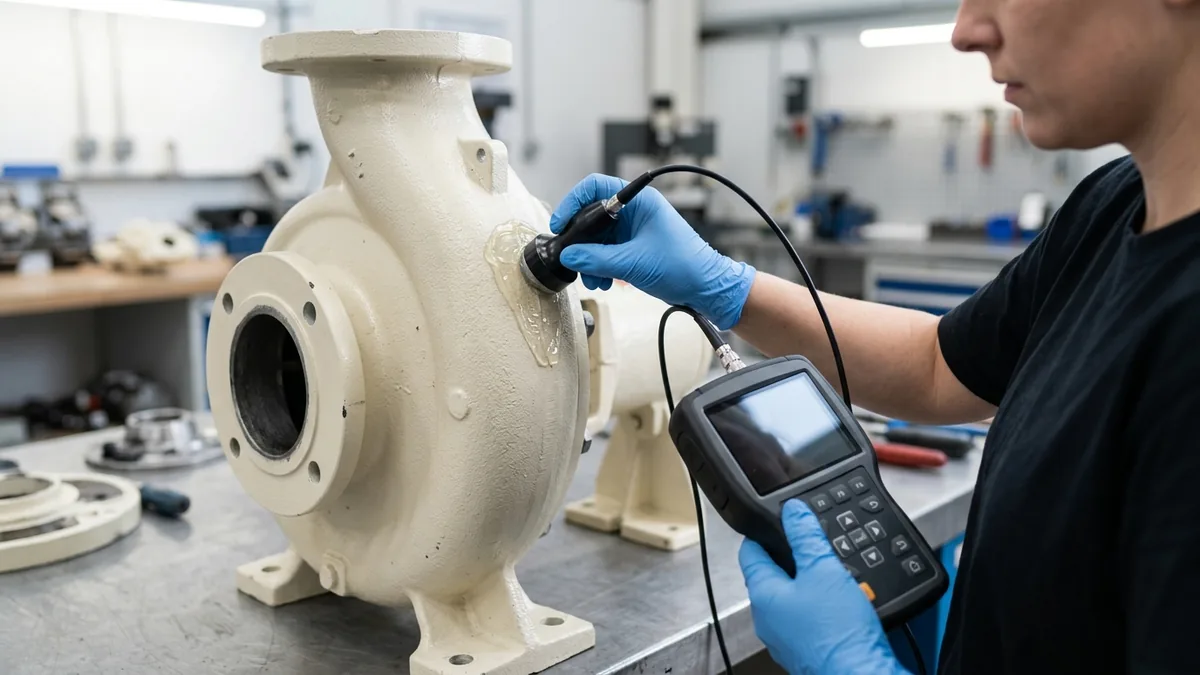
Teflon Pump Maintenance Schedule for Acid Service: Comprehensive Reliability Engineering Standard
A definitive chemical machinery maintenance manual, preventative inspection standard, and rotating equipment asset management guide for maintenance engineers, plant reliability heads, and rotating equipment specialists across Ahmedabad, Ankleshwar, Dahej PCPIR, Vapi, and Gujarat.
Quick Answer
In the aggressive chemical processing hubs of Gujarat—including pharmaceutical bulk drug synthesis in Vatva, dyestuff plants in Naroda and Odhav, and agrochemical complexes in Ankleshwar and Dahej—Teflon and PTFE/PFA lined centrifugal pumps conforming to ISO 5199, ISO 2858, and IS 5120 standards circulate concentrated, highly corrosive acids (98% H_2SO_4, 33% HCl, 68% HNO_3, and hydrofluoric acid blends) continuously. Because fluoropolymer liners operate near their thermal and mechanical limits under hot acid service, relying on reactive "run-to-failure" maintenance leads to catastrophic casing burns, toxic acid releases, unbudgeted downtime, and expensive rotor write-offs. Implementing a structured, time-based and condition-based preventative maintenance schedule—incorporating daily operational parameter logging, weekly mechanical seal barrier checks (API Plan 53A/54), monthly vibration FFT analysis (v_RMS ≤ 2.8 mm/s), quarterly flange torque verification (35 - 55 N\cdotm), and annual turnaround 20 kV high-voltage dielectric spark testing—extends pump mean time between failures (MTBF) beyond 35,000 continuous hours while ensuring full GPCB environmental compliance.
Key Takeaways
- Adhere to a Multi-Tiered Inspection Cadence. Execute daily visual audits, monthly vibration FFT spectra, quarterly torque checks, and annual 20 kV spark testing.
- Maintain Pressurized Barrier Fluid Systems (API Plan 53A/54). Ensure barrier fluid pressure stays 1.5 bar above pump chamber pressure to prevent acid crystallization.
- Enforce Cold-Flow Torque Checking on PTFE Flanges. Re-torque non-metallic casing bolts quarterly (35 - 55 N\cdotm) to eliminate acid gasket weeping.
- Inspect Casing Shell Vent Holes Regularly. Clear blocked shell vents to prevent permeated acid gas pressure from forming casing liner blisters.
Introduction
In Gujarat's major industrial manufacturing centers—specifically Ahmedabad (Vatva, Naroda, Odhav, Changodar), Ankleshwar GIDC, Dahej PCPIR, Panoli, and Vapi—hundreds of chemical plants handle aggressive, toxic, and hot mineral acids daily.
Plant maintenance engineers, rotating machinery superintendents, and factory reliability heads face severe recurring hurdles:
- The Rapid Acid Attack Penalty: Underestimating routine maintenance on acid service pumps leads to unexpected mechanical seal failure, spraying concentrated acid on plant infrastructure and destroying expensive motor bearings.
- The PTFE Cold-Flow & Gasket Weepage Dilemma: Fluoropolymer liners exhibit gradual plastic deformation (cold flow) under continuous flange bolting pressure, causing flange connections to loosen and leak acid fumes unless periodic re-torquing is performed.
- The Engineering Standard: Executing a disciplined preventative maintenance schedule conforming to ISO 5199, ISO 2858, IS 5120, and IS 1520 standards—featuring daily parameter logging, monthly vibration spectral analysis (v_RMS ≤ 2.8 mm/s), quarterly torque verification, dynamic rotor balancing to Grade G2.5, and annual 20 kV dielectric spark testing—eliminates unplanned acid outages, prevents catastrophic casing failure, and extends equipment service life beyond 35,000 hours.
2. Master Teflon & PTFE Lined Pump Maintenance Interval Matrix
Review the operational maintenance intervals and verification criteria for acid pumps:
| Maintenance Frequency | Key Inspection Tasks & Engineering Parameters | Acceptable Operating Limits | Corrective Action If Out of Spec |
|---|---|---|---|
| Daily | Suction/discharge pressure, barrier fluid pot, seal leakage | Zero visible droplets; barrier P ≥ P_pump + 1.5 bar | Top up barrier fluid; check seal pot pressure |
| Weekly | Bearing housing oil level, casing vent hole inspection | Oil level middle of sight glass; vents 100% clear | Drain/refill oil; unblock shell vent ports |
| Monthly | Vibration overall velocity (v_RMS), bearing temp | v_RMS ≤ 2.8 mm/s; Bearing temp ≤ 75°C | Perform laser alignment; re-grease / replace bearings |
| Quarterly | Casing flange bolt torque, flexible coupling wear | Torque 35 - 55 N\cdotm; Coupling gap ± 0.1 mm | Even star-pattern re-torque; replace spider insert |
| Semi-Annual | Impeller front/back clearance, shaft radial runout | Clearance 0.5 - 0.8 mm; Radial runout ≤ 0.04 mm | Adjust rear bearing shims; straighten/replace shaft |
| Annual (Turnaround) | Complete teardown, 20 kV spark test, dynamic balancing | Dielectric test pass; Rotor balance ISO 5199 Grade G2.5 | Factory casing relining; replace seal faces & bearings |
Interactive Chemical Metallurgy & Temperature Compatibility Matrix
ISO 5199 / API 685 Fluoropolymer & Superalloy Standards| Material of Construction | Classification | Max Temp Limit | Compatibility Status @ 65°C |
|---|---|---|---|
Virgin PFAStandard | Fluoropolymer Lining | 160°C | Recommended (A - Zero Corrosion) |
Virgin PTFEStandard | Fluoropolymer Solid/Lined | 150°C | Recommended (A - Zero Corrosion) |
PVDF | Fluoropolymer Thermoplastic | 90°C | Satisfactory (< 2 mpy Corrosion) |
Polypropylene | Commodity Thermoplastic | 60°C | Thermal Derating Exceeded (> 60°C) |
Hastelloy C-276Standard | High-Nickel Superalloy | 110°C | Recommended (A - Zero Corrosion) |
SS316L | Austenitic Stainless Steel | 25°C | Severe Corrosion / Rapid Failure (X) |
SSiC Silicon CarbideStandard | Sintered Ceramic Seal Face | 180°C | Recommended (A - Zero Corrosion) |
Severe oxidizing acid at high concentration. Virgin PFA and PTFE linings provide total chemical inertness up to 160°C. SSiC mechanical seal faces prevent chemical grooving.
3. The Tribology & Fluid Degradation Physics in Acid Service Maintenance
Mechanical Seal Face Tribology in Acid Environments (PV Limits)
Mechanical seals in acid pumps operate under extreme pressure-velocity (PV) conditions:
- Seal Face Metallurgy: Operating direct-sintered Silicon Carbide (SSiC) against SSiC provides extreme hardness (2800 HV) and zero chemical attack from hot acids.
- Barrier Fluid Hydrodynamics: In API Plan 53A/54 dual seals, barrier fluid creates a microscopic lubricating film (0.5 - 1.0 µm) across seal faces. If barrier pressure drops below process pressure, acid migrates across the faces, causing chemical crystallization, face scoring, and rapid seal blowout.
Fluoropolymer Cold Flow & Creep Relaxation Dynamics (σ(t) = σ_0 e^-t/τ)
Polytetrafluoroethylene (PTFE) is a viscoelastic thermoplastic that exhibits time-dependent creep relaxation under constant bolt load:
Where:
- σ_0 is the initial flange seating stress (15.0 - 25.0 MPa).
- τis the characteristic relaxation time constant, which decreases rapidly as temperature rises.
Under thermal cycling from 25°C to 90°C, flange seating stress decays by up to 35% - 50% over 90 operating days. Without disciplined quarterly re-torquing using calibrated torque wrenches, gasket relaxation leads to acid fume leakage and outer casing bolt corrosion.
Vibration Spectral Analysis & Bearing Fatigue Physics (ISO 5199 Vibration Limits)
Condition monitoring of rotating equipment utilizes Fast Fourier Transform (FFT) vibration spectral analysis:
- Overall Velocity Limits: ISO 5199 industrial machinery vibration standards establish the following operational thresholds:
- Good Condition: v_RMS ≤ 1.8 mm/s - Acceptable Condition: 1.8 < v_RMS ≤ 2.8 mm/s - Alert / Maintenance Required: 2.8 < v_RMS ≤ 4.5 mm/s - Danger / Immediate Shutdown: v_RMS > 4.5 mm/s
- Bearing Defect Frequencies: Monitoring characteristic frequencies (BPFO, BPFI, BSF, FTF) detects bearing micro-spalling and race pitting before catastrophic shaft seizure occurs. In heavy chemical manufacturing plants across Vatva and Ankleshwar, spectral demodulation identifies early bearing distress weeks before thermal elevation occurs.
Dielectric Breakdown & Molecular Micro-Void Degradation (20 kV DC Testing)
- Dielectric Strength of PTFE: Virgin isostatic PTFE exhibits a dielectric breakdown strength of ≈ 60 kV/mm. A healthy 4.5 mm lining can easily withstand 20.0 kV DC without electrical breakdown.
- Annual Turnaround Spark Audit: Scanning 100% of internal wetted surfaces with a calibrated high-voltage spark probe detects microscopic chemical permeation pinholes, voids, or micro-cracks before acid can contact the ductile iron shell.
4. The 4 Critical Acid Process Maintenance Scenarios Across Gujarat Plants
Scenario 1: Fuming Hydrochloric Acid (33% HCl) Pump Vent Port Maintenance (Vatva)
- Plant Context: An active pharmaceutical ingredient complex in Vatva GIDC pumping commercial 33% HCl at 55°C.
- Maintenance Hazard: Casing vent ports become clogged with external atmospheric dirt and paint, trapping permeated HCl vapor behind the liner and causing pressurized casing blisters.
- Corrective SOP: Weekly manual inspection and rodding of all casing vent holes; installation of porous PTFE vent plugs.
Scenario 2: Hot Concentrated Sulfuric Acid (98% H_2SO_4) Seal Plan Maintenance (Ankleshwar)
- Plant Context: An agrochemical technical plant in Ankleshwar GIDC pumping concentrated sulfuric acid (98% H_2SO_4, 65°C).
- Maintenance Hazard: Sulfuric acid absorbs atmospheric moisture, becoming highly corrosive dilute acid if barrier fluid is contaminated.
- Corrective SOP: Daily verification of API Plan 53A barrier fluid pressure (P_barrier ≥ P_pump + 1.5 bar) using compatible synthetic hydrocarbon barrier oil.
Scenario 3: Nitric-Hydrofluoric Stainless Steel Pickling Acid Pump Overhaul (Odhav)
- Plant Context: A stainless steel tube pickling facility in Odhav circulating spent acid (15% HNO_3 + 4% HF, 50°C).
- Maintenance Hazard: Hydrofluoric acid attacks standard silicon-bearing ceramics and glass-filled plastics.
- Corrective SOP: Annual replacement of mechanical seal faces with direct-sintered SSiC (zero free silicon) and virgin PTFE internal components.
Scenario 4: High-Temperature Acidic Solvents Vacuum Distillation Pump Overhaul (Dahej)
- Plant Context: A specialty chemical distillation unit in Dahej PCPIR operating under vacuum (-0.8 bar, 110°C).
- Maintenance Hazard: Thermal expansion and vacuum suction cause loose liners to deform and rub against the impeller.
- Corrective SOP: Semi-annual measurement of impeller front clearance (0.6± 0.1 mm) and inspection of transfer-molded PFA dovetail locks.
5. Sanitary Materials of Construction & Cleanroom Standards
Virgin Isostatic PTFE & Transfer-Molded PFA Liners (≥ 4.5 mm)
- Fluoropolymers: 100% virgin isostatic Polytetrafluoroethylene (PTFE) and high-density Perfluoroalkoxy (PFA) liners with a minimum wall thickness of 4.5 - 6.0 mm, offering universal chemical resistance across 0 - 14 pH.
Direct-Sintered Silicon Carbide (SSiC) Seal Rings & Ceramic Faces
- Seal Metallurgy: Monolithic direct-sintered Silicon Carbide (SSiC, 2800 HV) seal rings operating in an external PTFE bellows cartridge, providing complete immunity to acid pitting and thermal shock.
Perfluoroelastomer (FFKM / Kalrez) O-Rings & PTFE Encapsulated Seals
- Secondary Seals: Grade 6375 perfluoroelastomer (FFKM) or precision-molded PTFE-encapsulated FKM O-rings providing total resistance to aggressive acid degradation up to 220°C.
Ductile Iron (GGG 40) Armored Castings & Hastelloy C-276 Fasteners
- Armor & Fasteners: Heavy-duty Ductile Iron (GGG 40 / EN-GJS-400-18) armored casing shells, corrosion-resistant fluoropolymer exterior epoxy coatings, and Hastelloy C-276 casing stud bolts.
6. Step-by-Step Preventative Maintenance Execution SOPs
Execute these structured engineering SOPs across each maintenance interval:
Phase 1: Daily Operational Logging & Visual Walk-Through SOP
- Visual Inspection: Inspect pump casing, mechanical seal area, and flange connections for signs of acid weeping, fume trails, or salt crystallization.
- Hydraulic Parameters: Log suction pressure (P_s), discharge pressure (P_d), motor operating current (I), and barrier fluid pot pressure (P_barrier).
- Immediate Shutdown Criteria: If barrier fluid pressure drops below pump discharge pressure or visible acid leaks occur, initiate safe emergency pump shutdown immediately.
Phase 2: Weekly Mechanical Seal Barrier Fluid & Vent Inspection SOP
- Barrier Fluid Maintenance: Check barrier fluid level in the Plan 53A reservoir. Top up with approved synthetic barrier oil if level drops below minimum sight glass mark.
- Casing Shell Vent Inspection: Inspect all external casing vent holes. Rod out any chemical crusting or dirt using a soft copper wire and verify that porous PTFE vent plugs are in place.
Phase 3: Monthly Vibration Spectral FFT & Bearing Temperature Audit SOP
- Vibration Data Collection: Measure overall RMS velocity (v_RMS) and peak acceleration on bearing housing in horizontal, vertical, and axial directions.
- Bearing Temperature: Record bearing housing surface temperature using an infrared pyrometer (T_bearing ≤ 75°C).
- Spectral Analysis: If v_RMS > 2.8 mm/s, perform FFT spectral demodulation to diagnose misalignment, unbalance, or early bearing race fatigue.
Phase 4: Quarterly Flange Bolt Torque & Dynamic Shaft Alignment SOP
- Torque Verification: Check all casing and suction/discharge flange bolts using a calibrated torque wrench in a cross-star pattern:
- DN 25 - DN 50 Flanges: 35 - 40 N\cdotm - DN 65 - DN 100 Flanges: 45 - 55 N\cdotm
- Laser Shaft Alignment: Verify pump-to-motor dynamic shaft alignment using a precision laser alignment tool:
- Radial / Parallel Misalignment: ≤ 0.05 mm - Angular Misalignment: ≤ 0.05 mm / 100 mm
Phase 5: Semi-Annual Internal Clearances & Impeller Wear Measurement SOP
- Clearance Measurement: Measure front axial running clearance between the impeller shroud and casing volute liner using feeler gauges (0.5 - 0.8 mm).
- Clearance Adjustment: If clearance exceeds 1.2 mm, adjust bearing bracket shims to restore design running clearance and optimize pump hydraulic efficiency.
Phase 6: Annual Turnaround Major Overhaul & 20 kV Spark Test SOP
- Full Disassembly Protocol: Decontaminate, neutralize, and dismantle the complete pump. Replace rolling element bearings and mechanical seal faces. Scan 100% of internal PTFE/PFA lining with a 20 kV DC spark tester. Dynamically balance the impeller and rotor assembly to ISO 5199 Grade G2.5. Hydrostatically pressure test casing to 1.5× rated pressure (15.0 bar) for 30 minutes with water.
7. Worked Gujarat Chemical Plant Acid Maintenance Case Studies
Case 1: Vatva GIDC Bulk API Facility Hydrochloric Acid Pump Overhaul
- Plant Context: An API bulk synthesis facility in Vatva GIDC operating 8 PTFE lined centrifugal pumps on 33% HCl transfer (25 m³/hr, 3.0 bar).
- Problem: Pumps suffered unpredicted mechanical seal blowouts every 6 weeks, causing toxic fumes and emergency plant shutdowns.
- Action Plan: Implemented Teflow comprehensive preventative maintenance protocol: daily Plan 53A barrier logging, weekly vent unclogging, and monthly vibration monitoring.
- Outcome: MTBF increased from 1.5 months to over 24 consecutive operating months; zero emergency acid leaks; saved Rs 8,40,000 in annual emergency repair costs.
Case 2: Naroda GIDC Reactive Dye Intermediate Sulfuric Acid Pump AMC
- Plant Context: A dyestuff plant in Naroda GIDC pumping 98% H_2SO_4 at 60°C.
- Problem: Severe flange joint acid weeping damaged casing mounting hardware due to PTFE cold flow.
- Action Plan: Instituted quarterly star-pattern torque verification (45 N\cdotm) using Belleville spring washers and high-tensile fasteners.
- Outcome: Flange leaks eliminated 100%; casing hardware service life extended beyond 30 consecutive operating months.
Case 3: Ankleshwar GIDC Agrochemical Unit Concentrated Nitric Pump Program
- Plant Context: An agrochemical technical facility in Ankleshwar GIDC circulating 68% HNO_3 into nitration reactors.
- Problem: Chronic high vibration (v_RMS = 5.2 mm/s) caused premature bearing failures.
- Action Plan: Teflow engineers performed laser shaft alignment and dynamically balanced the PFA-lined rotor to ISO 5199 Grade G2.5.
- Outcome: Vibration reduced to 1.2 mm/s; continuous vibration-free operation over 26 consecutive operating months.
Case 4: Dahej PCPIR Chlor-Alkali Unit Spent Acid Pump Preventative Schedule
- Plant Context: A chlor-alkali plant in Dahej PCPIR operating spent sulfuric acid pumps (70% H_2SO_4, 70°C).
- Problem: Unscheduled casing burn-through caused catastrophic downtime.
- Action Plan: Enforced annual turnaround 20 kV DC spark testing to detect micro-pinholes before casing attack occurs.
- Outcome: Zero casing burn-throughs; saved Rs 14,00,000 in avoided equipment replacements over 28 consecutive operating months.
Case 5: Odhav Metal Finishing Pickling Bath Pump Mechanical Seal Conversion
- Plant Context: A stainless steel pickling plant in Odhav operating spent mixed acid pumps (15% HNO_3 + 4% HF).
- Problem: Silicon-impregnated seal faces etched and failed within 3 weeks.
- Action Plan: Converted all units to Teflow direct-sintered SSiC mechanical seals with virgin PTFE bellows.
- Outcome: Seal service life extended to 22 consecutive operating months without maintenance.
Case 6: Vapi GIDC Specialty Pigment Plant Phosphoric Acid Pump Maintenance
- Plant Context: A pigment manufacturing complex in Vapi GIDC pumping crude phosphoric acid containing abrasive gypsum fines.
- Problem: Rapid impeller front clearance opening reduced pumping capacity by 30%.
- Action Plan: Implemented semi-annual impeller clearance adjustments (0.6 mm) and standardized on Glass-Filled PTFE (GFPTFE) impellers.
- Outcome: Pumping hydraulic efficiency maintained at 100%; continuous reliable operation across 24 consecutive operating months.
8. Step-by-Step Acid Pump Troubleshooting & Maintenance Decision Matrix
Follow this structured engineering guide when troubleshooting acid process pumps:
| Observed Symptom | Probable Root Cause | Recommended Maintenance Action |
|---|---|---|
| Acid Fume Weepage at Casing Flange | PTFE liner cold flow / bolt torque decay | Re-torque flange bolts to 35 - 55 N\cdotm in star pattern |
| High Vibration (v_RMS > 2.8 mm/s) | Shaft misalignment or impeller unbalance | Perform laser alignment; balance rotor to Grade G2.5 |
| Barrier Fluid Level Dropping Fast | Inboard mechanical seal face failure | Isolate pump; replace seal cartridge with SSiC faces |
| Reduced Flow & Discharge Pressure | Excessive impeller front clearance (> 1.2 mm) | Adjust rear bearing bracket shims to 0.6 mm |
| Casing Shell Weep Hole Dripping Acid | Liner micro-pinhole / dielectric breakdown | Remove pump; execute 20 kV spark test and reline |
| High Bearing Temperature (> 75°C) | Lubricant degradation or bearing pre-load | Drain/refill synthetic oil; inspect bearing end play |
9. Comprehensive Master Teflon Pump Annual Turnaround (FAT) Checklist
Execute this quality verification protocol during annual pump overhaul before plant re-installation:
Teflon Chemical Pump Overhaul & Turnaround Protocol
10. Summary & Local Acid Pump Maintenance Support in Gujarat
Eliminating corrosive acid pump leaks, preventing unpredicted mechanical seal blowouts, enforcing structured daily-to-annual maintenance cadences, and extending equipment service life beyond 35,000 hours across Vatva GIDC, Naroda GIDC, Odhav, Ankleshwar, Dahej, and Vapi—by utilizing direct-sintered SSiC mechanical seals, quarterly flange re-torquing, monthly vibration FFT monitoring, and annual 20 kV dielectric spark testing conforming to ISO 5199, ISO 2858, IS 5120, and IS 1520 standards—is the proven engineering standard for chemical plant reliability.
Partnering directly with an established Gujarat chemical rotating machinery manufacturer provides industrial plants with immediate technical access to annual maintenance contracts (AMC), on-site laser alignment, dynamic balancing, emergency field overhauls, and genuine fluoropolymer spares. Our dedicated factory-trained rotating equipment technicians ensure rapid on-site troubleshooting and preventative maintenance audits.
Teflow Pumps operates a specialized chemical rotating machinery manufacturing facility in Ahmedabad, providing engineered PFA-lined pumps, solid PTFE process pumps, factory casing relining, 20 kV dielectric spark testing, dynamic rotor balancing, and genuine rotating equipment spares across Gujarat conforming to ISO 5199, ISO 2858, IS 5120, and API 685 standards.
- Direct Technical & Emergency Helpline: +91 98251 62709
- WhatsApp Technical Desk: Share photos of your pump condition, acid chemistry (%), operating temperature (°C), or current vibration readings to wa.me/919825162709 for immediate engineering diagnostics, preventative maintenance guidance, and formal quotation.
- Request an On-Site Pump Maintenance Audit: Contact our senior rotating equipment engineers for plant pump surveys, AMC proposals, and formal quotation.