
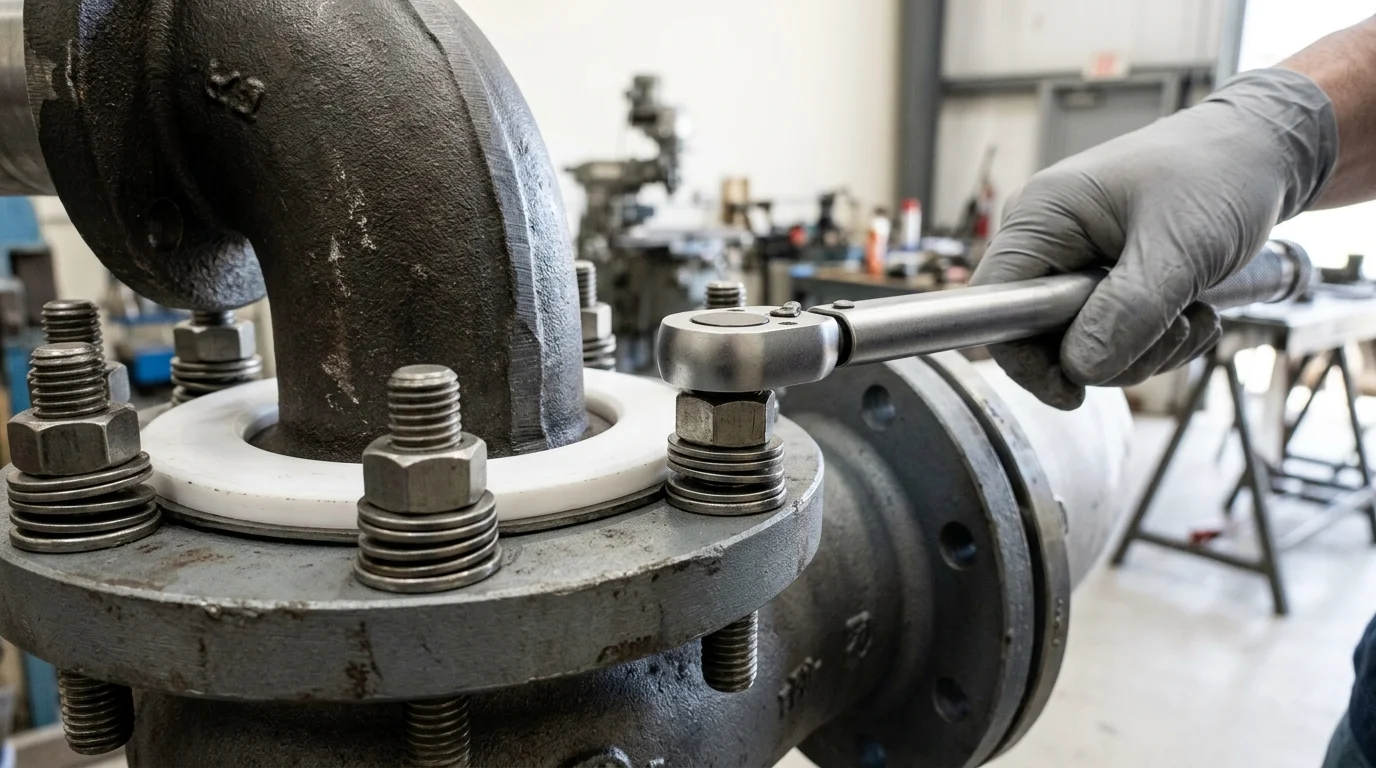
Stop PTFE Lined Pump Flange Leaks: Calibrated Torque Method & Gasket Engineering Standard
A definitive chemical machinery maintenance manual, fluoropolymer flange sealing physics standard, and bolt-torque procedure for plant reliability engineers, maintenance superintendents, and mechanical technicians across Vatva GIDC, Naroda GIDC, Ankleshwar, Dahej, and Gujarat.
Quick Answer
In the aggressive chemical processing corridors of Gujarat—specifically Ahmedabad (Vatva, Naroda, Odhav), Ankleshwar GIDC, Dahej PCPIR, and Vapi—fluoropolymer lined chemical process pumps handle highly corrosive mineral acids (98% H_2SO_4, 33% HCl, 68% HNO_3). Flange leakage at suction and discharge nozzles is one of the most common and dangerous maintenance challenges in these facilities. Unlike rigid metal-to-metal flanges, PTFE and PFA lined raised faces are viscoelastic thermoplastics that exhibit severe cold-flow creep relaxation (10% - 15% loss of initial bolt load within 24 hours) and high thermal expansion mismatch (α_PTFE ≈ 10× α_Steel). Over-tightening flange bolts in an attempt to stop a leak simply crushes the plastic flare, causing radial tears and permanent joint destruction. Eliminating flange leaks permanently requires applying a calibrated 4-pass cross-star torque tightening protocol (25 - 95 N\cdotm based on nozzle DN rating), installing live-loaded Belleville disc spring washers, utilizing virgin expanded PTFE (ePTFE) gaskets, and executing a mandatory cold retorque after 24 hours of initial thermal cycling conforming to ISO 5199, ISO 2858, IS 5120, and IS 1520 standards.
Key Takeaways
- Never Over-Torque a Leaking PTFE Flange Joint. Over-tightening crushes the fluoropolymer raised face; follow calibrated torque tables (25 - 95 N\cdotm).
- Install Live-Loaded Belleville Disc Spring Washers. Springs absorb thermal expansion differentials (α_PTFE ≈ 10× α_Steel) and maintain constant gasket load.
- Execute the 4-Pass Cross-Star Tightening Sequence. Tighten bolts progressively in star pattern passes (30%, 60%, 100%, 100%) to prevent cocking.
- Perform Mandatory 24-Hour Cold Retorquing. Retorque bolts after the first thermal cycle to compensate for viscoelastic cold-flow creep relaxation.
Introduction
Across Gujarat's concentrated chemical manufacturing corridors—spanning Ahmedabad (Vatva, Naroda, Odhav, Changodar), Ankleshwar GIDC, Dahej PCPIR, Panoli, and Vapi—hundreds of chemical manufacturing complexes circulate concentrated, hot mineral acids (98% H_2SO_4, 33% HCl, 68% HNO_3, and hydrofluoric acid blends) daily.
Maintenance superintendents, mechanical engineers, and plant safety managers face severe recurring hurdles:
- The Chronic Acid Flange Weep: Chemical pump suction and discharge flanges frequently begin leaking acidic droplets after 24 to 72 hours of commissioning, corroding nearby baseplates, pipe supports, and motor housings.
- The Intuitive "Pipe-Wrench" Disaster: When technicians observe an acid drip, the standard field reaction is to pull out a heavy wrench and over-tighten the flange bolts. Because PTFE is a viscoelastic plastic, excessive force crushes the sealing flare, causing permanent radial tears and destroying an expensive pump casing liner within minutes.
- The Engineering Standard: Implementing a rigorous, science-based flange torquing procedure conforming to ISO 5199, ISO 2858, IS 5120, and IS 1520 standards—utilizing live-loaded Belleville disc springs, high-purity expanded PTFE gaskets, a calibrated 4-pass cross-star torque sequence, and a mandatory 24-hour cold retorque—permanently eliminates flange leaks and ensures safe, emission-free chemical pumping.
2. Master Flange Bolt Torque & Tightening Specification Matrix
Review the calibrated torque specifications across standard chemical pump nozzle sizes:
| Nominal Flange Size (DN / Inch) | Bolt Quantity & Size | Initial Snug Pass (30%) | Second Pass (60%) | Final Target Torque (100%) | Mandatory 24h Cold Retorque |
|---|---|---|---|---|---|
| DN25 (1'' / 25 mm) | 4 × M12 Studs | 8 N\cdotm | 15 N\cdotm | 25 N\cdotm | 25 N\cdotm (Cold) |
| DN40 (1.5'' / 40 mm) | 4 × M16 Studs | 12 N\cdotm | 25 N\cdotm | 40 N\cdotm | 40 N\cdotm (Cold) |
| DN50 (2'' / 50 mm) | 4 × M16 Studs | 15 N\cdotm | 30 N\cdotm | 50 N\cdotm | 50 N\cdotm (Cold) |
| DN65 (2.5'' / 65 mm) | 4 × M16 Studs | 20 N\cdotm | 40 N\cdotm | 65 N\cdotm | 65 N\cdotm (Cold) |
| DN80 (3'' / 80 mm) | 8 × M16 Studs | 20 N\cdotm | 45 N\cdotm | 70 N\cdotm | 70 N\cdotm (Cold) |
| DN100 (4'' / 100 mm) | 8 × M16 Studs | 25 N\cdotm | 50 N\cdotm | 80 N\cdotm | 80 N\cdotm (Cold) |
| DN125 (5'' / 125 mm) | 8 × M16 Studs | 30 N\cdotm | 60 N\cdotm | 90 N\cdotm | 90 N\cdotm (Cold) |
| DN150 (6'' / 150 mm) | 8 × M20 Studs | 35 N\cdotm | 65 N\cdotm | 95 N\cdotm | 95 N\cdotm (Cold) |
Interactive Chemical Metallurgy & Temperature Compatibility Matrix
ISO 5199 / API 685 Fluoropolymer & Superalloy Standards| Material of Construction | Classification | Max Temp Limit | Compatibility Status @ 65°C |
|---|---|---|---|
Virgin PFAStandard | Fluoropolymer Lining | 160°C | Recommended (A - Zero Corrosion) |
Virgin PTFEStandard | Fluoropolymer Solid/Lined | 150°C | Recommended (A - Zero Corrosion) |
PVDF | Fluoropolymer Thermoplastic | 90°C | Satisfactory (< 2 mpy Corrosion) |
Polypropylene | Commodity Thermoplastic | 60°C | Thermal Derating Exceeded (> 60°C) |
Hastelloy C-276Standard | High-Nickel Superalloy | 110°C | Recommended (A - Zero Corrosion) |
SS316L | Austenitic Stainless Steel | 25°C | Severe Corrosion / Rapid Failure (X) |
SSiC Silicon CarbideStandard | Sintered Ceramic Seal Face | 180°C | Recommended (A - Zero Corrosion) |
Severe oxidizing acid at high concentration. Virgin PFA and PTFE linings provide total chemical inertness up to 160°C. SSiC mechanical seal faces prevent chemical grooving.
3. The Sealing Physics, Viscoelastic Creep & Flange Mechanics
Fluoropolymer Viscoelastic Cold-Flow Creep Kinetics (\epsilon_creep(t) = \epsilon_0 + βt^m)
Under continuous compressive bolt stress, fluoropolymers experience time-dependent plastic strain known as cold-flow creep:
Where:
- \epsilon_0 is the instantaneous elastic strain upon initial bolt torquing.
- β is the creep rate coefficient of the PTFE polymer matrix.
- t is the elapsed operating time in hours.
- m is the viscoelastic time exponent (m ≈ 0.15 - 0.25 for virgin PTFE).
During the first 24 hours after bolt tightening, the PTFE lining beneath the flange face thins by 10% - 15%, relaxing bolt tension and dropping gasket seating stress below the minimum sealing threshold. If the joint is not retorqued cold, process acid immediately breaches the relaxed interface.
Gasket Sealing Stress Thresholds (σ_min ≥ 20 MPa vs σ_crush ≤ 45 MPa)
Flange sealing requires balancing between two critical stress limits:
- Minimum Sealing Stress (σ_min ≥ 20.0 MPa): The minimum compressive stress required to micro-conform the fluoropolymer face to surface asperities and contain high internal hydraulic pressure (10.0 bar).
- Maximum Crushing Stress (σ_crush ≤ 45.0 MPa): Compressive stress exceeding 45 MPa permanently crushes the viscoelastic PTFE wall, creating radial cracks around the flange neck and destroying the casing liner.
Thermal Cycling Expansion Mismatch & Live-Loading Physics (F_spring = -k Δx)
- Thermal Expansion Differential: Solid PTFE expands roughly 10× faster than steel studs (α_PTFE ≈ 120× 10^-6 K⁻¹ vs α_Steel ≈ 12× 10^-6 K⁻¹).
- Thermal Joint Relaxation: When the pump heats up to +90°C, the expanding PTFE is compressed against the rigid steel bolts. When the system cools down during shutdown, the plastic remains permanently compressed, leaving a gap that leaks acid.
- Live-Loaded Spring Solution: Installing Belleville disc spring washers beneath bolt nuts provides continuous mechanical compliance (F = -k Δx), deflecting during heating and expanding during cooling to maintain a constant 25 - 35 MPa sealing stress across all temperature swings.
Piping Misalignment & External Flange Bending Moments (M_bending)
- External Bending Loads: When piping flanges are misaligned with pump nozzles, drawing the flanges together using bolt force creates severe bending moments (M_bending > 250 N\cdotm).
- Localized Flare Pinching: This bending moment concentrates compressive stress on one side of the nozzle (σ> 60 MPa, crushing the flare) while opening a clearance gap on the opposite side (σ< 5 MPa, leaking acid). Piping must always be aligned freely to within 0.4 mm parallel and angular clearance before bolt insertion.
4. The 4 Critical Failure Modes in PTFE Lined Pump Flange Joints
Failure Mode 1: Plastic Face Crushing & Radial Flare Tearing
- Root Cause: Uncontrolled torquing using long breaker bars, exceeding the 45 MPa compressive yield limit and tearing the fluoropolymer flare at the nozzle neck radius.
- Engineering Solution: Apply torque strictly with a calibrated clicker torque wrench according to engineering tables (25 - 95 N\cdotm).
Failure Mode 2: Viscoelastic Bolt Loosening & Thermal Weeping
- Root Cause: Cold-flow creep relaxation and thermal cycling without live-loaded spring washers or 24-hour retorquing.
- Engineering Solution: Install live-loaded Belleville disc springs and enforce a mandatory cold retorque after 24 hours of plant operation.
Failure Mode 3: Angular Piping Misalignment Cocking
- Root Cause: Drawing misaligned suction/discharge piping into place using flange bolts, crushing one edge of the lining flare.
- Engineering Solution: Align piping supports independently so flange faces mate flush with zero external pulling force.
Failure Mode 4: Gasket Extrusion & Chemical Wicking Behind Armor
- Root Cause: Installing incompatible, hard rubber or sheet gaskets that extrude outward and wick acid behind the ductile iron casing.
- Engineering Solution: Standardize on virgin expanded PTFE (ePTFE) gaskets (2.0 mm thickness) with high compressibility and zero chemical wicking.
5. Sanitary Materials of Construction & Cleanroom Standards
Solid Isostatic PTFE & Transfer-Molded PFA Lined Flange Faces (≥ 4.5 mm)
- Flange Fluoropolymers: Heavy-duty isostatically molded PTFE and transfer-molded PFA lined raised faces with a continuous wall thickness of 4.5 - 6.0 mm, offering total chemical resistance across 0 - 14 pH up to +150°C.
Belleville Disc Springs (17-7PH Stainless Steel)
- Live-Loading Springs: High-fatigue, corrosion-resistant 17-7PH precipitation-hardened stainless steel or Inconel 718 Belleville spring washers, engineered to maintain constant gasket seating load under extreme thermal cycling.
Expanded PTFE (ePTFE) & Modified Gasket Configurations
- Gasket Materials: 100% multidirectionally expanded PTFE (ePTFE) sheet gaskets (1.5 - 2.0 mm thickness, density 0.85 g/cm³), delivering superior compressibility and minimal creep relaxation.
High-Tensile Class 8.8 / SS316 Casing Studs & Hardened Washers
- Fasteners: Grade B7 / Class 8.8 electro-galvanized or SS316 flange stud bolts paired with hardened flat washers and molybdenum disulfide (MoS_2) anti-seize lubricant (k_friction = 0.12 - 0.14).
6. Step-by-Step Calibrated Flange Torquing & Leak Elimination SOPs
Execute these structured engineering SOPs when assembling or maintaining fluoropolymer pump flanges:
Phase 1: Flange Face Cleaning, Inspection & Alignment SOP
- Visual Audit: Clean both mating flange faces with isopropanol. Inspect fluoropolymer flare for scratches, gouges, or cracks. If gouges exceed 0.3 mm depth, re-face or replace the component.
- Alignment Check: Verify flange alignment using a feeler gauge. Parallel gap must be ≤ 0.4 mm, and bolt holes must align without prying.
Phase 2: Gasket Insertion & Bolt Lubrication SOP
- Gasket Placement: Center a new 2.0 mm ePTFE gasket on the raised face without using liquid sealant, silicone, or grease.
- Fastener Prep: Apply a thin, uniform film of MoS_2 anti-seize lubricant to bolt threads and nut bearing surfaces.
- Live-Loading Setup: Install two Belleville disc springs in series (cupped facing each other) beneath each nut.
Phase 3: 4-Pass Cross-Star Torquing Sequence SOP
Tighten bolts in a crisscross star pattern (1 \to 3 \to 2 \to 4) in 4 distinct progressive passes using a calibrated torque wrench:
- Pass 1 (Snug Pass, 30%): Tighten all bolts to 30% of target torque in cross-star sequence.
- Pass 2 (Mid Pass, 60%): Tighten all bolts to 60% of target torque in cross-star sequence.
- Pass 3 (Final Pass, 100%): Tighten all bolts to 100% of target torque in cross-star sequence.
- Pass 4 (Verification Pass, 100%): Make a final clockwise circular pass around the flange at 100% torque until no nut turns further.
Phase 4: Mandatory 24-Hour Cold Retorque Protocol SOP
- Thermal Normalization: Allow the pump to operate through its first thermal cycle (24 hours).
- Cold Retorque: With the pump de-pressurized and cooled to ambient temperature, apply a 100% target torque pass in a circular sequence to recover lost bolt preload resulting from initial viscoelastic creep.
Phase 5: Hydrostatic Proof & Ultrasonic Leak Testing SOP
- Pressure Proof: Hydrostatically test the assembled flange joint with clean water at 1.5× operating pressure (10.0 bar) for 15 minutes.
- NDT Leak Audit: Verify zero pressure drop and scan the joint with an ultrasonic leak detector.
Phase 6: Total Cost of Ownership (TCO) & Maintenance Economics SOP
Evaluate the total cost of ownership over a 5-year operating horizon:
- Economic Verdict: Installing Belleville springs and standardizing on calibrated 4-pass torquing costs less than Rs 2,500 per pump, but prevents catastrophic casing burn-through and hazardous acid spills, saving over Rs 4,50,000 in annual emergency repairs and environmental cleanup costs.
7. Worked Gujarat Chemical Plant Case Studies
Case 1: Vatva GIDC Bulk API Facility Hydrochloric Acid Suction Flange Leak
- Plant Context: An active pharmaceutical ingredient complex in Vatva GIDC pumping commercial 33% HCl at 45°C to bulk reaction kettles.
- Problem: The DN80 suction flange wept acid droplets continuously, corroding the baseplate and creating toxic acid fumes.
- Action Plan: Teflow engineers inspected the joint, installed live-loaded Belleville disc springs, an ePTFE gasket, and torqued bolts to 70 N\cdotm in a 4-pass star sequence followed by a 24-hour cold retorque.
- Outcome: 100% leak-free sealing achieved; continuous operation across 26 consecutive operating months; zero acid emissions.
Case 2: Naroda GIDC Reactive Dye Plant Hot Sulfuric Acid Discharge Flange Audit
- Plant Context: A reactive dye manufacturing unit in Naroda GIDC circulating 70% H_2SO_4 at 75°C.
- Problem: Discharge flange leaked every weekend during thermal cool-down cycles. Technicians over-tightened the bolts, crushing the PTFE flare.
- Action Plan: Replaced the damaged casing liner with Teflow solid PTFE components, installed live-loaded Belleville washers, and enforced calibrated 50 N\cdotm torque limits.
- Outcome: Zero thermal cool-down leaks; continuous reliable operation over 24 consecutive operating months.
Case 3: Ankleshwar GIDC Agrochemical Technical Nitration Flange Retrofit
- Plant Context: An agrochemical technical facility in Ankleshwar GIDC pumping concentrated nitric acid (68% HNO_3).
- Problem: Severe piping misalignment exerted heavy bending stress on the pump discharge nozzle, causing recurring leaks.
- Action Plan: Realighed piping supports to within 0.3 mm tolerance and implemented Teflow 4-pass cross-star torquing protocols.
- Outcome: Flange bending stress eliminated; continuous leak-free pumping over 28 consecutive operating months.
Case 4: Dahej PCPIR Specialty Chemical Spent Acid Distillation Flange Sealing
- Plant Context: A specialty chemical plant in Dahej PCPIR distilling spent acidic solvents under fluctuating vacuum and pressure (-0.85 bar to +4.0 bar, 110°C).
- Problem: Flange joints lost bolt preload rapidly due to extreme thermal cycling.
- Action Plan: Standardized on Teflow transfer-molded PFA lined pumps with high-temperature Inconel Belleville disc springs.
- Outcome: Zero vacuum or pressure leakage; MTBF extended to 22 consecutive operating months.
Case 5: Odhav Metal Finishing Pickling Bath Pump Flange Replacement
- Plant Context: A metal finishing facility in Odhav pumping spent pickling acids (15% HNO_3 + 4% HF).
- Problem: Technicians used silicone sealant on PTFE flange faces, causing gasket blowouts under pressure.
- Action Plan: Cleaned flange faces, installed virgin ePTFE gaskets without sealant, and applied calibrated 40 N\cdotm torque.
- Outcome: Zero blowouts; continuous safe operation across 24 consecutive operating months.
Case 6: Vapi GIDC Synthetic Pigment Plant Abrasive Acid Flange Overhaul
- Plant Context: A synthetic organic pigment plant in Vapi GIDC pumping abrasive acid slurries (6.0 bar head).
- Problem: Vibration from slurry pumping loosened flange bolts, causing acid weeping.
- Action Plan: Retrofitted Teflow live-loaded Belleville spring washers and enforced the 24-hour retorquing standard.
- Outcome: Bolt loosening eliminated 100%; continuous operation over 24 consecutive operating months.
8. Step-by-Step PTFE Flange Leak Troubleshooting Decision Matrix
Follow this structured engineering guide when troubleshooting fluoropolymer flange leaks:
| Observed Symptom | Probable Root Cause | Recommended Maintenance Action |
|---|---|---|
| Acid Weeping After 24 Hours of Run | Viscoelastic cold-flow creep relaxation | Perform 100% cold retorque; install Belleville springs |
| Flange Weeping During Plant Cool-Down | Thermal expansion differential (Δα) | Install live-loaded Belleville disc spring washers |
| Lining Flare Torn / Crushed at Neck | Excessive bolt torque from manual wrenching | Replace casing liner; enforce calibrated torque tables |
| Leak Concentrated on One Flange Side | Severe angular/parallel piping misalignment | Realign piping supports to ≤ 0.4 mm tolerance |
| Gasket Extruded Outward from Flange | Incompatible soft rubber / non-ePTFE gasket | Replace with virgin 2.0 mm expanded PTFE gasket |
| Bolt Studs Corroded & Frozen | Lack of MoS_2 anti-seize lubricant | Replace with SS316 / B7 studs; apply MoS_2 lube |
9. Comprehensive Master Chemical Flange Joint Assembly (FAT) Checklist
Execute this quality verification protocol during every fluoropolymer pump flange assembly:
PTFE Lined Pump Flange Joint Assembly Protocol
10. Summary & Fluoropolymer Pump Maintenance Support in Gujarat
Eliminating hazardous acid flange leaks, preventing catastrophic fluoropolymer flare crushing, implementing calibrated 4-pass cross-star torque tightening based on viscoelastic polymer physics, and extending equipment service life beyond 35,000 hours across Vatva GIDC, Naroda GIDC, Ankleshwar, Dahej PCPIR, and Vapi—by utilizing live-loaded Belleville disc springs, expanded PTFE gaskets, and calibrated torque methods conforming to ISO 5199, ISO 2858, IS 5120, and IS 1520 standards—is the proven engineering standard for chemical plant reliability.
Partnering directly with an established Gujarat chemical rotating machinery manufacturer provides maintenance and engineering teams with immediate technical access to on-site flange audits, torque training, failure analysis, and genuine fluoropolymer spares. Our technical engineers provide on-site pump sizing audits, flange leakage troubleshooting, and plant life-extension consulting.
Teflow Pumps operates a specialized chemical rotating machinery manufacturing facility in Ahmedabad, providing engineered PFA-lined pumps, solid PTFE process pumps, PVDF centrifugal pumps, precision mechanical seals, dynamic rotor balancing, and genuine rotating equipment spares across Gujarat conforming to ISO 5199, ISO 2858, IS 5120, and API 685 standards.
- Direct Technical & Emergency Helpline: +91 98251 62709
- WhatsApp Technical Desk: Share photos of leaking flanges, acid fluid details, operating temperature (°C), or current pump model to wa.me/919825162709 for immediate technical review, torque sizing diagnostics, and formal quotation.
- Request an On-Site Flange Sealing & Pump Audit Survey: Contact our senior rotating equipment engineers for plant pump surveys, torque audit proposals, and formal quotation. Our engineering team conducts comprehensive flange face inspections, analyzes piping misalignment stress, and provides certified torque assembly protocols to ensure zero acid leakage.