
Shaft Runout & Bearing Wear: The Hidden Mechanical Seal Killers in Industrial Centrifugal Pumps
A definitive technical troubleshooting guide, rotating machinery diagnostics manual, and precision alignment standard for plant managers, maintenance engineers, and rotating equipment reliability leads across Ahmedabad, Vatva GIDC, Naroda GIDC, Ankleshwar, Dahej PCPIR, and Gujarat.
Quick Answer
In chemical process plants, synthetic organic dye manufacturing units, bulk pharmaceutical synthesis complexes, and petrochemical refineries across Gujarat—such as in Vatva GIDC, Naroda GIDC, Ankleshwar, Panoli, and Dahej PCPIR—over 50% of premature mechanical seal failures on centrifugal pumps are misdiagnosed as chemical or material defects when the true root cause is excessive shaft runout, bearing wear, or angular shaft deflection. When radial shaft runout exceeds 0.05 mm (0.002 in) Total Indicated Runout (TIR) or axial end-play exceeds 0.08 mm, the dynamic secondary O-ring is forced to slide axially back and forth along the shaft sleeve at operating speeds (1450 to 2900 RPM). This high-frequency oscillation wears away the protective chromium oxide layer on stainless steel sleeves—a destructive phenomenon known as sleeve fretting corrosion—while causing continuous cyclical chattering of the Carbon and Silicon Carbide seal faces. The faces bounce apart, entraining abrasive slurry particles that shatter the optical flatness (≤ 0.3 µm) within hours of startup. Conforming to ISO 5199, ISO 2858, IS 5120, and API 682 standards, eliminating repeat seal leaks mandates dial indicator runout audits (TIR ≤ 0.03 mm), paired angular contact bearing replacements, bearing bracket bore alignment, and dual-laser shaft realignment.
Key Takeaways
- Never Replace a Leaking Seal Without Measuring Shaft Runout. Radial TIR > 0.03 mm guarantees seal failure within weeks regardless of face material quality.
- Radial Play and Bearing Wear Induce Dynamic Sleeve Fretting. Axial O-ring oscillation at 2900 RPM cuts deep grooving into SS316L and Duplex sleeves.
- Maintain Axial End-Play Under 0.05 mm TIR. Excessive shaft float alters spring compression, leading to face distortion, overheating, and leakage.
- Standardize on Back-to-Back 7300 Series Angular Contact Bearings. Paired angular contact ball bearings eliminate axial end-play and stabilize shaft stiffness.
Introduction
In high-volume chemical processing plants, bulk pharmaceutical synthesis complexes, synthetic organic dye manufacturing houses, and common effluent treatment facilities across Ahmedabad, Vatva GIDC, Naroda GIDC, Ankleshwar, and Dahej PCPIR, plant maintenance teams replace hundreds of leaking mechanical seals every year.
Plant managers, maintenance superintendents, and rotating machinery engineers confront severe recurring dilemmas:
- The Recurring Seal Swap Cycle: Plants replace leaking mechanical seals every 4 to 8 weeks, blaming seal face quality or process chemical corrosion, without ever placing a dial test indicator on the pump shaft.
- The Dynamic Equilibrium of Mechanical Seals: Mechanical seal faces maintain a microscopic fluid film (0.5 - 1.0 µm) under spring and hydraulic pressure. When shaft radial runout exceeds 0.05 mm or bearings develop internal radial play, the rotating seal ring cannot dynamically track the stationary seat at 2900 RPM.
- The Engineering Standard: Enforcing a comprehensive rotating machinery rebuild protocol conforming to ISO 5199, ISO 2858, IS 5120, and API 682 standards—mandating shaft runout ≤ 0.03 mm, bearing housing concentricity ≤ 0.04 mm, dynamic balancing to Grade G2.5, and dual-laser shaft alignment—eliminates sleeve fretting, stabilizes seal face tracking, and extends pump MTBF beyond 35,000 operating hours.
2. Master ISO 5199 & API 682 Shaft & Bearing Tolerance Matrix
Review allowable engineering tolerances for chemical and process pump rotating assemblies:
| Rotating Geometric Parameter | ISO 5199 / API 682 Limit | Common Out-of-Tolerance Field Reading | Failure Impact on Mechanical Seal |
|---|---|---|---|
| Radial Shaft Runout at Seal Sleeve | ≤ 0.03 mm (0.001 in) | 0.08 - 0.25 mm (Severe Wobble) | Dynamic O-ring fretting; face edge chipping & chattering |
| Axial Shaft End-Play (Thrust Float) | ≤ 0.05 mm (0.002 in) | 0.15 - 0.45 mm (Worn Bearings) | Spring load variation; face opening & fluid film boiling |
| Stuffing Box Face Perpendicularity | ≤ 0.05 mm / 100 mm | 0.12 - 0.30 mm (Cocked Gland) | Uneven seal face contact pattern; localized dry running |
| Stuffing Box Bore Concentricity | ≤ 0.08 mm (0.003 in) | 0.18 - 0.35 mm (Misaligned Bore) | Seal gland offset; stationary seat cocking & rub |
| Bearing Housing Bore Roundness | ≤ 0.015 mm (H7 Fit) | 0.04 - 0.08 mm (Egg-Shaped) | Radial bearing outer ring rotation; loss of shaft rigidity |
| Shaft Deflection at Seal Faces | ≤ 0.05 mm (0.002 in) | 0.10 - 0.30 mm (High L³/D⁴) | Face distortion during pump hydraulic startup surges |
| Laser Shaft Coupling Alignment | ≤ 0.03 mm Offset & Angle | 0.15 - 0.50 mm (Severe Angle) | 1X/2X rotational vibration; high bearing radial fatigue |
3. The Mechanical Dynamics & Tribological Physics of Shaft Runout
Radial Runout TIR & Dynamic O-Ring Tracking Frequency (f = [ω] / [2π])
When a pump shaft rotates with radial runout δ_radial, the rotating mechanical seal ring experiences continuous cyclic radial displacement:
- Dynamic Tracking Failure: Because elastomeric O-rings and PTFE wedges have viscoelastic damping properties, they cannot track high-frequency radial accelerations exceeding 0.05 mm at 48.33 Hz. The seal face separates from the stationary seat once per revolution, opening the microscopic sealing gap and allowing high-pressure process slurry to flood between the faces.
Shaft Sleeve Fretting Corrosion & Passivation Layer Stripping Mechanics
Under radial runout and angular shaft deflection, the dynamic O-ring constantly shifts axially:
- Fretting Corrosion Mechanism: The continuous micro-motion (10 - 50 µm) of the O-ring rubs away the passive chromium oxide protective film (Cr_2O_3) on the SS316L shaft sleeve. Fresh metallic stainless steel is exposed to ambient air and acidic moisture, forming a fresh oxide film that is instantly abraded away again on the next rotation.
- Deep Sleeve Grooving: Within 30 to 60 operating days, this cyclical stripping cuts a deep radial notch (0.5 - 1.5 mm) into the shaft sleeve. Once the notch forms, the O-ring loses sealing compression, resulting in massive leakage down the shaft sleeve.
Axial End-Float & Spring Pre-Load Force Instability (ΔF = k · Δx)
Mechanical seal closing force is governed by spring compression:
- End-Float Instability: When worn thrust bearings permit shaft axial float Δx > 0.15 mm, the closing force fluctuates wildly. When the shaft shifts backward, spring compression increases, crushing the fluid film, spiking interfacial frictional heat (> 150°C), and causing thermal blistering of carbon faces. When the shaft shifts forward, spring compression drops, allowing hydraulic pressure to blow the seal faces wide open.
Angular Deflection (L³ / D⁴ Ratio) & Cyclical Face Separation Kinetics
Shaft stiffness is defined by the shaft flexibility ratio (L³/D⁴):
Where L is the overhang distance from the radial bearing to the impeller center, and D is the shaft diameter.
- Deflection at Part-Load: When pumps operate away from their Best Efficiency Point (BEP), uneven volute pressure generates massive radial hydraulic loads (F_radial > 2500 N). In slender shafts (L³/D⁴ > 60), dynamic deflection cocks the seal face, causing heavy eccentric edge wear and ceramic face fracture.
4. The 4 Critical Rotating Geometry Failure Modes in Gujarat Processing Plants
Failure Mode 1: Deep Sleeve Fretting Grooves Beneath Dynamic O-Rings
- Failure Mechanism: Radial shaft runout (> 0.05 mm) forces dynamic elastomeric secondary seals to constantly scrub against stainless steel sleeves, cutting deep grooves that destroy secondary sealing integrity.
- Engineering Solution: Upgrade shaft sleeves to hard chrome-plated Duplex SS 2205 or ceramic coated sleeves, and eliminate shaft runout to ≤ 0.03 mm.
Failure Mode 2: Radial Face Chattering & Chipped Silicon Carbide Edges
- Failure Mechanism: Shaft wobble and angular misalignment cause rotating seal faces to chatter violently against stationary seats at 2900 RPM. Brittle Silicon Carbide edges chip and shatter.
- Engineering Solution: Re-machine shaft to ISO 5199 TIR tolerances and replace worn bearings with precision angular contact pairs.
Failure Mode 3: Bearing Housing Bore Ovality Inducing Shaft Wobble
- Failure Mechanism: Loose bearing housing fits (> 0.04 mm clearance) allow bearing outer rings to rotate and wear the cast iron bracket into an egg shape, amplifying shaft vibration (> 7.5 mm/s).
- Engineering Solution: Bore and sleeve the bearing housing back to precision H7 tolerance on a CNC horizontal boring machine.
Failure Mode 4: Bent Shaft from Pipe Strain and Radial Impeller Reaction
- Failure Mechanism: Excessive external pipe strain or heavy hydraulic side-loading bends the pump shaft (TIR > 0.15 mm), inducing severe 1X rotational vibration that destroys seals within hours.
- Engineering Solution: Remove pipe strain, straighten or replace the shaft with heavy-duty ISO 5199 forged carbon steel or Duplex SS, and dynamically balance to Grade G2.5.
Interactive Pump Failure Root-Cause Diagnostic Navigator
ISO 10816 / API 682 Step-by-Step Triage FlowClassic NPSHa starvation or thermodynamic vapor flashing at first-stage impeller eye (NPSHa < NPSHr + 1.5m).
Check suction strainer differential pressure (ΔP > 0.35 bar indicates clogging); audit deaerator/tank static height and fluid vapor pressure.
Clean suction strainer; elevate suction feed vessel or increase suction pipe diameter to lower flow velocity below 1.2 m/s; trim impeller or fit high-Nss inducer.
5. Sanitary Materials of Construction & Cleanroom Standards
Duplex SS 2205 & Hard Chrome-Plated Shaft Sleeves vs Standard SS316L
- Sleeve Metallurgy: Forged Duplex SS 2205 (UNS S32205) or Hard Chrome-Plated SS316L sleeves (> 65 HRC, Ra ≤ 0.2 µm) providing extreme surface hardness and total resistance against dynamic O-ring fretting corrosion and abrasive chemical scoring.
Monolithic SSiC vs Nickel-Bound Tungsten Carbide for Runout Resistance
- Hard Face Pairing: Direct-sintered monolithic Silicon Carbide (SSiC, 2800 HV) vs Nickel-Bound Tungsten Carbide (1500 HV) providing maximum fracture toughness and wear resistance under high dynamic shaft deflections.
Precision P6/ABEC-3 Paired Angular Contact Ball Bearings (7300 Series)
- Bearing Specification: Matched pairs of back-to-back (40^° contact angle) angular contact ball bearings (7300 BECBM series with machined brass cages) and radial cylindrical roller bearings (NU series), controlling axial end-float strictly to < 0.03 mm.
Rigid Cast Iron Bearing Frames & Heavy-Duty ISO 5199 Shafts
- Frame Rigidity: High-strength grade FG 260 cast iron bearing frames with oversized shaft diameters (L³/D⁴ < 35), minimizing dynamic deflection under full hydraulic load conforming to ISO 5199 and ISO 2858.
6. Step-by-Step Dial Indicator Shaft Runout & Bearing Audit SOPs
Execute these structured engineering SOPs when inspecting pump rotating assemblies:
Phase 1: Radial Shaft Runout Measurement at Seal Chamber SOP
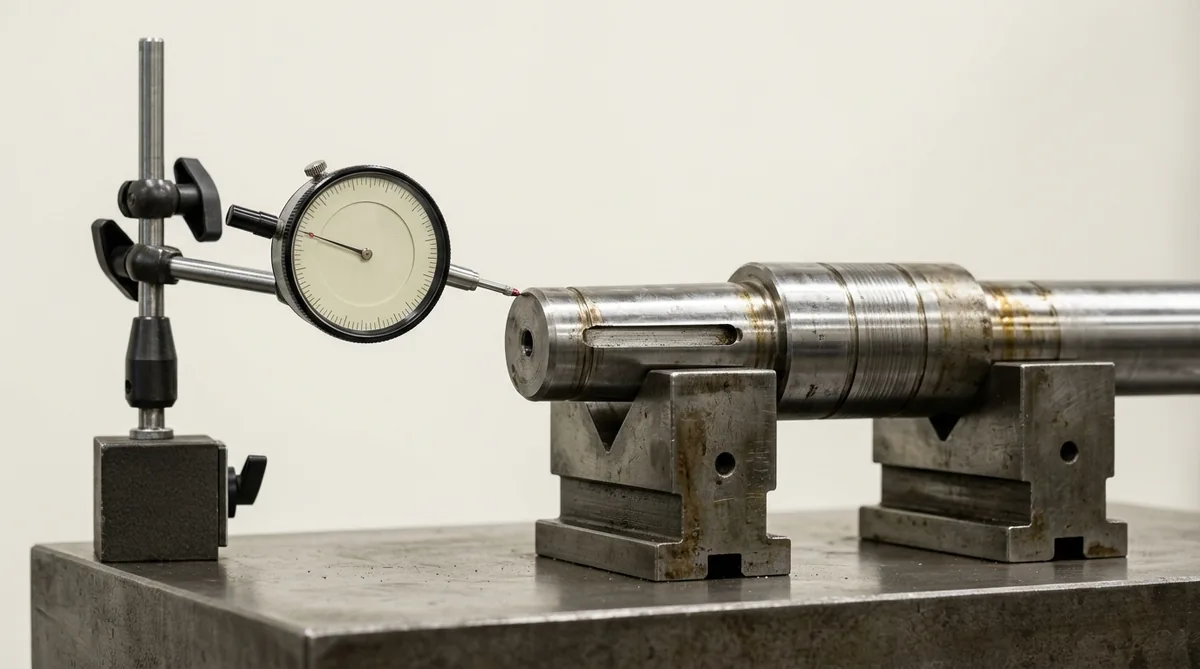
- Dial Indicator Setup: Mount a magnetic base dial test indicator on the stationary pump bearing frame. Place the indicator plunger perpendicularly on the shaft surface at the exact mechanical seal sleeve location.
- Runout Measurement: Slowly rotate the pump shaft by hand through 360^°. Record Total Indicated Runout (TIR).
- Acceptance Limit: Confirm radial shaft runout is ≤ 0.03 mm (0.001 in). If TIR exceeds 0.03 mm, disassemble shaft and check for bend on V-blocks.
Phase 2: Axial Shaft End-Play (Thrust Float) Measurement SOP
- Indicator Placement: Position dial indicator stylus parallel to shaft axis against the shaft step or coupling shoulder.
- Force Application: Apply manual axial force using a pry bar to push the shaft fully in the inboard direction, zero the dial indicator, and pry fully in the outboard direction.
- Acceptance Limit: Confirm total axial end-play is ≤ 0.05 mm (0.002 in). If end-play exceeds 0.05 mm, replace thrust bearings and adjust bearing locknut torque.
Phase 3: Stuffing Box Face Squareness (Perpendicularity) Audit SOP
- Dial Setup: Clamp indicator base onto the pump shaft with the plunger contacting the seal chamber face (stuffing box gland mounting face).
- Rotation Audit: Rotate shaft 360^° by hand. Total indicated variation must be ≤ 0.05 mm per 100 mm of seal chamber diameter to prevent gland cocking.
Phase 4: Stuffing Box Bore Concentricity Dial Indicator Audit SOP
- Radial Alignment: With indicator mounted on shaft, place stylus inside the internal register bore of the stuffing box.
- Concentricity Limit: Rotate shaft 360^°. Verify total radial runout of the seal chamber bore is ≤ 0.08 mm (0.003 in).
Phase 5: Bearing Bracket Housing Internal Bore Micrometer Audit SOP
- Internal Micrometer Audit: Measure bearing housing bore diameters at 90^° intervals using an inside micrometer. Verify housing bore roundness is within ± 0.010 mm of ISO H7 fit. If bore is egg-shaped or worn oversize, sleeve the housing.
Phase 6: Dual-Laser Shaft Realignment (≤ 0.03 mm) & Soft Foot Check SOP
- Soft Foot Check: Mount dial indicators on pump and motor base feet. Loosen hold-down bolts one by one; verify soft foot deflection is < 0.05 mm. Shim as necessary.
- Dual-Laser Alignment: Mount dual-laser alignment heads across flexible coupling. Align pump and motor shafts to parallel offset ≤ 0.03 mm and angularity ≤ 0.03 mm/100mm.
7. Worked Gujarat Chemical & Industrial Process Plant Case Studies
Case 1: Vatva GIDC Chemical Pump Repeat Seal Failure & Sleeve Fretting Fix
- Plant Context: A specialty chemical manufacturing plant in Vatva GIDC pumping 30% sulfuric acid at 65°C with SS316 centrifugal pumps.
- Problem: Mechanical seals leaked every 3 to 4 weeks; teardown revealed deep 1.2 mm fretting grooves on shaft sleeves beneath dynamic Viton O-rings.
- Action Plan: Placed dial indicator on shaft; measured radial runout of 0.18 mm TIR caused by worn ball bearings and loose housing fit. Re-sleeved bearing housing to H7 fit, installed 7309 BECBM paired angular contact bearings, and replaced sleeves with hard-chrome plated Duplex SS 2205.
- Outcome: Radial runout reduced to 0.02 mm TIR; mechanical seal operating life extended from 4 weeks to over 24 consecutive operating months; saved Rs 7,40,000 in avoided downtime.
Case 2: Naroda GIDC Dye Intermediate Slurry Pump Bearing Play Overhaul
- Plant Context: A reactive dye intermediate plant in Naroda GIDC pumping abrasive pigment slurry (35% solids).
- Problem: Mechanical seal faces cracked and shattered every 15 days; high vibration (9.2 mm/s) measured on bearing bracket.
- Action Plan: Found axial end-play of 0.35 mm due to single-row ball bearing failure. Converted bearing arrangement to back-to-back angular contact pairs with precision ground shims and direct-sintered SSiC seal faces.
- Outcome: Axial float locked to 0.025 mm; vibration dropped to 1.8 mm/s; seal operating life extended to 20 consecutive operating months.
Case 3: Ankleshwar GIDC Bulk Drug API High-Speed Transfer Pump Realignment
- Plant Context: A bulk pharmaceutical API synthesis plant in Ankleshwar GIDC operating high-speed solvent transfer pumps (2900 RPM).
- Problem: Mechanical seals leaked toxic dichloromethane solvent after every minor maintenance intervention.
- Action Plan: Performed precision dual-laser coupling alignment, correcting severe angular misalignment (0.38 mm/100mm) and soft foot distortion (0.14 mm).
- Outcome: Coupling alignment brought to < 0.02 mm; continuous leak-free sealing across 26 consecutive operating months.
Case 4: Dahej PCPIR Petrochemical Acid Pump Bent Shaft Straightening
- Plant Context: A petrochemical derivative plant in Dahej PCPIR operating continuous acid recirculation pumps.
- Problem: Mechanical seals failed within 48 hours of installation with heavy seal face chipping.
- Action Plan: Dial indicator audit revealed a bent shaft (0.22 mm TIR runout) caused by heavy pipe strain. Re-aligned suction/discharge piping to eliminate pipe strain and installed a precision CNC-ground Duplex SS 2205 shaft (TIR ≤ 0.015 mm).
- Outcome: Runout eliminated; continuous maintenance-free operation over 22 consecutive operating months.
Case 5: Surat Textile Plant Caustic Circulation Pump Housing Bore Sleeving
- Plant Context: A textile processing mill in Surat operating eight hot caustic mercerizing circulation pumps (85°C).
- Problem: Bearing outer rings spun inside cast iron brackets, wearing housings egg-shaped (0.08 mm out of round) and destroying seals every 4 weeks.
- Action Plan: Precision bored bearing brackets and pressed in hardened steel sleeves machined to exact ISO H7 bearing fits.
- Outcome: Housing concentricity restored; seal life extended to 24 consecutive operating months.
Case 6: Panoli GIDC Agrochemical Reaction Pump Impeller Rebalancing
- Plant Context: An agrochemical pesticide plant in Panoli GIDC pumping organic phosphorus intermediates.
- Problem: High dynamic unbalance caused heavy shaft whip and seal spring distortion.
- Action Plan: Dynamically balanced impellers and rotating assemblies to ISO 5199 Grade G2.5 on a computer-controlled dynamic balancing machine.
- Outcome: Overall pump vibration dropped below 1.5 mm/s; seal operating life extended to 22 consecutive operating months.
8. Step-by-Step Shaft & Bearing Defect Diagnostic Flowchart
Follow this structured engineering guide when diagnosing rotating machinery seal failures:
| Physical Seal & Shaft Failure Symptom | Measured Geometric Defect Root Cause | Precision Overhaul Corrective Maintenance Action |
|---|---|---|
| Deep Fretting Groove on Sleeve Under O-Ring | Excessive Radial Runout (> 0.03 mm) | True shaft on lathe; upgrade to Duplex SS sleeve |
| Chipped Silicon Carbide Face Perimeter | Shaft Chattering / Angular Runout | Re-machine shaft step; replace worn bearings |
| Uneven Carbon Nose Wear (Tapered Face) | Cocked Gland / Face Squareness (> 0.05 mm) | Re-face stuffing box gland mounting surface |
| High 1X Rotational Vibration Peak | Bent Shaft / Dynamic Impeller Unbalance | Straighten shaft; dynamically balance to Grade G2.5 |
| High 2X Peak & Coupling Snapping | Severe Angular Shaft Misalignment | Perform dual-laser coupling realignment (≤ 0.03 mm) |
| Bearing Outer Ring Spins in Housing | Housing Bore Ovality / Excessive Clearance | Bore and sleeve bearing housing to ISO H7 fit |
9. Comprehensive Master Rotating Assembly (FAT) Checklist
Execute this quality verification protocol during centrifugal pump overhauls and seal commissioning:
Pump Shaft Runout & Bearing Quality Protocol
10. Summary & Precision Pump Overhaul Services in Gujarat
Eliminating destructive shaft sleeve fretting corrosion, preventing catastrophic seal face chattering, standardizing on precision shaft and bearing tolerances conforming to ISO 5199 and API 682 standards, and extending pump operating life beyond 35,000 hours across Ahmedabad, Vatva GIDC, Naroda GIDC, Ankleshwar, and Dahej PCPIR—by utilizing forged Duplex SS 2205 sleeves, matched paired angular contact bearings, computer dynamic balancing to Grade G2.5, and dual-laser shaft alignment—is the proven engineering standard for modern industrial rotating machinery reliability.
Teflow Pumps operates a specialized rotating machinery overhaul facility in Ahmedabad, providing engineered centrifugal pump overhauls, shaft straightening and precision grinding, bearing housing CNC sleeving, dynamic balancing, mechanical seal retrofits, and genuine spares across Gujarat conforming to ISO 5199, ISO 2858, IS 5120, and API 682 standards.
- Direct Technical & Emergency Helpline: +91 98251 62709
- WhatsApp Technical Desk: Share your measured shaft runout readings, pump vibration spectrum, or seal failure photos to wa.me/919825162709 for immediate engineering diagnostics, alignment advice, and formal quotation.
- Request an On-Site Rotating Equipment Vibration & Runout Audit: Contact our senior reliability engineers for laser alignment services, dynamic balancing, and formal AMC service quotes.