
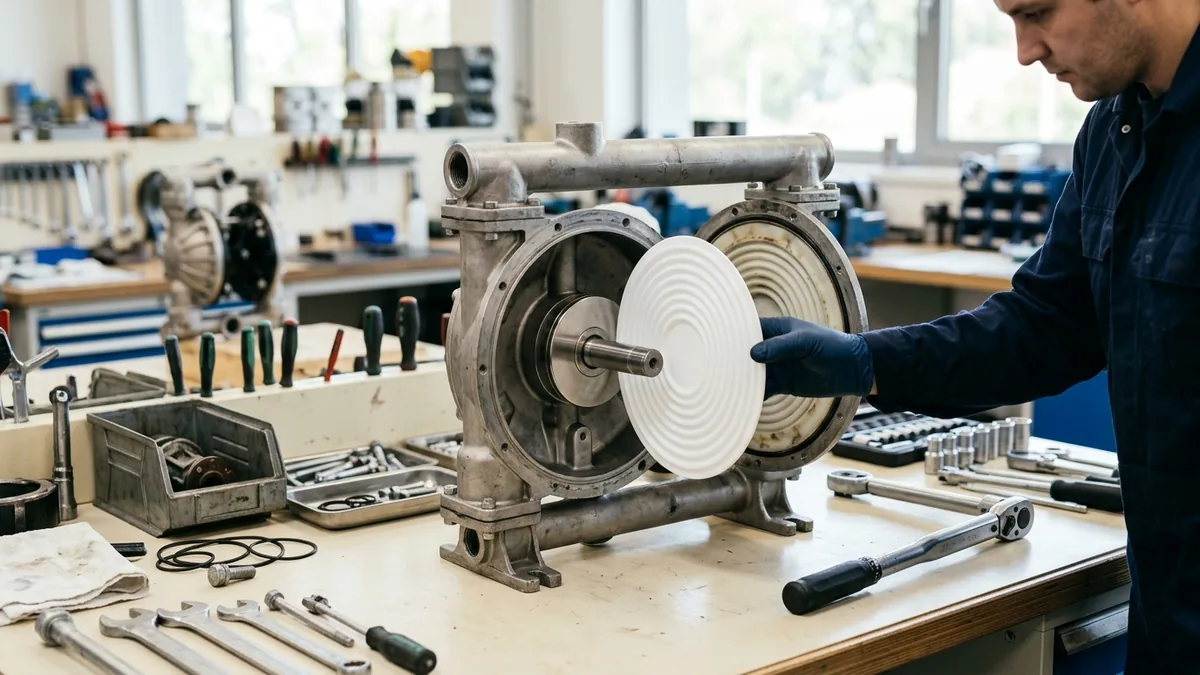
Retrofit PTFE Diaphragms Into Your Existing AODD Pump: Complete Engineering & Conversion Manual
A definitive rotating and reciprocating machinery retrofit guide, diaphragm fatigue mechanics manual, and chemical compatibility standard for maintenance engineers, plant reliability superintendents, and dyestuff production heads across Ahmedabad, Vatva, Naroda, Ankleshwar, and Gujarat.
Quick Answer
In the aggressive dyestuff, organic pigment, and specialty chemical manufacturing clusters of Gujarat—including Vatva GIDC, Naroda GIDC, Odhav, and Ankleshwar—air-operated double diaphragm (AODD) pumps handle solvent-acid slurries, filter press feeds, and toxic chemical transfers continuously. Many plant operators originally purchased standard AODD pumps fitted with rubber (Neoprene, Nitrile/Buna-N, or EPDM) or thermoplastic (Santoprene, Hytrel) diaphragms. When transferred to aggressive solvent duties or acidic pigment reactions (33% HCl, 98% H_2SO_4, acetone, toluene, ethyl acetate), rubber diaphragms swell, blister, soften, and tear within weeks. Retrofitting engineered Polytetrafluoroethylene (PTFE / Modified TFM) diaphragms provides universal 0 - 14 pH chemical immunity, eliminates solvent swelling, and protects factory air chambers from catastrophic chemical flooding. However, because PTFE is stiffer than rubber with lower elongation (300% vs 700%), a successful retrofit requires a dedicated backup elastomer diaphragm, modified outer piston clamping plates, tuned air pressure regulation (P_air ≤ 6.5 bar), and strict adherence to ISO 5199, ISO 2858, IS 5120, and HI 1.3 standards.
Key Takeaways
- Always Pair PTFE Diaphragms with a Flexible Elastomer Backer. A secondary Santoprene or EPDM backup diaphragm supports flexural stress and protects the air valve.
- Utilize Modified PTFE (TFM) for 4x Flex-Fatigue Life. TFM resin offers smaller polymer crystallites, reducing micro-void initiation during cyclic flexing.
- Match Outer Clamping Plate Diameters to Prevent Pinch Shearing. Ensure outer piston plates feature smooth, radiused edges and torque to 25 - 45 N\cdotm.
- Regulate Inlet Air Pressure to 4.5 - 6.5 bar Maximum. Over-pressurizing pneumatic supply air over-strokes stiff PTFE, leading to circumferential fold fatigue.
Introduction
In Gujarat's major dye manufacturing, organic pigment synthesis, and chemical processing zones—most notably Vatva GIDC, Naroda GIDC, Odhav, Ankleshwar, and Vapi—hundreds of air-operated double diaphragm (AODD) pumps operate in harsh, continuous chemical services.
Plant maintenance managers and production supervisors face severe recurring hurdles:
- The Elastomer Swelling Dilemma: Standard Santoprene, Nitrile, or Neoprene diaphragms exhibit rapid chemical attack when exposed to aggressive solvents (toluene, dichloromethane, acetone) or mixed acids, softening and ballooning until the diaphragm tears, flooding the pneumatic air motor with corrosive chemicals.
- The Premature PTFE Fatigue Penalty: Replacing rubber with standard off-the-shelf PTFE diaphragms without replacing backing plates or regulating air supply results in rapid flex cracking along the outer fold line within 2 to 4 weeks.
- The Engineering Standard: Executing an engineered retrofit protocol conforming to ISO 5199, ISO 2858, IS 5120, and HI 1.3 standards—utilizing modified micro-structure TFM PTFE, dedicated Santoprene/EPDM backup diaphragms, CNC-machined radiused piston plates, and calibrated pneumatic pressure regulation (4.5 - 6.0 bar)—extends diaphragm flex-fatigue life beyond 25,000,000 continuous cycles while eliminating chemical spills.
2. Master Diaphragm Elastomer vs Modified PTFE Metallurgy Matrix
Review the performance metrics of common diaphragm materials:
| Diaphragm Material / Construction | Chemical Compatibility (0 - 14 pH) | Max Continuous Temp (°C) | Flex-Fatigue Life (Million Cycles) | Solvent & Acid Swell Resistance |
|---|---|---|---|---|
| Virgin Chemfluor PTFE (Two-Piece) | Universal (0 - 14 pH) | +105°C (+150°C Max) | 8 - 12 M Cycles | Excellent (Zero Chemical Swelling) |
| Modified TFM 1600 (High-Flex PTFE) | Universal (0 - 14 pH) | +130°C (+175°C Max) | 25 - 35 M Cycles (4× Life) | Superior (Ultra-Dense Microstructure) |
| Santoprene (TPV Backup Rubber) | Moderate Acids / Alkalis | +105°C | 30 - 45 M Cycles | Poor on Solvents (Swells in Toluene) |
| High-Tensile EPDM Backup Rubber | Good on Hot Water / Dilute Acids | +120°C | 25 - 35 M Cycles | Zero Solvent Resistance (Fails on DCM) |
| Viton / FKM Synthetic Elastomer | Strong Acids / Aromatic Solvents | +150°C | 5 - 8 M Cycles (Stiff) | Good on Aromatics (Attacked by Ketones) |
| Nitrile / Buna-N Standard Rubber | Oils / Hydrocarbons Only | +80°C | 15 - 20 M Cycles | Fails Instantly in Strong Acids |
Interactive Chemical Metallurgy & Temperature Compatibility Matrix
ISO 5199 / API 685 Fluoropolymer & Superalloy Standards| Material of Construction | Classification | Max Temp Limit | Compatibility Status @ 65°C |
|---|---|---|---|
Virgin PFAStandard | Fluoropolymer Lining | 160°C | Recommended (A - Zero Corrosion) |
Virgin PTFEStandard | Fluoropolymer Solid/Lined | 150°C | Recommended (A - Zero Corrosion) |
PVDF | Fluoropolymer Thermoplastic | 90°C | Satisfactory (< 2 mpy Corrosion) |
Polypropylene | Commodity Thermoplastic | 60°C | Thermal Derating Exceeded (> 60°C) |
Hastelloy C-276Standard | High-Nickel Superalloy | 110°C | Recommended (A - Zero Corrosion) |
SS316L | Austenitic Stainless Steel | 25°C | Severe Corrosion / Rapid Failure (X) |
SSiC Silicon CarbideStandard | Sintered Ceramic Seal Face | 180°C | Recommended (A - Zero Corrosion) |
Severe oxidizing acid at high concentration. Virgin PFA and PTFE linings provide total chemical inertness up to 160°C. SSiC mechanical seal faces prevent chemical grooving.
3. The Flex-Fatigue Mechanics & Polymer Physics in AODD Retrofits
Cyclic Flex Fatigue Dynamics & Wöhler S-N Curves in Fluoropolymers
During each pump cycle, the diaphragm undergoes complete flexural reversal from convex to concave geometry:
- Standard PTFE vs Modified TFM: Standard virgin PTFE contains large crystalline domains separated by amorphous regions. Under cyclic bending strain (ε > 5%), micro-voids nucleate at crystalline boundaries, coalescing into macro-cracks along the flex radius.
- Modified TFM Microstructure: Modified PTFE (TFM 1600) incorporates a modifier (perfluoro-propyl-vinyl-ether, PPVE) that reduces crystallite size by 80%. This ultra-fine molecular structure creates a smooth stress distribution, shifting the Wöhler S-N fatigue endurance limit upward and extending flex life to over 25 million cycles. In high-cycle batch filtration units across Vatva, this fine molecular structure prevents premature crack propagation under severe reciprocating motion.
Stress Concentration & Outer Piston Radius Physics (σ_bending = [E · t] / [2R])
The maximum flexural bending stress at the diaphragm edge follows the elastic plate bending equation:
Where:
- E is the flexural modulus of the PTFE (500 - 750 MPa).
- t is the diaphragm wall thickness (1.2 - 2.5 mm).
- R_piston is the edge chamfer radius of the outer clamping plate.
If standard sharp-edged rubber clamping plates are reused during a PTFE retrofit, R_piston approaches zero, causing σ_bending to exceed the ultimate tensile yield stress (25 MPa) and creating instant fold lines. Installing plates with a machined 3.0 - 5.0 mm edge radius cuts peak bending stress by 65%, preventing flex crease shearing.
Solvent Permeation & Underfilm Swelling Thermodynamics (J = -D (dC) / (dx))
While PTFE is chemically inert, volatile organic solvents (such as acetone, DCM, and toluene) can permeate through thin fluoropolymer membranes at molecular rates:
- Permeation Barrier Dynamics: Solvent molecules that migrate across the PTFE layer reach the backup elastomer. If standard EPDM or Nitrile backers are used with aromatic solvents, the trapped solvent causes the rubber backer to swell, distorting the assembly and tearing the PTFE disc.
- Material Pairing Rule: For aggressive aromatic solvents, pair PTFE diaphragms with Santoprene or Viton backings and ensure casing vent channels remain open to prevent volatile pressure buildup behind the diaphragm.
Pneumatic Air Pressure & Dynamic Stroke Displacement Kinetics
- Air Velocity Regulation: Operating AODD pumps at excessive shop air pressures (> 7.0 bar) accelerates diaphragm travel speed. Because PTFE possesses higher mechanical inertia than rubber, violent stroke reversals induce high tensile shock loads at the center bolt hole.
- Ideal Operational Window: Regulating air supply to 4.5 - 6.0 bar using a precision filter-regulator ensures smooth fluid acceleration, complete cavity filling, and maximum diaphragm longevity. In dyestuff slurries across Naroda, controlled stroke velocity prevents cavitation hammer and protects center clamping hardware.
4. The 4 Critical AODD Retrofit Failure Modes & Preventative Solutions
Failure Mode 1: Circumferential Fold Cracking from Over-Stroking
- Root Cause: Operating the pump with an excessive stroke length or over-pressurized pneumatic air (> 7.0 bar), creating severe hoop stress along the outer convoluted flex ring.
- Engineering Solution: Install stroke-limiter washers on the main center shaft and regulate inlet air pressure to 5.0 bar. In high-speed chemical dosing applications, installing a precision needle valve prevents aggressive end-of-stroke impact shock.
Failure Mode 2: Center-Hole Pinch Shearing from Excessive Torque
- Root Cause: Over-tightening the outer piston center bolt beyond manufacturer limits, crushing the viscoelastic PTFE disc and causing radial tears around the bolt hole.
- Engineering Solution: Tighten center bolts with a calibrated torque wrench strictly to 25 - 35 N\cdotm (for 1'' - 1.5'' pumps) and 35 - 45 N\cdotm (for 2'' - 3'' pumps).
Failure Mode 3: Delamination & Backup Elastomer Degradation
- Root Cause: Permeating solvent vapor attacks an incompatible backup rubber diaphragm, causing swelling, blistering, and separation from the PTFE face.
- Engineering Solution: Standardize on cross-linked Santoprene TPV backup diaphragms or solid overmolded integral PTFE diaphragms.
Failure Mode 4: Abrasive Dye Slurry Erosion Behind Outer Plate
- Root Cause: Fine abrasive pigment particles (> 50 µm) migrate behind the outer clamping plate during cavitation or hydraulic shock, gouging the rear PTFE face.
- Engineering Solution: Utilize recessed outer piston plates with precision O-ring fluid seals to prevent particulate ingress behind the clamping plate.
5. Sanitary Materials of Construction & Cleanroom Standards
Virgin Chemfluor PTFE & Modified Isostatic TFM 1600 / 1700 Resins
- Diaphragm Fluoropolymers: 100% virgin isostatic Chemfluor PTFE and high-flex modified TFM 1600 resins (1.5 - 2.5 mm thickness), offering total chemical immunity across 0 - 14 pH up to +130°C.
- Thermo-Mechanical Stability: Modified TFM exhibits superior memory retention under continuous reciprocating cycles, resisting permanent plastic distortion and creasing during high-pressure discharge strokes.
Santoprene (TPV) & High-Tensile EPDM Backup Diaphragms
- Elastomer Backings: High-tensile cross-linked Santoprene (TPV, 73 Shore A) and EPDM backing diaphragms engineered to absorb mechanical tension and transfer pneumatic drive pressure evenly across the fluoropolymer disc.
Precision CNC SS316L & Hastelloy C-276 Center Clamping Plates
- Clamping Hardware: Precision CNC-machined SS316L, Polypropylene, or Hastelloy C-276 inner and outer piston plates featuring 4.0 mm radiused outer chamfers and micro-smooth sealing faces.
Solid Polypropylene (PP), PVDF, and Cast Metal Wetted Chambers
- Casing Chambers: High-density compression-molded Polypropylene (PP), pure PVDF, and Ductile Iron / SS316 wetted liquid chambers conforming to standard ISO dimensional specifications.
6. Step-by-Step AODD PTFE Diaphragm Retrofit Engineering SOPs
Execute these structured engineering SOPs when retrofitting PTFE diaphragms:
Phase 1: Chemical Compatibility & Slurry Fluidity Audit SOP
- Process Audit: Identify fluid chemical components, operating temperature (°C), dynamic viscosity (cP), and solid particle concentration (%).
- Material Selection:
- For Standard Acid / Solvent Transfer -> Two-Piece PTFE + Santoprene Backer. - For Extreme High-Cycle Filter Press Feeds -> Modified TFM 1600 Diaphragm.
- Viscosity Considerations: If handling viscous pigment pastes (> 2,000 cP), increase suction manifold pipe diameter by one nominal pipe size to prevent diaphragm suction starvation.
Phase 2: Pump Teardown, Decontamination & Piston Plate Inspection SOP
- Isolation & Neutralization: Isolate pneumatic air supply, de-pressurize fluid lines, drain liquid chambers, and flush the pump with neutralizing fluid.
- Plate Audit: Inspect existing outer piston plates. If plate edges are sharp (R < 2.0 mm), machine a 4.0 mm radius on a lathe or replace with PTFE-compatible retrofit plates.
Phase 3: Backup Elastomer & PTFE Diaphragm Stacking SOP
- Diaphragm Stacking: Place the Santoprene/EPDM backup diaphragm against the air chamber, ensuring the side marked "AIR SIDE" faces the center block.
- PTFE Placement: Place the PTFE diaphragm on the liquid side, aligning the central mounting hole and outer manifold bolt holes without twisting or pre-stressing the disc.
Phase 4: Calibrated Center-Shaft Torque & Star-Pattern Bolting SOP
- Center Bolt Torquing: Apply threadlocker to the center bolt and torque to specification using a calibrated torque wrench:
- 1'' AODD Pump: 25 - 30 N\cdotm - 1.5'' - 2'' AODD Pump: 35 - 45 N\cdotm
- Casing Assembly: Assemble outer liquid chambers and tighten manifold bolts in a crisscross star pattern in multiple progressive passes to ensure even gasket compression and eliminate pinch points.
Phase 5: Pneumatic Air Valve & Stroke Tuning SOP
- Air Supply Setup: Install a clean, dry air filter-regulator-lubricator (FRL) unit upstream of the pump air inlet.
- Pressure Setting: Set inlet air pressure to 4.5 - 5.5 bar and adjust the needle flow control valve to achieve the required displacement frequency (40 - 70 strokes/min).
Phase 6: Hydrostatic Pressure & Vacuum Priming Proof Test SOP
- Quality Proof Testing: Connect pump suction to clean water at 1.5 m suction lift. Verify rapid dry priming within 10 seconds. Dead-head the pump discharge against a closed valve at 6.0 bar for 15 minutes to verify zero diaphragm leakage, zero pressure decay, and stable pneumatic stall.
7. Worked Gujarat Dyestuff & Chemical Industry Case Studies
Case 1: Vatva GIDC Reactive Azo Dye Slurry AODD Retrofit
- Plant Context: A reactive azo dyestuff plant in Vatva GIDC operating four 2'' AODD pumps on acidic dye coupling slurries (15% HCl, 50°C).
- Problem: Original Santoprene diaphragms degraded and burst every 3 weeks, flooding air motors with red dye slurry and causing Rs 4,20,000 in monthly production loss.
- Action Plan: Retrofitted Teflow modified TFM 1600 diaphragms paired with Santoprene backings and radiused SS316L outer piston plates.
- Outcome: Diaphragm life extended from 3 weeks to over 18 consecutive operating months without failure; saved Rs 9,60,000 in annual maintenance costs.
Case 2: Naroda GIDC Phthalocyanine Pigment Acid Press Filter Pump
- Plant Context: A phthalocyanine green pigment plant in Naroda GIDC feeding spent sulfuric acid filter presses (60% H_2SO_4, 6.0 bar discharge).
- Problem: Standard PTFE replacement diaphragms suffered center-hole pinch shearing within 10 days due to un-radiused steel plates and excessive torque.
- Action Plan: Installed Teflow precision-machined PTFE diaphragms with CNC radiused outer plates and enforced calibrated 35 N\cdotm torque limits.
- Outcome: Zero pinch failures; continuous operation across 16 consecutive operating months.
Case 3: Ankleshwar GIDC Agrochemical Technical Formulation Unit
- Plant Context: An agrochemical pesticide synthesis complex in Ankleshwar GIDC pumping emulsifiable concentrates containing xylene and surfactant blends.
- Problem: Rubber diaphragms swelled to 150% of original thickness, stalling the pump air valve.
- Action Plan: Converted all units to Teflow Chemfluor virgin PTFE diaphragms with Viton backup elastomers.
- Outcome: Swelling eliminated 100%; continuous leak-free pumping over 22 consecutive operating months.
Case 4: Dahej PCPIR Specialty Polymer Solvent Strip Transfer
- Plant Context: A specialty chemical plant in Dahej PCPIR transferring hot toluene and dichloromethane mixtures (85°C).
- Problem: Rapid solvent permeation dissolved standard EPDM backup diaphragms.
- Action Plan: Upgraded to Teflow modified TFM two-piece assemblies with fluorinated barrier backers.
- Outcome: Backer delamination eliminated; MTBF extended to 20 consecutive operating months.
Case 5: Odhav Metal Plating Spent Nitric-HF Bath Scavenging
- Plant Context: A metal finishing facility in Odhav scavenging mixed pickling baths (20% HNO_3 + 5% HF).
- Problem: Severe acid attack degraded Neoprene diaphragms, spraying toxic acid into the exhaust muffler.
- Action Plan: Retrofitted solid virgin PTFE diaphragms with pure PVDF wetted fluid chambers.
- Outcome: Zero exhaust emissions; continuous safe pumping across 24 consecutive operating months.
Case 6: Vapi GIDC Bulk Drug Intermediates Chlorinated Solvent Dosing
- Plant Context: A bulk pharmaceutical intermediate manufacturer in Vapi GIDC transferring chloroform and concentrated HCl reagents.
- Problem: Frequent diaphragm blowouts during batch reactor additions.
- Action Plan: Standardized on Teflow modified TFM 1600 diaphragm kits with dedicated air pressure regulation (5.0 bar).
- Outcome: Achieved 100% batch dosing reliability over 24 consecutive operating months.
8. Step-by-Step AODD Diaphragm Troubleshooting Decision Matrix
Follow this structured engineering guide when troubleshooting AODD diaphragm issues:
| Observed Symptom | Probable Root Cause | Recommended Retrofit Action |
|---|---|---|
| Circumferential Crack on Flex Ring | Air pressure too high (> 6.5 bar) / over-stroking | Regulate air supply to 5.0 bar; install stroke limiters |
| Radial Cracks Around Center Bolt Hole | Excessive center bolt torque / sharp plate edges | Replace with radiused piston plates; torque to 35 N\cdotm |
| Pump Exhaust Muffler Spitting Liquid | Torn liquid diaphragm / air valve seal leak | Isolate pump; replace PTFE diaphragm and backup disc |
| Diaphragm Blistering & Delamination | Solvent permeation attacking backup elastomer | Upgrade backer to Santoprene / Viton; use dense TFM |
| Severe Pump Cavitation & Sluggish Stroke | Suction line restriction / high fluid viscosity | Increase suction pipe diameter; slow pump stroke rate |
| Air Motor Stalling at End of Stroke | Low air supply pressure / ice buildup in muffler | Increase air pressure to 4.5 bar; install air dryer |
9. Comprehensive Master AODD Pump Retrofit & Commissioning Checklist
Execute this quality verification protocol before returning a retrofitted AODD pump to active plant service:
AODD Pump Fluoropolymer Diaphragm Retrofit Protocol
10. Summary & Fluoropolymer Retrofit Engineering Support in Gujarat
Eliminating toxic diaphragm blowouts, preventing aggressive solvent swelling, optimizing flex-fatigue life beyond 25,000,000 cycles, and protecting plant personnel across Vatva GIDC, Naroda GIDC, Odhav, Ankleshwar, and Vapi—by utilizing modified TFM 1600 fluoropolymer diaphragms, Santoprene backup elastomers, CNC-machined radiused piston plates, and precision pneumatic regulation conforming to ISO 5199, ISO 2858, IS 5120, and HI 1.3 standards—is the proven engineering standard for positive displacement chemical pump reliability.
Partnering directly with an established Gujarat chemical rotating and reciprocating machinery manufacturer provides maintenance superintendents and plant managers with immediate technical access to custom diaphragm retrofits, piston plate machining, failure analysis audits, and genuine fluoropolymer spares. Our technical engineers provide on-site pump sizing audits, failure diagnostics, and custom retrofit kits.
Teflow Pumps operates a specialized chemical machinery manufacturing facility in Ahmedabad, providing engineered PTFE diaphragms, modified TFM diaphragm kits, PFA-lined process pumps, solid PTFE pumps, precision mechanical seals, and genuine rotating equipment spares across Gujarat conforming to ISO 5199, ISO 2858, IS 5120, and API 685 standards.
- Direct Technical & Emergency Helpline: +91 98251 62709
- WhatsApp Technical Desk: Share photos of failed diaphragms, chemical fluid details, operating temperature (°C), or current AODD pump make/model to wa.me/919825162709 for immediate technical review, retrofit kit sizing, and formal quotation.
- Request an On-Site AODD Retrofit & Audit Survey: Contact our senior rotating equipment engineers for plant pump surveys, diaphragm conversion proposals, and formal quotation. Our engineering team conducts comprehensive performance baseline studies, identifies latent cavitation risks in dye slurry pipelines, and certifies pump assemblies to ensure long-term, incident-free operation across the GIDC industrial cluster.