
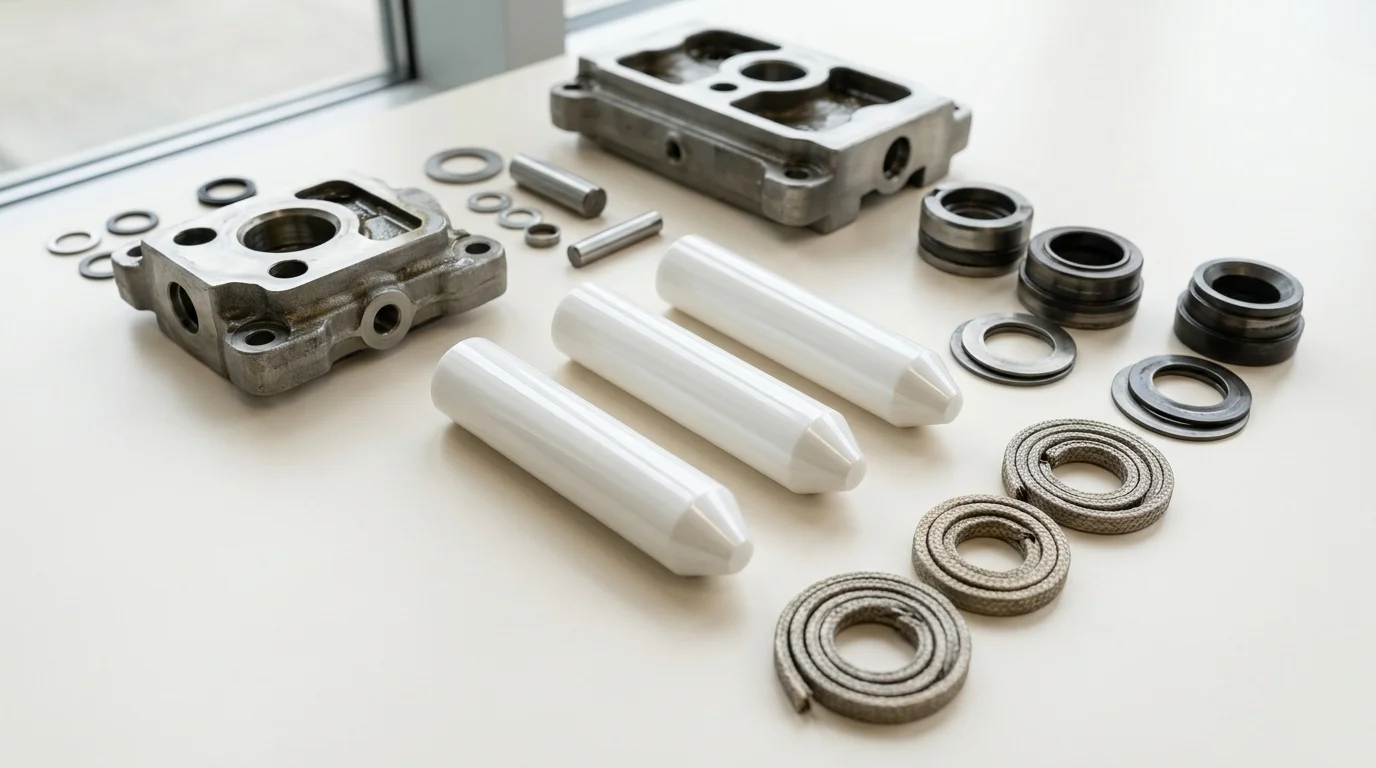
Industrial Reciprocating Pump Overhaul: Valves, Ceramic Liners, Gland Packing & Rebuild Engineering Standard
A definitive high-pressure positive displacement machinery overhaul manual, reciprocating tribology clearance standard, and rebuild protocol for plant maintenance superintendents, reliability engineers, and chemical process technicians across Ahmedabad, Ankleshwar, Dahej, Vapi, and Gujarat.
Quick Answer
In the high-pressure chemical synthesis, pharmaceutical bulk active manufacturing, and agrochemical reaction facilities across Gujarat—specifically Ahmedabad (Vatva, Naroda), Ankleshwar GIDC, Dahej PCPIR, and Vapi—reciprocating triplex plunger and piston pumps operate under extreme hydraulic pressures (50 - 450 bar) handling corrosive reactants, abrasive slurries, and high-pressure boiler feed liquids. Over continuous operation, severe cyclic hydraulic shock, cavitation pitting, and abrasive slurry wicking destroy suction/discharge valve seat sealing lands, score alumina ceramic plungers, and cause rapid gland packing blowout. Restoring full hydraulic capacity and eliminating toxic external leaks requires a precision dimensional overhaul: lapping valve seats to sub-micron flatness (< 0.4 µm Ra), measuring ceramic/zirconia plunger running clearances (0.03 - 0.08 mm), precision torquing chevron PTFE packing glands (15 - 25 N\cdotm), and aligning crosshead babbitt slide bearings conforming to ISO 5199, ISO 2858, IS 5120, and IS 1520 standards. Rebuilding reciprocating pumps with high-purity alumina ceramics, Hastelloy C-276 trim, and precision valve spring dynamics restores 96%+ volumetric efficiency and extends mean time between overhauls beyond 24 consecutive operating months.
Key Takeaways
- Lap Check Valve Seats to Sub-Micron Flatness. Precision diamond lapping (< 0.4 µm Ra) eliminates backflow leakage and pressure drop.
- Inspect Ceramic Plunger Liners for Micro-Spalling. Measure plunger diameter across 4 axes; replace plungers showing axial scoring > 0.025 mm.
- Torque Chevron PTFE Packing Progressively. Never over-compress packing; allow controlled micro-weepage (2 - 5 drops/min) for fluid lubrication.
- Verify Crosshead and Crankpin Running Clearances. Maintain crosshead shoe-to-guide clearance (0.08 - 0.15 mm) to prevent plunger side-loading.
Introduction
Across Gujarat's premier pharmaceutical synthesis corridors (Ahmedabad—Vatva, Naroda, Changodar), heavy chemical estates (Ankleshwar GIDC, Panoli), petrochemical complexes (Dahej PCPIR), and specialty chemical zones (Vapi, Vadodara), reciprocating power pumps perform mission-critical duties. Triplex plunger and piston pumps generate hydraulic pressures exceeding 300 bar to inject catalysts into high-pressure reactors, meter toxic reagents with micro-precision, and feed reverse osmosis desalination membranes.
Plant maintenance superintendents, mechanical engineers, and process reliability heads face severe recurring hurdles:
- The Valve Seat Erosion Penalty: High-velocity fluid jetting across worn suction and discharge check valves creates fluid slip, dropping volumetric efficiency by 30% - 50% and creating severe discharge pressure pulsations that shake plant piping.
- The Packing Burnout Trap: Maintenance technicians attempting to stop minor shaft weeping often over-tighten gland packing follower nuts. This starves the packing of fluid lubrication, generates extreme frictional heat (> 200°C), and causes sudden ceramic plunger thermal shock cracking.
- The Engineering Standard: Implementing a rigorous precision overhaul protocol conforming to ISO 5199, ISO 2858, IS 5120, and IS 1520 standards—diamond lapping valve seats to sub-micron flatness, replacing worn alumina plungers, installing precision chevron PTFE packing sets, and re-bushing crosshead guides—restores 96%+ volumetric efficiency, eliminates piping vibration, and extends service intervals beyond 24 consecutive operating months.
2. Master Reciprocating Pump Overhaul Clearance & Tolerance Matrix
Review the precision engineering clearance standards across pump power and pressure classes:
| Reciprocating Component Parameter | Low Pressure (< 50 bar) | Medium Pressure (50 - 150 bar) | High Pressure (150 - 450 bar) | Critical Slurry / Corrosive Service |
|---|---|---|---|---|
| Plunger-to-Throat Bushing Clearance | 0.05 - 0.08 mm | 0.04 - 0.06 mm | 0.03 - 0.05 mm | 0.06 - 0.10 mm |
| Valve-to-Seat Sealing Land Width | 1.5 - 2.5 mm | 2.0 - 3.5 mm | 3.0 - 5.0 mm | 3.5 - 6.0 mm |
| Valve Seat Surface Flatness (Ra) | < 0.8 µm (Lapped) | < 0.4 µm (Lapped) | < 0.2 µm (Mirror) | < 0.2 µm (Mirror) |
| Plunger Total Radial Runout (TIR) | ≤ 0.020 mm | ≤ 0.015 mm | ≤ 0.010 mm | ≤ 0.012 mm |
| Crosshead Shoe-to-Guide Clearance | 0.10 - 0.18 mm | 0.08 - 0.14 mm | 0.06 - 0.10 mm | 0.08 - 0.12 mm |
| Connecting Rod Crankpin Clearance | 0.05 - 0.08 mm | 0.04 - 0.07 mm | 0.03 - 0.06 mm | 0.04 - 0.06 mm |
| Volumetric Efficiency Target (\eta_v) | ≥ 92.0% | ≥ 95.0% | ≥ 97.0% | ≥ 94.0% |
3. The Kinematics, Tribology & Valve Dynamics Mechanics
Theoretical vs Actual Volumetric Delivery (Q = \eta_v · A · L · N · n)
Theoretical displacement in a multiplex reciprocating plunger pump follows the kinematic relation:
Interactive Engineering Hydraulic Sizer
Live ISO 5199 / API 610 Dynamic EngineWhere:
- A_plunger is the cross-sectional area of each plunger ([π] / [4] D²).
- L_stroke is the stroke length governed by the crankshaft throw.
- N is crankshaft rotational speed in RPM.
- n is the number of plungers (e.g., n = 3 for triplex, n = 5 for quintuplex).
- \eta_v is volumetric efficiency (typically 92% - 97%).
Loss of volumetric efficiency (\eta_v < 90%) indicates valve closing lag, valve seat erosion channels, fluid compressibility at extreme pressures (> 300 bar), or excessive packing weepage.
Valve Inertia, Spring Resonance & Closing Lag Dynamics
- Valve Dynamics: Suction and discharge valves open and close at high frequencies (200 - 450 cycles/min).
- Valve Closing Lag: If valve springs suffer fatigue relaxation or incorrect stiffness, the valve fails to seat instantly at top/bottom dead center, allowing pressurized fluid to rush backward into the suction chamber.
- Diamond Lapping: Restoring valve disc and seat flatness to < 0.4 µm Ra ensures instantaneous 100% hydraulic shutoff, preventing cavitation washout.
Plunger Fluid Film Lubrication & Hydrodynamic Packing Friction
- Hydrodynamic Lubrication: Plungers sliding through compression packing require a microscopic fluid boundary film (1 - 3 µm) to prevent dry frictional heating.
- Calibrated Weepage: A properly adjusted gland packing assembly must exhibit a controlled weep rate of 2 - 5 drops per minute. Complete dry compression burns the PTFE fibers and scorches the ceramic plunger surface.
Pulsation Acceleration Head & Net Positive Suction Head (NPSH_a vs NPSH_r)
- Acceleration Head Loss: Reciprocating motion continuously accelerates and decelerates the suction fluid column:
Where L is suction pipe length, v is mean fluid velocity, and C is pump kinematic factor. If acceleration head is ignored, available NPSH_a drops below required NPSH_r, causing severe suction cavitation and plunger knocking.
4. The 4 Critical Failure Modes in Reciprocating Pumps
Failure Mode 1: Valve Seat Washout & Discharge Pressure Loss
- Root Cause: Abrasive particulates wedge between the valve disc and seat, creating microscopic fluid bypass jets that rapidly cut deep erosion channels into the hardened metal seat.
- Engineering Solution: Machine and diamond lap valve seats to < 0.4 µm Ra, upgrade to Tungsten Carbide or Stellite trims, and replace fatigued valve springs.
Failure Mode 2: Ceramic Plunger Fracture from Thermal Shock
- Root Cause: Over-tightened dry packing generates extreme frictional heat (> 200°C); sudden contact with cold incoming process liquid creates severe thermal gradient stress, fracturing the brittle ceramic sleeve.
- Engineering Solution: Maintain controlled packing lubrication weepage (2 - 5 drops/min) and install external barrier fluid flush systems.
Failure Mode 3: Packing Burnout from Over-Tightened Gland Nuts
- Root Cause: Technicians tighten gland nuts unevenly or over-torque them to eliminate all weeping, compressing packing beyond its elastic limit and charring the PTFE fibers.
- Engineering Solution: Install precision-machined chevron PTFE V-ring sets and torque gland nuts in calibrated steps (15 - 25 N\cdotm).
Failure Mode 4: Crosshead Pin Galling & Crankshaft Bearing Knock
- Root Cause: Lubrication oil contamination with process chemicals degrades oil viscosity, causing metal-to-metal contact on crosshead wrist pins and connecting rod crankpin bearings.
- Engineering Solution: Replace degraded oil with synthetic ISO VG 220 lubricant, replace babbitt bushings, and install positive fluid deflector slingers on plunger shafts.
5. Sanitary Materials of Construction & Cleanroom Standards
High-Purity Alumina (99.5% Al_2O_3) & Yttria-Stabilized Zirconia Plungers
- Ceramic Plungers: Monolithic isostatic pressed 99.5% Alumina Ceramic (Al_2O_3, hardness > 1800 HV) and Yttria-Stabilized Zirconia (YSZ), precision ground to mirror finish (< 0.1 µm Ra), offering total corrosion immunity across 0 - 14 pH.
SS316L, 17-4PH Stainless Steel & Hastelloy C-276 Fluid Ends
- Fluid End Blocks: Forged SS316L, precipitation-hardened 17-4PH stainless steel, or Hastelloy C-276 fluid cylinders rated for continuous cyclic hydraulic pressures up to 450 bar.
Virgin PTFE & Carbon-Filled PTFE Chevron V-Ring Sets
- Gland Sealing: Precision molded chevron V-ring packing sets fabricated from virgin PTFE, carbon-filled PTFE, or Kevlar-reinforced PTFE with integral female support and male adapter rings.
Duplex SS (UNS S31803) & Tungsten Carbide Ball Check Valves
- Valves & Seats: Wing-guided disc valves, conical poppet valves, and ball check valves manufactured from Duplex SS (UNS S31803), solid Tungsten Carbide, or direct-sintered SSiC.
6. Step-by-Step Reciprocating Pump Overhaul & Rebuild SOPs
Execute these structured engineering SOPs during every industrial reciprocating pump overhaul:
Phase 1: Fluid End Teardown & Chemical Decontamination SOP
- Teardown: Safely isolate, depressurize, and disassemble fluid end manifolds, valve covers, valve assemblies, stuffing boxes, and ceramic plungers.
- Decontamination: Neutralize residual process chemicals in an ultrasonic cleaning bath. Inspect fluid end cylinder blocks for internal erosion washouts and fatigue micro-cracks.
Phase 2: Valve Seat Inspection & Diamond Lapping SOP
- Visual Audit: Inspect valve sealing faces for wire-drawing cuts, pitting, and uneven wear lands.
- Diamond Lapping: Mount valve seats on a precision lapping machine. Lap sealing faces with progressively finer diamond paste (15 µm \rightarrow 6 µm \rightarrow 1 µm) to achieve < 0.4 µm Ra surface finish and perfect circularity.
Phase 3: Ceramic Plunger Micrometer Audit & Polishing SOP
- Dimensional Check: Measure plunger outside diameter at 6 axial locations using an outside digital micrometer. Verify diameter tolerance (OD ± 0.005 mm) and circularity.
- Polishing: Diamond-polish ceramic plunger surfaces to remove chemical glaze and restore mirror finish (< 0.1 µm Ra).
Phase 4: Chevron V-Ring Packing Installation & Torquing SOP
- Stacking: Clean stuffing box bores. Install packing rings one by one with staggered joint splits (120^° offset). Seat each ring firmly using a split tamping tool.
- Calibrated Torquing: Tighten gland follower nuts evenly in 3 progressive passes:
- Pass 1: 30% torque (6 - 8 N\cdotm) to seat rings evenly. - Pass 2: 70% torque (12 - 15 N\cdotm). - Pass 3: 100% final torque (18 - 25 N\cdotm). Back off nuts 1/6 turn to establish initial running clearance.
Phase 5: Power End Crosshead & Crankshaft Bearing Overhaul SOP
- Crosshead Clearance: Measure crosshead shoe-to-guide running clearance with feeler gauges (0.08 - 0.14 mm). Shim or machine guides to restore concentricity.
- Crankpin Bearings: Inspect connecting rod white metal / babbitt shells. Measure journal clearance with Plastigauge (0.04 - 0.07 mm) and torque rod cap bolts to manufacturer specification.
Phase 6: Hydrostatic Pressure & Pulsation Flow Bench Test SOP
- Hydrostatic Test: Pressurize assembled fluid end with water to 1.5× rated pressure (450 bar) for 15 minutes to verify zero cylinder or valve cap leakage.
- Dynamic Performance Test: Run pump on motor test bench at rated speed and pressure. Verify volumetric flow rate (≥ 95% of rated), check packing weep rate (2 - 5 drops/min), and record vibration spectra conforming to ISO 5199 vibration criteria.
7. Worked Gujarat Pharmaceutical, Agrochemical & Chemical Case Studies
Case 1: Vatva GIDC Bulk Drug Active API High Pressure Dosing Overhaul
- Plant Context: A bulk pharmaceutical active manufacturer in Vatva GIDC operating a triplex plunger pump dosing concentrated hydrochloric acid at 120 bar.
- Problem: Frequent packing blowouts every 2 weeks and plunger scoring caused severe batch contamination and hazardous acid fumes.
- Action Plan: Teflow engineers overhauled the fluid end: installed 99.5% high-purity Alumina Ceramic plungers, diamond-lapped Hastelloy C-276 valve seats, and retrofitted chevron PTFE V-ring sets with external water flushing.
- Outcome: Packing life extended from 2 weeks to over 18 consecutive operating months; eliminated process contamination; saved Rs 7,60,000 annually.
Case 2: Ankleshwar GIDC Agrochemical Reactor Injection Pump Rebuild
- Plant Context: An agrochemical pesticide synthesis complex in Ankleshwar GIDC injecting liquid reactants into a continuous high-pressure reactor at 180 bar.
- Problem: Severe discharge pressure pulsation dropped reaction yield by 18% due to eroded discharge valve seats.
- Action Plan: Replaced valve seats with precision-machined Duplex SS trims, lapped faces to < 0.2 µm Ra, and calibrated valve spring preload stiffness.
- Outcome: Discharge pressure pulsation reduced by 85%; reaction yield restored to 99.2%; continuous operation over 22 consecutive operating months.
Case 3: Dahej PCPIR Petrochemical Triplex Plunger Hydrocarbon Overhaul
- Plant Context: A specialty petrochemical plant in Dahej PCPIR operating high-pressure hydrocarbon injection pumps (220 bar).
- Problem: Crankcase bearing knock and crosshead pin galling threatened catastrophic power end seizure.
- Action Plan: Line-bored crankcase bearing saddles, fitted new babbitt bearing shells with 0.05 mm running clearance, and aligned crosshead connecting rods.
- Outcome: Power end vibration dropped by 70%; continuous reliable pumping over 26 consecutive operating months.
Case 4: Vapi GIDC Bulk Chemical High Pressure Acid Injection Rebuild
- Plant Context: A chemical processing facility in Vapi GIDC pumping hot nitric acid slurries (65°C, 90 bar).
- Problem: Ceramic plunger thermal shock cracking occurred repeatedly during cold startup cycles.
- Action Plan: Retrofitted Yttria-Stabilized Zirconia (YSZ) plungers offering 3× higher fracture toughness, and installed pre-startup fluid warming bypass loops.
- Outcome: Zero plunger fractures; continuous uninterrupted pumping across 24 consecutive operating months.
Case 5: Odhav Metal Finishing High Pressure Descaling Pump Overhaul
- Plant Context: A steel forging plant in Odhav utilizing high-pressure water jet descaling pumps (350 bar).
- Problem: Abrasive mill scale ingress scored plungers and eroded packing within 150 operating hours.
- Action Plan: Installed Colmonoy-coated tungsten carbide plungers, upgraded to Kevlar-reinforced PTFE chevron packing, and installed a 25-micron dual-basket suction filtration skid.
- Outcome: Plunger service life extended to over 4,000 operating hours; saved Rs 6,40,000 in annual replacement parts.
Case 6: Vadodara Refinery Boiler Feed High Pressure Plunger Overhaul
- Plant Context: A thermal captive power utility in Vadodara pumping boiler feedwater at 160°C and 150 bar.
- Problem: Valve closing lag and seat cavitation caused severe water hammer in economizer piping.
- Action Plan: Overhauled fluid end with high-temperature Stellite valve trims and tuned Inconel valve springs.
- Outcome: Water hammer eliminated 100%; boiler feed pressure stabilized across 24 consecutive operating months.
8. Step-by-Step Reciprocating Pump Troubleshooting Decision Matrix
Follow this structured engineering guide when troubleshooting reciprocating power pumps across chemical and pharmaceutical plants in Gujarat:
| Observed Symptom | Probable Root Cause | Recommended Overhaul Action |
|---|---|---|
| Low Discharge Pressure / Pulsation | Worn suction/discharge valve seats or broken spring | Diamond lap valve seats; install calibrated springs |
| Severe Liquid Weeping from Gland | Worn chevron V-rings / scored ceramic plunger | Replace packing set; diamond polish ceramic plunger |
| Plunger Overheating & Smoking | Over-tightened packing gland follower nuts | Loosen gland nuts; establish 2 - 5 drops/min weep |
| Loud Knocking Noise in Fluid End | Suction line cavitation / insufficient NPSH_a | Increase suction pipe size; install pulsation dampener |
| Crankcase Bearing Knocking Noise | Excessive crankpin or crosshead pin clearance | Replace babbitt bearing shells; re-pin crosshead |
| Sudden Plunger Fracture | Thermal shock from dry packing / piping misalignment | Install YSZ plungers; verify crosshead alignment |
9. Comprehensive Master Reciprocating Pump Overhaul & Quality (FAT) Checklist
Execute this quality verification protocol before approving an overhauled reciprocating pump for plant installation:
Reciprocating Plunger Pump Overhaul Quality & FAT Protocol
10. Summary & Reciprocating Pump Overhaul Engineering Support in Gujarat
Eliminating fluid end valve washout, preventing catastrophic ceramic plunger thermal shock fractures, restoring precision crosshead and crankshaft clearances based on rigorous tribology and kinematic physics, and extending equipment service life beyond 24 consecutive operating months across Ahmedabad (Vatva, Naroda), Ankleshwar GIDC, Dahej PCPIR, Vapi, and Vadodara—by utilizing diamond-lapped Stellite valve trims, high-purity 99.5% Alumina and Zirconia ceramic plungers, precision chevron PTFE packing sets, and dynamic balancing conforming to ISO 5199, ISO 2858, IS 5120, and API 674 standards—is the proven engineering standard for positive displacement pump reliability.
Partnering directly with an established Gujarat rotating and reciprocating machinery manufacturer provides maintenance superintendents and plant managers with immediate technical access to precision diamond lapping, custom ceramic plunger grinding, failure root-cause analysis, and genuine spares. Our technical engineers provide on-site pump sizing audits, clearance measurements, and complete rebuild services.
Teflow Pumps operates a specialized chemical and industrial machinery manufacturing facility in Ahmedabad, providing engineered reciprocating pump overhauls, PFA-lined process pumps, solid PTFE pumps, PVDF centrifugal pumps, precision mechanical seals, dynamic rotor balancing, and genuine rotating equipment spares across Gujarat conforming to ISO 5199, ISO 2858, IS 5120, and API 685 standards.
- Direct Technical & Emergency Helpline: +91 98251 62709
- WhatsApp Technical Desk: Share photos of worn plungers, valves, pump make/model, fluid details, or operating pressure (bar) to wa.me/919825162709 for immediate technical review, clearance diagnostics, and formal quotation.
- Request an On-Site Reciprocating Pump Overhaul & Audit Survey: Contact our senior rotating and reciprocating equipment engineers for plant pump surveys, overhaul proposals, and formal quotation. Our engineering team conducts comprehensive internal clearance audits, analyzes hydraulic slip losses, dynamic shaft deflections, and certifies rebuilt assemblies to ensure maximum uptime across Gujarat's industrial processing clusters. We provide rapid technical evaluations, on-site plant surveys, and formal quotes.