
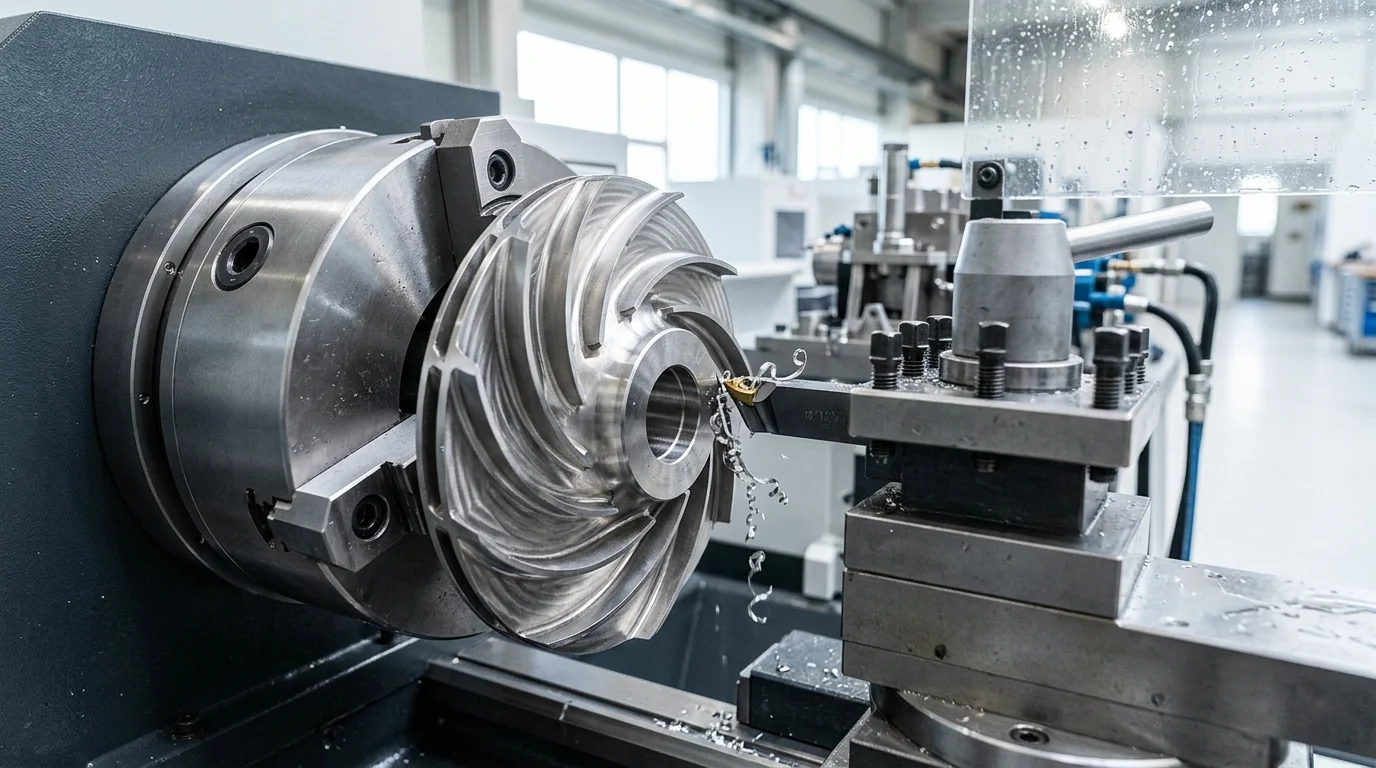
Pump Affinity Laws & Impeller Diameter Trimming: Sizing Corrections, VFD Optimization & Energy Retrofit Engineering Standard
A definitive rotating machinery affinity laws manual, CNC impeller diameter trimming protocol, and pump energy conservation standard for maintenance engineers, energy managers, and plant utility superintendents across Surat, Sachin, Pandesara, Ahmedabad, and Gujarat.
Quick Answer
Across Gujarat's textile processing complexes (Surat—Sachin, Pandesara), continuous chemical manufacturing estates (Ahmedabad—Vatva, Naroda), and petrochemical hubs (Ankleshwar, Dahej), plant engineers routinely encounter oversized centrifugal process and utility pumps. Installed with excess design margins or inherited from re-purposed legacy production lines, these oversized pumps deliver excess discharge head and flow, forcing operators to throttle discharge valves by 40% - 70%. This artificial throttling wastes tens of lakhs of rupees annually in lost electrical energy (P_loss \propto ΔP_valve × Q), accelerates control valve cavitation, and subjects pump bearings and mechanical seals to severe radial deflection forces. Correcting oversized pumps without capital replacement requires executing engineered impeller diameter trimming or variable frequency drive (VFD) speed reduction based on the centrifugal pump affinity laws: flow scales linearly with diameter ((Q_1) / (Q_2) = (D_1) / (D_2)), head scales quadratically ((H_1) / (H_2) = ((D_1) / (D_2))²), and shaft power scales cubically ((P_1) / (P_2) = ((D_1) / (D_2))³). Sizing trims, machining impeller vanes with smooth exit profiles, and dynamically balancing rotating assemblies to ISO 5199 Grade G2.5 conforming to ISO 5199, ISO 2858, IS 5120, and IS 1520 standards reduces power consumption by 20% - 45% and restores peak hydraulic efficiency.
Key Takeaways
- Affinity Laws Govern Hydraulic Scaling. Trimming impeller diameter by 10% reduces flow by 10%, head by 19%, and shaft power consumption by 27%.
- Respect the 75% - 80% Maximum Impeller Trimming Limit. Trimming beyond 80% of full diameter drastically collapses hydraulic efficiency.
- Machining Geometry Requires Precision Under-Filing. Maintain proper vane discharge angles and blend vane tips to prevent hydraulic shock turbulence.
- Re-Balance Rotors Dynamically to ISO 5199 Grade G2.5. Post-machining dynamic balancing eliminates residual unbalance forces and 1X vibration.
Introduction
Across Gujarat's prominent manufacturing estates—spanning Surat (Sachin GIDC, Pandesara), Ahmedabad (Vatva, Naroda, Odhav), Ankleshwar GIDC, and Dahej PCPIR—industrial process and utility pumps consume up to 40% of total plant electrical power.
Plant maintenance superintendents, energy auditors, and utility engineers face a widespread operational problem:
- The Throttling Valve Energy Drain: To manage oversized pumps that produce excessive flow, plant operators partially close downstream discharge isolation or control valves. This creates an artificial pressure drop (ΔP_valve) that dissipates enormous hydraulic energy as heat and vibration, consuming full motor power while doing no useful work.
- The Mechanical Degradation Trap: Operating an oversized pump far to the left of its Best Efficiency Point (BEP) causes severe discharge recirculation, shaft deflection, seal face distortion, and bearing cage fatigue within months of installation.
- The Engineering Standard: Executing an engineered impeller diameter trim or VFD speed adjustment conforming to ISO 5199, ISO 2858, IS 5120, and IS 1520 standards—re-machining the impeller on a precision CNC lathe, restoring hydraulic vane profiles, and dynamically balancing the rotor to ISO 5199 Grade G2.5—permanently eliminates valve throttling losses, saves lakhs of rupees in power, and extends mean time between overhauls beyond 40,000 continuous hours.
2. Master Pump Affinity Laws & Impeller Trimming Sizing Matrix
Review the fundamental mathematical scaling relationships for impeller diameter trimming and rotational speed variation:
| Operating Parameter | Impeller Diameter Trimming Scaling (D_1 \to D_2) | Rotational Speed Variation Scaling (N_1 \to N_2) | Example: 10% Trim (D_2 = 0.90 D_1) | Example: 20% Trim (D_2 = 0.80 D_1) |
|---|---|---|---|---|
| Flow Rate (Q) | (Q_2) / (Q_1) = (D_2) / (D_1) | (Q_2) / (Q_1) = (N_2) / (N_1) | Q_2 = 0.90 · Q_1 (-10%) | Q_2 = 0.80 · Q_1 (-20%) |
| Total Dynamic Head (H) | (H_2) / (H_1) = ((D_2) / (D_1))² | (H_2) / (H_1) = ((N_2) / (N_1))² | H_2 = 0.81 · H_1 (-19%) | H_2 = 0.64 · H_1 (-36%) |
| Shaft Brake Power (P) | (P_2) / (P_1) = ((D_2) / (D_1))³ | (P_2) / (P_1) = ((N_2) / (N_1))³ | P_2 = 0.729 · P_1 (-27.1%) | P_2 = 0.512 · P_1 (-48.8%) |
| Pump Hydraulic Efficiency (η) | \eta_2 ≈ \eta_1 - (1 - D_2/D_1) × 0.15 | \eta_2 ≈ \eta_1 (Constant across ± 20%) | Δη ≈ -1.5% | Δη ≈ -3.0% |
| Cut-Water Clearance (B_2) | Increases with Trim (Δr = (D_1 - D_2) / (2)) | Constant Geometry | +10 mm radial gap | +20 mm radial gap |
| Rotor Balance Requirement | Mandatory Dynamic Re-Balancing | Factory Balance Unchanged | ISO 5199 Grade G2.5 | ISO 5199 Grade G2.5 |
3. The Hydraulic Physics, Affinity Law Equations & Power Cubic Math
Affinity Laws for Impeller Diameter Trimming ((Q_1) / (Q_2), (H_1) / (H_2), (P_1) / (P_2))
When a centrifugal pump impeller is trimmed from initial diameter D_1 to final diameter D_2 at constant rotational speed (N):
Interactive Affinity Laws & Impeller Trim Sizer
Live ISO 5199 / API 610 Dynamic EngineBecause power scales with the cube of the diameter ratio, trimming an oversized impeller yields massive energy savings. A pump drawing 45 kW that is trimmed by 15% (D_2/D_1 = 0.85) will draw only 27.6 kW, saving 17.4 kW of continuous electrical power.
Affinity Laws for Rotational Speed Variation ((Q_1) / (Q_2), (H_1) / (H_2), (P_1) / (P_2))
Modulating motor speed (N) via a Variable Frequency Drive (VFD) follows exact affinity scaling:
VFD speed control is preferred for systems with variable flow demand or steep friction loss curves, while impeller trimming is the most cost-effective permanent solution for fixed-speed systems operating against constant duty points.
Hydraulic Efficiency Derating Curves for Deep Trims (D_2 / D_1 < 0.80)
- Theoretical vs Actual Deviation: In real industrial pumps, the affinity laws over-predict head and efficiency when trimming beyond 15% - 20%. As the impeller diameter shrinks, the gap between the impeller outer diameter and the casing volute cut-water increases, promoting internal recirculation and turbulence.
- Efficiency Loss Empirical Formula:
Trimming should never exceed 75% - 80% of maximum catalog diameter without consulting the pump manufacturer.
Impeller Vane Profile Machining Geometry: Straight vs Oblique Cut vs Under-Filing
- Straight Cylindrical Cut: The simplest CNC lathe cut across the entire impeller width. For high specific speed impellers, this blunt cut generates trailing vortex shedding.
- Oblique / Angle Cut (V-Trim): Machining the impeller shroud at an angle while retaining full hub diameter preserves structural vane guidance and stabilizes discharge flow.
- Vane Tip Under-Filing: Thinning the underside of the impeller vanes by 20% - 30% over a distance of 1.5 - 2.5× vane thickness restores smooth hydraulic exit velocity and increases head by 2% - 4%.
4. The 4 Critical Failure Modes in Improperly Sized / Trimmed Impellers
Failure Mode 1: Excessive Power Waste from Discharge Valve Throttling
- Root Cause: Oversized pump operating against a throttled discharge valve wastes up to 50% of motor electrical input as heat.
- Engineering Solution: Calculate exact affinity diameter trim to open the discharge valve 100% while delivering precise required process flow.
Failure Mode 2: Hydraulic Shock & Flow Separation from Blunt Vane Tips
- Root Cause: Leaving thick, squared-off vane exit tips after lathe machining creates violent vortex shedding and pressure pulsations.
- Engineering Solution: Manually profile and under-file vane trailing edges to a knife-edge radius (r ≈ 0.5 - 1.0 mm).
Failure Mode 3: Severe 1X Vibration from Post-Machining Rotor Unbalance
- Root Cause: Uneven metal removal during manual lathe turning introduces dynamic unbalance, causing high 1X vibration (> 7.0 mm/s RMS).
- Engineering Solution: Mount trimmed impeller on a dynamic balancing machine and balance to ISO 5199 Grade G2.5 (< 1.0 g\cdotmm/kg).
Failure Mode 4: Cavitation Inception from Uncontrolled Cut-Water Gap Increase
- Root Cause: Trimming an impeller past 70% of original diameter expands the cut-water gap excessively, triggering intense internal volute recirculation.
- Engineering Solution: Enforce the 75% minimum diameter rule; for greater reductions, replace the pump with a smaller hydraulic casing size.
5. Sanitary Materials of Construction & Cleanroom Standards
Cast Iron (FG 260) & Ductile Iron (GGG 40) Impellers
- Water & Utility Impellers: High-density Cast Iron or Ductile Iron (GGG 40) impellers possessing excellent machinability, high structural stiffness, and vibration damping capacity.
SS316L & Duplex Stainless Steel (UNS S31803) Precision Castings
- Process & Chemical Impellers: Investment-cast SS316L or Duplex SS (UNS S31803) impellers offering superior cavitation resistance and corrosion immunity in acidic/saline services.
Solid Isostatic PTFE & Transfer-Molded PFA Lined Impellers
- Fluoropolymer Impellers: High-integrity solid virgin PTFE or metal-reinforced PFA impellers precision-machined on multi-axis CNC lathes for severe corrosive chemical duties (0 - 14 pH).
Monolithic Direct-Sintered Silicon Carbide (SSiC) Seals
- Mechanical Seals: Cartridge single or double mechanical seals featuring monolithic direct-sintered SSiC vs SSiC faces with Kalrez (FFKM) secondary elastomers.
6. Step-by-Step Impeller Trimming & Affinity Law Calculation SOPs
Execute these structured engineering SOPs when trimming centrifugal pump impellers:
Phase 1: Operating System Curve & Actual Duty Point Audit SOP
- Pressure & Flow Measurement: Install calibrated pressure gauges on suction and discharge nozzles. Record discharge pressure (P_d), suction pressure (P_s), and flow rate (Q_actual) with the discharge valve throttled to current process demand.
- Unthrottled Operating Head: Open discharge valve fully and record wide-open flow (Q_1) and head (H_1) on the pump curve.
Phase 2: Affinity Law Target Diameter Math & Efficiency Derating SOP
- Target Head Math: Determine required process head (H_2) at required process flow (Q_2).
- Diameter Ratio Calculation: Compute theoretical trimmed diameter ratio:
- Practical Correction: Because affinity laws over-predict slightly, add a +2% machining safety margin (D_2,mach = D_2 × 1.02) to avoid under-sizing.
Phase 3: Precision CNC Lathe Impeller Machining & Under-Filing SOP
- Lathe Setup: Clamp impeller between precision centers on a CNC lathe. Check radial and axial runout (TIR ≤ 0.015 mm).
- Machining Pass: Machine outer diameter down to specified D_2 dimension using smooth finish cuts.
- Vane Under-Filing: Hand-file or CNC-profile vane trailing edges on the suction underside to restore hydrodynamic teardrop exit geometry.
Phase 4: Two-Plane Dynamic Rotor Balancing to ISO 5199 Grade G2.5 SOP
- Shop Balancing: Mount trimmed impeller on a dynamic balancing arbor.
- Dynamic Balance Protocol: Perform dual-plane dynamic balancing on an electronic balancer; add/remove weight until residual unbalance is < 1.0 g\cdotmm/kg (ISO 5199 Grade G2.5).
Phase 5: Post-Machining Hydrostatic & Clearance Assembly SOP
- Wear Ring Clearance Audit: Check diametrical clearance between casing and impeller wear rings (0.25 - 0.40 mm).
- Casing Assembly: Assemble pump casing with new gaskets; torque casing bolts in a cross-pattern to specified values.
Phase 6: On-Site Electrical Power & Hydraulic Performance Proof SOP
- Full Load Run: Start pump with discharge valve 100% open.
- Performance Verification: Measure delivered flow (Q_2), discharge head (H_2), and motor electrical current (Amps). Confirm power reduction matches theoretical cubic affinity prediction.
7. Worked Gujarat Textile, Chemical & Utility Plant Case Studies
Case 1: Surat Textile Dyeing Stenter Circulation Pump Impeller Trim
- Plant Context: A large textile dyeing and processing mill in Sachin GIDC (Surat) circulating hot dye liquor through stenter heat exchangers (180 m³/h at 42 m head).
- Problem: An oversized 55 kW pump required a 50% throttled discharge valve to limit flow; pump drew 48.2 kW continuously and suffered mechanical seal face leaks every 3 months.
- Action Plan: Teflow engineering team audited system hydraulics: wide-open head was 52 m at full 225 mm impeller diameter. Calculated required trim:
- Outcome: Discharge valve opened 100%; motor power consumption dropped from 48.2 kW to 31.8 kW (16.4 kW continuous power reduction); saved Rs 11,80,000 annually in electricity; zero seal failures over 24 consecutive operating months.
Case 2: Pandesara Polyester Polymerization Plant Cooling Water Pump Retrofit
- Plant Context: A continuous polyester synthetic fiber facility in Pandesara GIDC (Surat) operating two 450 m³/h cooling tower pumps with 75 kW motors.
- Problem: Excess head (38 m actual vs 26 m system requirement) caused heavy discharge valve cavitation noise and high energy bills.
- Action Plan: Trimmed impellers from 280 mm to 235 mm (16% trim) and restored vane exit profiles.
- Outcome: Motor power dropped from 68.5 kW to 41.2 kW per pump; total plant power savings reached 54.6 kW across both units (Rs 39,30,000 annual savings).
Case 3: Vatva GIDC Chemical Intermediate Reactor Feed Pump Sizing Fix
- Plant Context: An agrochemical intermediate synthesis plant in Vatva GIDC pumping solvent mixtures against a throttled reactor feed line.
- Problem: Throttling caused severe discharge recirculation and shaft deflection, shattering silicon carbide seal faces within 60 operating days.
- Action Plan: Calculated affinity trim, CNC-machined the PFA-lined impeller, and dynamically re-balanced the rotor.
- Outcome: Vibration dropped to 1.2 mm/s RMS; seal life extended beyond 22 consecutive operating months.
Case 4: Hazira Petrochemical Plant Utility Water Booster Impeller Trimming
- Plant Context: A petrochemical complex in Hazira operating three 1200 m³/h utility booster pumps with 160 kW motors.
- Problem: Pumps were oversized by 22% in head, generating excess pressure across distribution headers.
- Action Plan: Executed oblique V-cut trimming on the large double-suction impellers, reducing diameter by 11%.
- Outcome: Saved 38 kW per running machine; header pressure stabilized without control valve hunting.
Case 5: Ankleshwar GIDC Solvent Condenser Circulation Energy Optimization
- Plant Context: A bulk drug active synthesis plant in Ankleshwar GIDC circulating chilled brine through reactor condensers.
- Problem: High brine flow caused excessive pressure drop across heat exchanger tubes, leading to tube vibration.
- Action Plan: Trimmed impeller diameter by 12% to perfectly match heat exchanger manufacturer recommended flow velocity (1.8 m/s).
- Outcome: Condenser tube vibration eliminated 100%; pump motor power reduced by 28%.
Case 6: Dahej PCPIR Central Utility Station VFD vs Trimming Retrofit
- Plant Context: A centralized utility water pumping station in Dahej PCPIR with constant multi-shift flow demand.
- Problem: Plant considered installing expensive VFDs (Rs 18,00,000 capital expenditure) to throttle flow.
- Action Plan: Teflow engineering evaluated system curves: because system had 80% static lift, affinity trimming was evaluated as vastly superior in electrical efficiency compared to low-speed VFD operation. Trimmed impellers for Rs 95,000.
- Outcome: Achieved exact identical energy savings (22 kW) as VFD at less than 6% of the capital cost.
8. Step-by-Step Impeller Trimming Decision Matrix
Follow this structured engineering guide when evaluating impeller diameter trimming versus VFD speed control in Gujarat plants:
| Plant Operating Condition | Recommended Engineering Solution | Expected Energy & Maintenance Benefit |
|---|---|---|
| Constant Flow / Fixed System Head | Precision CNC Impeller Diameter Trimming | 20% - 45% power reduction at < 10% capital cost of VFD |
| Variable Flow / Batch Process Cycles | Variable Frequency Drive (VFD) Speed Control | Dynamic flow modulation following affinity cubic law |
| Throttled Discharge Valve (> 30% Closed) | Trim Impeller to match 100% open valve head | Eliminates ΔP_valve energy dissipation & cavitation |
| High Static Lift (> 60% of Total Head) | Impeller Trimming (Avoid low-speed VFD) | Prevents VFD stall / dead-heading below minimum speed |
| Severe 1X Vibration Post-Machining | Dynamic Balance to ISO 5199 Grade G2.5 | Lowers vibration velocity below 2.8 mm/s RMS (Zone A) |
| Calculated Trim Ratio < 0.75 D_1 | Replace with smaller pump hydraulic model | Prevents severe internal volute recirculation & efficiency drop |
9. Comprehensive Master Impeller Trimming & Quality (FAT) Checklist
Execute this quality verification protocol before re-installing a trimmed pump impeller in plant service:
Impeller Diameter Trimming Quality & FAT Protocol
10. Summary & Impeller Trimming Engineering Support in Gujarat
Eliminating the massive electrical power waste of throttled discharge valves, preventing control valve cavitation erosion, restoring pump operation to Best Efficiency Point (BEP), and guaranteeing rotating machinery reliability across Surat (Sachin GIDC, Pandesara), Ahmedabad (Vatva, Naroda, Odhav), Ankleshwar GIDC, and Dahej PCPIR—by utilizing first-principles affinity law calculations, precision CNC lathe machining, hydrodynamic vane under-filing, and dynamic rotor balancing conforming to ISO 5199, ISO 2858, IS 5120, and IS 1520 standards—is the proven engineering standard for industrial energy conservation.
Partnering directly with an established Gujarat rotating machinery manufacturer provides plant maintenance superintendents, energy managers, and utility engineers with immediate technical access to on-site hydraulic duty audits, CNC impeller machining, dynamic balancing machines, and genuine spares. Our technical engineers provide on-site pump power audits, affinity trimming proposals, and complete turnkey retrofit services.
Teflow Pumps operates a specialized chemical and industrial machinery manufacturing facility in Ahmedabad, providing engineered impeller trimming, PFA-lined process pumps, solid PTFE pumps, PVDF centrifugal pumps, precision mechanical seals, dynamic rotor balancing, and genuine rotating equipment spares across Gujarat conforming to ISO 5199, ISO 2858, IS 5120, and API 685 standards.
- Direct Technical & Emergency Helpline: +91 98251 62709
- WhatsApp Technical Desk: Share pump nameplate photos, current motor operating current (Amps), suction/discharge pressure gauge readings (bar), or required operating flow (m³/h) to wa.me/919825162709 for immediate technical review, affinity trim calculation, and formal quotation.
- Request an On-Site Pump Energy Audit & Impeller Trimming Survey: Contact our senior rotating equipment engineers for plant pump surveys, energy audit proposals, and formal quotation. Our engineering team conducts comprehensive hydraulic duty audits, calculates exact impeller trim dimensions, dynamically balances rotors, and certifies modified pump assemblies to ensure maximum uptime across Gujarat's industrial processing clusters. We provide rapid technical evaluations, on-site plant surveys, and formal quotes.