
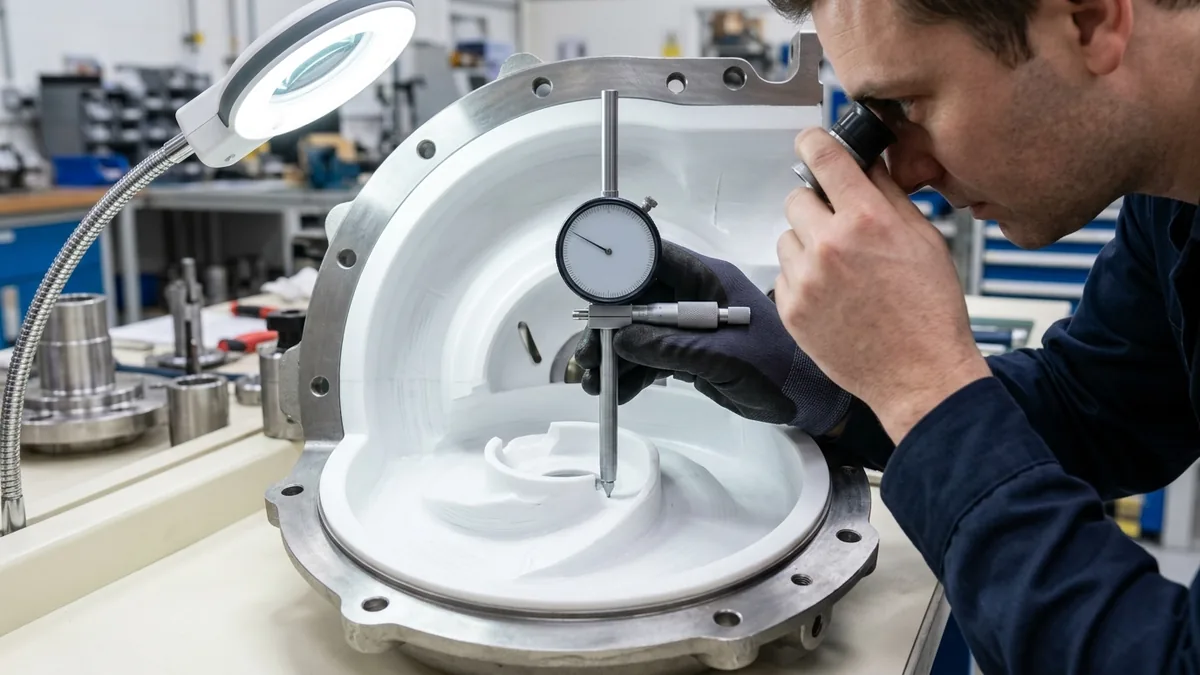
PTFE Pump Liner Blistering Diagnostics: Factory Relining vs Complete Replacement Decision Guide
An advanced fluoropolymer engineering manual, root-cause failure analysis standard, and rotating machinery economic decision guide for maintenance superintendents, reliability engineers, and plant managers across Gujarat chemical processing complexes.
Quick Answer
In aggressive chemical process operations across Gujarat—including pharmaceutical bulk drug synthesis in Vatva, dyestuff manufacturing in Naroda and Odhav, and agrochemical complexes in Ankleshwar and Dahej—PTFE lined centrifugal process pumps conforming to ISO 5199 and ISO 2858 standards represent the frontline defense against hot, highly corrosive acids (98% H_2SO_4, 33% HCl, 68% HNO_3, and hydrofluoric acid blends). However, after extended service involving elevated temperatures (> 80°C), rapid thermal cycling, or transient negative suction pressures (vacuum conditions), maintenance teams frequently uncover internal fluoropolymer blistering, bubbling, or localized liner delamination during turnaround inspections. Blistering compromises hydraulic efficiency, causes dynamic impeller rubbing, and exposes the ductile iron armored casing to severe acid attack. Deciding whether to reline the existing ductile iron casing or replace the pump with a transfer-molded PFA lined unit requires a rigorous engineering evaluation of permeation kinetics (J = -D (dC) / (dx)), casing dovetail groove integrity, cast iron substrate corrosion depth, and total lifecycle economics.
Key Takeaways
- Differentiate Between Surface Osmotic Blisters and Vacuum Collapse. Surface blisters stem from acid molecular permeation; full-depth delamination indicates dovetail failure or vacuum collapse.
- Inspect the Ductile Iron Casing Substrate for Acid Etching. If acid permeation has corroded the internal dovetail keyways beyond 0.5 mm, the casing must be replaced.
- Relining is Economical When Casing Keyways are Pristine. Factory relining with isostatic PTFE saves 40% - 55% of new equipment capital costs.
- Upgrade to Transfer-Molded PFA for High Vacuum and Thermal Cycling. Transfer-molded PFA provides superior melt-flow density, lower permeation, and higher bond strength.
Introduction
Across Gujarat's dense chemical manufacturing estates—specifically Vatva GIDC, Naroda GIDC, Odhav, Ankleshwar, and Dahej PCPIR—hundreds of chemical process pumps handle highly corrosive reagents daily.
Plant maintenance superintendents, rotating equipment engineers, and factory heads face severe recurring hurdles:
- The Sudden Liner Failure Dilemma: A PTFE lined pump operating on hot hydrochloric or sulfuric acid suddenly exhibits severe casing vibration, reduced discharge flow, and increased motor power draw. Disassembly reveals swollen, blistered, or torn fluoropolymer liners that rub against the spinning impeller.
- The Diagnostic Dilemma: Plant teams often struggle to determine whether a blistered liner is an isolated surface defect that can be relined in a factory workshop or an indicator of structural dovetail degradation that requires complete pump replacement.
- The Engineering Standard: Implementing a structured root-cause diagnostic protocol conforming to ISO 5199, ISO 2858, IS 5120, and IS 1520 standards—incorporating 20 kV high-voltage spark testing, ultrasonic wall thickness gauging, casing dovetail groove inspection, and lifecycle economic modeling—prevents catastrophic casing burn-through and extends equipment operating life beyond 35,000 hours.
2. Master Fluoropolymer Failure Modes: Blistering, Permeation & Delamination Matrix](#matrix)
Review the physical characteristics, root causes, and corrective action pathways for fluoropolymer lining failures:
| Lining Defect / Failure Mode | Visual / Physical Characteristics | Primary Root Cause Mechanism | Recommended Engineering Action |
|---|---|---|---|
| Surface Micro-Blistering | Small localized bubbles (2 - 10 mm); liner intact | Molecular gas permeation (J = -D (dC) / (dx)) + thermal expansion | Evaluate operating temp; strip and factory reline |
| Full-Depth Liner Delamination | Large sheet detachment from metal casing; baggy liner | Transient vacuum / negative suction pressure; failed dovetails | Upgrade to Dovetail-Locked Transfer-Molded PFA |
| Liner Mechanical Tearing / Rub | Impeller shroud gouging; shredded plastic flaps | Severe blister swelling into impeller running clearance | Complete rotor overhaul; factory relining or replacement |
| Casing Back-Shell Acid Etching | Corroded ductile iron shell behind liner; weeping vent | Permeated acid condensation; clogged shell vent holes | Scrap casing if keyways pitted; replace entire pump |
| Flange Neck Stress Cracking | Circumferential radial cracks at nozzle radius | Excessive piping nozzle moments; lack of PTFE expansion joints | Replace liner; re-support piping with PTFE bellows |
| Pin-Hole Spark Breakdown | High-voltage spark discharge (< 10 kV) to casing | Mechanical inclusion, void formation, or localized arc erosion | Strip liner, inspect casing, factory re-coat / reline |
Interactive Chemical Metallurgy & Temperature Compatibility Matrix
ISO 5199 / API 685 Fluoropolymer & Superalloy Standards| Material of Construction | Classification | Max Temp Limit | Compatibility Status @ 65°C |
|---|---|---|---|
Virgin PFAStandard | Fluoropolymer Lining | 160°C | Recommended (A - Zero Corrosion) |
Virgin PTFEStandard | Fluoropolymer Solid/Lined | 150°C | Recommended (A - Zero Corrosion) |
PVDF | Fluoropolymer Thermoplastic | 90°C | Satisfactory (< 2 mpy Corrosion) |
Polypropylene | Commodity Thermoplastic | 60°C | Thermal Derating Exceeded (> 60°C) |
Hastelloy C-276Standard | High-Nickel Superalloy | 110°C | Recommended (A - Zero Corrosion) |
SS316L | Austenitic Stainless Steel | 25°C | Severe Corrosion / Rapid Failure (X) |
SSiC Silicon CarbideStandard | Sintered Ceramic Seal Face | 180°C | Recommended (A - Zero Corrosion) |
Severe oxidizing acid at high concentration. Virgin PFA and PTFE linings provide total chemical inertness up to 160°C. SSiC mechanical seal faces prevent chemical grooving.
3. The Thermodynamic Kinetics of Fluoropolymer Permeation & Thermal Expansion Physics
Molecular Permeation & Fickian Diffusion Mechanics (J = -D · (dC) / (dx))
Fluoropolymers (PTFE, PFA) possess zero porosity on a macroscopic scale, but small, non-polar or low-molecular-weight molecules (such as dry HCl gas, HF, and Cl_2) can dissolve and diffuse through microscopic intermolecular voids:
Where:
- J is the molecular permeation flux rate across the fluoropolymer wall.
- D is the diffusion coefficient, which increases exponentially with operating temperature (D = D_0 e^-E_a / RT).
- (dC) / (dx) is the chemical concentration gradient across the 4.5 mm lining thickness.
When permeated gas molecules reach the non-permeable ductile iron back-shell, they condense into liquid acid. If the casing vent ports are plugged with paint or corrosion products, trapped gas expands during thermal cycles, forcing the liner away from the metal wall to create pressurized blisters.
Thermal Expansion Differential (α_PTFE ≈ 12 × α_Cast Iron)
Thermoplastics and metals expand at drastically different rates under process heating:
- High Hoop Stress: When process liquid heats from 25°C to 120°C, the PTFE liner expands roughly 11.4× more than the outer ductile iron casting.
- Buckling Tendency: If the liner is not securely keyed into machined dovetail grooves, compressive hoop stresses force the plastic to buckle inward toward the impeller, resulting in catastrophic rubbing.
Vacuum Transient Negative Pressure & Liner Buckling Thresholds
In chemical distillation and evaporation systems, pumps often experience transient vacuum conditions (P_suction < 0.2 bar absolute):
- Inward Pressure Differential: Atmospheric pressure or trapped permeated vapor behind the liner pushes inward against the vacuum inside the volute.
- Vacuum Collapse Threshold: Standard loose-lined or rotomolded plastic pumps collapse at vacuums as mild as -0.3 bar. In contrast, dovetail-locked transfer-molded PFA liners (≥ 4.5 mm) withstand full vacuum (-1.0 bar / 0.0 bar absolute) up to +150°C.
Microstructural Porosity: Isostatic PTFE vs Transfer-Molded PFA
- Sintered Isostatic PTFE: Manufactured by cold-pressing PTFE resin powder followed by high-temperature sintering (370°C). While chemically inert, it retains micro-voids between polymer granules, resulting in higher permeation rates on fuming acids.
- Transfer-Molded PFA: Injected under extreme hydraulic pressure in a molten state (380°C), producing an amorphous, void-free fluoropolymer structure with 3× lower permeation rates and superior resistance to blistering under thermal cycling.
4. The 4 Critical Industrial Failure Scenarios in Gujarat Chemical Plants
Scenario 1: Hot Fuming Hydrochloric Acid (33% HCl) Permeation Blistering
- Plant Operating Context: A pharmaceutical active ingredient plant in Vatva GIDC pumping fuming 33% HCl at 65°C.
- Failure Mechanism: HCl gas permeated through the sintered PTFE liner, condensed against the cool cast iron casing, and formed hydrochloric acid liquid behind the liner. Trapped gas expansion produced multiple 25 mm diameter blisters along the casing volute.
- Engineering Solution: Stripped damaged liner, sandblasted ductile iron casing, cleared shell vent ports, and factory relined with high-density isostatic PTFE.
Scenario 2: Vacuum Stripper Overhead Pump Liner Buckling & Delamination
- Plant Operating Context: A specialty dye intermediate plant in Naroda GIDC operating an acidic vacuum distillation receiver pump (-0.85 bar vacuum, 80°C).
- Failure Mechanism: A loose-lined PTFE pump collapsed inward under vacuum, wrapping around the impeller and snapping the pump shaft.
- Engineering Solution: Replaced the failed unit with a Teflow transfer-molded PFA lined chemical process pump featuring dovetail locking grooves conforming to ISO 2858.
Scenario 3: Rapid Steam-Clean Thermal Shock Casing Detachment
- Plant Operating Context: An agrochemical formulation complex in Ankleshwar cleaning acidic piping headers with high-pressure steam flushes (130°C).
- Failure Mechanism: Sudden thermal expansion differential caused non-dovetailed PTFE to expand rapidly, shearing casing mounting pins.
- Engineering Solution: Standardized operating SOPs to limit steam flush rates and upgraded installations to PFA-lined process pumps rated for +180°C.
Scenario 4: Mixed Acid Pickling Liquor Chemical Degradation & Cracking
- Plant Operating Context: A stainless steel tube pickling facility in Odhav circulating spent nitric-hydrofluoric pickling liquor (15% HNO_3 + 4% HF, 55°C).
- Failure Mechanism: Low-grade fluoropolymer liner contained inorganic fillers that reacted with hydrofluoric acid, causing embrittlement and cracking.
- Engineering Solution: Replaced with 100% virgin transfer-molded PFA lined process pumps with direct-sintered SSiC mechanical seal faces.
5. Sanitary Materials of Construction & Cleanroom Standards
Isostatic Compression-Molded Virgin PTFE Liners (≥ 4.5 mm)
- Liner Metallurgy / Fluoropolymers: 100% virgin isostatically molded Polytetrafluoroethylene (PTFE) with a solid wall thickness of 4.5 - 6.0 mm, offering universal chemical inertness across all mineral acids and organic solvents up to 160°C.
Transfer-Molded High-Density PFA (DuPont Teflon / Daikin Neoflon)
- Thermoplastic Fluoropolymers: High-density Perfluoroalkoxy (PFA) injection-molded under high hydraulic pressure, creating an ultra-dense, void-free barrier that reduces gas permeation by up to 70% compared to standard PTFE.
Ductile Iron Outer Casing Armor (GGG 40) with Precision Dovetail Grooves
- Structural Armored Casings: Heavy-duty Ductile Iron (GGG 40 / EN-GJS-400-18) armored casing shell incorporating CNC-machined dovetail retention keyways that mechanically lock the fluoropolymer liner against vacuum pullout and thermal movement.
Direct-Sintered Silicon Carbide (SSiC) Seal Faces & Hastelloy Hardware
- Sealing & Fasteners: External PTFE bellows mechanical seals featuring direct-sintered Silicon Carbide (SSiC, 2800 HV) faces with zero free silicon binders, Hastelloy C-276 casing fasteners, and PTFE casing vent plugs.
6. Step-by-Step Reline vs Replace Engineering Audit SOPs
Execute these structured engineering SOPs when assessing blistered PTFE lined chemical pumps:
Phase 1: Visual & Ultrasonic Non-Destructive Blister Depth Profiling SOP
- Decontamination & Inspection: Flush and neutralize the pump with alkaline wash, disassemble the casing, and inspect under high-intensity white light.
- Ultrasonic Profiling: Measure remaining fluoropolymer wall thickness across blistered and non-blistered zones with a calibrated ultrasonic thickness gauge.
- Classification Rule:
- Category A: Superficial blisters (< 1.0 mm height, no mechanical rubbing) -> Polish surface and monitor. - Category B: Deep blisters (> 3.0 mm height, localized delamination) -> Proceed to Phase 2 & 3.
Phase 2: High-Voltage 20 kV DC Spark Testing & Pin-Hole Inspection SOP
- Dielectric Test: Scan 100% of the internal fluoropolymer surface with a calibrated high-voltage DC spark tester set to 20.0 kV.
- Verification: Any dielectric breakdown or blue electrical arc indicates a through-thickness pinhole or micro-crack requiring complete liner removal.
Phase 3: Casing Substrate Corrosion & Dovetail Keyway Integrity Audit SOP
- Liner Removal: Carefully strip the defective fluoropolymer liner from the ductile iron casting using controlled thermal softening.
- Casing Substrate Audit: Inspect the machined dovetail keyways in the ductile iron shell:
- If dovetail keyways are clean, sharp, and pit-free (< 0.5 mm corrosion depth) -> Approve Casing for Factory Relining. - If dovetail keyways are severely corroded, rounded, or structurally thinned -> Scrap Casing and Replace Entire Pump.
Phase 4: Operating Duty & Process Transients Re-Evaluation SOP
- Operating Review: Review historical SCADA logs for unexpected vacuum surges, dry running, or high-temperature steam washdowns.
- Technology Selection: If severe vacuum transients (< 0.3 bar abs) or rapid thermal cycles are recurring, mandate Transfer-Molded PFA replacement over standard PTFE relining.
Phase 5: Factory Relining Technical Execution SOP
- Surface Preparation: Grit-blast internal ductile iron casing to SA 2.5 finish.
- Isostatic Relining: Insert high-density virgin PTFE preform, heat to sintering temperature (370°C), and hydro-expand into dovetail grooves under 50.0 bar pressure.
- Post-Lining Machining: CNC-machine critical flange faces and volute running clearances conforming to ISO 2858 tolerances.
Phase 6: Lifecycle Cost & MTBF Economic Decision SOP
Evaluate the total cost of ownership before approving repair vs replacement:
- Economic Rule: If factory relining cost is < 50% of new pump cost and delivers ≥ 85% of new equipment MTBF, reline the pump. If casing damage is extensive or process duty exceeds PTFE thermal limits, replace with transfer-molded PFA.
7. Worked Gujarat Chemical Plant Case Studies
Case 1: Vatva GIDC API Synthesis Plant Fuming HCl Pump Liner Relining
- Plant Context: An active pharmaceutical ingredient complex in Vatva GIDC operating a 33% HCl transfer pump (35 m³/hr, 2.5 bar, 60°C).
- Problem: Disassembly revealed multiple 15 mm blisters on the PTFE casing volute due to permeated acid vapor accumulation behind a blocked casing vent hole.
- Action Plan: Casing dovetail audit confirmed the ductile iron shell was 100% sound. Teflow stripped the damaged liner, sandblasted the casing, cleared vent ports, and factory relined with isostatic virgin PTFE (≥ 4.5 mm).
- Outcome: 100% dielectric spark test pass at 20 kV; pump restored to original ISO 2858 tolerances; saved Rs 2,80,000 compared to buying a new pump; zero blistering across 24 consecutive operating months.
Case 2: Naroda GIDC Reactive Dye Plant Vacuum Stripper PFA Replacement
- Plant Context: A dyestuff manufacturing facility in Naroda GIDC operating an acidic vacuum stripper bottoms pump (-0.8 bar vacuum, 85°C).
- Problem: Repeated vacuum collapse of loose-lined PTFE pumps every 3 to 4 months, wrapping the liner around the impeller and causing mechanical seal blowouts.
- Action Plan: Replaced the failed loose-lined pump with a Teflow transfer-molded PFA lined chemical process pump featuring precision dovetail retention grooves.
- Outcome: Zero liner delamination under full vacuum; continuous leak-free pumping across 26 consecutive operating months.
Case 3: Ankleshwar GIDC Agrochemical Complex Concentrated Nitric Pump Audit
- Plant Context: An agrochemical technical synthesis plant in Ankleshwar GIDC pumping 68% HNO_3 into nitrators at 75°C.
- Problem: Severe blistering and deep plastic discoloration on a 3-year-old PTFE pump casing.
- Action Plan: High-voltage spark testing detected micro-pinholes; casing dovetail inspection revealed 1.5 mm deep acid pitting in the metal shell.
- Outcome: Scrapped compromised casing; installed new Teflow PFA-lined magnetic drive process pump, eliminating dynamic seal maintenance completely.
Case 4: Dahej PCPIR Chlor-Alkali Unit Acid Recirculation Pump Overhaul
- Plant Context: A chlor-alkali facility in Dahej PCPIR circulating spent sulfuric acid (70% H_2SO_4, 65°C).
- Problem: Superficial osmotic blistering observed during planned turnaround inspection.
- Action Plan: Performed ultrasonic profiling (> 4.0 mm sound thickness remaining); verified zero dielectric breakdown at 20 kV; dressed casing vent holes and returned pump to service.
- Outcome: Avoided unnecessary premature replacement; pump operated reliably for an additional 18 operating months before scheduled relining.
Case 5: Odhav Metal Finishing Pickling Bath Pump Casing Salvage
- Plant Context: A steel tube pickling facility in Odhav operating spent hydrochloric acid pumps (15% HCl, 50°C).
- Problem: Mechanical damage to suction flange liner from overtightened mating pipe bolts.
- Action Plan: Teflow factory machined the damaged flange face, welded a virgin PTFE replacement stub, and re-faced the flange to ISO 2858 flat-face dimensions.
- Outcome: Rapid turnaround completed; avoided full casing replacement; zero flange leakage across 22 consecutive operating months.
Case 6: Changodar Specialty Polymer Monomer Transfer Pump Upgrade
- Plant Context: A specialty polymer plant in Changodar transferring aggressive fluorinated monomers under fluctuating pressure.
- Problem: Frequent PTFE liner cracking at casing nozzle radii due to severe pipe strain and lack of flexible joints.
- Action Plan: Re-supported suction and discharge headers with structural pipe stands, installed virgin PTFE expansion bellows, and factory relined the pump casing.
- Outcome: Mechanical nozzle strain eliminated 100%; continuous operation over 24 consecutive operating months.
8. Step-by-Step Reline vs Replace Decision Flowchart
Follow this structured engineering guide when evaluating blistered fluoropolymer pumps:
| Casing & Liner Inspection Finding | Metallurgical / Mechanical Condition | Recommended Engineering Action |
|---|---|---|
| Clean Casing Keyways; Blister Depth < 2 mm | Ductile Iron Shell 100% Sound; Zero Metal Pitting | Factory Relining with Isostatic Virgin PTFE |
| Severe Dovetail Pitting (> 0.5 mm depth) | Metal Shell Corroded Behind Liner; Vents Blocked | Scrap Casing; Replace with New Lined Pump |
| Full-Depth Vacuum Buckling / Collapse | Pump Operates on Continuous Negative Suction Head | Upgrade to Transfer-Molded PFA Lined Pump |
| Flange Face Mechanical Bolt Cracking | Casing Body Sound; Flange Face Locally Damaged | Factory Flange Re-Facing / Stub Relining |
| High Thermal Cycling (> 120°C Process) | PTFE Experiences Extreme Thermal Expansion | Upgrade to Transfer-Molded PFA Lined Pump |
| Toxic / Fuming Chemical Service (API / Agro) | Zero Fugitive Emissions Mandated by Safety Team | Upgrade to Seal-less PFA Magnetic Drive Pump |
9. Comprehensive Master Chemical Pump Factory Acceptance (FAT) Checklist
Execute this quality verification protocol following pump relining or replacement before plant re-installation:
Fluoropolymer Lined Chemical Pump FAT Protocol
10. Summary & Fluoropolymer Pump Repair and Supply Support in Ahmedabad
Eliminating corrosive acid pump failures, accurately diagnosing PTFE liner blistering, restoring damaged ductile iron casings through precision factory relining conforming to ISO 5199, ISO 2858, IS 5120, and IS 1520 standards, and extending pump operating life beyond 35,000 hours across Vatva GIDC, Naroda GIDC, Odhav, Ankleshwar, and Dahej—by utilizing high-density isostatic virgin PTFE, transfer-molded PFA, 20 kV dielectric spark testing, and dynamic rotor balancing to Grade G2.5—is the proven engineering standard for modern chemical process reliability.
Partnering directly with an established Ahmedabad chemical rotating machinery manufacturer provides chemical plants with immediate technical access to expert failure analysis, factory relining capabilities, custom CNC machining, and genuine fluoropolymer spares.
Teflow Pumps operates a specialized chemical rotating machinery manufacturing facility in Ahmedabad, providing engineered PFA-lined pumps, solid PTFE/PVDF process pumps, factory casing relining, 20 kV dielectric spark testing, dynamic balancing, and genuine rotating equipment spares across Gujarat conforming to ISO 5199, ISO 2858, IS 5120, and API 685 standards.
- Direct Technical & Emergency Helpline: +91 98251 62709
- WhatsApp Technical Desk: Share photos of your blistered liner, pump model, acid chemistry (%), operating temperature (°C), and operating pressure to wa.me/919825162709 for immediate failure analysis, reline feasibility evaluation, and formal quotation.
- Request an On-Site Pump Inspection & Relining Audit: Contact our senior rotating equipment engineers for plant pump surveys, material compatibility audits, and formal quotation.