
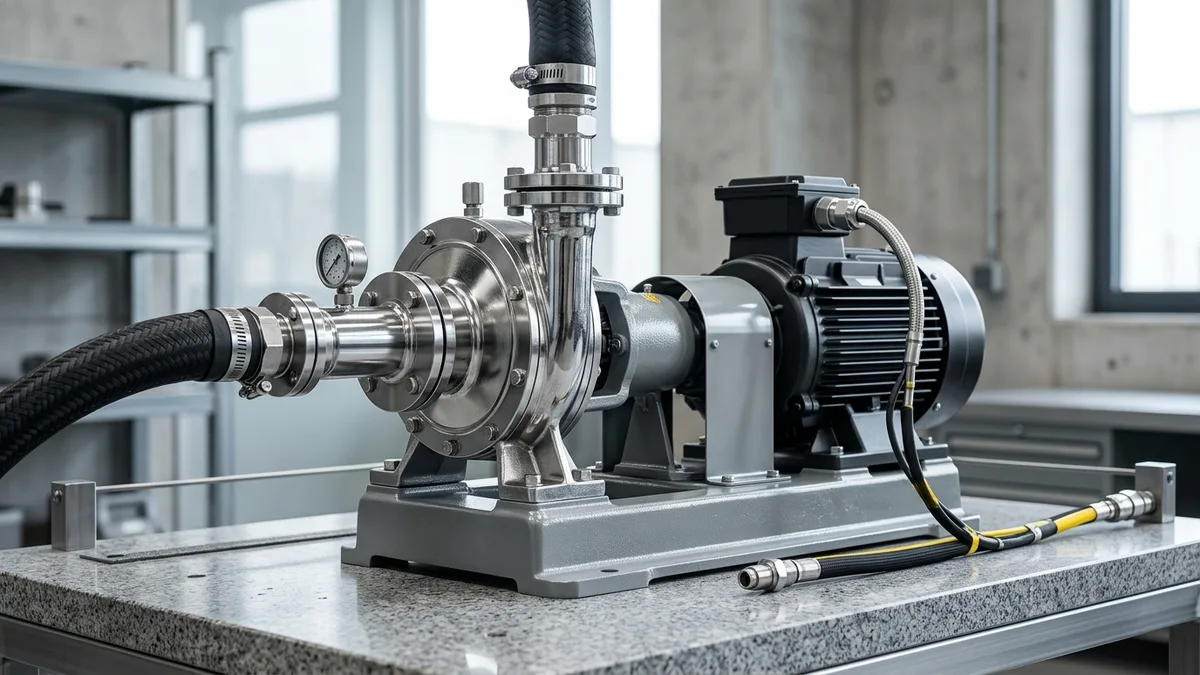
Morbi Ceramic Plant Machine Service & Repair: Slurry Pumps, Glaze Transfer & Heavy Machinery Overhaul Engineering Standard
A definitive ceramic factory rotating machinery maintenance manual, high-abrasion slurry pump overhaul standard, and mechanical seal rebuild protocol for factory owners, plant maintenance managers, and production superintendents across Morbi, Wankaner, Thangadh, and Gujarat.
Quick Answer
In the world's second-largest ceramic manufacturing cluster centered in Morbi, Wankaner, and Thangadh (Gujarat)—producing over 80% of India's vitrified porcelain tiles, large ceramic slabs, and vitreous sanitaryware—industrial pumps operate in the most punishing abrasive environments in continuous manufacturing. Heavy machinery pumps continuously transport high-density raw ceramic ball mill slip (65% - 72% solids by weight, SG = 1.65 - 1.80), feed high-pressure spray drying towers (25 - 45 bar), circulate viscous zircon glaze slurries, and dewater continuous polishing line abrasive wastewater. When slurry pumps fail—due to severe impingement erosion in impellers, shredded gland packings, shattered mechanical seals, or bent pump shafts—vitrified tile production halts, triggering massive ceramic kiln cooling losses. Executing engineered pump rebuilds conforming to ISO 5199, ISO 2858, IS 5120, and IS 1520 standards—utilizing ASTM A532 Class III 27% High-Chrome White Iron (> 650 HB), monolithic direct-sintered silicon carbide (SSiC) mechanical seal conversions, dynamic rotor balancing to ISO 5199 Grade G2.5, and precision laser shaft alignment (< 0.03 mm)—eliminates catastrophic slurry line shutdowns and extends pump wear life beyond 18 to 24 months.
Key Takeaways
- Upgrade Slurry Wet Ends to 27% High-Chrome White Iron. ASTM A532 Class III alloy (> 650 HB) resists severe quartz sand and feldspar abrasive gouging.
- Convert Gland Packing to Monolithic Silicon Carbide (SSiC) Seals. Pre-set dual cartridge seals eliminate continuous slurry leakage and shaft sleeve grooving.
- Dynamically Re-Balance Slurry Impellers to ISO 5199 Grade G2.5. Precision balancing eliminates heavy 1X centrifugal unbalance forces at high rotational speeds.
- Maintain Critical Front-Shroud Running Clearances. Adjust impeller nose gaps to 0.50 - 0.75 mm to suppress abrasive internal recirculation and casing wash-out.
Introduction
Morbi—spanning the NH-8A highway corridor, Pipali Road, Old Ghuntu Road, and neighboring Wankaner and Thangadh in Saurashtra, Gujarat—is the beating heart of India's ceramic industry, housing over 800 vitrified tile and sanitaryware manufacturing factories.
Ceramic factory owners, production directors, and plant maintenance engineers manage continuous machinery operations where pumps run 24 hours a day under intense abrasive conditions:
- The High Downtime Cost: In a continuous vitrified tile production line, an unpredicted failure of a ball mill slip feed pump or spray dryer transfer pump starves hydraulic tile presses and kilns, causing thousands of square meters of lost tile production and lakhs of rupees in lost production per hour.
- The Non-Specialized Repair Trap: Many local workshops in Morbi weld worn impellers using soft mild steel electrodes and fit low-cost braided packing, resulting in catastrophic balance failure, rapid casing erosion within weeks, and severe electrical power over-consumption.
- The Engineering Standard: Partnering with an engineering manufacturer conforming to ISO 5199, ISO 2858, IS 5120, and IS 1520 standards—utilizing 27% High-Chrome White Cast Iron wet ends, diamond-lapped silicon carbide mechanical seals, dynamic rotor balancing to ISO 5199 Grade G2.5, and rapid emergency rebuild services—guarantees continuous machinery availability, eliminates slurry leakage, and slashes total maintenance expenditure.
2. Master Morbi Ceramic Machinery & Slurry Pump Servicing Matrix
Review the primary ceramic machinery pump duties, abrasive slurry characteristics, and engineered repair protocols across Morbi tile plants:
| Ceramic Factory Equipment Duty | Slurry Concentration & Fluid Specifics | Primary Failure Mechanism | Engineered Overhaul Protocol |
|---|---|---|---|
| Raw Ball Mill Slip Transfer | 65% - 72% Solids (Clay, Quartz, Feldspar) | Impeller vane gouging, gland wash-out, shaft grooving | 27% Cr High-Chrome wet end, dual SSiC cartridge seals |
| High-Pressure Spray Dryer Feed | 30 - 45 bar, High-Viscosity Ceramic Slip | Plunger packing wear, valve seat scoring & cavitation | Ceramic/Tungsten Carbide plungers, forged steel fluid ends |
| Vitrified Tile Glaze Circulation | 45% - 55% Solids (Zirconium Silicate, Frit) | Extreme abrasive seal face scratching & binding | Monolithic direct-sintered SSiC vs SSiC mechanical seal conversion |
| Continuous Polishing Line Slurry | 25% - 35% Fine Silicon Carbide & Tile Dust | Casing volute wash-out, cutwater erosion | High-density rubber liner / 27% Cr casing retrofit |
| Filter Press High-Pressure Slurry | 0 - 16 bar Variable Flow, Clay Slurry | Motor stalling, high radial deflection, bearing failure | Heavy-duty large-diameter shaft, SKF spherical roller bearings |
| Ceramic Kiln Waste Heat ETP Sump | Acidic Effluent (2.5 - 4.5 pH), Fly Ash Slurry | Combined chemical corrosion and abrasive wear | Solid isostatic PTFE / PFA lined armored centrifugal pump |
3. The Mechanical Physics, Slurry Dynamics & Hydrodynamic Erosion Math
Abrasive Slurry Hydrodynamic Impingement Erosion Modeling (E_wear \propto v³.2)
Abrasive wear in ceramic slip and glaze pumps is driven by high-velocity particle impingement:
- Impingement Kinetic Energy: The rate of erosive material loss (E_wear) scales exponentially with fluid velocity (v) and particle hardness (H_p):
Interactive Engineering Hydraulic Sizer
Live ISO 5199 / API 610 Dynamic Engine- In ceramic slip slurries containing silica quartz (1100 HV) and feldspar (800 HV), the velocity exponent n ranges from 2.8 to 3.5. Increasing pump rotational speed by just 20% doubles abrasive erosion rates.
- Alloy Hardness: Standard cast iron (180 HB) fails within weeks. Upgrading to ASTM A532 Class III 27% High-Chrome White Iron with martensitic matrix and primary chromium carbides (Cr_7C_3, hardness > 1500 HV, bulk hardness > 650 HB) increases erosion resistance by 600% to 800%.
Ceramic Slip Non-Newtonian Bingham Plastic Rheology & Viscosity Yield Stress
Raw ball mill ceramic slip behaves as a non-Newtonian Bingham plastic fluid:
- Yield Stress Behavior: The slip requires a finite yield stress (τ_0) before fluid flow initiates:
- At rest inside suction piping, ceramic slip forms a rigid gel structure (τ_0 > 15 Pa). If a pump trips during a power blip, restarting requires high torque and low-shear open impellers to break the gel structure without causing high motor current trips.
Mechanical Seal Face Tribology in Micronized Quartz & Zircon Glaze Slurries
Tile glaze containing micronized Zirconium Silicate (ZrSiO_4, Mohs hardness 7.5) destroys conventional carbon/ceramic mechanical seals:
- Face Scoring: Fine sub-micron glaze particles penetrate the microscopic fluid film (0.5 - 1.0 µm), embedding in soft carbon faces and grinding circular grooves into stationary mating faces.
- Seal Tribology Standard: Monolithic direct-sintered Silicon Carbide (SSiC) vs SSiC provides exceptional hardness (> 2500 HV), exceeding quartz and zircon hardness, preventing particle embedment and ensuring zero face wear.
Slurry Pump Specific Speed (N_s) & Impeller Shroud Recirculation Clearance
Slurry recirculation between the high-pressure volute and the low-pressure suction eye accelerates front-shroud casing erosion:
- Suction Recirculation Math: Fluid leaking across the front shroud creates high-velocity micro-jets (v_jet \propto √(ΔP)) carrying abrasive particles that gouge deep circular wash-out channels.
- Clearance Adjustment: Maintaining tight, adjustable front-shroud clearances (0.50 - 0.75 mm) via external axial bearing cartridge adjustment screws minimizes back-leakage, maintains hydraulic efficiency, and prevents casing cutwater destruction.
4. The 4 Critical Failure Modes in Morbi Ceramic Plant Pumps
Failure Mode 1: Impeller Vane Leading Edge Impingement Perforation
- Root Cause: Soft cast iron or mild steel fabricated impellers operating at high peripheral speeds (> 25 m/s) suffer rapid particle impingement gouging, perforating vane leading edges within 60 days.
- Engineering Solution: Upgrade impellers to solid investment-cast 27% High-Chrome White Iron with thick leading edge vane profiles (12 - 18 mm thickness).
Failure Mode 2: Gland Packing Slurry Wash-Out & Severe Shaft Sleeve Grooving
- Root Cause: Traditional braided PTFE/graphite packing without continuous high-pressure clean water flushing allows ceramic slip into the stuffing box, grinding deep grooves into shaft sleeves.
- Engineering Solution: Retrofit Teflow pre-set dual cartridge mechanical seals with monolithic SSiC vs SSiC faces and an API Plan 53A pressurized barrier fluid loop.
Failure Mode 3: Ball Mill Slip Settling & Suction Line Choking During Power Trips
- Root Cause: Heavy ceramic slip (70% solids) settles in horizontal suction pipes during sudden factory power outages, creating solid clay blockages that starve pumps upon restart.
- Engineering Solution: Install automatic suction line flush valves connected to overhead DM water reservoirs and size suction piping for continuous 1.5 m/s slurry velocity.
Failure Mode 4: Bearing Housing Contamination from Ceramic Clay Dust Ingress
- Root Cause: Fine airborne ceramic clay dust penetrates standard lip seals, contaminating bearing lubricating oil and causing rapid abrasive bearing cage failure.
- Engineering Solution: Retrofit bearing housings with non-contact metallic labyrinth isolators (IP66 rated) and fill with high-viscosity synthetic ISO VG 220 gear oil.
5. Sanitary Materials of Construction & Cleanroom Standards
High-Chrome White Cast Iron (ASTM A532 Class III Type A, 27% Cr)
- Slurry Hydraulic Components: High-Chrome White Iron containing 27% Chromium and 2.8% Carbon, heat-treated to a fully martensitic matrix with primary chromium carbides (Cr_7C_3, bulk hardness > 650 HB) for ball mill slip and polishing slurry impellers.
Natural Rubber & Polyurethane Hydrodynamic Liners
- Fine Slurry Casings: High-resilience natural rubber or molded polyurethane liners providing exceptional bounce-back elasticity against high-velocity fine glaze and polishing slurries (< 100 µm particle size).
Solid Isostatic PTFE & Transfer-Molded PFA Wet End Liners
- Kiln Gasifier Chemicals: 100% virgin isostatic solid PTFE or high-density transfer-molded PFA lined pumps (4.5 - 6.0 mm wall thickness) for hot phenolic gasifier effluents and acid neutralization lines (0 - 14 pH).
Monolithic Direct-Sintered Silicon Carbide (SSiC) Mechanical Seals
- Cartridge Mechanical Seals: Heavy-duty replacement cartridge mechanical seals featuring monolithic direct-sintered SSiC vs SSiC faces with Kalrez (FFKM) secondary elastomers.
6. Step-by-Step Ceramic Slurry Pump Overhaul & Servicing SOPs
Execute these structured engineering SOPs during ceramic plant pump overhauls:
Phase 1: In-Situ Vibration Analysis & Slurry Hydraulic Performance Audit SOP
- Operational Audit: Measure slurry specific gravity (SG), solids concentration, motor electrical operating current (Amps), and suction/discharge pressures.
- FFT Vibration Audit: Record 1X unbalance, 2X misalignment, and vane-pass frequency vibration spectra on pump bearing pedestals.
Phase 2: Precision Slurry Wet End Teardown & Thickness Gauging SOP
- Controlled Disassembly: Remove casing suction cover, split casing liners, and impeller using hydraulic pullers.
- Ultrasonic Thickness Audit: Measure residual wall thickness on casing volute and impeller vanes; discard parts worn below 50% of original casting thickness.
Phase 3: CNC Shaft Grinding, Hard-Chroming & Sleeve Replacement SOP
- Shaft Reconditioning: Check shaft straightness on precision lathe centers (TIR ≤ 0.015 mm).
- Sleeve Fitting: Install new hardened SS316L shaft sleeves with ceramic oxide coating (> 1200 HV) under seal areas.
Phase 4: Two-Plane Dynamic Balancing to ISO 5199 Grade G2.5 SOP
- Impeller Balancing: Mount heavy High-Chrome slurry impeller on dynamic balancing center arbor.
- Dynamic Balancing Run: Perform dual-plane dynamic balancing at operating speed; grind balancing pads on impeller back-shroud until residual unbalance is < 1.0 g\cdotmm/kg (ISO 5199 Grade G2.5).
Phase 5: Silicon Carbide Mechanical Seal Retrofit & Pressure Setting SOP
- Cartridge Seal Mounting: Install pre-set dual cartridge seal with monolithic direct-sintered SSiC vs SSiC faces.
- Barrier Loop Setup: Connect API Plan 53A thermosiphon buffer pot pressurized to 1.5 bar above maximum stuffing box pressure.
Phase 6: Hydrostatic Pressure Proof & Full Slurry Performance FAT SOP
- Hydrostatic Proof: Pressurize reassembled casing to 1.5× rated discharge pressure for 30 minutes.
- Performance Verification: Run 2-hour full-load test on slurry loop; verify vibration is < 1.8 mm/s RMS (ISO 5199 Zone A), bearing temperatures < 55°C, and zero seal leakage.
7. Worked Morbi Ceramic Vitrified Tile & Sanitaryware Case Studies
Case 1: Morbi Pipali Road Large Slab Vitrified Tile Slip Pump Overhaul
- Plant Context: A mega-slab porcelain vitrified tile plant on Pipali Road (Morbi) operating four 150 m³/h ball mill slip feed pumps (68% solids, SG = 1.72, 8 bar).
- Problem: Soft cast iron impellers wore out within 45 days; gland packing leaked 200 liters of thick clay slurry per shift onto the factory floor, destroying motor bearings and causing unexpected line shutdowns.
- Action Plan: Teflow engineering team executed a complete turnkey overhaul:
- Retrofitted ASTM A532 Class III 27% High-Chrome White Iron impellers and wear liners (650 HB). - Converted gland packing stuffing boxes to Teflow dual cartridge SSiC vs SSiC mechanical seals with API Plan 53A barrier fluid pots. - Dynamically balanced impellers to ISO 5199 Grade G2.5. - Executed precision dual-plane laser shaft alignment on rigid baseplates (0.025 mm parallel offset).
- Outcome: Impeller wear life extended from 45 days to over 24 consecutive operating months; zero slurry leakage on factory floors; electrical energy consumption reduced by 14.2 kW per pump train, saving Rs 9,40,000 annually in power bills.
Case 2: Wankaner Sanitaryware Glaze Preparation Pump Seal Conversion
- Plant Context: A premium sanitaryware facility in Wankaner circulating abrasive zirconium glaze slurry (52% solids).
- Problem: Conventional carbon/ceramic mechanical seals failed every 20 days due to particle scoring.
- Action Plan: Retrofitted Teflow monolithic direct-sintered SSiC vs SSiC cartridge mechanical seals with non-clogging wave springs and Kalrez elastomers.
- Outcome: Zero seal failures across 22 consecutive operating months; eliminated glaze contamination.
Case 3: Old Ghuntu Road High-Pressure Spray Dryer Feed Pump Rebuild
- Plant Context: A double-charge vitrified tile plant on Old Ghuntu Road feeding a 12,000 kg/h spray drying tower (35 bar).
- Problem: Plunger packing wear caused pressure fluctuations, resulting in uneven spray-dried granule bulk density and tile pressing defects.
- Action Plan: Rebuilt pump fluid end with solid Tungsten Carbide plungers, precision-lapped ceramic check valve seats, and high-tensile forged steel fluid blocks.
- Outcome: Discharge pressure stabilized at 35 bar with zero pulsation; granule bulk density consistency improved by 18%.
Case 4: Halvad Road Ceramic Raw Material Ball Mill Slurry Transfer Upgrade
- Plant Context: A ceramic raw material grinding plant on Halvad Road pumping raw clay slip to settling silos.
- Problem: Severe 1X vibration (8.2 mm/s RMS) caused by unbalanced impeller replacements cracked motor mounting feet.
- Action Plan: Dynamically balanced impellers to ISO 5199 Grade G2.5 and laser-aligned motor coupling to 0.02 mm.
- Outcome: Vibration plummeted to 1.2 mm/s RMS (Zone A); bearing temperatures dropped from 78°C to 44°C.
Case 5: Trajpar Morbi Continuous Tile Polishing Line Wastewater Pump Fix
- Plant Context: A vitrified tile polishing unit in Trajpar pumping abrasive tile polishing wastewater containing fine silicon carbide grit.
- Problem: Casing volutes washed out within 90 days.
- Action Plan: Installed heavy-duty rubber-lined slurry pumps with open recessed vortex impellers.
- Outcome: Wet end wear life extended to over 20 consecutive operating months.
Case 6: Morbi Ceramic Gasifier Plant Tar & Phenolic Effluent Pump Overhaul
- Plant Context: A ceramic coal gasifier unit in Morbi pumping hot phenolic tar effluent (85°C, 1.5 pH).
- Problem: Highly corrosive and tarry effluent corroded metallic pumps within 60 days.
- Action Plan: Replaced wet end with a Teflow PFA-lined ductile iron armored pump with direct-sintered SSiC mechanical seals.
- Outcome: Complete corrosion and erosion immunity; continuous operation across 26 consecutive operating months.
8. Step-by-Step Ceramic Machinery Pump Troubleshooting Decision Matrix
Follow this structured engineering guide when troubleshooting ceramic plant pumps in Morbi:
| Observed Slurry Pump Symptom | Identified Root Cause Mechanism | Recommended Engineering Sizing Action |
|---|---|---|
| Rapid Impeller Wear (< 90 days) | Soft metallurgy / High fluid velocity (v > 25 m/s) | Upgrade to ASTM A532 27% High-Chrome (> 650 HB) |
| Continuous Slurry Leakage from Shaft | Slurry ingress into braided gland packing | Convert to dual cartridge SSiC vs SSiC mechanical seal |
| High 1X Vibration Peak (> 5.0 mm/s) | Dynamic unbalance from asymmetric impeller wear | Shop dynamic balance to ISO 5199 Grade G2.5 (< 1.0 g\cdotmm/kg) |
| Severe Discharge Pressure Loss (> 20%) | Wide front-shroud recirculation clearance | Adjust front impeller clearance to 0.50 - 0.75 mm |
| Bearing Overheating & Screeching Noise | Ceramic clay dust ingress into bearing housing | Install IP66 labyrinth bearing isolators & synthetic oil |
| Acidic Effluent Casing Perforation | Combined chemical corrosion & abrasive wear | Install Teflow PFA / PTFE lined armored process pump |
9. Comprehensive Master Ceramic Plant Pump Servicing & FAT Checklist
Execute this quality verification protocol before re-commissioning an overhauled ceramic plant pump:
Morbi Ceramic Plant Pump Overhaul & Quality (FAT) Protocol
10. Summary & Ceramic Slurry Pump Engineering Support in Morbi & Gujarat
Eliminating catastrophic ball mill slip pump failures, preventing continuous slurry leaks on tile plant floors, suppressing abrasive hydrodynamic erosion in vitrified tile polishing systems, and guaranteeing heavy machinery availability across Morbi (Pipali Road, Old Ghuntu Road, NH-8A), Wankaner, Thangadh, and Gujarat—by utilizing ASTM A532 Class III 27% High-Chrome White Cast Iron wet ends, monolithic direct-sintered silicon carbide (SSiC) mechanical seals, dynamic rotor balancing to ISO 5199 Grade G2.5, and precision laser alignment conforming to ISO 5199, ISO 2858, IS 5120, and IS 1520 standards—is the proven engineering standard for ceramic manufacturing.
Partnering directly with an established Gujarat rotating machinery manufacturer provides ceramic factory owners, plant maintenance managers, and production superintendents with immediate technical access to High-Chrome casting metallurgy, CNC machining centers, dynamic balancing facilities, cartridge mechanical seals, and genuine rotating equipment spares dispatched directly from our nearby Ahmedabad manufacturing plant. Our technical engineers provide rapid on-site troubleshooting, diagnostic vibration surveys, and complete turnkey pump overhauls.
Teflow Pumps operates a specialized chemical and industrial machinery manufacturing facility in Ahmedabad, providing engineered High-Chrome slurry pumps, PFA-lined process pumps, solid PTFE pumps, high-pressure multistage pumps, precision mechanical seals, dynamic rotor balancing, laser alignment, and genuine rotating equipment spares across Morbi and Gujarat conforming to ISO 5199, ISO 2858, IS 5120, and API 685 standards.
- Direct Technical & Emergency Helpline: +91 98251 62709
- WhatsApp Technical Desk: Share pump nameplate photos, slurry operating details (solids %, specific gravity), failed impeller photos, or current pressure readings to wa.me/919825162709 for immediate technical review, spare parts identification, and formal quotation.
- Request an On-Site Ceramic Plant Pump Audit & Servicing Survey: Contact our senior rotating equipment engineers for plant pump surveys, AMC maintenance proposals, and formal quotation. Our engineering team conducts comprehensive vibration FFT audits, laser shaft alignments, High-Chrome wet end upgrades, and specialized overhaul services to ensure maximum uptime across Morbi's ceramic vitrified tile and sanitaryware clusters. We provide rapid technical evaluations, on-site plant surveys, and formal quotes.