
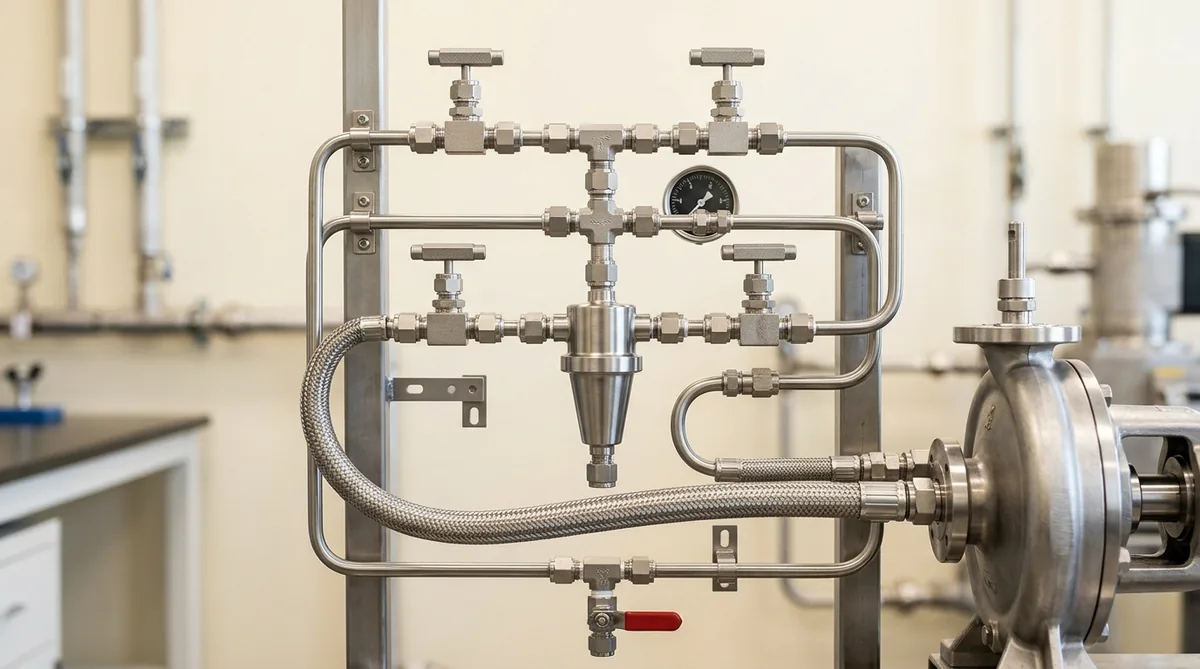
Mechanical Seal Flush Water Quality Requirements: Preventing Calcium Scaling, Chloride Pitting & Face Wear
A definitive technical engineering standard, seal flush water specification manual, and auxiliary piping reliability protocol for plant utility managers, rotating equipment specialists, and chemical process engineers across Ahmedabad, Vatva GIDC, Naroda GIDC, Ankleshwar, Dahej PCPIR, and Gujarat.
Quick Answer
In chemical processing complexes, synthetic organic dye manufacturing units, bulk pharmaceutical API plants, and common effluent treatment plants (CETPs) across Gujarat—such as in Vatva GIDC, Naroda GIDC, Ankleshwar, Panoli, and Dahej PCPIR—over 45% of repeat mechanical seal failures on slurry, crystallizing, and hazardous chemical pumps are caused by poor auxiliary flush water quality rather than process fluid attack. When industrial plants connect raw GIDC borewell water, unsoftened cooling tower blowdown, or unfiltered utility water to API 682 Plan 32 (clean external flush), Plan 53A/B (pressurized barrier fluid), or Plan 54 (forced circulation), high water hardness (> 300 ppm CaCO_3) and high dissolved chlorides (> 250 ppm) rapidly precipitate rock-hard calcium carbonate (CaCO_3) scale across the microscopic seal interface (0.5 µm) where temperatures reach 80°C - 120°C. This scale acts as an abrasive grinding compound, gouging Carbon and Silicon Carbide seal faces, clogging multi-coil springs ("spring hang-up"), and inducing severe chloride pitting corrosion on SS316L drive sleeves. Conforming to ISO 5199, ISO 2858, IS 5120, and API 682 standards, achieving reliable multi-year seal operation mandates demineralized or RO permeate water with hardness < 25 ppm, TDS < 150 ppm, 5 µm absolute filtration, and a positive differential pressure of +1.5 bar to +2.0 bar above stuffing box pressure.
Key Takeaways
- Never Use Raw Borewell or Cooling Tower Water for Seal Flush Loops. Hardness > 25 ppm precipitates calcium scale between faces, causing rapid abrasive wear and leakage.
- Maintain Total Dissolved Solids (TDS) < 150 ppm and Chlorides < 10 ppm. High chlorides induce severe pitting and crevice corrosion across SS316L hardware and springs.
- Install Dual 5 µm Absolute Cartridge Filtration on All Flush Lines. Particulate larger than the sub-micron fluid film (0.5 µm) scratches polished ceramic faces.
- Maintain Minimum Flush Pressure +1.5 bar Above Stuffing Box Pressure. Positive differential pressure guarantees zero inward migration of abrasive chemical process slurry.
Introduction
In continuous chemical manufacturing complexes, bulk active pharmaceutical ingredient (API) facilities, textile processing houses, and environmental wastewater treatment plants across Ahmedabad, Vatva GIDC, Naroda GIDC, Ankleshwar, and Dahej PCPIR, centrifugal process pumps handle challenging slurries, toxic acids, and polymerizing liquids.
Plant utility heads, rotating machinery engineers, and maintenance teams face severe operating hurdles:
- The High Failure Rate of Utility-Flushed Seals: Over 45% of premature mechanical seal failures on slurry and chemical pumps are caused by poor flush water quality rather than process fluid attack. Hard, unfiltered utility water ruins seals within weeks.
- The Microscopic Sealing Gap Equilibrium: Mechanical seal faces glide on a microscopic fluid film (0.5 - 1.0 µm). When flush water contains dissolved minerals, high hardness, or abrasive silt > 5 µm, thermal vaporization triggers mineral precipitation that destroys optical flatness (≤ 0.3 µm).
- The Engineering Standard: Implementing a rigorous water quality conditioning standard conforming to ISO 5199, ISO 2858, IS 5120, and API 682 standards—utilizing softened demineralized water (hardness < 25 ppm), duplex 5 µm filtration, and positive differential pressure control—eliminates scaling, prevents spring hang-up, and extends seal operating life beyond 30,000 hours.
2. Master Mechanical Seal Flush Water Quality Specifications Matrix
Compare required water quality standards across API 682 auxiliary piping plans:
| Water Quality Parameter | Maximum Allowable Limit | Standard GIDC Raw Borewell Water | Risk of Out-of-Spec Water on Seal Faces |
|---|---|---|---|
| Total Hardness (CaCO_3) | < 25 ppm (Soft / DM) | 300 - 850 ppm (Severe Hardness) | Calcite scale precipitation; face grooving & hang-up |
| Total Dissolved Solids (TDS) | < 150 ppm | 1200 - 3500 ppm | Rapid salt crusting on atmospheric side of gland |
| Chloride Ion Content (Cl^-) | < 10 ppm | 250 - 900 ppm | Severe pitting and stress corrosion on SS316 springs |
| Suspended Solids Particulate | < 5 µm (Filtered) | 25 - 100 µm (Silt / Sand) | 3-body abrasive gouging of carbon and ceramic faces |
| pH Range | 6.5 - 7.8 pH | 7.8 - 8.6 pH | High pH accelerates calcium carbonate scale deposition |
| Supply Temperature | 15°C - 30°C | 35°C - 45°C (Summer) | Reduced cooling capacity; flashing at interface |
| Supply Pressure Differential | +1.5 to +2.0 bar | Unregulated / Fluctuating | Inward migration of aggressive process slurry |
3. The Chemical Thermodynamics & Tribological Physics of Water Scaling
Langelier Saturation Index (LSI) & Calcium Carbonate Precipitation Kinetics
Water scaling propensity is evaluated using the Langelier Saturation Index (LSI):
Interactive Engineering Hydraulic Sizer
Live ISO 5199 / API 610 Dynamic EngineWhere:
- A = [\log_10(TDS) - 1] / [10], B = -13.12 · \log_10(T + 273) + 34.55
- C = \log_10(Ca²+ as CaCO_3) - 0.4, D = \log_10(Total Alkalinity)
- Scaling Kinetics: When LSI > 0, water is supersaturated with calcium carbonate. In GIDC industrial estates where borewell water exhibits LSI = +1.5 to +2.4, water entering the warm mechanical seal chamber immediately precipitates crystalline calcite across all stationary hardware and dynamic sliding faces.
Frictional Interfacial Heat & Calcite Crystallization (Ca²+ + 2HCO_3^- \rightarrow CaCO_3 + H_2O + CO_2)
At the sliding interface between rotating and stationary seal rings:
- Calcite Hardness: Precipitated calcium carbonate forms hard calcite crystals (3.0 Mohs, equivalent to 140 HV). Because electro-graphite resin carbon faces have a hardness of only 80 - 100 HV, calcite crystals embed into the soft carbon face, acting as an abrasive lap that rapidly grooves and scores the opposing ceramic ring under continuous rotation.
Chloride-Induced Pitting Corrosion Potential (E_pit) on SS316L Metallurgy
- Electrochemical Pitting: When flush water contains chlorides (> 50 ppm), chloride ions penetrate the passive chromium oxide film (Cr_2O_3) on SS316L hardware. In stagnant crevices beneath dynamic O-rings and around small multi-coil springs, localized pitting corrosion rates exceed 2.5 mm/year. Under cyclic rotational stresses, pitted springs undergo catastrophic chloride stress corrosion cracking (SCC), snapping the springs and dumping seal closing pressure.
Abrasive Particulate Entrainment & 3-Body Abrasive Wear Mechanics
- 3-Body Wear Physics: When unfiltered raw water contains suspended silica sand (1100 HV) or iron oxide particles (600 HV) larger than the 0.5 µm fluid film thickness, particles enter the sealing interface. High sliding velocity (V = 15 - 25 m/s) rolls the particles between the faces, cutting microscopic helical grooves across both rings and destroying optical flatness.
4. The 4 Critical Flush Water Failure Modes in Gujarat Industrial Facilities
Failure Mode 1: Interfacial Calcite Scaling Gouging Carbon Faces
- Failure Mechanism: Utilizing hard borewell water in API Plan 32 flush systems results in rapid calcium carbonate precipitation across seal faces. Hard calcite crystals groove the carbon nose within 3 weeks.
- Engineering Solution: Standardize on demineralized water (hardness < 25 ppm) and upgrade faces to monolithic direct-sintered Silicon Carbide (SSiC) vs SSiC.
Failure Mode 2: Multi-Coil Spring Silt Clogging & Dynamic Hang-Up
- Failure Mechanism: Unfiltered river or utility water containing suspended silt (> 10 µm) deposits fine mud inside small multi-coil spring pockets. Silt packs solid, preventing dynamic tracking of shaft runout and causing immediate seal separation.
- Engineering Solution: Install dual 5 µm cartridge filters and switch to open single wave springs.
Failure Mode 3: Chloride Stress Corrosion Cracking of SS316 Springs
- Failure Mechanism: High chloride content (> 200 ppm) in untreated water attacks stressed SS316 multiple springs, causing brittle fracture within 60 days of operation.
- Engineering Solution: Upgrade all spring metallurgy to Hastelloy C-276 (UNS N10276) with zero chloride susceptibility.
Failure Mode 4: Thermal Shock Fracturing from Cold Flush Interruption
- Failure Mechanism: If external flush water flow stops while pumping hot chemical fluid (> 120°C), seal faces overheat to > 250°C. When cold flush water (25°C) is suddenly re-introduced, steep thermal gradients fracture the ceramic rings instantly.
- Engineering Solution: Install automated flow transmitters with low-flow pump trip interlocks.
5. Sanitary Materials of Construction & Cleanroom Standards
Monolithic Direct-Sintered Silicon Carbide (SSiC) vs Reaction-Bonded Faces
- SSiC Metallurgy: Monolithic alpha direct-sintered Silicon Carbide (2800 HV, 99.5% SiC) with zero free silicon binders, diamond-lapped to ≤ 1 helium light band (0.3 µm) for total resistance against abrasive mineral scale and universal acid/caustic corrosion (0 - 14 pH). Monolithic SSiC rapidly conducts frictional heat away into the flush stream, preventing localized fluid film boiling.
Hastelloy C-276 & Alloy 20 Drive Springs vs Stainless Steel
- Spring Metallurgy: Nickel-molybdenum-chromium alloy Hastelloy C-276 (UNS N10276) or Alloy 20 (UNS N08020) multiple coil and wave springs offering total immunity against chloride stress corrosion cracking, crevice attack, and pitting in high-TDS industrial waters.
Duplex 5-Micron Bag and Cartridge Filtration Systems
- Filtration Architecture: Parallel duplex stainless steel SS316 filter housings with 5-micron absolute polypropylene melt-blown or pleated cartridge elements, allowing online filter changeover without interrupting pump operation.
Cyclone Separators (API Plan 31) for Solid Particulate Removal
- Hydrocyclone Technology: Stainless steel hydrocyclone separators using centrifugal velocity to separate heavy sand and mineral solids from pump discharge liquid, routing clean fluid to the seal faces and returning solids to pump suction.
6. Step-by-Step Seal Flush Water Quality Monitoring & Conditioning SOPs
Execute these structured engineering SOPs when managing seal flush water systems:
Phase 1: Raw Utility Water Chemical Composition & Hardness Audit SOP
- Water Sampling: Collect water samples from seal supply header. Test for total hardness (ppm CaCO_3), TDS (ppm), chloride ion (ppm Cl^-), silica (ppm SiO_2), and pH.
- Compliance Verification: Confirm total hardness is < 25 ppm, TDS is < 150 ppm, and chlorides are < 10 ppm. If out of spec, route water through an industrial water softener or RO unit.
Phase 2: Filtration System Sizing & Pressure Drop Calibration SOP
- Filter Selection: Install parallel duplex 5 µm absolute filter vessels with differential pressure (ΔP) gauges.
- Element Replacement: Establish maintenance SOP to replace filter cartridges whenever differential pressure exceeds ΔP ≥ 1.0 bar (15 psi).
Phase 3: Flush Flow Rate & Heat Removal Sizing (Q = m C_p ΔT) SOP
- Flow Calculation: Size flush flow rate to remove seal generated frictional heat and maintain temperature rise ΔT ≤ 15°C:
- Velocity Verification: Ensure flush injection velocity is between 3.0 - 5.0 m/s across the seal faces to sweep away micro-bubbles.
Phase 4: API Plan 32 / Plan 53A Differential Pressure Setting SOP
- Pressure Setting: Set external flush pressure to exactly +1.5 bar to +2.0 bar above maximum stuffing box pressure using a precision backpressure regulator.
- Barrier Loop Check: For API Plan 53A barrier pots, charge nitrogen gas bladder to maintain barrier pressure above process seal chamber pressure continuously.
Phase 5: Automated Flush Flow Switch & Low-Pressure Interlock Testing SOP
- Safety Interlocks: Wire digital thermal dispersion flow switches and pressure transmitters into pump motor MCC control circuit. Program automatic pump trip if flush flow drops below minimum threshold for > 5 seconds, preventing catastrophic dry-running.
Phase 6: Chemical Scale Acid Descaling & Preventive Flushing SOP
- Maintenance Cleaning: If calcium scale deposits form inside seal glands, circulate a 5% citric acid or inhibited sulfamic acid solution for 30 minutes to dissolve carbonate crystals safely without attacking stainless steel hardware.
7. Worked Gujarat Chemical & Pharmaceutical Industrial Case Studies
Case 1: Vatva GIDC Chemical Plant Raw Borewell Water Seal Scaling Fix
- Plant Context: A specialty chemical plant in Vatva GIDC pumping organic acid slurry (25% solids, 70°C) with API Plan 32 external water flush.
- Problem: Mechanical seals failed every 2 to 3 weeks; teardown showed heavy white calcium carbonate scale packed between Silicon Carbide and Carbon faces.
- Action Plan: Water audit revealed borewell hardness of 580 ppm; installed an automatic zeolite water softener supplying softened water (< 15 ppm hardness) and upgraded seal faces to direct-sintered SSiC vs SSiC.
- Outcome: Scaling eliminated 100%; mechanical seal operating life extended from 3 weeks to over 22 consecutive operating months; saved Rs 6,80,000 in annual overhaul costs.
Case 2: Naroda GIDC Reactive Dye Intermediate Reactor Flush Overhaul
- Plant Context: A dye intermediate plant in Naroda GIDC operating pressurized reactor circulation pumps (4.0 bar, 85°C).
- Problem: Multi-coil SS316 springs snapped due to chloride stress corrosion cracking from cooling tower water containing 420 ppm chlorides.
- Action Plan: Retrofitted pumps with Hastelloy C-276 single wave spring seals and routed clean RO permeate water (< 5 ppm chlorides) to the seal glands.
- Outcome: Spring cracking eliminated completely; continuous maintenance-free operation across 24 consecutive operating months.
Case 3: Ankleshwar GIDC Bulk Drug API Pressurized Barrier Loop Upgrade
- Plant Context: A bulk pharmaceutical API synthesis unit in Ankleshwar GIDC operating dual pressurized mechanical seals (API Plan 53A) on solvent transfer pumps.
- Problem: Barrier fluid pots filled with unfiltered utility water fouled with airborne algae and silt, scoring barrier seal faces.
- Action Plan: Installed closed-loop pressurized barrier systems filled with pharmaceutical-grade USP demineralized water and 0.2 µm sterile breathers.
- Outcome: 100% clean barrier fluid; zero seal face scratching over 28 consecutive operating months.
Case 4: Dahej PCPIR Petrochemical Acid Slurry Plan 32 Water Conditioning
- Plant Context: A petrochemical facility in Dahej PCPIR pumping abrasive catalyst slurry with API Plan 32 water injection.
- Problem: Fluctuating flush water supply pressure allowed abrasive catalyst slurry to back-flow into the seal chamber, destroying seal faces in 10 days.
- Action Plan: Installed a dedicated positive-displacement flush water booster pump skid with automated differential pressure regulators maintaining constant +2.0 bar over stuffing box pressure.
- Outcome: Inward catalyst slurry migration eliminated; seal operating life extended to 20 consecutive operating months.
Case 5: Surat Textile Mill Dye Liquor Circulation Pump Flush Retrofit
- Plant Context: A textile dyeing mill in Surat operating ten pressurized dye liquor pumps (130°C).
- Problem: Silt in river intake water packed mechanical seal spring cavities, causing spring hang-up and daily weeping leaks.
- Action Plan: Installed parallel duplex 5 µm cartridge filter skids with automated differential pressure alarms.
- Outcome: Spring silt clogging eliminated 100%; seal operating life extended from 1 month to 18 operating months.
Case 6: Panoli GIDC Agrochemical Synthesis Hot Solvent Barrier Fix
- Plant Context: A pesticide manufacturing plant in Panoli GIDC circulating hot aromatic solvents (110°C).
- Problem: Hard water scale formed around atmospheric quench ports, jamming the dynamic seal collar.
- Action Plan: Converted quench lines to closed-loop cooled condensate water with Inconel 718 metal bellows seals.
- Outcome: Quench port scaling eliminated completely; continuous leak-free operation over 24 consecutive operating months.
8. Step-by-Step Flush Water Quality Troubleshooting Flowchart
Follow this structured engineering guide when troubleshooting seal flush water failures:
| Water Quality Failure Symptom | Diagnostic Root Cause Issue | Immediate Corrective Maintenance Action |
|---|---|---|
| White Hard Crust on Seal Faces | High Water Hardness (> 25 ppm) | Install water softener / RO permeate supply |
| Snapped SS316 Coil Springs | Chloride Stress Corrosion (> 10 ppm) | Upgrade spring metallurgy to Hastelloy C-276 |
| Fine Radial Scratches on Face Mirror | Particulate in Flush (> 5 µm) | Install duplex 5 µm absolute filter skid |
| Mud / Silt Packed in Spring Cavity | Unfiltered Raw Utility Water Supply | Switch to single wave spring + 5 µm filters |
| Seal Overheats & Flashes to Steam | Insufficient Flush Flow / Low Pressure | Increase flush flow rate; size to ΔT ≤ 15°C |
| Slurry Enters Seal Chamber | Flush Pressure Lower Than Stuffing Box | Set regulator to +1.5 to +2.0 bar differential |
9. Comprehensive Master Seal Flush Water (FAT) Checklist
Execute this quality verification protocol during auxiliary flush system installation and commissioning:
Mechanical Seal Flush Water Conditioning Protocol
10. Summary & Mechanical Seal Flush Conditioning Services in Gujarat
Eliminating catastrophic calcium carbonate scaling, preventing chloride stress corrosion cracking on seal springs, enforcing strict water quality standards conforming to ISO 5199 and API 682 standards, and extending chemical pump seal life beyond 30,000 hours across Ahmedabad, Vatva GIDC, Naroda GIDC, Ankleshwar, and Dahej PCPIR—by utilizing softened demineralized water, duplex 5 µm filtration skids, Hastelloy C-276 metallurgy, and dynamic balancing to Grade G2.5—is the proven engineering standard for modern chemical plant reliability.
Teflow Pumps operates a specialized rotating machinery overhaul facility in Ahmedabad, providing engineered mechanical seal flush water audits, duplex filtration skid fabrication, cartridge seal retrofits, dynamic balancing, and genuine chemical spares across Gujarat conforming to ISO 5199, ISO 2858, IS 5120, and API 682 standards.
- Direct Technical & Emergency Helpline: +91 98251 62709
- WhatsApp Technical Desk: Share your current water quality analysis (hardness/TDS/chlorides), pump model, or seal failure photos to wa.me/919825162709 for immediate engineering diagnostics, water conditioning advice, and formal quotation.
- Request an On-Site Seal Flush Water Audit: Contact our senior rotating equipment reliability engineers for water hardness testing, filtration system surveys, and formal AMC service quotes.