
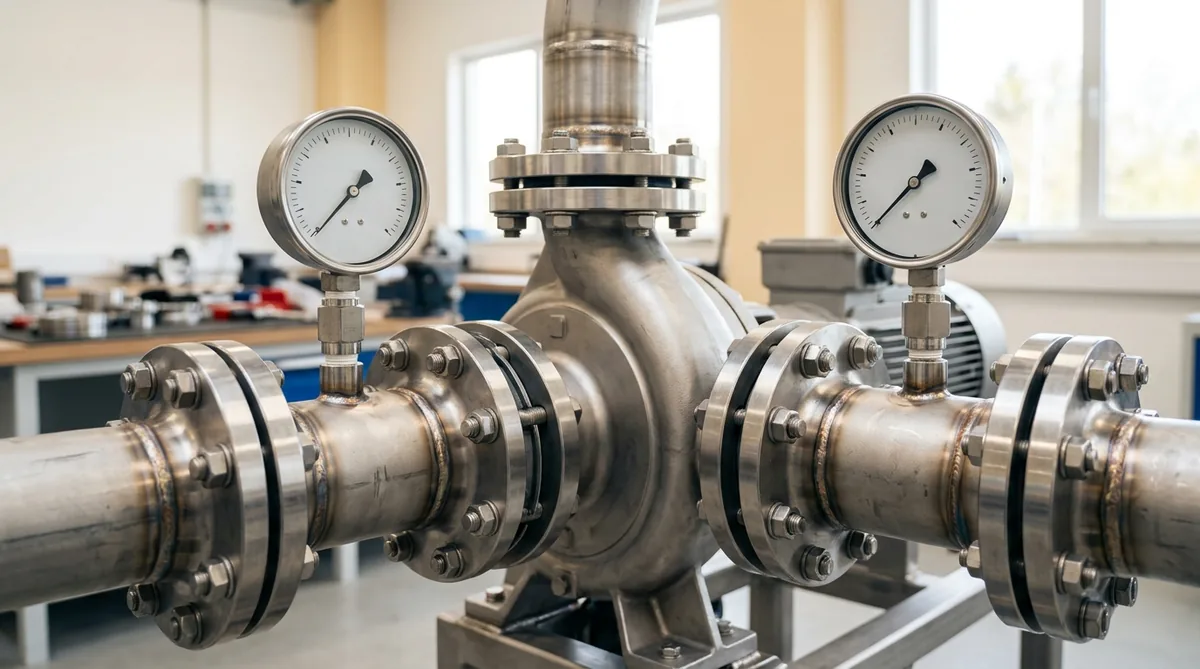
Low Water Pressure at Industrial Plants: Root Causes, Diagnostic Physics & Hydraulic Head Restoration
A definitive technical troubleshooting guide, centrifugal pump hydraulic diagnostics manual, and discharge pressure restoration standard for plant managers, utility maintenance heads, and process engineers across Ankleshwar GIDC, Panoli GIDC, Dahej PCPIR, Jhagadia GIDC, and Gujarat.
Quick Answer
In large chemical manufacturing complexes, bulk pharmaceutical active ingredient (API) facilities, agrochemical synthesis plants, and common effluent treatment systems across South Gujarat—particularly in Ankleshwar GIDC, Panoli, Dahej PCPIR, and Jhagadia—centrifugal utility and cooling water pumps frequently experience sudden or progressive drops in discharge pressure (P_discharge < P_design). When industrial pumps lose 25% - 60% of their rated pressure output, plant operations suffer severe process disruptions: reactor cooling jackets fail to remove exothermic heat, high-pressure scrubbers lose scrubbing efficiency, and boiler feedwater systems stall. While plant operators often suspect external piping blockages or faulty pressure gauges, over 80% of low-pressure issues originate inside the pump casing due to excessive wear ring clearances (> 0.8 mm permitting internal back-leakage), suction vortex air ingress (> 2% air by volume), reverse electrical phase rotation (30% - 50% head output), or severe impeller vane tip erosion. Conforming to ISO 5199, ISO 2858, IS 5120, IS 1520, and API 610 standards, diagnosing and restoring pump discharge pressure requires systematic total dynamic head (TDH) audits, shutoff head pressure testing, wear ring machining to nominal clearances (0.25 - 0.35 mm), and laser shaft alignment.
Key Takeaways
- Conduct a Dead-Head Shutoff Pressure Test First. A pump generating design shutoff head confirms that piping or speed—not internal pump wear—is the true root cause.
- Worn Casing Wear Rings Cause Severe Internal Back-Leakage. Clearances > 0.8 mm allow 20% - 40% of discharge flow to bypass back to suction, dropping line pressure.
- Verify Motor Electrical Phase Rotation. A centrifugal pump running backward still delivers fluid, but generates only 30% - 50% of its rated discharge pressure.
- Eliminate Suction Vortices and Air Pocket Ingress. Entrained air as low as 2% causes internal air-locking, dropping head output and inducing severe cavitation.
Introduction
In continuous chemical synthesis complexes, bulk pharmaceutical API manufacturing units, dye intermediate plants, and petrochemical utilities across Ankleshwar GIDC, Panoli GIDC, Dahej PCPIR, and Jhagadia GIDC, centrifugal process water pumps provide essential cooling, scrubbing, and boiler feed utilities.
Plant managers, utility maintenance heads, and rotating equipment engineers face severe operating hurdles:
- The High Cost of Unplanned Low Pressure: When a plant utility pump experiences a 30% - 50% drop in discharge pressure, reactor cooling water flow collapses, triggering emergency reactor shutdowns and costing chemical plants Rs 5,00,000 - 25,00,000 per day in lost production.
- The Diagnostic Dilemma: Maintenance teams frequently misdiagnose low discharge pressure, spending days cleaning external distribution headers or replacing entire pump motors when the true mechanical defect resides within internal wear ring clearances or suction air ingress.
- The Engineering Standard: Implementing a structured rotating machinery hydraulic troubleshooting protocol conforming to ISO 5199, ISO 2858, IS 5120, IS 1520, and API 610 standards—utilizing dead-head shutoff pressure testing, precision wear ring clearance restoration (0.25 - 0.35 mm), and suction line hydraulics optimization—restores 100% rated pressure output promptly.
2. Master Low Discharge Pressure Diagnostic Matrix & Failure Hierarchy
Review the primary physical root causes and measured symptoms of low pump discharge pressure:
| Diagnostic Symptom & Reading | Operating Condition | Primary Root Cause Mechanical Defect | Immediate Field Verification Action |
|---|---|---|---|
| Discharge Pressure Low (< 50%); Shutoff Head Low | Valve Fully Closed | Reverse Motor Rotation or Wrong Impeller Diameter | Check motor rotation arrow; measure impeller OD |
| Discharge Pressure Low at Flow; Normal at Shutoff | Valve Modulated Open | Excessive Wear Ring Clearance (> 0.8 mm) | Conduct internal micrometer wear ring audit |
| Pressure Gauge Needle Fluctuates Violently (± 1 bar) | Running at Normal Load | Suction Air Ingress or Vortex Formation in Sump | Inspect suction pipe submergence; seal air leaks |
| Discharge Pressure & Flow Low; High Suction Vacuum | High Suction Gauge Reading | Partially Clogged Suction Strainer or Foot Valve | Pull and clean suction basket strainer / line |
| Discharge Pressure Low; High Motor Current (> FLA) | Full Open Discharge | Operating Beyond BEP / Over-Pumping on Flat Curve | Throttle discharge valve; check system resistance |
| Discharge Pressure Drops Gradually Over 6 Months | Continuous Operation | Impeller Vane Cavitation & Cutwater Erosion | Inspect impeller vanes and volute casing cutwater |
3. The Fluid Dynamics & Hydrodynamic Physics of Low Discharge Pressure
Euler's Turbomachinery Head Equation (H_euler = (u_2 c_u2 - u_1 c_u1) / (g))
Theoretical head generated by a centrifugal impeller is defined by Euler's equation:
Interactive Engineering Hydraulic Sizer
Live ISO 5199 / API 610 Dynamic EngineWhere:
- u_2 = [πD_2 N] / [60] is the tangential tip speed at the impeller outer diameter D_2.
- c_u2 is the tangential component of absolute fluid velocity leaving the vane.
- u_1, c_u1 are the tangential velocities at the impeller eye inlet.
- Tip Speed & Diameter Physics: Head is proportional to the square of impeller diameter (H \propto D_2²) and speed (H \propto N²). If an impeller is trimmed undersized or eroded by 10% on its outer diameter, the generated discharge pressure drops by 19%.
Wear Ring Volumetric Leakage Hydrodynamics (ΔQ_leak = C_d A √(2g ΔH))
To prevent high-pressure fluid from circulating back to the low-pressure suction eye, tight-clearance wear rings are installed:
- Clearance Doubling Effect: As abrasive silt or chemical corrosion widens wear ring radial clearance from design (0.30 mm) to 0.90 mm (3× increase), internal back-leakage increases by 300%. This massive internal recirculation starves the discharge nozzle, dropping developed head and driving the operating point to a lower pressure on the H-Q curve.
Reverse Motor Rotation Fluid Mechanics (H_reverse ≈ 0.4 · H_forward)
- Vane Curvature Aerodynamics: Backward-curved centrifugal impeller vanes (β_2 < 90^°) are engineered to smoothly decelerate fluid and convert kinetic energy to static pressure.
- Reverse Rotation Consequence: When a 3-phase electric motor is wired backward, the impeller rotates forward-curved against the fluid stream. The pump continues to pump water due to centrifugal action, but efficiency collapses (< 25%), and discharge pressure drops to only 30% - 50% of rated design pressure.
Two-Phase Air Entrainment & Hydraulic Choking Kinetics
- Air Bubble Expansion: When air is drawn into the pump suction through loose flange gaskets, packing glands, or shallow sump vortexing:
- Performance Drop: An air concentration of just α_air = 2% causes a 10% - 15% drop in discharge pressure. At α_air > 4%, air accumulates at the low-pressure impeller eye, causing complete hydraulic vapor-locking and total loss of discharge pressure.
4. The 5 Critical Root Causes of Low Pump Pressure in Ankleshwar Chemical Facilities
Root Cause 1: Casing & Impeller Wear Ring Clearance Degradation
- Failure Mechanism: Pumping utility water with dissolved minerals and abrasive silt wears away bronze or stainless steel wear rings. Once radial clearance exceeds 0.8 mm, high-pressure discharge liquid continuously recirculates back to suction.
- Engineering Solution: Machine and install new wear rings to nominal ISO 5199 clearance (0.25 - 0.35 mm).
Root Cause 2: Reverse 3-Phase Electrical Motor Rotation
- Failure Mechanism: Following electrical maintenance or motor starter replacement, swapping any two incoming 3-phase power leads reverses motor rotation, reducing pressure by 60%.
- Engineering Solution: Verify rotation direction against casing cast arrow using an optical tachometer or momentary bump test.
Root Cause 3: Suction Strainer Clogging & Suction Cavitation Choking
- Failure Mechanism: Debris, algae, or plastic bags clogging the suction basket strainer drop Available Net Positive Suction Head (NPSHa < NPSHr), causing heavy cavitation that chokes fluid passage.
- Engineering Solution: Clean suction strainers and install differential pressure transmitters across the basket.
Root Cause 4: Entrained Air & Vortex Ingress in Suction Sump
- Failure Mechanism: Shallow liquid submergence in raw water cooling ponds generates surface vortices that suck atmospheric air directly into the pump suction nozzle.
- Engineering Solution: Increase sump liquid level or install anti-vortex baffle plates conforming to Hydraulic Institute (HI 1.3) standards.
Root Cause 5: Severely Eroded Impeller Vanes and Cutwater Clearance
- Failure Mechanism: Long-term cavitation and sand erosion wear down impeller vane tips and widen the casing cutwater gap (> 15 mm), destroying energy conversion.
- Engineering Solution: Replace damaged impeller with precision CNC-machined CF8M (SS316) impeller and re-profile the volute cutwater.
5. Sanitary Materials of Construction & Cleanroom Standards
Grade FG 260 Cast Iron & Ductile Iron Pump Casings
- Casing Metallurgy: Heavy-walled Grade FG 260 cast iron or ductile iron (GGG 40) casings designed with smooth hydraulic passages conforming to ISO 2858 and DIN 24255, resisting internal pressure surges up to 16.0 bar.
CF8M (SS316) & Bronze Wear Rings with Nitronic 60 Anti-Galling Inserts
- Wear Ring Metallurgy: Leaded Bronze (LG2/LG4), CF8M (SS316), or Nitronic 60 anti-galling stainless steel wear rings, heat-treated to maintain precision dimensional stability and prevent rotational galling under tight operating clearances.
Monolithic Direct-Sintered Silicon Carbide (SSiC) vs Hardened Sleeves
- Mechanical Sealing: Direct-sintered monolithic Silicon Carbide (SSiC, 2800 HV) mechanical seal faces preventing atmospheric air ingress into suction-lift pumps.
Calibrated Bourdon Tube Gauges & Precision Digital Pressure Transmitters
- Instrumentation Standards: Class 1.0 calibrated Bourdon tube pressure gauges with glycerin dampening and digital piezoresistive pressure transmitters installed at suction and discharge nozzles for exact total dynamic head calculation.
6. Step-by-Step Field Low Pressure Diagnostic & Overhaul SOPs
Execute these structured engineering SOPs when troubleshooting low discharge pressure:
Phase 1: Total Dynamic Head (TDH) & Gauge Calibration SOP
- Pressure Measurement: Record suction pressure (P_s) and discharge pressure (P_d) using calibrated gauges mounted at the pump nozzle centerlines.
- Total Dynamic Head Calculation:
- Performance Comparison: Compare measured TDH against the OEM factory pump curve at the measured motor amperage.
Phase 2: Closed-Valve Dead-Head Shutoff Pressure Audit SOP
- Test Execution: Momentarily close the pump discharge isolation valve completely for < 15 seconds.
- Pressure Analysis:
- If discharge pressure matches OEM shutoff head: The pump rotating assembly is healthy; the root cause is high system demand, pipe leakage, or low motor RPM. - If discharge pressure is < 80% of OEM shutoff head: The defect is internal to the pump (worn wear rings, reverse rotation, or eroded impeller).
Phase 3: Motor Electrical Rotation & Strobe RPM Audit SOP
- Rotation Check: Disconnect coupling or perform a momentary motor bump test. Confirm shaft rotation strictly matches the arrow cast on the pump casing.
- Speed Audit: Measure motor shaft rotational speed under full load using an optical digital tachometer. Verify speed matches nameplate rating (e.g., 2920 RPM at 50 Hz).
Phase 4: Casing Internal Wear Ring Micrometer Clearance Audit SOP
- Disassembly: Unbolt casing cover; extract rotor assembly.
- Measurement: Measure impeller eye outer diameter (OD_impeller) and casing wear ring inner diameter (ID_ring) using calibrated micrometers:
- Acceptance Limit: Confirm diametral clearance is ≤ 0.35 mm (0.014 in) for ring diameters up to 150 mm. If clearance exceeds 0.60 mm, machine and install new wear rings.
Phase 5: Suction Piping Incline & Vortex Submergence Audit SOP
- Submergence Audit: Verify minimum suction pipe submergence depth S ≥ 1.5 · D_pipe to eliminate air-drawing surface vortices.
- Incline Audit: Ensure horizontal suction pipe slopes continuously upward toward the pump nozzle (minimum 1:50 gradient) to prevent high-point air pockets.
Phase 6: Impeller Vane Trimming & Dynamic Rebalancing SOP
- Precision Trimming: If higher discharge pressure is required, machine replacement impeller to exact diameter calculated via Affinity Laws (H_2 / H_1 = (D_2 / D_1)²). Dynamically balance trimmed impeller to ISO 5199 Grade G2.5 before casing reassembly.
7. Worked South Gujarat Chemical & Petrochemical Industrial Case Studies
Case 1: Ankleshwar GIDC Bulk Drug Reactor Utility Water Pressure Restoration
- Plant Context: A bulk API manufacturing plant in Ankleshwar GIDC operating two 45 kW cooling water supply pumps (120 m³/hr, 4.5 bar).
- Problem: Discharge pressure dropped from 4.5 bar to 2.6 bar, starving reactor condensers and causing production bottlenecks.
- Action Plan: Dead-head test showed shutoff pressure was 35% low. Teardown revealed wear ring diametral clearance had worn to 1.15 mm due to river silt erosion. Re-machined casing and pressed in new CF8M wear rings with 0.28 mm clearance.
- Outcome: Discharge pressure restored to 4.6 bar; full reactor cooling capacity achieved; saved Rs 9,20,000 in avoided product spoilage.
Case 2: Panoli GIDC Agrochemical Cooling Tower Circulation Pump Overhaul
- Plant Context: An agrochemical pesticide plant in Panoli GIDC circulating water across three cooling tower cells.
- Problem: Cooling tower supply line pressure dropped to 1.8 bar, failing to reach upper spray nozzles.
- Action Plan: Found shallow sump level (S = 0.4 m) creating strong surface vortices sucking air into pump suction. Installed stainless steel cross-baffle anti-vortex plates and elevated sump water level by 0.6 m.
- Outcome: Air entrainment eliminated 100%; discharge pressure stabilized at 3.2 bar with zero gauge flutter.
Case 3: Dahej PCPIR Petrochemical Raw Water Booster Pump Wear Ring Fix
- Plant Context: A petrochemical facility in Dahej PCPIR operating high-capacity raw water booster pumps (350 m³/hr, 6.0 bar).
- Problem: Discharge pressure gradually decayed over 9 months, reducing transfer flow by 40%.
- Action Plan: Overhauled pump rotating assembly, replacing worn bronze wear rings (δ= 1.40 mm) with Nitronic 60 wear rings machined to 0.32 mm clearance and dynamically balanced rotor to Grade G2.5.
- Outcome: Discharge pressure restored to 6.1 bar; pump efficiency increased by 14%; saved Rs 4,80,000 in annual electrical energy costs.
Case 4: Jhagadia GIDC Industrial Estate Boiler Feedwater Pump Low Head Fix
- Plant Context: A chemical utility boiler house in Jhagadia GIDC operating multistage boiler feedwater pumps (18.0 bar).
- Problem: Multistage pump could not develop sufficient pressure to overcome boiler drum pressure (15.5 bar).
- Action Plan: Diagnostic teardown revealed heavy stage-to-stage interstage bushing wear. CNC-machined new precision SS410 interstage bushings and restored axial thrust clearance.
- Outcome: Developed head restored to 19.2 bar; continuous stable boiler feed achieved over 24 consecutive operating months.
Case 5: Vatva GIDC Chemical Scrubber Circulation Pump Reverse Rotation Fix
- Plant Context: A specialty chemical plant in Vatva GIDC pumping caustic wash across an exhaust gas scrubber.
- Problem: After electrical starter maintenance, the pump generated only 1.2 bar instead of its rated 3.5 bar.
- Action Plan: Performed motor rotation check; discovered motor was running in reverse. Swapped two phase leads at the MCC terminal block.
- Outcome: Discharge pressure immediately surged to 3.6 bar; scrubber flow fully restored within 15 minutes.
Case 6: Surat Textile Sizing Plant Hot Condensate Return Pump Air Lock Fix
- Plant Context: A textile sizing and processing mill in Surat pumping hot condensate (90°C).
- Problem: Condensate pump discharge pressure dropped to zero intermittently due to vapor locking.
- Action Plan: Modified suction piping to eliminate high-point hump and installed an automatic air-release valve on the pump casing vent port.
- Outcome: Vapor locking eliminated completely; continuous condensate return across 22 consecutive operating months.
8. Step-by-Step Low Water Pressure Troubleshooting Flowchart
Follow this structured engineering guide when diagnosing industrial pump low-pressure issues:
| Field Diagnostic Observation | Measured Hydraulic Parameter | Overhaul Corrective Maintenance Action |
|---|---|---|
| Shutoff Head < 50% of Design | Valve Closed; Motor Reverse Rotation | Swap two phase leads at motor MCC starter |
| Shutoff Head Normal; Pressure Drops at Flow | Wear Ring Clearance > 0.8 mm | Machine and install new wear rings (0.25 - 0.35 mm) |
| Gauge Needle Vibrating Wildly | Suction Vortex / Air Ingress (> 2%) | Install anti-vortex plates; check pipe gaskets |
| High Suction Vacuum Gauge Reading | Suction Strainer Differential ΔP > 0.5 bar | Clean suction basket strainer and foot valve |
| Pump Running Below Rated Speed | Motor Slip / Low Line Frequency (< 48 Hz) | Audit electrical supply voltage and VFD settings |
| Low Pressure After Impeller Overhaul | Undersized Impeller Trim Diameter | Machine replacement impeller to exact design OD |
9. Comprehensive Master Pump Hydraulic Performance (FAT) Checklist
Execute this quality verification protocol during centrifugal pump overhauls and pressure commissioning:
Pump Hydraulic Pressure Restoration Protocol
10. Summary & Pump Diagnostic and Overhaul Services in Gujarat
Eliminating sudden and progressive discharge pressure losses, restoring precision wear ring clearances conforming to ISO 5199, ISO 2858, IS 5120, IS 1520, and API 610 standards, and extending centrifugal pump operating life beyond 35,000 hours across Ankleshwar GIDC, Panoli GIDC, Dahej PCPIR, Jhagadia, and Vatva GIDC—by utilizing precision-machined CF8M wear rings, computer dynamic balancing to Grade G2.5, anti-vortex suction engineering, and dual-laser shaft alignment—is the proven engineering standard for modern industrial chemical utility reliability.
Teflow Pumps operates a specialized rotating machinery overhaul facility in Ahmedabad, providing on-site pump performance diagnostics, dead-head shutoff audits, CNC wear ring machining, impeller trimming, dynamic balancing, and genuine rotating equipment spares across Gujarat conforming to ISO 5199, ISO 2858, IS 5120, and API 610 standards.
- Direct Technical & Emergency Helpline: +91 98251 62709
- WhatsApp Technical Desk: Share your current suction/discharge pressure readings, motor nameplate data, pump model, or gauge photos to wa.me/919825162709 for immediate engineering diagnostics, performance evaluation, and formal quotation.
- Request an On-Site Pump Pressure & Flow Audit: Contact our senior rotating equipment reliability engineers for comprehensive plant utility surveys, laser alignment audits, and formal AMC service quotes.