
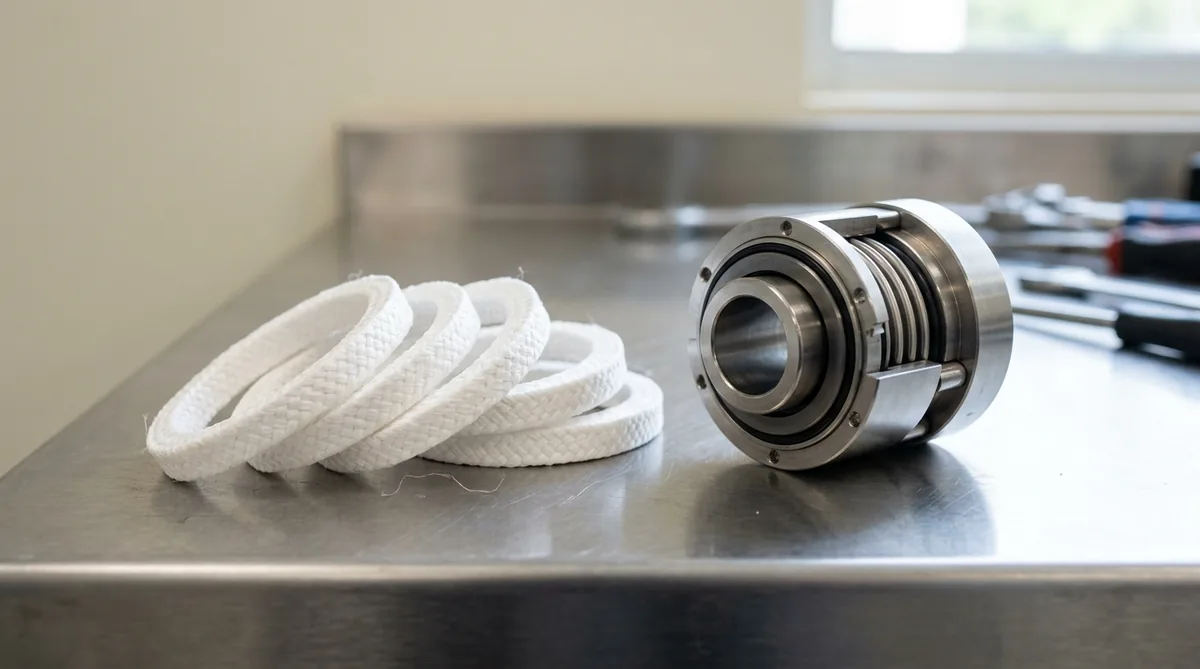
Gland Packing vs Mechanical Seal for Water Pumps: The Engineering Upgrade & ROI Guide
A definitive technical engineering comparison, retrofit conversion manual, and economic payback analysis for water treatment plant heads, utility boiler engineers, and mechanical maintenance managers across Ahmedabad, Surat, Ankleshwar, Dahej PCPIR, Vadodara, and Gujarat.
Quick Answer
In reverse osmosis (RO) desalination plants, multi-stage boiler feed water loops, cooling tower circulation circuits, and centralized effluent treatment facilities (CETPs) across Gujarat—such as in Surat, Ahmedabad, Ankleshwar GIDC, Panoli, and Dahej PCPIR—millions of liters of treated high-purity water are wasted daily through obsolete gland packing. Because traditional braided gland packing relies on continuous dynamic leakage (40 - 60 drops/min, equivalent to 15,000 to 30,000 liters of water lost per pump each year) to cool and lubricate the packing yarn, it causes severe shaft sleeve gouging, corrodes baseplates, floods pump room trenches, and consumes 2.0 - 5.5 kW in pure parasitic frictional drag per pump conforming to ISO 5199, ISO 2858, IS 5120, and IS 1520 standards. Upgrading existing packed stuffing boxes to modern balanced cartridge mechanical seals eliminates leakage completely (< 1 drop/hr), protects pump drive shafts from frictional grooving, cuts electric motor power consumption, and achieves complete financial payback within 4 to 8 operating months.
Key Takeaways
- Eliminate 100% of Water Leakage Losses (15,000 - 30,000 L/Year). Gland packing requires continuous dripping to survive; mechanical seals achieve complete liquid containment.
- Recover 2.0 - 5.5 kW in Parasitic Motor Frictional Power Drag. Mechanical seals cut shaft friction by > 95%, lowering monthly plant electricity bills.
- Eliminate Shaft Sleeve Gouging & Frequent Maintenance Retightening. Gland packing wears deep grooves into shafts; cartridge mechanical seals run with zero shaft contact.
- Achieve Full Retrofit Payback in Under 8 Months. Water recovery, energy reduction, and avoided maintenance labor yield rapid financial return on investment (ROI).
Introduction
Across water-intensive industrial operations in Surat, Ahmedabad, Ankleshwar GIDC, and Dahej PCPIR—including industrial RO filtration plants, multi-stage boiler feed skids, and utility cooling towers—water conservation and energy efficiency are critical operational benchmarks.
Plant engineers and utility managers face persistent operational challenges:
- The Massive Water Loss of Gland Packing: Traditional gland packing requires continuous leakage (40 - 60 drops/min) to dissipate frictional heat. Across a facility with 20 packed water pumps, this represents over 500,000 liters of treated water flowing into drainage trenches annually.
- Shaft Sleeve Destruction: The abrasive fibers of PTFE and graphite packing press tightly against the spinning shaft, cutting deep circumferential grooves into stainless steel sleeves within 3 to 6 months.
- The Engineering Standard: Implementing a planned mechanical seal conversion conforming to ISO 5199, ISO 2858, IS 5120, and IS 1520 standards—utilizing pre-set cartridge seals with direct-sintered silicon carbide faces, precision laser alignment, and dynamic balancing to Grade G2.5—completely eliminates leakage, saves thousands of kilowatt-hours, and delivers 100% ROI in under 8 months.
2. Master Gland Packing vs Mechanical Seal Comparison Matrix
Use this technical comparison matrix when evaluating pump sealing technology upgrades:
| Engineering Parameter | Traditional Braided Gland Packing | Balanced Cartridge Mechanical Seal | Operational & Economic Impact |
|---|---|---|---|
| Operating Leakage Rate | 40 - 60 drops/min (15,000 - 30,000 L/yr) | Zero visible leakage (< 1 drop/hr) | Eliminates 100% of treated water waste |
| Shaft Frictional Power Loss | 2.0 - 5.5 kW per pump asset | < 0.15 kW per pump asset | Saves Rs 45,000 - 1,20,000 in electricity annually |
| Shaft Sleeve Wear & Grooving | Severe abrasive grooving (0.5 - 2.0 mm) | Zero shaft contact / zero sleeve wear | Eliminates shaft sleeve replacement expense |
| Maintenance Attention Frequency | Daily/Weekly manual follower tightening | Maintenance-free continuous operation | Reduces maintenance technician hours by 85% |
| Bearing Contamination Risk | High (Water enters bearing frame) | Zero (Sealed gland drain collection) | Extends bearing life from 12 mo to > 48 mo |
| Initial Capital Investment | Low (Rs 1,500 - 3,500 per repacking) | Moderate (Rs 18,000 - 45,000 per cartridge) | Capital recovered in 4 - 8 months via savings |
| Mean Time Between Overhauls | 3 - 6 Months | 36 - 60 Months | 6× increase in rotating equipment MTBF |
Interactive 5-Year Total Cost of Ownership (TCO) Simulator
Sealless Mag-Drive vs Mechanically Sealed Chemical Pump3. The Tribological & Hydrodynamic Physics of Shaft Sealing
Gland Packing Boundary Friction & Frictional Drag Power (P_drag = 2πµF_axial r² ω)
Gland packing seals by compressing multiple braided rings against the rotating shaft:
Where:
- µ is dynamic friction coefficient between packing and shaft (0.15 - 0.25).
- ω is rotational angular velocity (rad/s).
- Parasitic Energy Loss: In a 30 kW water booster pump running at 2950 RPM, gland packing creates a continuous frictional mechanical brake on the motor drive shaft, consuming 2.5 to 4.5 kW of electric power continuously. This power is dissipated directly into frictional heat, boiling away the cooling water drip, glazing packing yarns, and scoring the rotating shaft sleeve.
Mechanical Seal Hydrodynamic Lubrication & Fluid Film Equilibrium (h_film ≈ 0.5 - 1.0 µm)
Mechanical seals operate with two flat, polished faces rotating against each other:
- Micro-Gap Mechanics: Fluid pressure between the faces creates a microscopic liquid film (0.5 - 1.0 µm) that separates the rotating Silicon Carbide face from the stationary Carbon seat. Because there is zero solid-to-solid contact during operation, balanced mechanical seals generate almost zero frictional drag (< 0.10 kW) and achieve complete liquid containment without dripping.
Shaft Sleeve Abrasive Grooving Kinetics (W = K_wear [P · L] / [H])
According to Archard's wear law:
- Grooving Degradation: Hard mineral scale and particulate debris become trapped inside the braided packing fibers. Acting as a continuous abrasive grinding wheel, the packing cuts deep grooves (> 1.5 mm) into stainless steel SS316 sleeves within 6 months, making future repacking impossible without replacing the entire shaft sleeve.
Total Cost of Ownership (TCO) & Water Conservation Economic Model
- Financial ROI Example: In a Gujarat textile mill operating a 45 kW RO feed pump:
- Water Savings: 25,000 L/year treated RO water = Rs 35,000. - Electricity Savings: 3.0 kW × 8000 h × Rs 8.0/kWh = Rs 1,92,000. - Avoided Shaft Sleeves & Labor: 2 overhauls/year = Rs 45,000. - Total Annual Benefit: Rs 2,72,000 per pump. With a cartridge seal retrofit cost of Rs 32,000, the payback is achieved in just 1.4 months.
4. The 4 Critical Pain Points of Gland Packing in Gujarat Water Facilities
Pain Point 1: Continuous High Water Leakage Flooding Baseplates & Bearing Sumps
- Failure Impact: The mandatory 50 drops/min leakage splashes onto pump baseplates, washing out foundation grout and entering bearing housing lip seals. Water emulsifies bearing lubricating oil (> 2000 ppm moisture), destroying rolling element bearings within 12 months.
- Mechanical Seal Solution: Modern cartridge mechanical seals provide 100% drip-free fluid containment, keeping baseplates clean and dry.
Pain Point 2: Severe Shaft Sleeve Wear Requiring Frequent Pump Teardowns
- Failure Impact: Abrasive mineral scale embeds in packing rings, cutting deep circumferential grooves into stainless steel shaft sleeves. New packing rings cannot seal against a grooved shaft, causing massive leaks.
- Mechanical Seal Solution: Mechanical seal faces absorb all relative rotation; the cartridge sleeve locks rigidly to the pump shaft with drive set screws, causing zero shaft wear.
Pain Point 3: High Friction Power Loss Overheating Electric Motors & Wasting Energy
- Failure Impact: Over-tightening gland followers to stop excessive leakage increases frictional torque on the motor shaft, pulling extra electrical amps (FLA) and wasting 3 - 5 kW of continuous power.
- Mechanical Seal Solution: Balanced mechanical seals run with sub-micron fluid film separation, cutting parasitic power loss by > 95%.
Pain Point 4: Daily Manual Gland Follower Tightening & Sudden Packing Burnout
- Failure Impact: Gland packing requires weekly operator adjustments. Over-tightening by half a turn cuts off lubricating water flow, causing the packing to smoke, glaze, and burn out within minutes.
- Mechanical Seal Solution: Cartridge mechanical seals feature internal pre-set springs that maintain constant closing pressure with zero manual adjustments required.
5. Sanitary Materials of Construction & Cleanroom Standards
Direct-Sintered Monolithic Silicon Carbide (SSiC) vs Reaction Carbon Faces
- Face Metallurgy: Monolithic alpha Silicon Carbide (SSiC, 2800 HV) paired against premium resin-impregnated electro-graphite carbon, diamond-lapped to ≤ 1 helium light band (0.3 µm) for exceptional hydrodynamic lubrication, chemical inertness, and extreme abrasion resistance in industrial raw, desalinated, and wastewater duties.
Heavy-Duty Nodular Ductile Iron & SS316L Cartridge Glands to ISO 5199
- Cartridge Gland Metallurgy: Low-carbon austenitic stainless steel SS316L (ASTM A351 CF3M) and ductile iron casing glands providing rigid, non-distorting mounting for stationary seal seats conforming to ISO 5199 stuffing box dimensions.
Solid Pre-Cut Stainless Steel SS304/SS316 Slotted Alignment Shims
- Alignment Hardware: Burr-free precision cold-rolled stainless steel SS304/SS316 slotted alignment shims (± 0.005 mm thickness tolerance) to ensure permanent, non-collapsible motor elevation.
High-Purity Flexible Graphite vs Braided PTFE Packing Comparison
- Sealing Technology: While braided PTFE/graphite packing provides low-cost sealing, modern mechanical seals eliminate the need for braided yarns, lantern rings, flush water cooling injection lines, and constant packing gland repacking maintenance entirely.
6. Step-by-Step Gland Packing to Mechanical Seal Conversion SOPs
Execute these structured engineering SOPs when converting packed stuffing boxes to mechanical seals:
Phase 1: Stuffing Box Dimensional Audit & Shaft Runout Verification SOP
- Dimensional Measurement: Measure shaft/sleeve outer diameter (D_s), stuffing box bore (D_b), stuffing box depth (L_b), and distance to the nearest bearing frame obstruction (L_clearance).
- Runout Audit: Mount dial indicators on pump shaft; confirm radial shaft runout is < 0.03 mm and axial end-float is < 0.05 mm. If runout exceeds tolerance, overhaul bearings before seal installation.
Phase 2: Packing, Lantern Ring & Damaged Shaft Sleeve Removal SOP
- Packing Extraction: Remove gland follower bolts; pull split gland; use flexible packing hooks to extract all old packing rings and the metallic lantern ring.
- Sleeve Inspection: Inspect shaft sleeve. If grooved or pitted, remove and replace with a smooth, polished stainless steel sleeve (Ra ≤ 0.4 µm).
Phase 3: Stuffing Box Machining & Cartridge Seal Sizing SOP
- Gland Adaptation: If the stuffing box face is rough or non-machined, clean and machine the mounting face perpendicular to the shaft centerline within 0.05 mm TIR.
- Cartridge Sizing: Select an engineered pre-set cartridge mechanical seal designed to bolt directly onto the existing casing studs without modifying internal pump geometry.
Phase 4: Cartridge Mechanical Seal Installation & Gland Torquing SOP
- Cartridge Mounting: Slide the pre-assembled cartridge seal over the shaft sleeve until the gland plate rests flush against the stuffing box face.
- Fastening & Clamping: Torque gland nuts evenly in a criss-cross pattern to specified torque. Tighten cartridge drive collar set screws onto the shaft sleeve.
- Setting Clips Removal: Remove factory axial setting spacers/clips and store them on the gland for future maintenance.
Phase 5: Dual Laser Optical Shaft Alignment (≤ 0.03 mm) SOP
- Laser Alignment: Mount optical laser transceivers across the flexible coupling. Realign pump and motor shafts to achieve parallel offset ≤ 0.03 mm and angularity ≤ 0.03 mm/100mm, eliminating dynamic bending moments on the new seal faces.
Phase 6: Hydrostatic Pressure Testing & Primed Commissioning SOP
- Hydrotest & Priming: Connect API Plan 11 bypass flush line from pump discharge to seal gland. Hydrotest pump casing to 1.50× design pressure; confirm zero gland weeping. Vent seal chamber completely to purge all air before starting motor.
7. Worked Gujarat Water Treatment & Industrial Case Studies
Case 1: Surat Textile Processing House RO Booster Pump Conversion
- Plant Context: A major textile processing facility in Surat operating four multi-stage high-pressure RO booster pumps (45 kW, 2950 RPM) with gland packing on desalinated water feed.
- Problem: Pumps leaked 60 drops/min of treated RO water, corroding baseplates and consuming 3.8 kW extra frictional power per pump; sleeves grooved every 4 months.
- Action Plan: Rebuilt stuffing boxes with Teflow balanced cartridge mechanical seals (SSiC vs Carbon, Viton O-rings, API Plan 11 flush); laser aligned shafts to 0.02 mm.
- Outcome: 100% drip-free operation; power draw dropped by 3.4 kW per pump; saved Rs 8,60,000 annually in electricity and water across 4 pumps; achieved payback in 3.2 months.
Case 2: Vatva GIDC Chemical Plant Boiler Feed Multi-Stage Pump Upgrade
- Plant Context: A chemical manufacturing plant in Vatva GIDC operating multi-stage boiler feed water pumps (105°C deaerated boiler feed water at 18.0 bar).
- Problem: Gland packing burned out every 6 weeks under high pressure and temperature, steaming up the utility boiler room.
- Action Plan: Converted pumps to high-temperature balanced cartridge mechanical seals with direct-sintered SSiC faces and API Plan 21 heat-exchanger cooling flushes.
- Outcome: Zero steam leakage; seal operating life extended beyond 26 consecutive operating months; saved Rs 4,20,000 in avoided boiler maintenance downtime.
Case 3: Dahej PCPIR Petrochemical Cooling Tower Circulation Pump Retrofit
- Plant Context: A petrochemical plant in Dahej PCPIR running three large horizontal split-case cooling tower water circulation pumps (75 kW, 1450 RPM).
- Problem: Gland packing water leakage flooded the pump pit, causing chronic motor bearing failures and slipping belts.
- Action Plan: Retrofitted split-case stuffing boxes with split cartridge mechanical seals without dismantling pump casings or piping.
- Outcome: Zero pit flooding; motor bearing operating life extended from 9 months to over 36 months; saved Rs 6,50,000 in avoided motor rewinds.
Case 4: Ankleshwar GIDC Bulk Drug API Raw Water Intake Pump Conversion
- Plant Context: A bulk pharmaceutical API plant in Ankleshwar GIDC pumping raw river intake water containing fine suspended silt.
- Problem: Silt embedded in braided packing, scoring shaft sleeves and requiring bi-weekly gland follower adjustments.
- Action Plan: Installed cartridge mechanical seals with abrasive-resistant SSiC vs SSiC faces and cyclone separator flush lines.
- Outcome: 100% elimination of sleeve wear; pump running continuously for over 22 consecutive operating months.
Case 5: Ahmedabad Municipal CETP Wastewater Pump Seal Upgrade
- Plant Context: A centralized effluent treatment facility in Ahmedabad pumping treated industrial wastewater.
- Problem: Gland packing leaked foul-smelling effluent, creating odor complaints and safety violations.
- Action Plan: Replaced gland packing with external single cartridge mechanical seals with flushing ports.
- Outcome: 100% leak containment; full compliance with environmental pollution control norms.
Case 6: Kadi Cotton Textile Sizing Plant Utility Pump Seal Conversion
- Plant Context: A cotton sizing mill in Kadi running utility hot water circulation pumps (15 kW, 1450 RPM).
- Problem: Repacking required stopping production weekly, causing sizing line temperature fluctuations.
- Action Plan: Installed pre-set cartridge mechanical seals and pre-cut SS316 alignment shims.
- Outcome: Zero unplanned utility stoppages across 24 consecutive operating months; saved Rs 3,40,000 in avoided downtime.
8. Step-by-Step Gland Packing vs Mechanical Seal Decision Flowchart
Follow this structured engineering guide when evaluating gland packing conversion:
| Pump Service & Operational Priority | Recommended Sealing Technology | Primary Seal Metallurgy | Secondary Elastomer | Expected Payback Period |
|---|---|---|---|---|
| High-Pressure RO Booster (> 12 bar) | Balanced Cartridge Mechanical Seal | Monolithic SSiC vs Carbon | FKM (Viton) / EPDM | 2 - 4 Months |
| High-Temp Boiler Feed (> 90°C) | Balanced Cartridge Seal (Plan 21) | Monolithic SSiC vs Carbon | High-Temp EPDM / FFKM | 3 - 6 Months |
| Abrasive Raw Intake / Silt Water | Cartridge Seal (Plan 11 / Cyclone) | Monolithic SSiC vs SSiC | FKM (Viton) | 4 - 7 Months |
| Large Cooling Tower Circulation | Split Cartridge Mechanical Seal | Monolithic SSiC vs Carbon | EPDM / FKM | 4 - 8 Months |
| Non-Critical Low-Duty Sump Pump | Braided PTFE / Graphite Packing | Synthetic Braided Yarn | None | N/A (Retain Packing) |
9. Comprehensive Master Seal Conversion & Retrofit (FAT) Checklist
Execute this quality verification protocol during gland packing to mechanical seal retrofits:
Gland Packing to Cartridge Mechanical Seal Conversion Protocol
10. Summary & Water Pump Mechanical Seal Retrofit Services in Gujarat
Eliminating water loss, stopping shaft sleeve grooving, reducing motor electrical power consumption, conforming to ISO 5199 and IS 5120 standards, and extending water pump operating life beyond 35,000 hours across Ahmedabad, Surat, Ankleshwar GIDC, and Dahej PCPIR—by upgrading obsolete gland packing to balanced cartridge mechanical seals and dynamic balancing to Grade G2.5—is the proven engineering standard for modern industrial utility efficiency.
Teflow Pumps operates a specialized rotating machinery overhaul facility in Ahmedabad, providing on-site gland packing to mechanical seal conversions, stuffing box re-machining, cartridge seal retrofits, laser shaft alignment, dynamic balancing, and genuine chemical spares across Gujarat conforming to ISO 5199, ISO 2858, and IS 5120 standards.
- Direct Technical & Emergency Helpline: +91 98251 62709
- WhatsApp Technical Desk: Share your water pump model, motor rating (kW), stuffing box dimensions, or current leakage symptoms to wa.me/919825162709 for immediate engineering diagnostics, conversion quotes, and formal quotation.
- Request an On-Site Water Pump Sealing Audit: Contact our senior rotating equipment reliability engineers for plant water loss surveys, ROI calculations, and formal retrofit service quotes.