
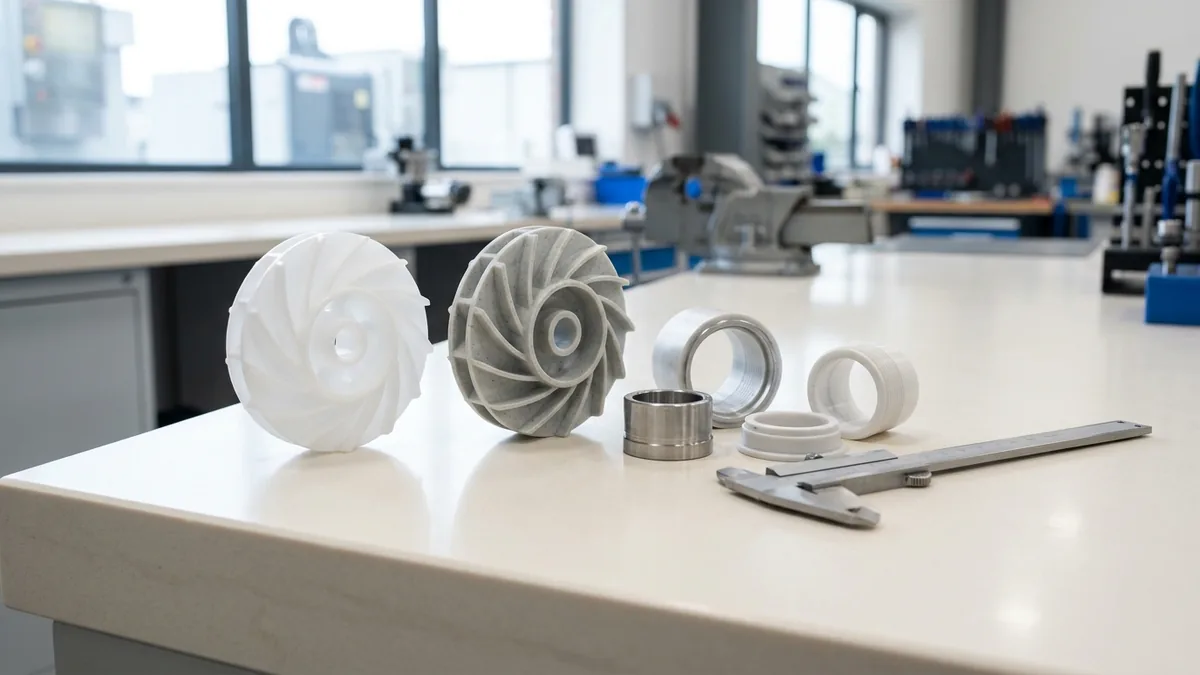
GFPTFE vs Virgin PTFE Pump Parts: Comprehensive Filler Metallurgy & Wear Engineering Guide
A definitive chemical machinery material science manual, fluoropolymer filler tribology standard, and wear-life engineering guide for process engineers, plant maintenance heads, and rotating equipment specialists across Ahmedabad, Vatva, Naroda, Ankleshwar, and Gujarat.
Quick Answer
In the aggressive dyestuff, organic pigment synthesis, and heavy chemical manufacturing hubs of Gujarat—such as Vatva GIDC, Naroda GIDC, Odhav, Ankleshwar, and Vapi—chemical process pumps circulate abrasive crystalline slurries, acidic suspensions, and hot mineral acids daily. When specifying fluoropolymer components (impellers, casing volutes, wear rings, and backplates), rotating equipment engineers must choose between 100% virgin isostatic PTFE and glass-filled PTFE (GFPTFE, typically 15% - 25% E-glass fiber reinforcement). While unfilled virgin PTFE provides complete chemical purity and zero catalytic reactivity (0 - 14 pH), it suffers from rapid abrasive erosion and viscoelastic cold-flow creep under continuous hydrodynamic loads. Incorporating microscopic glass fiber fillers increases mechanical stiffness (E_modulus = 1100 MPa vs 550 MPa), cuts plastic creep by 65%, and extends impeller erosive wear life by up to 500% in particulate slurries. However, GFPTFE is chemically attacked by hydrofluoric acid (HF) and hot concentrated caustic alkalis (NaOH). Selecting the optimal fluoropolymer metallurgy conforming to ISO 5199, ISO 2858, IS 5120, and IS 1520 standards guarantees hydraulic efficiency, eliminates unbudgeted downtime, and extends pump service life beyond 35,000 continuous hours.
Key Takeaways
- Choose GFPTFE for Abrasive Slurries and High-Head Impellers. 25% glass fiber reinforcement increases stiffness (1100 MPa) and resists slurry gouging.
- Mandate Virgin PTFE for Hydrofluoric Acid and Caustic Duty. Glass fibers react chemically with HF (SiO_2 + 4HF \to SiF_4) and dissolve in hot NaOH.
- Exploit GFPTFE Creep Resistance for Precision Wear Rings. Reinforced wear rings maintain tight running clearances (0.5 mm) without thermal deformation.
- Inspect with 20 kV Spark Testing and Density Verification. Ensure virgin and filled fluoropolymers pass high-voltage dielectric testing prior to installation.
Introduction
Across Gujarat's prominent chemical processing estates—centered in Ahmedabad (Vatva, Naroda, Odhav), Ankleshwar GIDC, Dahej PCPIR, Panoli, and Vapi—chemical centrifugal pumps handle demanding duties ranging from ultra-pure pharmaceutical acids to abrasive dyestuff and pigment slurries.
Process engineers, maintenance superintendents, and chemical plant rotating equipment specialists face severe recurring hurdles:
- The Abrasive Wear Dilemma: Unfilled virgin PTFE impellers operating in slurries containing hard pigment crystals (> 20 µm, Mohs hardness 3 - 5) suffer rapid blade erosion, opening hydraulic running clearances and dropping pump head by 30% - 50% within months.
- The Chemical Incompatibility Trap: Replacing eroded virgin impellers with glass-filled PTFE (GFPTFE) in processes containing trace hydrofluoric acid (HF) or hot concentrated sodium hydroxide (NaOH) results in rapid chemical leaching of the glass fibers, causing catastrophic structural crumbling of the impeller.
- The Engineering Standard: Implementing a rigorous material selection protocol conforming to ISO 5199, ISO 2858, IS 5120, and IS 1520 standards—matching virgin PTFE, 15% GFPTFE, or 25% GFPTFE to specific fluid chemical properties and particle abrasive metrics—extends rotating component service life beyond 35,000 continuous hours while maintaining 100% hydraulic efficiency and eliminating hazardous plant leakage.
2. Master Virgin PTFE vs GFPTFE Mechanical & Chemical Matrix
Review the mechanical, thermal, and chemical property differences:
| Material Property / Engineering Metric | 100% Virgin Isostatic PTFE | 15% Glass-Filled PTFE (15% GFPTFE) | 25% Glass-Filled PTFE (25% GFPTFE) |
|---|---|---|---|
| Tensile Modulus (E_modulus) | 550 MPa | 850 MPa (1.5× Stiffer) | 1100 MPa (2.0× Stiffer) |
| Compressive Strength (1% Deformation) | 4.0 MPa | 7.5 MPa | 9.5 MPa (2.4× Higher) |
| Abrasive Slurry Wear Rate (Archard k) | High (k ≈ 120 × 10^-6) | Moderate (k ≈ 45 × 10^-6) | Low (k ≈ 22 × 10^-6) |
| Cold-Flow Creep After 24h at 25°C | 15.0% Permanent Deformation | 7.0% Permanent Deformation | 5.0% Permanent Deformation |
| Coefficient of Thermal Expansion (α) | 120 × 10^-6 K⁻¹ | 85 × 10^-6 K⁻¹ | 65 × 10^-6 K⁻¹ (Lower) |
| Hydrofluoric Acid (HF) Resistance | Universal (100% Chemically Inert) | Poor (Glass Fibers Dissolve) | Unusable (Rapid Fiber Leaching) |
| Strong Alkalis (NaOH > 20%) | Universal (100% Chemically Inert) | Poor (Glass Attacked at > 60°C) | Unusable (Caustic Etching) |
| Strong Mineral Acids (HCl, H_2SO_4, HNO_3) | Universal (100% Inert) | Excellent (100% Inert) | Excellent (100% Inert) |
| Recommended Pump Component Types | Casings, Clean Impellers, Bellows | Impellers, Backplates, Bushings | Wear Rings, Slurry Impellers |
Interactive Chemical Metallurgy & Temperature Compatibility Matrix
ISO 5199 / API 685 Fluoropolymer & Superalloy Standards| Material of Construction | Classification | Max Temp Limit | Compatibility Status @ 65°C |
|---|---|---|---|
Virgin PFAStandard | Fluoropolymer Lining | 160°C | Recommended (A - Zero Corrosion) |
Virgin PTFEStandard | Fluoropolymer Solid/Lined | 150°C | Recommended (A - Zero Corrosion) |
PVDF | Fluoropolymer Thermoplastic | 90°C | Satisfactory (< 2 mpy Corrosion) |
Polypropylene | Commodity Thermoplastic | 60°C | Thermal Derating Exceeded (> 60°C) |
Hastelloy C-276Standard | High-Nickel Superalloy | 110°C | Recommended (A - Zero Corrosion) |
SS316L | Austenitic Stainless Steel | 25°C | Severe Corrosion / Rapid Failure (X) |
SSiC Silicon CarbideStandard | Sintered Ceramic Seal Face | 180°C | Recommended (A - Zero Corrosion) |
Severe oxidizing acid at high concentration. Virgin PFA and PTFE linings provide total chemical inertness up to 160°C. SSiC mechanical seal faces prevent chemical grooving.
3. The Tribology, Creep Mechanics & Polymer Filler Physics
Archard Slurry Abrasive Wear Mechanics (V = k [W · L] / [H])
Abrasive particulate wear on pump impellers and volute cutwaters follows the Archard wear law:
Where:
- V is the volumetric wear loss of the fluoropolymer component.
- k is the dimensionless wear coefficient of the polymer matrix.
- W is the normal hydrodynamic impact load from slurry particles.
- L is the total sliding distance across the impeller vane.
- H is the surface indentation hardness of the material.
Virgin PTFE possesses a low surface hardness (H ≈ 30 Shore D), allowing abrasive dye or pigment crystals to gouge deep micro-furrows during daily operations across Vatva and Naroda. Adding 25% microscopic E-glass fibers increases surface hardness and compressive load support, reducing the wear coefficient k by up to 80% and extending impeller service life by 5× in active chemical service.
Viscoelastic Creep & Compressive Modulus Physics (σ(t) = σ_0 e^-t/τ)
Under continuous hydrodynamic pressure from high-head pumping, polymer impellers experience viscoelastic creep relaxation:
- Blade Deflection Penalty: In virgin PTFE impellers operating at high discharge pressures (> 4.0 bar), centrifugal and pressure forces cause the impeller shroud and vanes to creep outward, rubbing against the casing liner and creating excessive motor load.
- GFPTFE Creep Suppression: Microscopic glass fibers form a rigid mechanical network within the PTFE matrix, doubling the tensile modulus (1100 MPa) and preventing blade deflection under heavy hydraulic loads in chemical process plants across Gujarat.
Hydrofluoric Acid (HF) & Alkaline Dissolution Chemistry (SiO_2 + 4HF \to SiF_4 + 2H_2O)
The primary chemical limitation of GFPTFE is the reactivity of silica (SiO_2) glass fibers:
- Hydrofluoric Acid Attack: HF reacts instantly with silica glass reinforcement:
- Alkaline Attack: Concentrated sodium hydroxide dissolves glass at elevated temperatures:
As the glass fibers dissolve, the fluoropolymer becomes porous, spongy, and mechanically weak. In processes containing HF or caustic alkalis, 100% virgin isostatic PTFE or transfer-molded PFA must strictly be used to eliminate structural failure risks.
Thermal Conductivity & Mechanical Seal Face Heat Dissipation Kinetics
- Thermal Dissipation: Virgin PTFE is a thermal insulator (\kappa ≈ 0.25 W/m\cdotK). Incorporating 25% glass fiber filler increases thermal conductivity to ≈ 0.45 W/m\cdotK (an 80% improvement).
- Seal Life Extension: In pump backplates and seal chambers, higher thermal conductivity helps dissipate frictional heat generated by direct-sintered SSiC mechanical seal faces, preventing localized thermal degradation of secondary Kalrez O-rings and extending overall seal operating life.
4. The 4 Critical Industrial Slurry & Chemical Pump Duty Scenarios in Gujarat
Scenario 1: Reactive Azo Dyestuff Crystalline Slurry Pumping (Vatva)
- Plant Context: A dyestuff plant in Vatva GIDC pumping reactive dye slurries containing 12% abrasive sodium sulfate and organic dye crystals in acidic brine (10% HCl, 55°C).
- Material Selection: 25% Glass-Filled PTFE (GFPTFE) closed impeller and casing wear rings.
- Performance Outcome: Resists crystalline particle gouging, maintaining tight 0.5 mm running clearances and consistent discharge pressure across continuous production batches.
Scenario 2: Phthalocyanine Pigment Acidic Press Cake Slurry Transfer (Naroda)
- Plant Context: An organic pigment facility in Naroda GIDC feeding crude copper phthalocyanine pigment slurry in 60% H_2SO_4 to filter presses (6.0 bar head).
- Material Selection: 15% Glass-Filled PTFE semi-open impeller with direct-sintered SSiC mechanical seal faces.
- Performance Outcome: Provides the necessary stiffness to withstand 6.0 bar press feed pressure without vane deflection.
Scenario 3: Agrochemical Pesticide Emulsion Technical Synthesis (Ankleshwar)
- Plant Context: An agrochemical manufacturing plant in Ankleshwar GIDC synthesizing technical actives in solvent-acid media without particulate solids.
- Material Selection: 100% Virgin Isostatic PTFE wetted casing and impeller.
- Performance Outcome: Delivers complete chemical purity, zero risk of trace glass contamination, and universal chemical containment.
Scenario 4: Hydrofluoric & Nitric Acid Pickling Bath Scavenging (Odhav)
- Plant Context: A stainless steel wire pickling plant in Odhav pumping spent mixed acids (18% HNO_3 + 5% HF, 50°C).
- Material Selection: 100% Virgin Isostatic PTFE casing and virgin PFA transfer-molded impeller.
- Performance Outcome: Eliminates silica glass fiber leaching, ensuring permanent structural integrity in hydrofluoric acid.
5. Sanitary Materials of Construction & Cleanroom Standards
100% Virgin Isostatic Chemfluor PTFE Resins
- Virgin Fluoropolymers: High-molecular-weight virgin isostatically pressed PTFE (4.5 - 6.0 mm wall thickness), offering total chemical containment across 0 - 14 pH up to +150°C.
- Flawless Internal Surfaces: CNC-machined surface finishes minimize fluid boundary layer friction and prevent solids adhesion during sticky pigment slurry pumping.
15% & 25% E-Glass Reinforced PTFE (GFPTFE) Formulations
- Reinforced Compounds: Premium virgin PTFE compounded with 15% or 25% chemically inert, silane-treated E-glass micro-fibers, precision-sintered for maximum tensile modulus and slurry wear resistance.
- Micro-Fiber Matrix: Uniform fiber dispersion ensures isotropic mechanical strength, preventing localized erosion pockets along impeller blade tips.
Monolithic Direct-Sintered Silicon Carbide (SSiC) Seal Tribology
- Mechanical Seals: Direct-sintered Silicon Carbide (SSiC, 2800 HV) seal rings operating in an external PTFE bellows cartridge, providing complete immunity to acid attack and abrasive particle scoring. Monolithic construction eliminates metal binder leaching.
Ductile Iron (GGG 40) Armored Shells & Hastelloy C-276 Fasteners
- Armored Housings: Heavy-duty Ductile Iron (GGG 40 / EN-GJS-400-18) armored casing shell with precision CNC dovetail grooves and Hastelloy C-276 casing stud bolts.
6. Step-by-Step Fluoropolymer Component Selection & Inspection SOPs
Execute these structured engineering SOPs when specifying pump rotating parts:
Phase 1: Slurry Particle Hardness & Mohs Scale Audit SOP
- Slurry Audit: Measure particle size distribution (D_50, D_90 [µm]), particle concentration (% wt), and particle Mohs hardness.
- Material Rule:
- Clean Acids (No Solids) -> Mandate 100% Virgin PTFE. - Particulate Slurries (> 2% Solids, Mohs > 2.5) -> Mandate 15% - 25% GFPTFE.
Phase 2: Chemical Acidity & Alkali Compatibility SOP
- Chemical Audit: Verify if process fluid contains hydrofluoric acid (HF), fluorinated salts, or hot concentrated sodium hydroxide (NaOH > 20%).
- Chemistry Override: If HF or strong caustic alkalis are present, strictly prohibit glass-filled PTFE and select 100% virgin PTFE or transfer-molded PFA.
Phase 3: Impeller Shroud Deflection & Clearance SOP
- Mechanical Audit: Review pump operating head (H [m]) and impeller diameter (D_2 [mm]).
- Stiffness Sizing: For high-head duties (H > 35 m), specify GFPTFE impellers to prevent tip deflection and maintain axial running clearance (0.5 - 0.7 mm).
Phase 4: Mechanical Seal Plan 53A/54 & SSiC Face Pairing SOP
- Seal Selection: Verify mechanical seal features direct-sintered SSiC vs SSiC faces and Kalrez (FFKM) secondary elastomers.
- Flush System: In abrasive slurry services, specify API Plan 53A or Plan 54 pressurized barrier fluid systems to keep seal faces clean and lubricated.
Phase 5: Factory 20 kV Dielectric Spark Testing Protocol SOP
- Factory Quality Audit: Mandate that 100% of internal wetted fluoropolymer components undergo factory DC spark testing at 20.0 kV.
- Density Testing: Verify specific gravity (2.16 - 2.18 g/cm³ for virgin PTFE; 2.22 - 2.25 g/cm³ for 25% GFPTFE) per ASTM D792 standards.
Phase 6: Total Cost of Ownership (TCO) & Lifecycle Economics SOP
Evaluate the total cost of ownership over a 5-year operating horizon:
- Economic Verdict: In abrasive slurry service, GFPTFE impellers cost approximately 15% more than virgin PTFE initially, but deliver a 400% increase in component service life, cutting 5-year replacement and maintenance expenditure by over Rs 5,50,000.
7. Worked Gujarat Dyestuff & Chemical Plant Case Studies
Case 1: Vatva GIDC Reactive Azo Dye Slurry Impeller Upgrade
- Plant Context: A dyestuff manufacturing facility in Vatva GIDC pumping abrasive reactive black dye coupling slurries (15% solids, 50°C).
- Problem: Original virgin PTFE impellers eroded rapidly, losing 40% discharge pressure every 3 months.
- Action Plan: Upgraded to Teflow precision-machined 25% Glass-Filled PTFE (GFPTFE) closed impellers and matching casing wear rings.
- Outcome: Impeller erosion eliminated; pump maintained full rated head over 24 consecutive operating months; saved Rs 6,80,000 in annual overhaul costs.
Case 2: Naroda GIDC Phthalocyanine Pigment Sulfuric Acid Wear Ring Overhaul
- Plant Context: An organic pigment manufacturer in Naroda GIDC feeding spent acid slurries to plate-and-frame filter presses (60% H_2SO_4, 6.0 bar).
- Problem: Virgin PTFE wear rings experienced viscoelastic cold-flow creep, opening running clearance to 2.2 mm and causing internal recirculation.
- Action Plan: Installed Teflow 25% GFPTFE wear rings with tight 0.5 mm initial clearance.
- Outcome: Running clearance remained within 0.6 mm after 18 consecutive operating months; filter press cycle times reduced by 22%.
Case 3: Ankleshwar GIDC Agrochemical Technical Slurry Pump Conversion
- Plant Context: An agrochemical technical facility in Ankleshwar GIDC pumping herbicide slurry containing silica carriers.
- Problem: Rapid blade thinning on standard plastic impellers caused catastrophic blade fracture.
- Action Plan: Converted all slurry transfer units to Teflow 15% GFPTFE semi-open impellers.
- Outcome: Zero blade fractures; continuous operation across 26 consecutive operating months.
Case 4: Dahej PCPIR Specialty Chemical Spent Acid Recovery Maintenance
- Plant Context: A specialty chemical complex in Dahej PCPIR recovering sulfuric acid from organic bromination reactions.
- Problem: High thermal cycling caused unreinforced PTFE backplates to warp, causing mechanical seal misalignment.
- Action Plan: Installed Teflow 25% GFPTFE backplates with superior dimensional stability.
- Outcome: Seal misalignment eliminated 100%; MTBF extended to 28 consecutive operating months.
Case 5: Odhav Metal Finishing Pickling Bath Material Correction
- Plant Context: A stainless steel pickling plant in Odhav pumping spent mixed acids (15% HNO_3 + 4% HF).
- Problem: Low bidder supplied glass-filled PTFE pump internals; hydrofluoric acid dissolved the glass fibers within 4 weeks.
- Action Plan: Teflow engineering audit corrected the metallurgy to 100% virgin isostatic PTFE and transfer-molded PFA.
- Outcome: Total chemical containment restored; continuous reliable operation over 24 consecutive operating months.
Case 6: Vapi GIDC Synthetic Pigment Phosphoric Slurry Pump Retrofit
- Plant Context: A pigment manufacturing plant in Vapi GIDC pumping crude phosphoric acid containing gypsum crystals.
- Problem: Severe abrasive wear on virgin fluoropolymer casing liners and impellers.
- Action Plan: Retrofitted Teflow 25% GFPTFE impellers with direct-sintered SSiC mechanical seals.
- Outcome: Abrasive wear reduced by 80%; continuous operation over 22 consecutive operating months.
8. Step-by-Step Virgin PTFE vs GFPTFE Selection Decision Flowchart
Follow this structured engineering guide when selecting fluoropolymer rotating parts:
| Fluid Service Condition & Process Medium | Chemical Composition & Solid Particles | Recommended Fluoropolymer Metallurgy |
|---|---|---|
| Abrasive Acid Slurries (> 2% Solids) | Mineral Acids + Dye / Pigment Crystals | 25% Glass-Filled PTFE (GFPTFE) Impeller |
| High-Head Press Feeds (H > 35 m) | Acid Slurry under High Pressure | 25% GFPTFE Impeller & Wear Rings |
| Clean Mineral Acids (Zero Solids) | HCl, H_2SO_4, HNO_3 Solutions | 100% Virgin Isostatic PTFE Liners |
| Hydrofluoric Acid (HF) or Fluorides | HF Blends / Fluosilicic Acid | 100% Virgin PTFE / Transfer-Molded PFA |
| Hot Concentrated Alkalis (NaOH > 20%) | Caustic Scrubbing / Alkali Neutralization | 100% Virgin PTFE / Compression Pure PVDF |
| High-Vacuum Distillation (-1.0 bar) | Cyclic Organic Solvents / Acid Vapors | Transfer-Molded PFA with Dovetail Keyways |
9. Comprehensive Master Fluoropolymer Rotating Parts (FAT) Checklist
Execute this quality verification protocol before approving fluoropolymer rotating parts for plant installation:
Fluoropolymer Rotating Parts Quality & FAT Protocol
10. Summary & Fluoropolymer Pump Engineering Support in Gujarat
Eliminating abrasive slurry impeller erosion, preventing catastrophic chemical leaching in hydrofluoric or caustic duties, optimizing fluoropolymer filler selection (virgin PTFE vs 15% GFPTFE vs 25% GFPTFE) based on rigorous polymer science, and extending equipment service life beyond 35,000 hours across Vatva GIDC, Naroda GIDC, Ankleshwar, Dahej PCPIR, and Vapi—by utilizing precision-machined GFPTFE impellers, monolithic SSiC mechanical seals, 20 kV dielectric spark testing, and dynamic balancing to ISO 5199 Grade G2.5—is the proven engineering standard for chemical process reliability.
Partnering directly with an established Gujarat chemical rotating machinery manufacturer provides process and maintenance teams with immediate technical access to transparent material compounding, computerized hydraulic sizing, dynamic balancing, failure analysis audits, and genuine fluoropolymer spares. Our technical engineers provide on-site pump sizing audits, commercial bid evaluations, and plant life-extension consulting.
Teflow Pumps operates a specialized chemical rotating machinery manufacturing facility in Ahmedabad, providing engineered GFPTFE-lined pumps, solid PTFE process pumps, PFA-lined chemical pumps, PVDF centrifugal pumps, precision mechanical seals, dynamic rotor balancing, and genuine rotating equipment spares across Gujarat conforming to ISO 5199, ISO 2858, IS 5120, and API 685 standards.
- Direct Technical & Emergency Helpline: +91 98251 62709
- WhatsApp Technical Desk: Share your fluid chemistry details, slurry solid concentration (%), operating temperature (°C), or current pump model to wa.me/919825162709 for immediate technical review, filler selection diagnostics, and formal quotation.
- Request an On-Site Slurry & Pump Material Audit: Contact our senior rotating equipment engineers for plant pump surveys, material selection proposals, and formal quotation. Our engineering team conducts comprehensive slurry rheology audits, analyzes particle abrasive wear coefficients, and delivers certified component drawings to optimize mean time between repairs.