
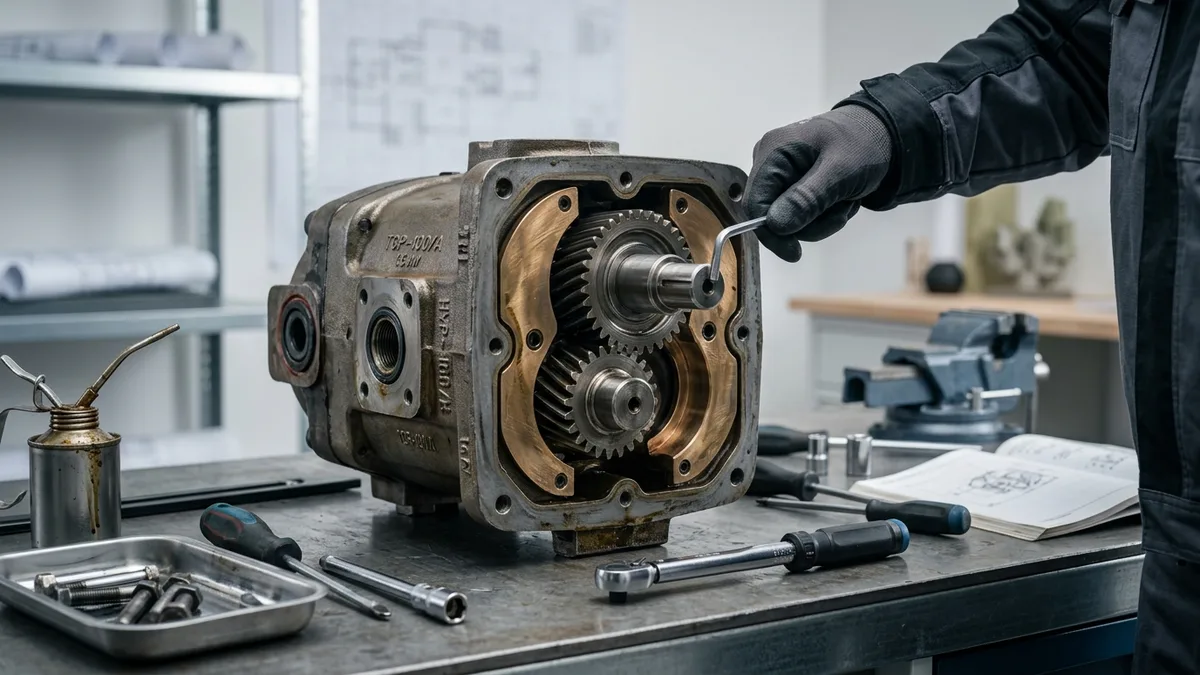
Industrial Gear Pump Overhaul: Clearances, Wear Plates, Backlash & Rebuild Engineering Standard
A definitive rotary positive displacement machinery overhaul manual, gear tribology clearance standard, and rebuild protocol for plant maintenance superintendents, reliability engineers, and process technicians across Ahmedabad, Surat, Ankleshwar, Dahej, and Gujarat.
Quick Answer
In Gujarat's major textile processing hubs (Surat—Sachin, Pandesara), petrochemical refineries, polymer processing plants, and chemical synthesis corridors (Ahmedabad, Ankleshwar, Dahej), rotary positive displacement gear pumps transfer heavy fuel oils, high-temperature thermic fluids (+280°C), viscous resins (> 50,000 cP), and corrosive chemical monomers daily. Over continuous operation, abrasive particulates and thermal fatigue open internal clearances, creating severe internal volumetric slip flow (Q_slip \propto h³) that drops pump volumetric efficiency by 40% - 60% and elevates operating temperatures. Executing a professional gear pump overhaul requires precision dimensional restoration: radial tooth tip-to-casing clearance (0.05 - 0.12 mm), axial gear-to-side-wear-plate clearance (0.03 - 0.08 mm), tooth mesh backlash (0.10 - 0.25 mm), and journal bushing running clearance (0.04 - 0.09 mm). Rebuilding gear pumps conforming to ISO 5199, ISO 2858, IS 5120, and IS 1520 standards—utilizing precision surface grinding, CNC lapping (< 0.8 µm Ra), phosphor bronze or carbon-graphite wear plates, and direct-sintered SSiC mechanical seals—restores 95%+ volumetric efficiency and extends operating life beyond 35,000 continuous hours.
Key Takeaways
- Control Internal Axial and Radial Clearances Strictly. Volumetric slip scales cubically (h³) with clearance; maintain axial clearance within 0.03 - 0.08 mm.
- Precision Lap Side Wear Plates to Sub-Micron Flatness. Precision surface grinding and lapping (< 0.8 µm Ra) eliminates pressure bypass channels.
- Account for High-Temperature Thermal Expansion (ΔT). In thermic oil service (+250°C), expand cold clearances to prevent gear galling.
- Verify Tooth Mesh Backlash with Lead Wire Gauging. Maintain gear backlash within 0.10 - 0.25 mm to eliminate gear root hydraulic trapping.
Introduction
Across Gujarat's major industrial manufacturing zones—centered in Surat (textile dyeing, thermic fluid heating), Ahmedabad (Vatva, Naroda, Odhav—synthetic resins, polymers), Ankleshwar GIDC, Dahej PCPIR, and Vapi—rotary gear pumps serve as the workhorses for moving heavy, viscous, and high-temperature process fluids.
Plant maintenance superintendents, mechanical engineers, and process reliability heads face severe recurring hurdles:
- The Volumetric Slip Penalty: As internal side wear plates and gear tooth tips experience microscopic abrasive wear, the internal clearance gap (h) widens. Because internal slip flow scales with the cube of the gap (h³), a doubling of clearance causes an 8× increase in slip, dropping flow output and creating chronic process slowdowns.
- The Thermal Expansion Galling Trap: In high-temperature thermic oil systems (+200°C to +280°C), operating with standard cold clearances causes the rotating gears to expand faster than the casing shell, resulting in sudden, catastrophic metal-to-metal galling and seized drive motors.
- The Engineering Standard: Implementing a rigorous precision rebuild protocol conforming to ISO 5199, ISO 2858, IS 5120, and IS 1520 standards—re-machining casing bores, surface lapping wear plates to sub-micron flatness, replacing journal bushings, and verifying dynamic rotor balancing to ISO 5199 Grade G2.5—restores full factory discharge pressure and extends mean time between failures (MTBF) beyond 35,000 continuous hours.
2. Master Industrial Gear Pump Overhaul Clearance & Tolerance Matrix
Review the precision engineering clearance standards across pump viscosity classes:
| Internal Inspection Parameter | Low Viscosity (< 100 cP) | Medium Viscosity (100 - 5,000 cP) | High Viscosity (> 5,000 cP) | High-Temp Thermic Oil (> 200°C) |
|---|---|---|---|---|
| Axial Gear-to-Wear-Plate Clearance | 0.03 - 0.05 mm | 0.05 - 0.08 mm | 0.08 - 0.14 mm | 0.10 - 0.16 mm |
| Radial Tooth Tip-to-Casing Clearance | 0.05 - 0.08 mm | 0.08 - 0.12 mm | 0.12 - 0.18 mm | 0.14 - 0.22 mm |
| Gear Tooth Mesh Backlash (j_n) | 0.10 - 0.15 mm | 0.15 - 0.20 mm | 0.20 - 0.30 mm | 0.25 - 0.35 mm |
| Journal Bushing Running Clearance | 0.04 - 0.06 mm | 0.06 - 0.09 mm | 0.09 - 0.14 mm | 0.12 - 0.18 mm |
| Wear Plate Surface Flatness (Ra) | < 0.4 µm (Lapped) | < 0.8 µm (Lapped) | < 0.8 µm (Ground) | < 0.4 µm (Lapped) |
| Shaft Total Radial Runout (TIR) | ≤ 0.015 mm | ≤ 0.020 mm | ≤ 0.025 mm | ≤ 0.015 mm |
| Volumetric Efficiency Target | ≥ 90.0% | ≥ 94.0% | ≥ 96.0% | ≥ 92.0% |
3. The Tribology, Volumetric Slip & Fluid Film Mechanics
Hagen-Poiseuille Volumetric Slip Flow Dynamics (Q_slip = [w · h³ · ΔP] / [12 µL])
Internal slip flow across gear faces follows laminar slot flow kinematics:
Interactive Engineering Hydraulic Sizer
Live ISO 5199 / API 610 Dynamic EngineWhere:
- w is the width of the sealing land across the gear face.
- h is the internal axial or radial clearance gap.
- ΔP is the differential pressure (P_discharge - P_suction).
- µ is the dynamic fluid viscosity (Pa\cdots).
- L is the length of the sealing interface.
The cubic dependence on clearance (h³) means that if abrasive wear increases the axial gap from 0.05 mm to 0.10 mm, internal slip increases by 800%. In low-viscosity or hot thermic oil service, this slip destroys delivery pressure and overheats the pump.
Hydrodynamic Journal Bearing Lubrication & Sommerfeld Number (S = [µN] / [P] ((R) / (c))²)
Journal bearings rely on hydrodynamic fluid wedge formation:
Where N is shaft rotational speed, P is projected bearing load, R is journal radius, and c is radial clearance. If clearance (c) expands from abrasive wear, the Sommerfeld number drops below the critical minimum, collapsing the fluid film and causing direct metal-to-metal boundary friction.
Trapped Liquid Pocket Pressure Spikes & Relief Groove Geometry
- Hydraulic Trapping Phenomenon: As mating gear teeth mesh, fluid becomes trapped in the root cavity between the two contact lines. Because liquids are virtually incompressible, this trapped volume generates massive localized pressure spikes (> 250 bar) that exert severe cyclical thrust on the gears.
- Relief Grooves: Precision-machined relief slots on side wear plates vent this trapped fluid to the discharge port during meshing and to the suction port during unmeshing. Maintaining exact relief groove geometry and depth is essential to eliminate cyclic shaft bending fatigue, bearing overload, and catastrophic gear tooth root fracture in continuous chemical processing plants across Gujarat.
Thermal Expansion Differentials in High-Temperature Thermic Oil Service
- Thermal Growth Kinetics: Alloy steel gears expand proportionally to temperature:
- Clearances at +280°C: In hot thermic oil pumps, gear diameter increases by up to 0.15 mm. If cold machining clearances are set too tight (< 0.10 mm), the gears expand against the casing during startup, leading to catastrophic galling and seizure. Maintenance teams must carefully compensate for differential thermal expansion between the gears and pump housing during cold shop assembly.
4. The 4 Critical Failure Modes in Industrial Gear Pumps
Failure Mode 1: Side Wear Plate Scoring & Severe Flow Loss
- Root Cause: Abrasive solid contaminants (> 25 µm) trapped between rotating gear faces and stationary wear plates gouge deep radial bypass channels.
- Engineering Solution: Machine and lap wear plates to < 0.8 µm Ra, install 50-mesh suction strainers, and upgrade to hardened phosphor bronze or carbon-graphite materials.
Failure Mode 2: Journal Bushing Seizure from Viscosity Starvation
- Root Cause: Pumping high-viscosity resins at low rotational speeds prevents fluid penetration into internal bushing lubrication spiral grooves.
- Engineering Solution: Machine oversized helical lubrication grooves and install external pressurized grease or fluid flush ports.
Failure Mode 3: Gear Tooth Pitting & Root Hydraulic Fracture
- Root Cause: Blocked wear plate relief grooves trap incompressible fluid, exerting extreme cyclic root bending fatigue.
- Engineering Solution: CNC machine precision relief slots on wear plates and verify tooth backlash (0.15 - 0.25 mm).
Failure Mode 4: Shaft Deflection & Casing Bore Rubbing
- Root Cause: Operating at excessive discharge pressures (> 16.0 bar) causes shaft deflection, forcing tooth tips to rub against the suction casing bore.
- Engineering Solution: Upgrade shafts to high-tensile heat-treated alloy steel (AISI 4340) and enforce pressure relief valve settings.
5. Sanitary Materials of Construction & Cleanroom Standards
High-Tensile Hardened Alloy Steel (Case-Carburized AISI 8620) Gears
- Rotating Gears: Precision CNC hobbed and ground spur, helical, or herringbone gears manufactured from case-carburized alloy steel (case-carburized AISI 8620, surface hardness 58 - 62 HRC), delivering exceptional tooth bending strength and resistance against abrasive slurry wear.
Phosphor Bronze (PB2 / SAE 660) & Carbon-Graphite Wear Plates
- Side Wear Plates: High-lead Phosphor Bronze (PB2 / SAE 660) for lubricated oil service, or self-lubricating antimony-impregnated Carbon-Graphite for high-temperature thermic fluids (+280°C).
Direct-Sintered Silicon Carbide (SSiC) & Tungsten Carbide Seals
- Shaft Sealing: Heavy-duty single or double mechanical seals featuring monolithic direct-sintered SSiC vs SSiC or Tungsten Carbide faces with Kalrez (FFKM) secondary elastomers.
Ductile Iron (GGG 40) & Cast Steel Armored Casings
- Pump Casings: High-density Ductile Iron (GGG 40 / ductile iron) or Cast Carbon Steel (WCB) casings with precision CNC-machined figure-8 gear cavities.
6. Step-by-Step Gear Pump Overhaul & Rebuild SOPs
Execute these structured engineering SOPs during every industrial gear pump overhaul:
Phase 1: Pump Teardown, Degreasing & NDT Magnaflux Audit SOP
- Teardown: Disassemble casing covers, drive/driven gear shafts, wear plates, and bushings with dedicated mechanical pullers to avoid bending the shafts.
- Cleaning & NDT: Degrease components in an ultrasonic solvent tank. Perform magnetic particle inspection (Magnaflux) on gear teeth and shaft journals to detect micro-cracks before machining.
Phase 2: Radial & Axial Clearance Feeler Gauge Audit SOP
- Radial Measurement: Install gears in casing without wear plates. Using a precision feeler gauge, measure radial tooth tip-to-casing bore clearance at 90^° intervals.
- Axial Measurement: Measure gear face width and casing depth with depth micrometers to calculate initial axial end-play across both drive and idler assemblies.
Phase 3: Side Wear Plate Surface Grinding & Lapping SOP
- Surface Grinding: Grind scored wear plates on a precision horizontal surface grinder to remove all scoring (< 0.05 mm stock removal).
- Lapping: Hand-lap wear plate sealing faces on a diamond lapping plate to achieve < 0.8 µm Ra surface finish and less than 2 helium light bands flatness.
Phase 4: Shaft Journal Grinding & Bushing Replacement SOP
- Journal Restoration: Precision cylindrical grind shaft journals to clean up scoring (< 0.02 mm TIR runout). Upgrade shafts to high-tensile heat-treated alloy steel (AISI 4340) if deflection exceeds tolerance limits.
- Bushing Fitting: Press new phosphor bronze or carbon-graphite bushings into casing bores using an arbor press. Line-ream bushings to achieve specified running clearance (0.05 - 0.08 mm).
Phase 5: Gear Mesh Backlash & Relief Groove Verification SOP
- Backlash Check: Insert lead wire between meshing teeth and rotate gears. Measure flattened wire thickness with a micrometer to verify backlash (0.15 - 0.25 mm).
- Relief Slots: Inspect wear plate relief grooves to ensure complete, unrestricted venting to suction and discharge ports.
Phase 6: Hydrostatic Pressure & Volumetric Flow Proof Test SOP
- Hydrostatic Test: Pressurize assembled casing with test fluid to 1.5× rated discharge pressure (24.0 bar) for 15 minutes to verify zero joint leakage.
- Flow Testing: Run pump on test bench at rated operating temperature and speed. Measure flow rate across discharge pressure steps (0, 5, 10, 15 bar) to verify ≥ 94% volumetric efficiency.
7. Worked Gujarat Textile, Polymer & Chemical Case Studies
Case 1: Surat Textile Processing Mill Thermic Oil Pump Overhaul
- Plant Context: A major textile dyeing and printing mill in Sachin GIDC (Surat) operating three gear pumps on hot thermic fluid circulation (+240°C, 8.0 bar).
- Problem: Flow rate dropped by 45% due to severe axial wear plate scoring; thermic fluid temperature spiked, stalling stenter machines across the processing floor.
- Action Plan: Teflow engineering team performed a comprehensive overhaul: precision surface ground and diamond-lapped wear plates, installed carbon-graphite bushings with thermal expansion clearances (0.12 mm), and balanced gear assemblies conforming to ISO 5199 Grade G2.5 standards.
- Outcome: Restored 96% volumetric flow; eliminated stenter temperature fluctuations; saved Rs 9,20,000 in avoided production downtime and reduced thermal fluid oxidation.
Case 2: Ahmedabad Polymer Resin Extrusion Gear Pump Rebuild
- Plant Context: A plastic compounding plant in Odhav GIDC (Ahmedabad) pumping hot polymer melt (25,000 cP, 12.0 bar).
- Problem: Extreme gear tip scoring caused internal slip and polymer degradation from localized shear heating.
- Action Plan: CNC line-bored the casing, installed case-hardened alloy steel gears with optimized tip clearances, and fitted tungsten carbide mechanical seals with pressurized barrier fluid flush.
- Outcome: Extruder throughput increased by 28%; continuous operation across 24 consecutive operating months.
Case 3: Ankleshwar Agrochemical Viscous Monomer Dosing Pump Overhaul
- Plant Context: An agrochemical technical facility in Ankleshwar GIDC dosing viscous active intermediates.
- Problem: Severe gland packing leakage and journal bushing galling caused monthly shutdowns and fugitive chemical emissions.
- Action Plan: Replaced packing with a Teflow external cartridge mechanical seal and retrofitted phosphor bronze bushings with precision spiral lubrication grooves.
- Outcome: Zero chemical leakage; MTBF extended from 1 month to 22 consecutive operating months.
Case 4: Dahej PCPIR Petrochemical Heavy Fuel Oil Gear Pump Overhaul
- Plant Context: A petrochemical utility plant in Dahej PCPIR transferring heavy fuel oil (HFO, 380 cSt).
- Problem: Abrasive catalytic fines eroded wear plates, reducing burner feed pressure and causing combustion instability.
- Action Plan: Installed hardened tool steel wear plates with diamond lapping and rebuilt gear shafts with plasma-nitrided journal sleeves.
- Outcome: Constant burner pressure restored; continuous operation over 26 consecutive operating months.
Case 5: Odhav Metal Working Quench Oil Circulation Pump Rebuild
- Plant Context: A commercial heat treatment plant in Odhav circulating hot quenching oil (160°C).
- Problem: Trapped liquid pressure spikes fractured driven gear teeth and bent the drive shaft.
- Action Plan: Redesigned wear plate relief groove geometry, adjusted gear backlash to 0.20 mm, and upgraded to high-tensile alloy steel shafts.
- Outcome: Zero gear failures; continuous reliable pumping over 24 consecutive operating months.
Case 6: Vapi Bulk Drug Synthetic Resin Transfer Pump Overhaul
- Plant Context: A bulk pharmaceutical active manufacturer in Vapi GIDC transferring viscous binding resins.
- Problem: Gland packing contaminated pharmaceutical batches with fiber particulates.
- Action Plan: Upgraded to a sanitary SS316 gear pump with monolithic direct-sintered SSiC mechanical seals and FDA-compliant carbon bushings.
- Outcome: Product contamination eliminated 100%; continuous operation over 24 consecutive operating months.
8. Step-by-Step Gear Pump Troubleshooting Decision Matrix
Follow this structured engineering guide when troubleshooting rotary gear pumps across industrial plants in Gujarat. Auditing hydraulic symptoms and mechanical vibration patterns enables maintenance engineers to quickly pinpoint internal root causes and implement corrective overhaul actions:
| Observed Symptom | Probable Root Cause | Recommended Overhaul Action |
|---|---|---|
| Low Discharge Flow (< 70% Rated) | Excessive axial/radial clearance (Q_slip \propto h³) | Surface lap wear plates; re-bush casing bores |
| Pump Overheating & Stalling Motor | Clearance too tight for operating temperature (ΔT) | Expand running clearances for thermal expansion |
| High-Pitched Whine / Cavitation Noise | Suction line restriction / high fluid viscosity | Increase suction pipe diameter; reduce pump RPM |
| Gear Teeth Pitted & Root Fractures | Blocked wear plate relief grooves / trapped liquid | CNC machine relief slots; verify gear backlash |
| Rapid Mechanical Seal Face Failure | Shaft deflection (> 0.05 mm) / bad journal bushings | Grind shaft journals; install new precision bushings |
| Shaft Seizure During Initial Startup | Cold clearances galling under hot process fluid | Machine thermal growth clearance (0.12 - 0.16 mm) |
9. Comprehensive Master Gear Pump Overhaul & Quality (FAT) Checklist
Execute this quality verification protocol before returning an overhauled gear pump to plant service:
Industrial Gear Pump Overhaul Quality & FAT Protocol
10. Summary & Gear Pump Overhaul Engineering Support in Gujarat
Eliminating internal volumetric slip flow, preventing high-temperature thermic fluid galling, restoring rotary gear pump internal clearances based on rigorous tribology and Hagen-Poiseuille fluid physics, and extending equipment service life beyond 35,000 hours across Surat (Sachin, Pandesara), Ahmedabad (Vatva, Naroda, Odhav), Ankleshwar, Dahej PCPIR, and Vapi—by utilizing diamond-lapped wear plates, CNC precision machining, monolithic SSiC mechanical seals, and dynamic balancing to ISO 5199 Grade G2.5—is the proven engineering standard for process reliability.
Partnering directly with an established Gujarat rotating machinery manufacturer provides maintenance superintendents and plant managers with immediate technical access to precision CNC surface grinding, custom wear plate manufacturing, failure root-cause analysis, and genuine rotary spares. Our technical engineers provide on-site pump sizing audits, clearance measurements, vibration spectra analysis, and comprehensive overhaul services.
Teflow Pumps operates a specialized chemical and industrial machinery manufacturing facility in Ahmedabad, providing engineered gear pump overhauls, PFA-lined process pumps, solid PTFE pumps, PVDF centrifugal pumps, precision mechanical seals, dynamic rotor balancing, and genuine rotating equipment spares across Gujarat conforming to ISO 5199, ISO 2858, IS 5120, and API 685 standards.
- Direct Technical & Emergency Helpline: +91 98251 62709
- WhatsApp Technical Desk: Share photos of worn gear pumps, pump make/model, fluid viscosity (cP), or operating temperature (°C) to wa.me/919825162709 for immediate technical review, clearance diagnostics, and formal quotation.
- Request an On-Site Gear Pump Overhaul & Audit Survey: Contact our senior rotating equipment engineers for plant pump surveys, overhaul proposals, and formal quotation. Our engineering team conducts comprehensive internal clearance audits, analyzes hydraulic slip losses, dynamic shaft deflections, and certifies rebuilt assemblies to ensure maximum uptime across Gujarat's industrial processing clusters. We provide rapid technical evaluations, on-site plant surveys, precision laser alignment, and formal quotes.