
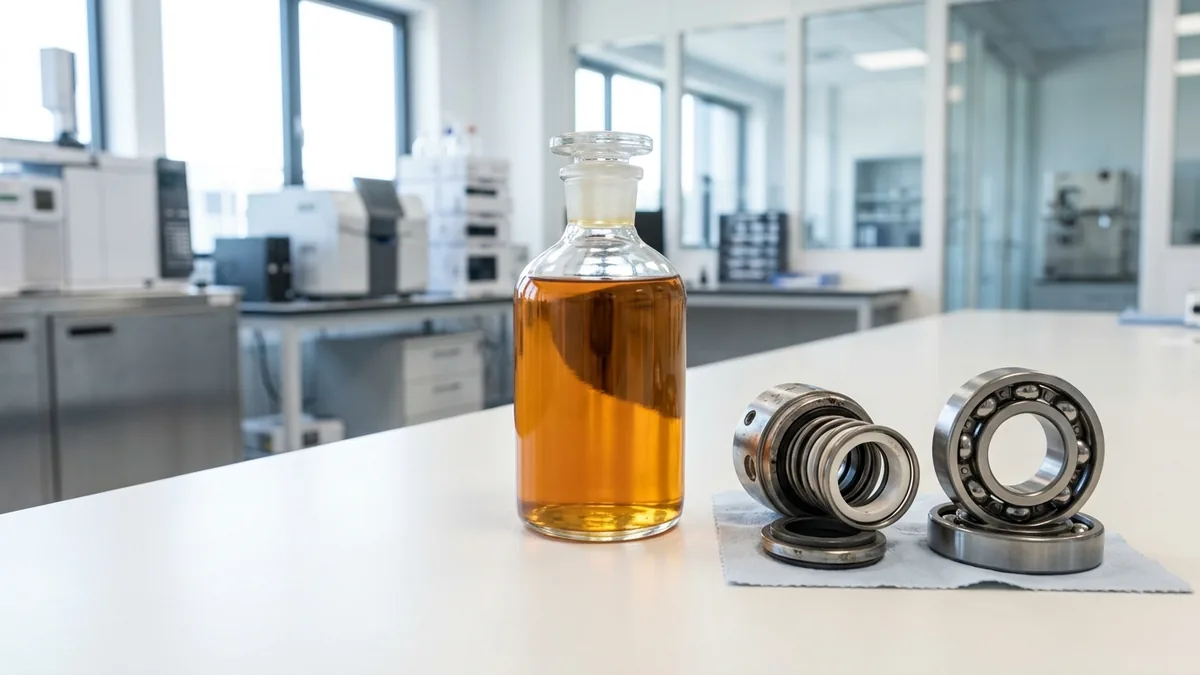
Degraded Thermic Fluid: The Hidden Root Cause of Industrial Pump Wear, Mechanical Failure & Systemic Remediation Manual
A definitive fluid chemistry analysis, mechanical wear mechanics guide, and preventive maintenance standard for process engineers, plant utility superintendents, and maintenance leads across Vatva GIDC, Narol, Odhav, Surat, and Gujarat.
Quick Answer
In the continuous textile processing mills, chemical synthesis plants, plywood pressing factories, and edible oil refining installations of Gujarat—spanning Ahmedabad (Vatva GIDC, Narol, Odhav), Surat, Ankleshwar, and Dahej—thermic fluid heater systems circulate organic heat transfer media at bulk operating temperatures between 250°C and 320°C. While maintenance engineers frequently blame mechanical seal manufacturers or bearing suppliers when circulation pumps suffer premature failure, the true underlying root cause in over 65% of recurring pump breakdowns is chemically degraded heat transfer fluid. When thermic fluid undergoes thermal cracking, atmospheric oxidation, and contamination, it generates volatile light ends, acidic polymers, and hard abrasive carbon grit (> 50 µm). These chemical degradation products systematically destroy centrifugal pump components: suspended coke particles scour wear rings (increasing internal recirculation by 30%), acidic sludge corrodes metal surfaces (TAN > 1.0 mg KOH/g), volatile light fractions cause flashing cavitation, and carbon encrustation locks mechanical seal springs, leading to catastrophic seal face grooving and massive hot oil leakage. Implementing regular ASTM fluid testing and pump overhaul protocols in accordance with ISO 5199, ISO 2858, and DIN 24255 standards is essential to safeguard plant uptime and asset longevity.
Key Takeaways
- Monitor Total Acid Number (TAN) and Flash Point Regularly. TAN > 1.0 mg KOH/g or a > 15% drop in flash point signals severe fluid breakdown.
- Recognize Abrasive Three-Body Mechanical Seal Wear. Suspended carbon grit scores circular grooves into monolithic silicon carbide seal faces.
- Prevent Wear Ring Clearance Widening. Carbon scouring increases wear ring gap beyond 0.80 mm, collapsing pump hydraulic efficiency.
- Install High-Temperature Slip-Stream Filtration (10 µm). Continuous micro-filtration purges abrasive insolubles before they erode pump internals.
Introduction
Across Gujarat's industrial processing belts—including the major textile dyeing centers of Narol and Surat, the chemical manufacturing estates of Vatva GIDC, Odhav, and Ankleshwar, and the petrochemical corridor of Dahej—thermic fluid pumps circulate specialized heat transfer oils at temperatures exceeding 280°C to 320°C.
While modern mineral and synthetic thermal fluids are engineered for thermal stability, they inevitably degrade over extended operating campaigns:
- The Chemical Oxidation Breakdown: Contact with atmospheric air in open expansion tanks produces acidic oxidation products (TAN > 1.0) and sticky asphaltic sludges.
- The Thermal Cracking Hazard: Localized overheating in boiler tubes breaks hydrocarbon molecules into volatile light ends (lowering flash point) and heavy polymers that precipitate out as abrasive coke.
- The Mechanical Pump Destruction: As degraded fluid circulates through the pump, suspended sub-micron and macro carbon particles act like liquid sandpaper, scouring wear rings, gouging throttle bushings, and grinding mechanical seal faces.
- The Engineering Standard: Conforming to ISO 5199, ISO 2858, and DIN 24255 standards—incorporating routine ASTM laboratory testing, slip-stream micron filtration, high-temperature silicon carbide sealing, and nitrogen blanketing—eliminates unexpected downtime and restores peak hydraulic efficiency.
2. Master Thermic Fluid Degradation Metrics & Pump Damage Matrix
Review the chemical degradation metrics, allowable laboratory thresholds, and corresponding mechanical pump damage modes:
| Fluid Degradation Metric | ASTM Test Standard | Normal Fresh Fluid | Action Threshold Limit | Mechanical Pump Impact |
|---|---|---|---|---|
| Kinematic Viscosity (40°C) | ASTM D445 | 30 - 36 cSt | ± 20% Change | Motor over-amperage or boundary film breakdown |
| Total Acid Number (TAN) | ASTM D664 | < 0.05 mg KOH/g | > 1.00 mg KOH/g | Chemical corrosion of casing & seal faces |
| Closed-Cup Flash Point | ASTM D93 | > 210°C | > 15% Reduction | Volatile light-ends cavitation & fire hazard |
| Conradson Carbon Residue | ASTM D189 / D4530 | < 0.05 wt% | > 1.00 wt% | Hard carbon coking & mechanical seal hang-up |
| Pentane / Toluene Insolubles | ASTM D893 | < 0.01 wt% | > 0.50 wt% | Three-body abrasive scouring of wear rings |
3. The Chemical Physics, Fluid Degradation & Wear Kinetics Math
Thermal Cracking Kinetics & Light-Ends Vaporization Math
Thermal cracking follows first-order reaction kinetics:
- When bulk or boundary film temperature exceeds 340°C, hydrocarbon chains rupture, producing low-boiling light fractions (C_1 - C_8).
- These volatile light ends lower the fluid's vapor pressure, causing localized vaporization in the pump impeller eye:
- The pump suffers from gaseous cavitation and erratic discharge pressure fluctuations even when suction tank static head is fully adequate.
Atmospheric Oxidation & Total Acid Number (TAN) Reaction Chemistry
When hot thermal fluid (> 60°C) in the expansion tank contacts atmospheric oxygen (O_2):
- Organic acids increase the fluid's Total Acid Number (TAN).
- At TAN > 1.0 mg KOH/g, the fluid becomes chemically corrosive to ductile iron pump casings and copper-based alloys, accelerating galvanic pitting and chemical leaching of carbon-graphite mechanical seal faces.
Three-Body Abrasive Wear Rate Equation (Archard's Law: V_wear = K · [W · L] / [H])
Wear ring and throttle bushing volumetric loss (V_wear) caused by suspended carbon particles is governed by Archard's abrasive wear law:
Where:
- K_abrasive is the abrasive wear coefficient, which increases by 10× to 50× when pentane insolubles exceed 0.5%.
- H_metallurgy is the surface hardness of the metallic wear ring.
- Standard cast iron wear rings (180 HB) wear out 8× faster than hardened stainless steel (450 HB) when operating in degraded thermic fluid.
Internal Recirculation Loss vs Wear Ring Clearance Math (Q_leak \propto c^1.5)
Internal leakage flow (Q_leak) across the impeller front wear ring back into the suction eye increases with diametrical clearance (c):
- When abrasive carbon wear widens the wear ring gap from OEM 0.35 mm to 1.10 mm (3.14× increase), internal recirculation leakage surges by over 300%:
- Delivered pump output drops from 100 m³/h to 78 m³/h, causing process heating delays and higher power costs.
Cavitation Inception with Volatile Light Ends (NPSHa vs P_vapor)
Degraded fluid with high light ends exhibits an elevated vapor pressure (P_v):
- The drop in available Net Positive Suction Head (NPSHa) causes cavitation bubbles to form in the impeller eye, producing loud acoustic rattling, pitting damage to ductile iron vanes, and severe axial shaft vibration.
4. The 4 Mechanical Pump Wear Modes Caused by Degraded Fluid
Wear Mode 1: Impeller Wear Ring & Volute Cutwater Micro-Scouring
- Mechanism: High-velocity fluid carrying sharp sub-micron carbon particles impinges on the impeller wear rings and volute cutwater.
- Damage: Grooving, metal loss, and clearance opening from 0.35 mm to > 1.00 mm, leading to 15% - 30% drop in pump discharge pressure and head.
- Fix: Fit replacement wear rings in hardened SS316 or Stellite and clean system with slip-stream micron filtration.
Wear Mode 2: Mechanical Seal Face Grooving, Heat Checking & Spring Hang-Up
- Mechanism: Carbon particles enter the 0.5 µm lubricating film between the seal faces, causing abrasive three-body scoring. Carbon sludge packs the multi-spring assembly.
- Damage: Concentric grooves on silicon carbide faces, thermal heat checking cracks, spring freeze, and rapid hot oil spray leakage.
- Fix: Install monolithic direct-sintered SSiC vs SSiC faces with protected single coil springs or stationary bellows.
Wear Mode 3: Throttle Bushing Clearance Erosion & Bracket Thermal Choking
- Mechanism: Carbon sludge bakes inside the long throttle bush of the intermediate cooling bracket.
- Damage: Abrasive erosion destroys the tight thermal barrier, while baked carbon insulates the bracket walls, driving conducted shaft heat directly into the bearings (> 115°C).
- Fix: Re-bore intermediate bracket, install hardened throat bushing, and chemically flush cooling jacket cavities.
Wear Mode 4: Shaft Sleeve Scoring & Secondary Grafoil Embrittlement
- Mechanism: Degraded acidic fluid attacks the shaft sleeve beneath flexible Grafoil packing rings.
- Damage: Deep fretting and pitting grooves under the seal sleeve, hardening and embrittlement of flexible Grafoil, leading to secondary shaft leakage.
- Fix: Install high-purity die-formed Grafoil rings and ceramic-coated or hard-chromed SS316 shaft sleeves.
Interactive Pump Failure Root-Cause Diagnostic Navigator
ISO 10816 / API 682 Step-by-Step Triage FlowClassic NPSHa starvation or thermodynamic vapor flashing at first-stage impeller eye (NPSHa < NPSHr + 1.5m).
Check suction strainer differential pressure (ΔP > 0.35 bar indicates clogging); audit deaerator/tank static height and fluid vapor pressure.
Clean suction strainer; elevate suction feed vessel or increase suction pipe diameter to lower flow velocity below 1.2 m/s; trim impeller or fit high-Nss inducer.
5. ASTM Laboratory Testing Standards for Thermic Fluid Quality
Implement this comprehensive ASTM laboratory analysis schedule to monitor thermal fluid health:
Kinematic Viscosity (ASTM D445 at 40°C and 100°C)
- Test Purpose: Detects both light-ends cracking (viscosity drop) and heavy-ends polymerization (viscosity rise).
- Action Limit: A change of ± 15% - 20% from fresh fluid specifications requires immediate slip-stream filtration or partial fluid replenishment.
Total Acid Number (TAN per ASTM D664)
- Test Purpose: Quantifies acidic oxidation products formed by atmospheric air contact.
- Action Limit: Fresh fluid TAN < 0.05 mg KOH/g. If TAN ≥ 1.00 mg KOH/g, fluid is highly corrosive and must be neutralized or replaced.
Closed-Cup Flash Point (ASTM D93 Pensky-Martens)
- Test Purpose: Identifies dangerous volatile light-ends contamination from thermal cracking.
- Action Limit: If flash point drops by > 15% (e.g., from 220°C down to < 185°C), the thermal loop presents severe cavitation and fire risks. Deaeration venting is mandatory.
Conradson Carbon Residue (CCR per ASTM D189 / D4530)
- Test Purpose: Measures the fluid's tendency to form hard carbon coke deposits when heated.
- Action Limit: CCR ≥ 1.00 wt% indicates severe degradation; carbon coking inside pump seal chambers is imminent.
Pentane & Toluene Insolubles (ASTM D893)
- Test Purpose: Quantifies suspended solid carbon grit causing abrasive pump wear.
- Action Limit: Pentane insolubles ≥ 0.50 wt% requires immediate online high-temperature micro-filtration.
6. Step-by-Step Degraded Fluid Remediation & Pump Overhaul SOPs
Execute this structured engineering protocol when repairing pumps damaged by degraded thermic fluid:
Phase 1: In-Situ Chemical Sampling & Laboratory Fluid Audit SOP
- Hot Sampling: Draw a 500 ml fluid sample from the active circulation loop at 120°C using a dedicated closed-loop sampling cooler.
- Lab Testing: Test for ASTM D445 (viscosity), ASTM D664 (TAN), ASTM D93 (flash point), and ASTM D189 (CCR). Categorize fluid degradation level.
Phase 2: Hot Slip-Stream Micron Filtration & Centrifugation SOP
- Filter Skid Installation: Connect a mobile high-temperature slip-stream filtration unit across the pump discharge and suction lines (280°C rated).
- Continuous Polishing: Filter 5% - 10% of circulating flow through 10 µm glass-fiber filter elements until pentane insolubles drop below < 0.05 wt%.
Phase 3: Pump Dismantling, Metrology & Clearance Measurement SOP
- Back Pull-Out Overhaul: Extract the rotating assembly to the workshop.
- Precision Metrology: Measure wear ring clearance with inside micrometers; verify shaft runout (< 0.03 mm); inspect volute cutwater for erosion.
- Component Machining: Machine casing wear ring lands; fit new hardened wear rings to OEM diametrical clearance (0.30 - 0.35 mm).
Phase 4: Monolithic Direct-Sintered SSiC Seal Lapping SOP
- Optical Flat Inspection: Inspect monolithic silicon carbide seal faces under monochromatic light.
- Diamond Table Lapping: Lap faces to within < 2 light bands (0.6 µm) flatness and surface finish R_a < 0.05 µm. Replace packed spring cages with clean Inconel wave springs.
Phase 5: Dynamic Rotor Balancing to ISO 5199 Grade G2.5 SOP
- Dual-Plane Balancing: Mount the cleaned impeller and shaft assembly onto an electronic dynamic balancing machine.
- Balance Certification: Achieve residual unbalance < 1.0 g\cdotmm/kg conforming to ISO 5199 Grade G2.5.
Phase 6: Expansion Tank Nitrogen Blanketing & Loop Recommissioning SOP
- Nitrogen Skid Setup: Install a low-pressure (0.2 - 0.5 bar) dry nitrogen blanketing system on the expansion tank to prevent atmospheric oxygen ingress.
- Laser Hot Alignment: Assemble pump, set cold target growth offset (-0.45 mm), and verify alignment hot at 280°C (< 0.03 mm offset).
7. Materials of Construction, Metallurgy & Wear-Resistant Upgrades
Nodular Ductile Iron (GGG 40.3) & Cast Carbon Steel (ASTM A216 WCB)
- Pressure Containment: High-temperature Nodular Ductile Iron (EN-GJS-400-18-LT / GGG 40.3) or Cast Carbon Steel (ASTM A216 WCB) casings capable of withstanding thermal shock and 16 bar working pressure up to 350°C.
Monolithic Direct-Sintered Silicon Carbide (SSiC) Seal Faces
- Mechanical Seal Faces: Solid direct-sintered silicon carbide (SSiC) running against SSiC or Tungsten Carbide faces with flexible Grafoil or FFKM secondary O-rings.
Tungsten Carbide Throttle Bushings & Hardened SS316 Sleeves
- Abrasive Resistance: High-hardness Tungsten Carbide or Stellite-faced throttle bushings (> 65 HRC) resisting suspended carbon scouring in intermediate brackets.
Pure Flexible Grafoil Gaskets & Secondary Packing Rings
- Casing Joints: 100% pure exfoliated flexible graphite (Grafoil) die-formed rings and SS316 spiral-wound gaskets for leak-tight casing joints at 350°C.
8. The Plant Engineer's Fluid Quality & Pump Overhaul Decision Matrix
Follow this structured engineering framework when determining corrective actions for degraded fluid loops:
| Fluid Condition Status | Primary ASTM Indicator | Recommended Engineering Remediation | Expected Turnaround Time |
|---|---|---|---|
| Moderate Insolubles | Insolubles 0.2% - 0.5%, TAN < 0.5 | Online 10 µm slip-stream filtration skid | 12 to 24 hours on-site |
| High Acidity / Light Coking | TAN = 0.5 - 1.0, CCR 0.5% - 1.0% | Nitrogen blanket + Seal ultrasonic descaling | 24 to 48 hours workshop |
| Severe Carbonization / Cavitation | TAN > 1.0, Flash drop > 15%, CCR > 1.0% | Full fluid flush + Complete pump overhaul | 3 to 4 working days |
| Complete Fluid Solidification | Fluid gelatinized / pitch black | Complete fluid dump + Full system chemical boil-out | 5 to 7 working days |
9. Worked Gujarat Textile, Chemical & Processing Mill Case Studies
Case 1: Vatva GIDC Textile Dyehouse Thermic Fluid Degradation Overhaul
- Plant Context: A continuous textile dyeing and finishing mill in Vatva GIDC operating a 2.5 Million kcal/hr thermic fluid heater with a 120 m³/h circulation pump (290°C).
- Problem: Mechanical seals leaked every 5 to 7 weeks; pump discharge pressure dropped from 4.8 bar to 3.6 bar; bearing temperatures reached 118°C.
- Root Cause: Lab tests revealed fluid TAN = 1.48 mg KOH/g, CCR = 1.65 wt%, and pentane insolubles = 0.82 wt%. Suspended carbon had scoured wear rings to 1.25 mm gap.
- Action Plan: Teflow Pumps emergency field team:
- Installed a mobile 10 µm slip-stream filtration skid, reducing insolubles to < 0.05%. - Extracted pump assembly; machined casing lands; fitted hardened SS316 wear rings (0.35 mm gap). - Lapped monolithic SSiC mechanical seal faces on diamond table. - Dynamically balanced impeller to ISO 5199 Grade G2.5 and installed nitrogen blanketing on expansion tank.
- Outcome: Pump discharge pressure restored to 4.8 bar; bearing temperature stabilized at 74°C; seal ran leak-free for over 22 consecutive operating months.
Case 2: Narol Continuous Cotton Stenter Hot Oil Pump Abrasive Wear Fix
- Plant Context: A cotton fabric stenter facility in Narol operating dual 80 m³/h hot oil circulation pumps (280°C).
- Problem: Severe three-body abrasive scoring on shaft sleeves and premature seal face grooving.
- Action Plan: Fitted hard-coated tungsten carbide throttle bushings and upgraded mechanical seal faces to monolithic direct-sintered SSiC.
- Outcome: Extended seal MTBF from 2 months to over 24 months; eliminated shaft sleeve scouring.
Case 3: Surat Synthetic Weaving Plant Degraded Thermic Fluid Pump Reconditioning
- Plant Context: A polyester yarn processing plant in Surat operating dual thermic fluid pumps (270°C).
- Problem: Fluid cracking dropped flash point by 22%, causing severe impeller eye cavitation and high vibration (5.8 mm/s RMS).
- Action Plan: Performed thermal degassing boil-out, dynamically balanced rotor to ISO 5199 Grade G2.5, and restored cold target laser alignment.
- Outcome: Vibration reduced to 0.90 mm/s RMS (Zone A); eliminated cavitation rattling.
Case 4: Odhav Industrial Estate Plywood Laminating Press Circulation Audit
- Plant Context: A decorative laminate pressing plant in Odhav operating hot oil platens at 230°C.
- Problem: Wear ring erosion caused a 25% drop in circulation flow, resulting in uneven platen heating.
- Action Plan: Machined casing, installed new hardened wear rings, and cleaned internal bracket cooling passages.
- Outcome: Restored full rated flow; platen temperature variance reduced to ± 2°C.
Case 5: Ankleshwar GIDC Specialty Chemical Reactor Thermal Loop Overhaul
- Plant Context: A pharmaceutical synthesis facility in Ankleshwar GIDC operating at 310°C.
- Problem: Acidic fluid (TAN = 1.35) caused galvanic pitting on casing joints and flexible Grafoil leaks.
- Action Plan: Replaced thermal fluid, fitted SS316 spiral-wound Grafoil gaskets, and installed nitrogen expansion tank blanketing.
- Outcome: Passed rigorous plant environmental safety audit with zero emissions.
Case 6: Dahej PCPIR Petrochemical Terminal Heat Transfer Circulation Audit
- Plant Context: A bulk storage terminal in Dahej PCPIR operating high-flow BB1 split-case hot oil pumps (2000 m³/h).
- Problem: High insolubles scoured throttle bushings during heavy fuel oil heating.
- Action Plan: Installed continuous slip-stream micro-filters and laser aligned pump skids to hot expansion targets.
- Outcome: Throttle bushing life extended > 3×; zero emergency shutdowns during winter tanker unloading.
10. Comprehensive Master Degraded Thermic Fluid Pump Maintenance Checklist
Execute this maintenance verification protocol to safeguard pumps against fluid degradation:
Degraded Thermic Fluid Pump Inspection & Maintenance Protocol
11. Summary & Specialized Thermic Fluid Pump Services in Gujarat & India
Preventing and resolving industrial pump wear caused by degraded thermic fluid—implementing ASTM laboratory fluid testing, installing high-temperature slip-stream micro-filtration, fitting monolithic direct-sintered silicon carbide mechanical seals, replacing scoured wear rings, and dynamically balancing rotating assemblies to ISO 5199 Grade G2.5 across Vatva GIDC, Narol, Odhav, Surat, Ankleshwar, and Dahej—conforming to ISO 5199, ISO 2858, and DIN 24255 standards—is the proven engineering standard for maximum uptime.
Partnering directly with an established Gujarat rotating machinery manufacturer provides textile mill managers, utility superintendents, and chemical plant engineers with immediate technical access to on-site fluid sampling teams, mobile filtration skids, precision diamond lapping tables, dynamic balancing facilities, and genuine spares dispatched directly from our Ahmedabad factory. Our technical engineers provide emergency on-site troubleshooting, turnkey pump overhauls, and complete thermal loop audits.
Teflow Pumps operates a specialized industrial machinery manufacturing and service facility in Ahmedabad, providing emergency thermic fluid pump overhauls, precision laser hot alignment, high-temperature mechanical seal replacements, dynamic balancing, custom wear ring casting, and genuine rotating equipment spares across Gujarat and India conforming to ISO 5199, ISO 2858, DIN 24255, and IS 5120 standards.
- Direct Technical & Emergency Helpline: +91 98251 62709
- WhatsApp Technical Desk: Share fluid laboratory reports (TAN, flash point, CCR), pump nameplate photos, worn seal photos, or vibration spectra to wa.me/919825162709 for immediate technical review, fluid wear diagnosis, and formal quotation.
- Request an On-Site Thermic Fluid Loop & Pump Audit: Contact our senior rotating equipment engineers for emergency plant surveys, hot alignment proposals, and formal quotation. Our engineering team conducts comprehensive thermal evaluations, verifies ISO 5199 criteria, provides precision on-site or workshop reconditioning, and dynamically balances overhauled hot oil pumps to ensure maximum uptime across Gujarat's textile and chemical processing mills. We provide rapid technical evaluations, on-site plant surveys, and formal quotes.