
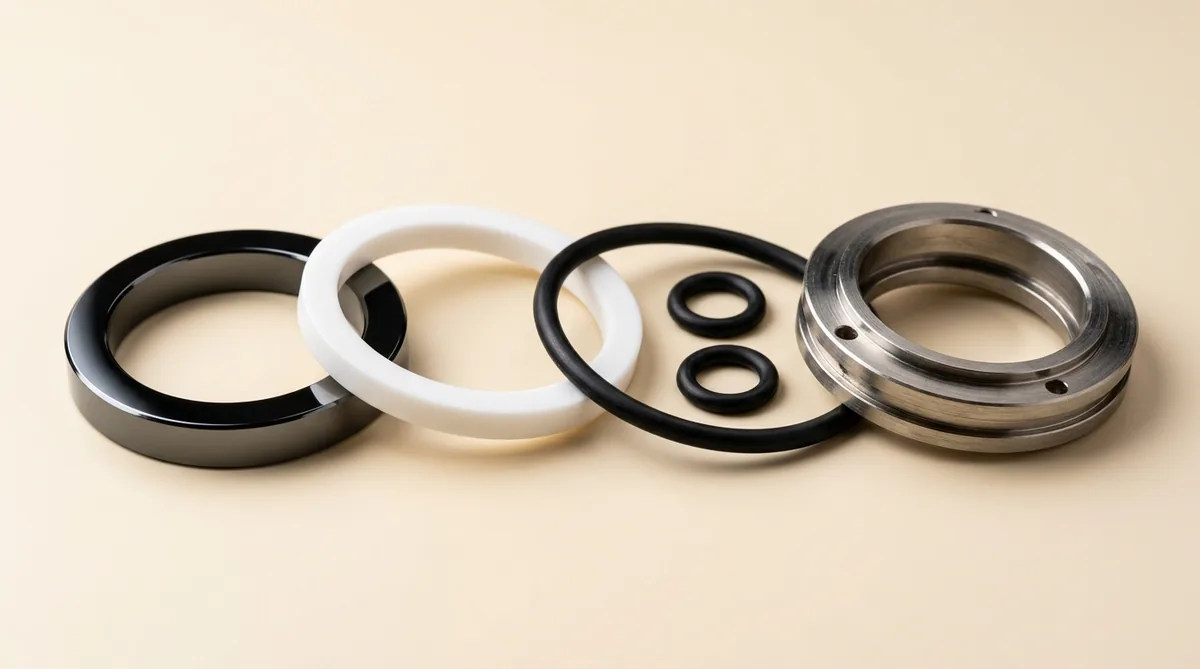
Chemical Pump Seal Face & Elastomer Material Selection: Hard Ceramics, Carbons & O-Rings for Severe Acid & Solvent Duty
A definitive technical engineering standard, materials selection manual, and elastomer chemical compatibility protocol for chemical process engineers, rotating machinery specialists, and plant reliability managers across Ahmedabad, Vatva GIDC, Naroda GIDC, Ankleshwar, Dahej PCPIR, and Gujarat.
Quick Answer
In aggressive chemical manufacturing, dye and pigment intermediate synthesis, bulk pharmaceutical API manufacturing, and pesticide formulation plants across Gujarat—such as in Vatva GIDC, Naroda GIDC, Ankleshwar, and Dahej PCPIR—over 70% of premature mechanical seal blowouts are caused by material incompatibility rather than mechanical wear. When pumping concentrated hydrochloric acid, hot sulfuric acid, fuming nitric acid, aggressive organic solvents (such as toluene, methylene chloride, or tetrahydrofuran), or abrasive slurries, selecting the wrong seal face ceramic or secondary elastomer conforming to ISO 5199, ISO 2858, IS 5120, and API 682 standards causes rapid chemical failure within days. A single material error—such as using Reaction-Bonded Silicon Carbide (RBSiC) in hot sodium hydroxide (which leaches metallic silicon binders), installing standard Viton (FKM) O-rings on ketone or amine solvents (which induces massive volumetric swelling and extrusion), or pairing soft Carbon faces with abrasive slurries—destroys face flatness, generates toxic chemical vapor emissions, and forces emergency unit shutdowns. Implementing a structured metallurgical and polymer selection matrix—matching direct-sintered monolithic SSiC, Diamond-Like Carbon (DLC), genuine Perfluoroelastomer (FFKM / Kalrez), and pure virgin PTFE—guarantees total chemical containment and extends mechanical seal service life beyond 30,000 continuous operating hours.
Key Takeaways
- Specify 100% Direct-Sintered Monolithic Silicon Carbide (SSiC) for Corrosives & Caustics. Monolithic SSiC contains zero free metallic silicon, preventing leaching attack in acids and caustics.
- Deploy Perfluoroelastomers (FFKM / Kalrez) for Aggressive Organic Solvents. FFKM resists polar solvents, ketones, amines, and aromatic hydrocarbons up to +315°C without swelling.
- Pair Monolithic SSiC vs SSiC for Abrasive Slurry Duties (> 5% Solids). Hard-on-hard ceramic pairings resist micro-gouging and scratching from hard pigment and salt crystals.
- Use Self-Lubricating Resin-Impregnated Carbon for Clean, Non-Abrasive Acid Fluids. Carbon-on-SSiC pairings provide low friction coefficients (f < 0.04) and high PV operating limits (100 bar\cdotm/s).
Introduction
In continuous chemical synthesis, dyestuff manufacturing, and pharmaceutical bulk active ingredient (API) production plants across Ahmedabad, Vatva GIDC, Naroda GIDC, Ankleshwar, and Dahej PCPIR, chemical process pumps are subjected to aggressive operating environments.
Process engineers and mechanical maintenance managers operate under demanding technical constraints:
- The Extreme Aggressiveness of Process Chemicals: Chemical streams include concentrated hydrochloric acid, hot sulfuric acid, fuming nitric acid, strong caustic soda, abrasive dye intermediate slurries, and dynamic organic solvents. Selecting an incompatible seal face material or O-ring results in rapid chemical degradation within days.
- The Strict Containment Imperative: Toxic chemicals, volatile organic compounds (VOCs), and corrosive acid vapors cannot be allowed to leak into the atmosphere, demanding engineered chemical containment and high-integrity materials.
- The Engineering Standard: Implementing a structured material selection protocol conforming to ISO 5199, ISO 2858, IS 5120, and API 682 standards—utilizing 100% direct-sintered monolithic Silicon Carbide (SSiC), genuine Perfluoroelastomers (FFKM / Kalrez), and Hastelloy C-276 hardware—guarantees 100% emission-free containment and extends pump operating life beyond 30,000 hours.
2. Master Chemical Pump Seal Face & Elastomer Selection Matrix
Use this technical engineering roadmap when specifying mechanical seal materials across chemical duties:
| Process Chemical Service | Fluid Severity & Key Chemical Challenge | Optimal Primary Seal Face Pair | Recommended Secondary Elastomer | Wetted Hardware Metallurgy |
|---|---|---|---|---|
| Concentrated Hydrochloric Acid (33% HCl) | Highly corrosive, non-oxidizing, fuming | Monolithic SSiC vs Resin Carbon | Pure Virgin PTFE / FFKM | Hastelloy C-276 / PFA |
| Hot Sulfuric Acid (98% H_2SO_4, 80°C) | Strongly oxidizing, high viscosity | Monolithic SSiC vs Monolithic SSiC | FFKM (Kalrez) / PTFE | Alloy 20 / Hastelloy C-276 |
| Fuming Nitric Acid (68% HNO_3) | Extreme oxidizer, attacks rubbers | Direct-Sintered SSiC vs Carbon | Perfluoroelastomer (FFKM) | SS316L / Hastelloy C-276 |
| Hot Caustic Soda (> 30% NaOH, 85°C) | Strongly alkaline, leaches free silicon | Direct-Sintered SSiC vs Carbon | Peroxide-Cured EPDM | SS316L / Duplex SS |
| Volatile Organic Solvents (DCM, Toluene) | Swells elastomers, low lubricating film | Monolithic SSiC vs Monolithic SSiC | FFKM / Chemraz | SS316L / Hastelloy C-276 |
| Abrasive Dye & Pigment Slurries | Abrasive solids (15 - 30%), micro-cutting | Monolithic SSiC vs Monolithic SSiC | FKM (Viton) / EPDM | Duplex Stainless Steel 2205 |
Interactive Chemical Metallurgy & Temperature Compatibility Matrix
ISO 5199 / API 685 Fluoropolymer & Superalloy Standards| Material of Construction | Classification | Max Temp Limit | Compatibility Status @ 65°C |
|---|---|---|---|
Virgin PFAStandard | Fluoropolymer Lining | 160°C | Recommended (A - Zero Corrosion) |
Virgin PTFEStandard | Fluoropolymer Solid/Lined | 150°C | Recommended (A - Zero Corrosion) |
PVDF | Fluoropolymer Thermoplastic | 90°C | Satisfactory (< 2 mpy Corrosion) |
Polypropylene | Commodity Thermoplastic | 60°C | Thermal Derating Exceeded (> 60°C) |
Hastelloy C-276Standard | High-Nickel Superalloy | 110°C | Recommended (A - Zero Corrosion) |
SS316L | Austenitic Stainless Steel | 25°C | Severe Corrosion / Rapid Failure (X) |
SSiC Silicon CarbideStandard | Sintered Ceramic Seal Face | 180°C | Recommended (A - Zero Corrosion) |
Severe oxidizing acid at high concentration. Virgin PFA and PTFE linings provide total chemical inertness up to 160°C. SSiC mechanical seal faces prevent chemical grooving.
3. The Tribological & Chemical Degradation Kinetics of Sealing Materials
Chemical Corrosion & Binder Leaching in Reaction-Bonded Carbides (RBSiC)
Reaction-Bonded Silicon Carbide (RBSiC) contains 8 - 12% unreacted free metallic silicon (Si^0). In alkaline or acidic chemical environments:
- Leaching Kinetics: The alkaline chemical fluid selectively dissolves the metallic silicon veins within the matrix, creating deep microscopic pits and turning the ceramic surface into a fragile, porous honeycomb that shatters under hydraulic closing pressure.
- Monolithic SSiC Solution: Direct-sintered monolithic alpha SSiC is formed by solid-state sintering of pure sub-micron silicon carbide powder with boron and carbon additives at 2100°C, yielding a 100% homogeneous alpha crystal structure with zero free silicon binders and absolute chemical resistance.
Polymer Swelling Thermodynamics & Flory-Rehner Cross-Link Degradation
Elastomer swelling in dynamic organic solvents is governed by the Flory-Rehner thermodynamic equilibrium:
Where:
- v_2 is polymer volume fraction in the swollen gel matrix.
- \chi is Flory-Huggins polymer-solvent interaction parameter.
- V_1 is molar volume of the solvent, and M_c is average molecular weight between polymer cross-links.
- Swelling Degradation: When standard Fluoroelastomer (FKM) contacts polar organic solvents (\chi < 0.5), solvent molecules permeate into the polymer matrix, increasing volume by > 40%. The swollen O-ring extrudes through the mechanical clearance gap and locks the dynamic seal ring, opening seal faces and causing major chemical leaks.
Hard-on-Hard vs Hard-on-Soft Face Friction & Thermal Shock Heat-Checking
- Hard-on-Soft Pairing (SSiC vs Resin Carbon): Carbon graphite provides self-lubrication through basal-plane shearing of graphite crystals, generating low friction (f = 0.02 - 0.04) and tolerating minor dry-running events without heat checking or thermal cracking. This combination is ideal for clean acid, demineralized water, and light solvent streams where fluid lubricity is low.
- Hard-on-Hard Pairing (SSiC vs SSiC): Essential for abrasive chemical slurries to prevent grooving wear. However, friction is higher (f = 0.10 - 0.14). If the fluid film flashes, thermal gradients generate high compressive stresses, creating radial heat-checking cracks across the ceramic face. Hard-on-hard pairs mandate continuous environmental flush flow.
Abrasive Micro-Gouging & Boundary Lubrication Wear Equations
- Micro-Scratching Resistance: Abrasive mineral and chemical slurry particles scratch materials where particle hardness exceeds surface hardness (H_abrasive > 0.8 H_surface). Direct-sintered monolithic SSiC (2800 HV) is significantly harder than silica sand (1100 HV) and titanium dioxide (1000 HV), providing total resistance against abrasive micro-gouging, edge chipping, and face distortion during continuous slurry pumping.
4. The 4 Critical Material Failure Modes in Gujarat Chemical Facilities
Failure Mode 1: Free Silicon Leaching Dissolving RBSiC in Hot Caustic Streams
- Failure Mechanism: Utilizing economical RBSiC seal rings in sodium hydroxide or hot alkaline scrubbers leads to rapid binder leaching, surface pitting, and face crumbling within 30 operating days.
- Material Solution: Standardize 100% on direct-sintered monolithic alpha Silicon Carbide (SSiC) with zero free silicon.
Failure Mode 2: FKM/Viton O-Ring Chemical Swelling & Dynamic Hang-Up
- Failure Mechanism: Viton O-rings exposed to amines, ketones, or halogenated solvents swell by > 30%, jamming the dynamic collar and causing face separation during minor shaft runout.
- Material Solution: Specify genuine Perfluoroelastomer (FFKM / Kalrez) or pure virgin PTFE secondary seals.
Failure Mode 3: Soft Carbon Face Grooving & Rapid Erosive Thinning
- Failure Mechanism: Installing carbon face pairs on slurries containing crystalline salts or dye pigments causes rapid abrasive grooving, wearing away the carbon nose within 4 weeks.
- Material Solution: Upgrade slurry pump seals to monolithic direct-sintered SSiC vs SSiC face pairs.
Failure Mode 4: Thermal Shock Fracturing of Tungsten Carbide in Acid Quenches
- Failure Mechanism: Nickel-bound or cobalt-bound tungsten carbide exposed to hot acids suffers binder leaching and catastrophic thermal shock cracking when cold quench water is introduced.
- Material Solution: Deploy monolithic SSiC with high thermal shock resistance and universal acid immunity.
5. Sanitary Materials of Construction & Cleanroom Standards
Direct-Sintered Monolithic Silicon Carbide (SSiC) vs Nickel-Bound Tungsten Carbide
- SSiC Metallurgy: Monolithic alpha Silicon Carbide (2800 HV, 99.5% SiC) produced by pressureless solid-state sintering with zero free binders, diamond-lapped to ≤ 1 helium light band (0.3 µm) for universal corrosion resistance against all industrial inorganic acids, fuming oxidizers, and caustics (0 - 14 pH).
- Tungsten Carbide Metallurgy: Nickel-bound Tungsten Carbide (6% Ni-WC, 1600 HV) offering high fracture toughness (12 MPa\cdotm^1/2) and mechanical shock resistance for high-shock hydraulic, boiler feed, and heavy slurry pumping applications.
Antimony-Impregnated & Synthetic Resin Electro-Graphite Carbons
- Carbon Metallurgy: Ultra-fine electro-graphite impregnated with chemical-resistant phenolic resin or antimony metal, providing self-lubricating micro-boundary film formation, low friction (f < 0.04), and high PV operating limits up to 100 bar\cdotm/s in clean, non-abrasive chemical duties.
FFKM (Kalrez / Chemraz), FKM (Viton), EPDM & Pure Virgin PTFE Secondary Seals
- High-Performance Polymers: Genuine FFKM (Perfluoroelastomer) rated up to +315°C with universal chemical inertness across all organic solvents and dynamic amines, peroxide-cured EPDM for hot alkaline caustics, and pure virgin PTFE wedge rings for concentrated inorganic acids.
Hastelloy C-276, Alloy 20 & Duplex Stainless Steel Drive Hardware
- Metallic Alloys: Hastelloy C-276 (UNS N10276) multiple coil springs, Alloy 20 (UNS N08020) gland plates, and 2205 Duplex Stainless Steel drive sleeves providing total immunity against chloride pitting, crevice corrosion, and stress corrosion cracking.
6. Step-by-Step Mechanical Seal Material Selection & Verification SOPs
Execute these structured engineering SOPs when specifying seal face and elastomer materials:
Phase 1: Process Chemical Stream Property & pH Characterization SOP
- Chemical Profiling: Record exact chemical composition, concentration (%), fluid pH (0 - 14), operating temperature range (°C), vapor pressure (P_v), dynamic viscosity (µ), and solids content (% wt).
- Category Assignment: Classify fluid into Strong Acid, Strong Caustic, Polar Solvent, Aromatic Hydrocarbon, Polymerizing Monomer, or Abrasive Slurry to establish baseline material requirements.
Phase 2: Face Material Hardness & PV Capability Sizing SOP
- Hardness Matching: For fluids with solids > 2%, specify hard-on-hard direct-sintered SSiC vs SSiC to resist abrasive micro-grooving and particulate gouging.
- PV Verification: Calculate operating PV = P_face · V_sliding. Confirm operating PV is within safe design limits (< 65 bar\cdotm/s for SSiC/SSiC; < 100 bar\cdotm/s for SSiC/Carbon) to prevent interfacial thermal vapor flashing.
Phase 3: Secondary Elastomer Chemical Compatibility Audit SOP
- Solvent Matching: Cross-reference fluid against polymer compatibility charts. Specify FFKM for ketones, esters, amines, and aromatic solvents.
- Acid Matching: Specify virgin PTFE or FFKM for nitric and sulfuric acids; specify peroxide-cured EPDM for hot caustic solutions.
Phase 4: Metallic Spring & Hardware Metallurgy Selection SOP
- Spring Selection: For hydrochloric acid and chloride-bearing streams, select Hastelloy C-276 multiple springs to eliminate chloride stress corrosion cracking.
- Gland Selection: Specify Alloy 20 or SS316L for chemical process glands conforming to ISO 5199 stuffing box dimensions.
Phase 5: Laboratory Immersion & Durometer Hardness Proof Testing SOP
- Immersion Proof Test: Submerge sample elastomer O-rings in process chemical fluid at operating temperature for 72 hours under atmospheric test conditions.
- Volume & Hardness Audit: Measure weight change (< 5%) and durometer hardness change (< 5 Shore A). Confirm zero cracking, volumetric swelling, or gummy softening.
Phase 6: Precision Dual Laser Realignment (≤ 0.03 mm) & Startup SOP
- Alignment & Commissioning: Assemble cartridge seal; remove setting clips; optical laser align pump and motor shafts to parallel offset ≤ 0.03 mm; vent seal chamber completely to purge trapped vapor pockets before energizing the drive motor.
7. Worked Gujarat Chemical & Pharmaceutical Industrial Case Studies
Case 1: Vatva GIDC Reactive Dye Intermediate Plant Acid Slurry Seal Conversion
- Plant Context: A synthetic organic dye manufacturing facility in Vatva GIDC pumping reactive blue dye acid slurry (20% solids, 18% H_2SO_4, 70°C).
- Problem: Mechanical seals failed every 12 to 18 days due to carbon face grooving and Viton O-ring chemical attack.
- Action Plan: Replaced single component seal with a balanced cartridge mechanical seal featuring direct-sintered SSiC vs SSiC faces, FFKM secondary O-rings, and Hastelloy C-276 springs; installed an API Plan 32 clean water flush.
- Outcome: Seal operating life extended from 2 weeks to over 18 consecutive operating months; saved Rs 7,20,000 in avoided downtime and maintenance overhauls.
Case 2: Ankleshwar GIDC Bulk Drug API Methylene Chloride Pump FFKM Upgrade
- Plant Context: A pharmaceutical API synthesis plant in Ankleshwar GIDC transferring pure methylene chloride (DCM) solvent (25°C).
- Problem: Standard FKM O-rings swelled by 35%, jamming the dynamic collar and causing continuous solvent vapor leaks.
- Action Plan: Retrofitted pumps with genuine Perfluoroelastomer (FFKM / Kalrez) O-rings and monolithic SSiC seal faces with an API Plan 53B dual pressurized barrier system.
- Outcome: Zero solvent vapor emissions; continuous leak-free operation over 26 consecutive operating months; achieved 100% environmental audit compliance.
Case 3: Dahej PCPIR Petrochemical Fuming Nitric Acid Seal Metallurgy Fix
- Plant Context: A petrochemical plant in Dahej PCPIR handling 68% HNO_3 concentrated nitric acid at 50°C.
- Problem: Tungsten carbide seal faces suffered cobalt binder leaching and pitted severely within 4 weeks.
- Action Plan: Converted seal faces to monolithic alpha direct-sintered SSiC paired with pure virgin PTFE wedge rings and Alloy 20 glands.
- Outcome: 100% acid containment across 30 consecutive operating months with zero face pitting.
Case 4: Naroda GIDC Concentrated Caustic Circulation Pump SSiC Retrofit
- Plant Context: A chemical scrub unit in Naroda GIDC circulating 35% NaOH caustic solution at 80°C.
- Problem: Reaction-bonded silicon carbide faces turned porous and crumbled due to caustic leaching of free metallic silicon.
- Action Plan: Replaced faces with direct-sintered monolithic SSiC containing zero free silicon and peroxide-cured EPDM elastomers.
- Outcome: Seal operating life extended from 5 weeks to over 24 consecutive operating months.
Case 5: Surat Textile Processing House Hot Dye Liquor Seal Face Upgrade
- Plant Context: A textile processing mill in Surat operating twenty fabric dyeing circulation pumps (130°C pressurized dye liquor).
- Problem: Carbon seal faces chipped and overheated due to thermal boundary friction under low lubrication.
- Action Plan: Upgraded seal face metallurgy to direct-sintered SSiC vs SSiC with Diamond-Like Carbon (DLC) coating for ultra-low friction.
- Outcome: Operating friction reduced by 65%; seal life extended from 3 months to 22 months.
Case 6: Panoli GIDC Agrochemical Synthesis Hot Solvent Cartridge Upgrade
- Plant Context: A pesticide formulation plant in Panoli GIDC pumping hot chlorobenzene and toluene solvent (110°C).
- Problem: In-house assembled component seals leaked due to technician handling errors and incorrect spring compression.
- Action Plan: Converted pump frames to pre-set cartridge mechanical seals with FFKM O-rings and Hastelloy C-276 springs.
- Outcome: Installation errors eliminated 100%; continuous leak-free operation over 20 consecutive operating months.
8. Step-by-Step Material Compatibility Decision Flowchart
Follow this structured engineering guide when selecting seal faces and elastomers:
| Process Fluid Category & Chemistry | Primary Seal Face Pairing | Recommended Secondary Elastomer | Wetted Hardware Metallurgy |
|---|---|---|---|
| Clean Inorganic Acid (HCl, HNO_3) | Monolithic SSiC vs Resin Carbon | Pure Virgin PTFE / FFKM | Hastelloy C-276 / Alloy 20 |
| Hot Concentrated Acid (H_2SO_4 > 70°C) | Monolithic SSiC vs Monolithic SSiC | FFKM (Kalrez) / PTFE | Hastelloy C-276 |
| Strong Caustic Soda (> 20% NaOH) | Direct-Sintered SSiC vs Carbon | Peroxide-Cured EPDM | SS316L / Duplex SS |
| Aggressive Polar / Aromatic Solvent | Monolithic SSiC vs Monolithic SSiC | Perfluoroelastomer (FFKM) | SS316L / Hastelloy C-276 |
| Abrasive Dye, Salt or Acid Slurry | Monolithic SSiC vs Monolithic SSiC | FKM (Viton) / EPDM | Duplex Stainless Steel 2205 |
| High-Temp Thermic Fluid (> 200°C) | Monolithic SSiC vs DLC Carbon | Inconel Flexible Graphite | SS316L / Hastelloy C-276 |
9. Comprehensive Master Seal Materials Verification (FAT) Checklist
Execute this quality verification protocol during mechanical seal material specification and overhauls:
Chemical Pump Mechanical Seal Material Selection Protocol
10. Summary & Chemical Pump Mechanical Seal Overhaul Services in Gujarat
Eliminating hazardous chemical leaks, matching seal face metallurgies to process fluid chemistry conforming to ISO 5199 and API 682 standards, selecting high-performance FFKM and PTFE secondary elastomers, and extending chemical pump seal life beyond 30,000 hours across Ahmedabad, Vatva GIDC, Naroda GIDC, Ankleshwar, and Dahej PCPIR—by utilizing direct-sintered monolithic Silicon Carbide, genuine FFKM polymers, and dynamic balancing to Grade G2.5—is the proven engineering standard for modern chemical plant reliability.
Teflow Pumps operates a specialized rotating machinery overhaul facility in Ahmedabad, providing engineered mechanical seal material selection audits, diamond face lapping, cartridge seal reconditioning, dynamic balancing, and genuine chemical spares across Gujarat conforming to ISO 5199, ISO 2858, IS 5120, and API 682 standards.
- Direct Technical & Emergency Helpline: +91 98251 62709
- WhatsApp Technical Desk: Share your chemical process fluid, operating temperature (°C), pump model, or current seal failure symptoms to wa.me/919825162709 for immediate engineering diagnostics, material recommendations, and formal quotation.
- Request an On-Site Mechanical Seal Material Audit: Contact our senior rotating equipment reliability engineers for plant seal surveys, elastomer compatibility audits, and formal AMC service quotes.