
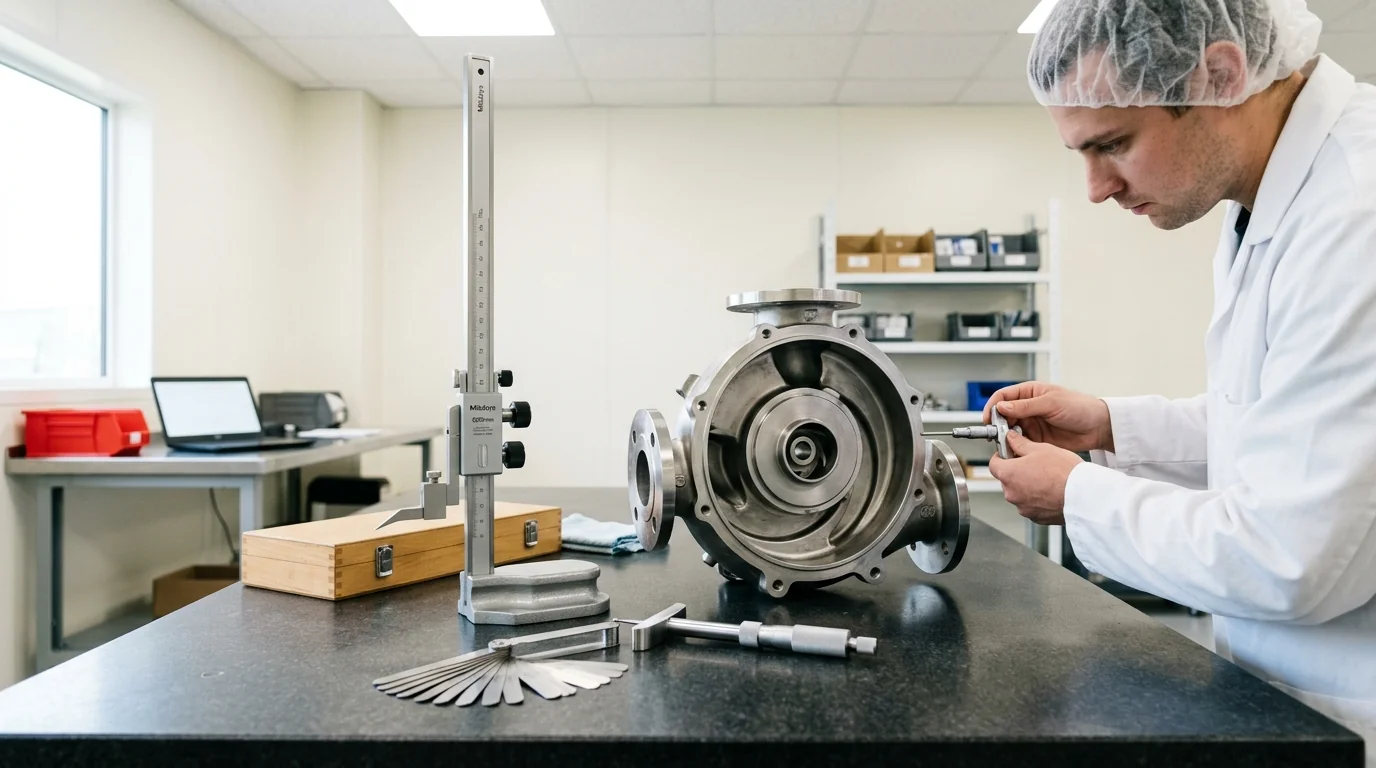
API 610 Pump Vendor QAP & Inspection Document Checklist: The Plant Buyer's Technical Audit Guide
A definitive quality assurance manual, Inspection & Test Plan (ITP) protocol, and document deliverable standard for procurement managers, rotating machinery leads, and EPC quality engineers across Dahej PCPIR, Jamnagar, Vadodara, Hazira, and India.
Quick Answer
In the high-hazard petroleum refining complexes, mega-scale petrochemical installations, and heavy chemical processing facilities of Gujarat and India—spanning Dahej PCPIR, Jamnagar, Hazira, Vadodara, and Mumbai—procuring rotating equipment requires total documentary verification of design, metallurgy, and performance prior to factory dispatch. Under API 610 (Centrifugal Pumps for Petroleum, Petrochemical and Natural Gas Industries), a comprehensive Quality Assurance Plan (QAP) and Inspection and Test Plan (ITP) establish mandatory witness (W), hold (H), and review (R) milestones: verifying Mill Test Certificates (Type 3.1 MTC) with Positive Material Identification (PMI), Non-Destructive Testing (NDT radiography, ultrasonic, dye penetrant), casing hydrostatic pressure proof containment (1.5× MAWP held for at least 30 to 60 minutes), dynamic rotor balancing to ISO 5199 Grade G2.5 (< 1.0 g\cdotmm/kg), API 682 mechanical seal cartridge certification, and a full 4-hour performance Factory Acceptance Test (FAT) with tri-axial vibration FFT spectral logging. Enforcing these structured document deliverables ensures that plant asset owners eliminate foundry defects, verify regulatory compliance, and compile an indisputable digital Manufacturing Record Book (MRB).
Key Takeaways
- Establish Clear QAP & ITP Witness and Hold Points. Classify every inspection milestone as Review (R), Witness (W), or mandatory Hold (H) prior to manufacturing.
- Audit Material Test Certificates (MTC) & 100% PMI. Verify Type 3.1 material certificates and Positive Material Identification on pressure castings.
- Enforce 1.5× MAWP Hydrostatic Hold Proofs. Require at least 30 minutes holding time for standard steel and 60 minutes for high-alloy castings.
- Compile the Master Manufacturing Record Book (MRB). Ensure complete digital archiving of test curves, balancing logs, NDT reports, and seal certificates.
Introduction
Across India's industrial heartlands—from Gujarat's premier refining block in Jamnagar and petrochemical complexes in Dahej PCPIR to the chemical corridors of Hazira, Vadodara, Ankleshwar, and Mumbai—centrifugal process pumps operate in severe continuous services handling flammable, toxic, and high-pressure media.
Procurement directors, package managers, and rotating equipment specialists frequently encounter major vendor execution challenges:
- The Documentation Gap: When a pump skid arrives on site with incomplete Mill Test Certificates, missing radiography films, or uncertified mechanical seal test logs, plant commissioning is halted, causing weeks of contractual dispute and delayed commercial operations.
- The Quality Compromise: In the absence of a prescriptive, contractual Inspection and Test Plan (ITP), vendors may perform only static balancing or abbreviate hydrostatic holding times, resulting in premature bearing failure and hazardous casing leaks under full process pressure.
- The Engineering Standard: Establishing a comprehensive API 610 Quality Assurance Plan (QAP) and Inspection & Test Plan (ITP) in harmonization with API 682, ISO 5199, ISO 2858, IS 5120, and IS 1520 standards ensures 100% material traceability, certified mechanical balancing, verified hydraulic performance, and lowest 20-year lifecycle operating risk.
2. Master 10-Point API 610 QAP & ITP Quality Milestone Matrix
Review the 10 mandatory inspection stages, verification scopes, and documentation deliverables governed by an API 610 vendor QAP:
| QAP Milestone / Inspection Activity | Governing Code | Inspection Class (H / W / R) | Mandatory Document Deliverable |
|---|---|---|---|
| 1. Raw Material Verification (MTC) | API 610 / ASTM Standards | Review (R) + 100% PMI Witness (W) | Type 3.1 Material Certificate + PMI Report |
| 2. Casing Non-Destructive Testing | API 610 Clause 8.2.2 | Witness (W) / Review (R) | RT Film / UT Defect Report / PT Inspection Log |
| 3. Casing Hydrostatic Pressure Proof | API 610 Clause 8.3.2 | Mandatory Hold Point (H) | Certified Hydrostatic Test Chart (1.5× MAWP) |
| 4. Dynamic Rotor Balancing | ISO 5199 / API 610 | Witness (W) | Dual-Plane Grade G2.5 Dynamic Balancing Certificate |
| 5. Mechanical Seal API 682 Proof | API 682 4th Edition | Review (R) / Witness (W) | Cartridge Air Pressure Decay Test Certificate |
| 6. Hydraulic Performance Testing | ISO 9906 / API 610 | Mandatory Hold Point (H) | 5-Point Certified Head, Flow, Power & Efficiency Curve |
| 7. NPSH3 Cavitation Breakdown Test | ISO 9906 / HI 14.6 | Witness (W) | NPSH3 Cavitation Inception & Breakdown Curve |
| 8. 4-Hour Mechanical Endurance Run | API 610 Clause 8.3.3 | Witness (W) | Tri-Axial Vibration FFT Spectrum & Bearing Thermal Log |
| 9. Post-Test Strip-Down Inspection | API 610 / Customer Spec | Witness (W) / Hold (H) | Internal Bearing & Wear Ring Clearance Inspection Log |
| 10. Final Packing & Preservation | API 610 Clause 8.4 | Review (R) / Final Inspection | Nitrogen Purge Log, Rust Preventive & MRB Dossier |
3. The Mechanical Physics, Inspection Math & Quality Metrics
Positive Material Identification (PMI) Spectrometry Chemistry Math
PMI testing via X-ray Fluorescence (XRF) or Optical Emission Spectroscopy (OES) verifies exact elemental chemistry:
- Stainless Steel 316L Chemistry Bounds:
- Chromium (Cr): 16.0% - 18.0% - Nickel (Ni): 10.0% - 14.0% - Molybdenum (Mo): 2.0% - 3.0% - Carbon (C): ≤ 0.030% (OES verified to prevent intergranular corrosion)
- Duplex SS (UNS S31803) PREN Formula:
Interactive Engineering Hydraulic Sizer
Live ISO 5199 / API 610 Dynamic EngineNon-Destructive Testing (NDT) Flaw Detection Physics (RT / UT / PT)
Pressure containment castings undergo volumetric and surface NDT examinations:
- Radiographic Testing (RT): Identifies internal shrinkage voids, gas porosity, and inclusions in critical casing nozzles and volute walls per ASME Section VIII Div 1 Appendix 7.
- Ultrasonic Testing (UT): Pulse-echo wave propagation detects planar laminations and subsurface cracks in forged pump shafts.
- Liquid Penetrant Testing (PT): Fluorescent dye penetrant highlights surface micro-cracks on machined casing parting flanges and impeller vane tips.
Hydrostatic Proof Stress Limits (1.5× MAWP Holding Math)
Casings must withstand extreme internal hydrostatic pressure without micro-porosity sweating:
- Test Pressure: P_hydro = 1.5× MAWP.
- Holding Duration: API 610 enforces at least 30 minutes for standard steel castings and at least 60 minutes for high-alloy, Duplex, and complex multi-stage fabricated casings, verified with calibrated digital chart recorders.
Dynamic Rotor Balancing Grade G2.5 Residual Unbalance Limits
Dynamic balancing of stacked rotors and individual impellers must satisfy ISO 5199 Grade G2.5:
- Residual unbalance must be documented on a certified digital balancing certificate detailing initial unbalance, correction masses added or removed, and final residual unbalance per plane (< 1.0 g\cdotmm/kg).
4-Hour Performance FAT & Vibration FFT Spectral Math
During the continuous 4-hour performance FAT run:
- Vibration Severity: Tri-axial RMS velocity (10 - 1000 Hz) must remain within ISO 5199 Zone A (< 1.80 mm/s RMS) across the continuous operating range.
- FFT Spectral Breakdown: Discrete unbalance peak (1X) must not exceed 1.0 mm/s, and vane pass frequency (Z · RPM) harmonics must show zero structural resonance.
- Thermal Equilibrium: Bearing skin temperature rise must not exceed ΔT ≤ 40°C above ambient (T_max ≤ 82°C).
4. The 4 Costly Traps in API 610 Vendor Document Audits
Trap 1: Ambiguous ITP Hold Points Causing Production Delays
- Problem: Failing to define contractual Witness (W) versus Hold (H) points in the purchase order.
- Consequence: The vendor assembles or hydro-tests the pump without third-party inspection, resulting in mandatory dismantling, re-testing, and weeks of project schedule delay.
- Solution: Issue a formalized, signed ITP matrix specifying exact inspection notice periods (typically 7 working days) prior to casting pouring and hydro testing.
Trap 2: Missing Sub-Vendor Raw Material Traceability (MTC Gaps)
- Problem: Sourcing raw castings from unapproved foundries without matching heat numbers and chemical analysis certificates.
- Consequence: Failure of QA audit during client pre-shipment inspection, rejecting entire pump skids.
- Solution: Enforce 100% MTC Type 3.1 verification with physical stamping on raw casing envelopes prior to machining.
Trap 3: Incomplete API 682 Mechanical Seal Auxiliary Skid Testing
- Problem: Testing the process pump with a shop test seal while shipping the project cartridge seal untested.
- Consequence: Seal failure and toxic hydrocarbon leakage on initial plant startup.
- Solution: Mandate API 682 air pressure decay testing on the actual project cartridge mechanical seal prior to pump integration.
Trap 4: Inadequate Digital Manufacturing Record Book (MRB) Compilations
- Problem: Receiving unorganized, paper-only documentation dossiers with missing hydrostatic charts or uncalibrated instrument certificates.
- Consequence: Statutory PESO or OISD plant operating license approval delays.
- Solution: Standardize on an indexed, searchable digital MRB compilation deliverable prior to final commercial dispatch.
5. Materials of Construction, Metallurgy & Cleanroom Standards
API Material Classes (S-1, S-6, C-6, A-8, D-1, D-2) Compliance
- S-1 Class: Carbon steel casing with cast iron trim for general non-corrosive hydrocarbons.
- S-6 Class: Carbon steel casing with 12% Cr martensitic stainless steel trim for sour hydrocarbons.
- C-6 Class: 12% Cr stainless steel casing and trim for high-temperature boiler feed water.
- A-8 Class: Austenitic SS316 / SS316L for corrosive process fluids.
- D-1 & D-2 Classes: Duplex SS (UNS S31803) and Super Duplex (UNS S32750) for high-chloride crude and sea-water injection.
Solid Isostatic PTFE & Transfer-Molded PFA Liners (Armored Casings)
- Armored Fluoropolymer Pumps: 100% virgin isostatic solid PTFE or high-density transfer-molded PFA lined ductile iron armored pumps (4.5 - 6.0 mm wall thickness) conforming to ISO 2858 dimensions for complete chemical corrosion resistance across 0 - 14 pH up to 200°C.
Carbon Steel (ASTM A216 WCB) & Duplex SS (UNS S31803) NDT Standards
- NDT Testing: 100% radiographic (RT) or ultrasonic (UT) examination of critical casing casting sections, paired with liquid penetrant (PT) examination of all machined mating faces.
Monolithic Direct-Sintered Silicon Carbide (SSiC) Seals
- API 682 Cartridge Mechanical Seals: Pre-set cartridge single or double mechanical seals featuring monolithic direct-sintered SSiC vs SSiC faces with Kalrez (FFKM) secondary elastomers.
6. Step-by-Step API 610 Vendor QAP Audit & Verification SOPs
Execute these structured engineering SOPs when auditing an API 610 pump manufacturer or witnessing factory tests:
Phase 1: Vendor Document & Drawing Review (VDDR) Schedule Audit SOP
- VDDR Kick-Off: Review vendor engineering submittals: general arrangement drawings, sectional cross-sections, P&ID auxiliary piping diagrams, and baseplate FEA lifting calculations.
- Compliance Check: Confirm compliance with API 610 12th Edition and project technical specifications.
Phase 2: Raw Casting Material Test Certificate (MTC) & PMI Audit SOP
- Heat Traceability: Cross-check heat numbers physically stamped on raw casing and impeller castings against Type 3.1 Mill Test Certificates.
- PMI Verification: Perform on-site XRF spectrometer PMI testing on casing walls and shaft forgings. Confirm chemistry conforms to specified ASTM standards.
Phase 3: Casing NDT Radiography & Ultrasonic Examination SOP
- Radiography Review: Audit raw radiographic (RT) films of high-stress casing volute sections and nozzle necks per ASME Section VIII Div 1 Appendix 7.
- Surface NDT Check: Witness liquid penetrant (PT) examination on machined casing flange gasket sealing faces. Zero linear indications permitted.
Phase 4: Casing Hydrostatic Pressure Proof (1.5× MAWP) SOP
- Pressure Setup: Blank off casing nozzles with blind flanges and calibrated digital pressure transducers.
- Pressurization & Hold: Apply deaerated water at 1.5× MAWP; hold pressure for at least 30 minutes (60 minutes for high alloys). Verify zero pressure drop and zero external weeping.
Phase 5: Dynamic Rotor Balancing to ISO 5199 Grade G2.5 SOP
- Balancing Run: Witness dual-plane dynamic balancing of the complete rotating assembly (impeller, shaft, keys) on electronic dynamic balancing machine. Confirm residual unbalance is < 1.0 g\cdotmm/kg (ISO 5199 Grade G2.5).
Phase 6: Full Load 4-Hour Performance FAT, Vibration & MRB Review SOP
- Hydraulic 5-Point Test: Measure head, flow, and power at 0%, 50%, 75%, 100%, and 120% rated flow per ISO 9906 Grade 2B.
- Vibration & Thermal Logging: Run pump for 4 hours; log tri-axial RMS vibration velocity (v_RMS < 1.80 mm/s Zone A) and bearing skin temperature (ΔT ≤ 40°C).
- MRB Compilation: Assemble signed test certificates, NDT logs, balancing records, and calibration reports into the final Manufacturing Record Book.
7. Worked Indian Refinery, Petrochemical & Chemical Complex Case Studies
Case 1: Dahej PCPIR Aromatics Plant API 610 Pump Vendor QAP Audit
- Plant Context: A petrochemical aromatics facility in Dahej PCPIR procuring 12 API 610 Type OH2 pumps for hot xylene distillation (175°C, 18 bar).
- Problem: Initial vendor documentation lacked RT film reports for suction nozzle casting transitions.
- Action Plan: Teflow quality team conducted an on-site vendor audit:
- Enforced 100% RT examination of nozzle joints, discovering and rejecting 2 porous castings. - Witnessed 60-minute hydrostatic proof testing at 27 bar. - Verified API 682 4th Edition Plan 53B seal cartridge certificates.
- Outcome: Zero field casting leaks; flawless plant startup across 24 consecutive operating months.
Case 2: Jamnagar Refinery Vacuum Gas Oil Booster ITP Witness Inspection
- Plant Context: A refinery processing block in Jamnagar purchasing API 610 Type BB2 between-bearing pumps (320°C, 35 bar).
- Problem: Rotor unbalance induced excessive 1X vibration harmonics (4.2 mm/s) during initial FAT run.
- Action Plan: Enforced dynamic rotor balancing to ISO 5199 Grade G2.5 (0.55 g\cdotmm/kg) and laser aligned coupling.
- Outcome: Vibration velocity reduced to 1.08 mm/s RMS (Zone A); approved for immediate dispatch.
Case 3: Hazira Petrochemical Complex Light Hydrocarbon Pump MRB Review
- Plant Context: A polymer plant in Hazira operating high-pressure butane booster pumps (28 bar).
- Problem: Delayed statutory PESO plant licensing due to missing PMI test reports.
- Action Plan: Conducted on-site XRF PMI verification on 100% of casing components and compiled certified digital MRB.
- Outcome: Secured PESO operating permit within 5 working days.
Case 4: Vadodara Chemical Complex API 685 Sealless Pump Audit
- Plant Context: A chemical synthesis complex in Vadodara handling toxic phosgene derivatives.
- Problem: Strict environmental safety mandate required zero VOC emissions.
- Action Plan: Audited API 685 magnetic drive pumps with secondary containment proof-tested to 30 bar.
- Outcome: 100% emission-free operation over 26 consecutive operating months.
Case 5: Ankleshwar GIDC Chlorinated Hydrocarbon Intermediate Pump QAP
- Plant Context: A specialty active intermediate plant in Ankleshwar GIDC procuring SS316L process pumps.
- Problem: Sourcing sub-vendor castings with unverified carbon content (> 0.040% C) risking intergranular corrosion.
- Action Plan: Enforced OES carbon testing on all heats; ensured carbon content ≤ 0.025%.
- Outcome: Total corrosion resistance; zero weld decay over 24 operating months.
Case 6: Mumbai Offshore Terminal High-Flow Crude Booster Inspection
- Plant Context: A crude oil loading terminal near Mumbai operating high-flow BB1 axially split pumps (2200 m³/h, 16 bar).
- Problem: Split-line casing weeping during hydrostatic testing.
- Action Plan: Re-machined casing parting faces, verified flatness to < 0.025 mm, and held hydrostatic test at 24 bar for 60 minutes.
- Outcome: 100% leak-free joint integrity verified.
8. Step-by-Step Vendor Quality Non-Conformance Remediation Matrix
Follow this structured engineering guide when managing quality non-conformances during vendor audits:
| Observed QAP / ITP Non-Conformance | Identified Technical Risk | Mandatory Corrective Engineering Action |
|---|---|---|
| MTC heat number mismatch or missing PMI | Unverified metallurgy & corrosion failure | Quarantine component; execute 100% XRF / OES PMI check |
| Radiography shows planar void / crack | Catastrophic casing rupture under pressure | Reject casting immediately; foundry re-pour required |
| Hydrostatic pressure drop or weeping | Sub-surface porosity or flange distortion | Dismantle; inspect gasket face; re-cast porous body |
| FAT vibration > 1.80 mm/s RMS (Zone B/C) | Dynamic rotor unbalance or shaft runout | Re-balance rotor to ISO 5199 Grade G2.5 (< 1.0 g\cdotmm/kg) |
| Head or flow outside ISO 9906 tolerances | Motor overload or insufficient process head | Trim impeller diameter to calculated duty curve point |
9. Comprehensive Master API 610 Vendor QAP & ITP Checklist
Execute this quality verification protocol when inspecting or witnessing an API 610 pump package:
API 610 Pump Vendor QAP & ITP Quality Verification Protocol
10. Summary & API 610 Quality Assurance Support in Gujarat & India
Enforcing a rigorous API 610 Quality Assurance Plan (QAP) and Inspection & Test Plan (ITP)—verifying Type 3.1 material test certificates, NDT casting radiography, 1.5× MAWP hydrostatic pressure proofs, ISO 5199 Grade G2.5 dynamic rotor balancing, and full 4-hour performance FAT runs across Dahej PCPIR, Jamnagar, Hazira, Vadodara, Ankleshwar, and Mumbai—by evaluating operating temperature, pressure, fluid flammability, and lifecycle costs conforming to API 610, API 682, API 685, ISO 5199, ISO 2858, IS 5120, and IS 1520 standards—is the proven engineering standard for industrial reliability.
Partnering directly with an established Gujarat rotating machinery manufacturer provides process design engineers, plant safety heads, and procurement directors with immediate technical access to pump hydraulic selection software, statutory OISD/PESO compliance audits, precision CNC machining, dynamic rotor balancing facilities, and genuine spares dispatched directly from our Ahmedabad factory. Our technical engineers provide comprehensive engineering audits, hydraulic sizing proposals, and complete pump rebuilds.
Teflow Pumps operates a specialized chemical and industrial machinery manufacturing facility in Ahmedabad, providing engineered PFA-lined process pumps, solid PTFE pumps, high-pressure multistage pumps, precision mechanical seals, dynamic rotor balancing, laser alignment, and genuine rotating equipment spares across Gujarat and India conforming to ISO 5199, ISO 2858, IS 5120, and API 685 standards.
- Direct Technical & Emergency Helpline: +91 98251 62709
- WhatsApp Technical Desk: Share process fluid data sheets, operating temperature (°C), design pressure (bar), flow rate (m³/h), or current pump datasheets to wa.me/919825162709 for immediate technical review, API 610 QAP audit scheduling, and formal quotation.
- Request an On-Site Process Pump QAP & Inspection Audit: Contact our senior rotating equipment engineers for plant pump surveys, compliance proposals, and formal quotation. Our engineering team conducts comprehensive hydraulic evaluations, verifies API 610 and ISO 5199 criteria, provides custom pump integration, and tests overhauled rotating equipment to ensure maximum uptime across India's petrochemical and refining complexes. We provide rapid technical evaluations, on-site plant surveys, and formal quotes.