
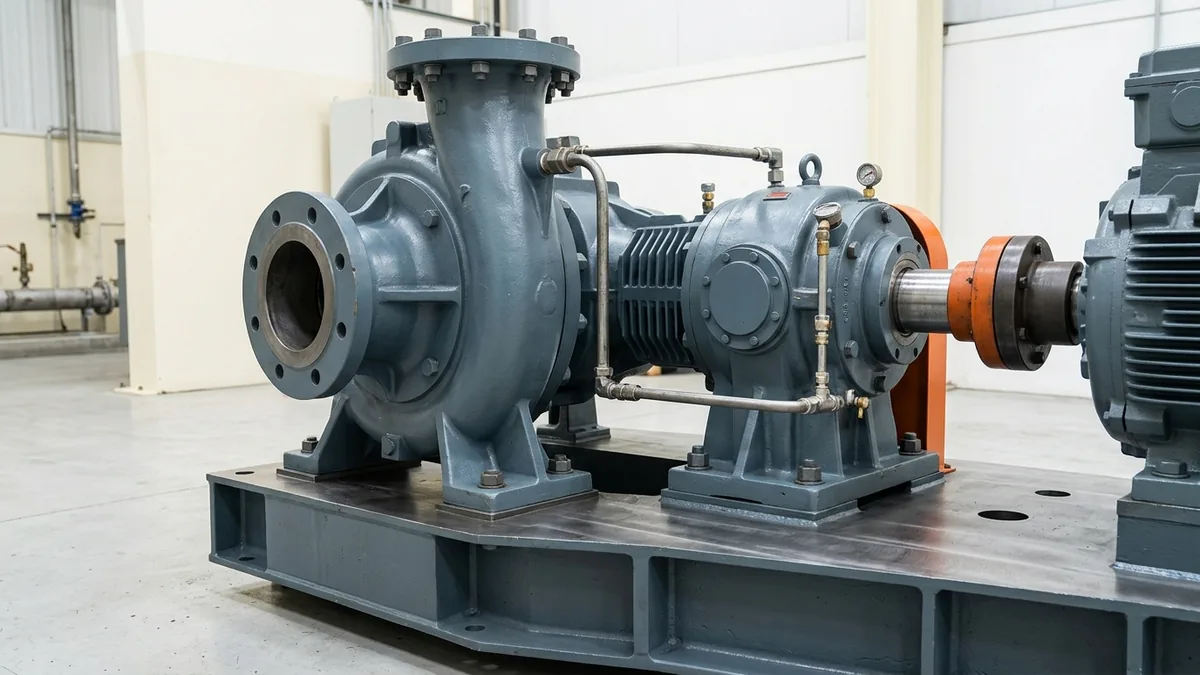
API 610 Pump Types Explained: Complete OH1 to BB5 Selection, Mechanical Architecture & Engineering Standard
A definitive rotating equipment selection manual, API 610 pump classification protocol, and mechanical architecture guide for process engineers, piping leads, and EPC rotating machinery specialists across Dahej PCPIR, Jamnagar, Vadodara, Hazira, and India.
Quick Answer
In the capital-intensive petrochemical complexes, continuous petroleum refining facilities, and heavy hydrocarbon processing plants of Gujarat and India—spanning Dahej PCPIR, Jamnagar, Vadodara, Hazira, and Mumbai—selecting the correct centrifugal process pump design is the single most critical decision determining plant safety, unscheduled flare events, and 20-year lifecycle expenditure. While standard general-purpose chemical pumps conforming to ISO 5199 or ISO 2858 perform reliably for ambient, moderate-pressure chemical duties (P ≤ 16 bar, T ≤ 150°C), hazardous hydrocarbon duties exceeding 20 bar pressure, 150°C temperature, or carrying flammable, auto-igniting, or lethal vapors strictly require pumps built to the American Petroleum Institute (API) Standard 610 (11th & 12th Editions). API 610 classifies centrifugal pumps into three major structural families: Overhung (OH1 to OH6), Between-Bearings (BB1 to BB5), and Vertically Suspended (VS1 to VS7). Understanding the hydraulic boundary limits, mechanical casing supports (centerline vs foot-mounted), shaft stiffness criteria (L³/D⁴), allowable nozzle load envelopes, and API 682 cartridge mechanical seal sealing plans ensures complete fluid containment, zero thermal shaft binding, and continuous MTBF exceeding 36 months.
Key Takeaways
- Distinguish Between OH, BB, and VS Configurations. Select OH2 for single-stage hydrocarbons up to 450°C, BB2/BB3 for high pressures, and BB5 for extreme boiler feed service.
- Enforce Centerline Casing Mounting Above 150°C. OH2 and BB2 centerline mounts allow symmetric thermal growth without driving shafts out of alignment.
- Comply with Strict API 610 Shaft Stiffness (L³/D⁴). Heavy-duty shaft geometry limits mechanical seal face deflection strictly below 0.05 mm at maximum load.
- Integrate Standardized API 682 Mechanical Seal Piping Plans. Match Plan 11, Plan 23, Plan 52, or Plan 53B flushing configurations to fluid vapor pressure and toxicity.
Introduction
Across India's premier refining and petrochemical zones—including Gujarat's Dahej PCPIR, Jamnagar petroleum corridor, Hazira industrial belt, and Vadodara chemical complex—pumps handle extreme process conditions involving volatile light hydrocarbons, hot vacuum residues, hydrogen-rich condensates, and toxic aromatics.
Process design engineers, rotating equipment consultants, and plant utility managers encounter a crucial engineering dilemma:
- The Over-Specification Trap: Specifying heavy API 610 BB2 or BB5 pumps for ambient, non-hazardous utility or corrosive acid transfer lines drives equipment capital cost 3x to 5x higher than necessary and complicates routine maintenance.
- The Under-Specification Trap: Installing general-purpose ISO 5199 foot-mounted chemical pumps on hot flammable hydrocarbon service (T > 200°C, P > 25 bar) leads to extreme thermal shaft deflection, nozzle flange distortion from thermal piping growth, catastrophic mechanical seal blowouts, and hazardous hydrocarbon fires.
- The Engineering Standard: Following a rigorous pump selection framework conforming to API 610 (11th & 12th Editions), API 682, ISO 5199, ISO 2858, IS 5120, and IS 1520 standards—evaluating fluid operating temperature, differential head, casing mounting kinematics, nozzle load allowable limits, and shaft stiffness ratios—guarantees total fluid containment, lowest lifecycle operating cost, and complete compliance.
2. Master API 610 Pump Classification & Boundary Limits Matrix
Review the standard API 610 pump classifications, mechanical architectures, and operating boundary envelopes:
| API 610 Type Code | Family & Mechanical Architecture | Typical Pressure / Temp Limits | Primary Petrochemical & Refinery Application |
|---|---|---|---|
| OH1 | Overhung, Foot-Mounted, Single-Stage | ≤ 20 bar, ≤ 150°C | Offsite utilities, non-critical general services |
| OH2 | Overhung, Centerline-Mounted, Single-Stage | ≤ 50 bar, -40°C to 450°C | Refinery process units, hot hydrocarbons, distillation |
| OH3 | Overhung, Vertical In-Line with Bearing Housing | ≤ 40 bar, ≤ 250°C | Compact plot space, offshore platform hydrocarbon transfer |
| BB1 | Between-Bearings, Axially Split 1 or 2 Stage | ≤ 35 bar, ≤ 200°C | High-volume crude transfer, cooling water, pipeline |
| BB2 | Between-Bearings, Radially Split 1 or 2 Stage | ≤ 50 bar, -80°C to 450°C | High-temp refinery feeds, vacuum bottoms, light ends |
| BB3 | Between-Bearings, Axially Split Multistage | ≤ 150 bar, ≤ 200°C | High-pressure water injection, long-distance pipeline |
| BB5 | Between-Bearings, Double-Casing Barrel Multistage | ≤ 300 bar, -100°C to 450°C | High-pressure boiler feed, hydrocracker charge, autothermal |
| VS4 | Vertically Suspended, Sump Pump with Line Shaft | ≤ 25 bar, ≤ 150°C | Refinery closed drain sumps, oily water collection |
| VS6 | Vertically Suspended, Double-Casing Canned Pump | ≤ 100 bar, -100°C to 250°C | Low NPSH light hydrocarbon booster, cryogenic LPG/LNG |
Interactive 5-Year Total Cost of Ownership (TCO) Simulator
Sealless Mag-Drive vs Mechanically Sealed Chemical Pump3. The Mechanical Physics, Rotordynamic Standards & Thermal Growth Math
Centerline Mounting Kinematics & Radial Thermal Expansion Modeling
When pumping fluids at temperatures exceeding 150°C, thermal expansion of the pump casing becomes a critical mechanical factor:
- Foot-Mounted Pump Thermal Growth (OH1): In foot-mounted pumps, thermal growth expands upward from the baseplate feet:
- Centerline-Mounted Pump Kinematics (OH2 & BB2): Centerline mounting positions the casing support feet directly at the horizontal centerline plane of the pump shaft. Thermal expansion occurs symmetrically upward and downward from the centerline plane:
- Vertical shaft centerline displacement remains ΔY ≈ 0 mm. - Casing dowel pins guide axial expansion away from the drive coupling, maintaining perfect collinear shaft alignment across all operating temperatures.
Shaft Deflection & Stiffness Ratio (L³ / D⁴) Sealing Interface Math
Under hydraulic radial side loads (F_radial) acting on the impeller, the pump shaft deflects elastically:
Where:
- L is the shaft overhang length from the radial bearing centerline to the impeller center.
- D is the shaft diameter under the mechanical seal sleeve.
- API 610 Stiffness Requirement: API 610 mandates that shaft deflection at the mechanical seal faces must not exceed 0.05 mm (50 µm) under the most severe continuous operating condition (from minimum continuous stable flow to maximum run-out).
- In comparison, standard ISO 5199 / ASME B73.1 chemical pumps allow higher shaft flexibility ratios, which can cause seal face angular tracking errors under heavy off-BEP radial loads.
Nozzle Load Allowables: API 610 vs ISO 5199 / ASME B73.1 Comparison
In heavy refinery piping networks, thermal expansion of large-diameter process pipes exerts massive forces (F_x, F_y, F_z) and bending moments (M_x, M_y, M_z) on pump suction and discharge nozzles:
- Allowable External Nozzle Loads: API 610 Tables 4 and 5 specify allowable nozzle forces and moments that are 2× to 3× higher than ISO 5199 and ASME B73.1 standards.
- Heavy Armored Casing Architecture: API 610 pump casings feature heavy carbon steel wall thicknesses with integrated structural gussets, heavy baseplate anchor bolting, and precision dowel pinning to ensure zero internal casing distortion under extreme piping strain.
Rotordynamic Critical Speed Margin & Lateral Damping Analysis (N_crit)
For high-speed between-bearings multistage pumps (BB3, BB4, BB5):
- Critical Speed Separation: API 610 mandates that the first lateral critical speed (N_crit) must be separated from the operating speed (N_op) by at least ≥ 20% margin for rigid rotors (N_op ≤ 0.80 N_crit) or ≥ 15% above first critical for flexible rotors (N_op ≥ 1.15 N_crit).
- Rotor Balancing Limit: Dynamic balancing to ISO 5199 Grade G2.5 (< 1.0 g\cdotmm/kg) on dual-plane electronic balancing machines ensures negligible residual unbalance excitation.
4. The 3 Core API 610 Structural Families Detailed
Overhung Pump Types: OH1, OH2, OH3, OH4, OH5, OH6 Architecture
- OH1 (Foot-Mounted End Suction): General-purpose foot-supported pump with separate bearing bracket; restricted to non-hazardous fluids ≤ 150°C.
- OH2 (Centerline-Mounted End Suction): The workhorse refinery process pump; features centerline support, heavy bearing bracket with oil lube ring, 360-degree bearing housing cooling jacket, and full compliance for temperatures up to 450°C.
- OH3 (Vertical In-Line with Bearing Housing): Vertical shaft pump with separate thrust bearing housing, reducing footprint on offshore decks and tight modular skids.
- OH4 / OH5 (Close-Coupled Vertical In-Line): Impeller mounted directly on motor shaft (OH5) or rigid coupling (OH4); used for non-critical space-constrained services.
- OH6 (High-Speed Integrally Geared): Single-stage impeller driven through an internal speed-increasing gearbox at speeds up to 25,000 RPM for ultra-high head, low flow duties.
Between-Bearings Pump Types: BB1, BB2, BB3, BB4, BB5 Architecture
- BB1 (Axially Split 1 or 2 Stage): Horizontally split casing allowing rotor removal without disturbing suction/discharge piping; ideal for high-flow cooling water and pipeline crude (Q > 2000 m³/h).
- BB2 (Radially Split 1 or 2 Stage): Centerline-mounted radially split casing with impellers between bearings; designed for hot, high-pressure refinery distillation bottoms (T > 250°C, P > 35 bar).
- BB3 (Axially Split Multistage): Opposed impeller configuration providing inherent hydraulic axial thrust balancing for high-pressure water injection and pipeline duties.
- BB4 (Radially Split Ring-Section Multistage): Segmental ring-casing multistage pump with tie-bolts; suited for clean utility boiler feed water.
- BB5 (Double-Casing Barrel Multistage): Inner ring-section cartridge pull-out bundle enclosed inside a heavy forged steel outer barrel pressure vessel; the gold standard for supercritical refinery hydrocracker charge and ultra-high-pressure boiler feed (P > 150 bar, T > 350°C).
Vertically Suspended Pump Types: VS1, VS4, VS6 Architecture
- VS1 (Wet Pit Vertically Suspended): Submerged column pump with open sump suction for seawater intake and cooling water basins.
- VS4 (Line-Shaft Sump Pump): Sump pump with separate discharge pipe and grease/fluid-lubricated line shaft bearings for closed drain hydrocarbon collection sumps.
- VS6 (Double-Casing Canned Booster): Vertical multistage pump enclosed in a suction containment can (barrel); creates artificial suction head (NPSH_a) below ground grade for volatile light hydrocarbon transfer (LPG, propane, butane).
5. Sanitary Materials of Construction & Cleanroom Standards
API 610 Standard Metallurgy Classes (S-1 to D-2)
- S-1 Class (Carbon Steel Casing / Cast Iron Trim): Non-corrosive hydrocarbons and general utility services.
- S-5 & S-6 Classes (Carbon Steel Casing / 12% Cr Stainless Trim): Hydrocarbons containing trace hydrogen sulfide (H_2S) and refinery process streams.
- C-6 Class (12% Cr Martensitic Stainless Casing & Trim): High-temperature boiler feed water and erosive steam condensate.
- A-8 Class (Austenitic SS316 / SS316L Casing & Trim): Corrosive chemical hydrocarbons, active acids, and offshore seawater.
- D-1 & D-2 Classes (Duplex UNS S31803 / Super Duplex UNS S32750): Highly aggressive, high-chloride produced water, sour crude, and marine process environments.
Carbon Steel & Duplex Stainless Steel (UNS S31803 / S32750) Castings
- Heavy Pressure Casings: Heavy investment and sand-cast ASTM A216 WCB carbon steel or ASTM A890 Grade 4A Duplex SS casings offering 100% radiographic weld quality.
Solid Isostatic PTFE & PFA Lined Casings for Corrosive Petrochemicals
- Fluoropolymer Process Pumps: 100% virgin isostatic solid PTFE or high-density transfer-molded PFA lined ductile iron armored pumps (4.5 - 6.0 mm wall thickness) for aggressive acid catalysis, chlorination units, and alkylation headers (0 - 14 pH) where metallic alloys fail.
Monolithic Direct-Sintered Silicon Carbide (SSiC) Seals
- API 682 Cartridge Mechanical Seals: Pre-set cartridge single or double mechanical seals featuring monolithic direct-sintered SSiC vs SSiC faces with Kalrez (FFKM) secondary elastomers.
6. Step-by-Step API 610 vs ISO 5199 Pump Selection SOPs
Execute these structured engineering SOPs when selecting process pumps for chemical, petrochemical, and refinery facilities:
Phase 1: Process Fluid Hazard, Vapor Pressure & Flammability Audit SOP
- Fluid Hazard Classification: Classify fluid toxicity, flammability, vapor pressure (P_v), and auto-ignition temperature.
- Standard Selection Gate: If fluid is flammable hydrocarbon with T > 150°C or P > 20 bar -> Mandate API 610. If fluid is corrosive chemical at ambient/moderate temperature ≤ 150°C -> Select ISO 5199 / PFA-lined pump.
Phase 2: Operating Temperature & Centerline Support Verification SOP
- Temperature Check:
- T < 150°C -> Foot-mounted casing (OH1 or ISO 5199) is acceptable. - T ≥ 150°C -> Centerline-mounted casing (OH2 or BB2) is mandatory to prevent thermal misalignment.
Phase 3: Operating Pressure, Specific Speed (N_s) & Staging Selection SOP
- Hydraulic Staging Math:
- Differential Head H ≤ 250 m -> Single-stage overhung (OH2). - Differential Head H > 250 m, Flow Q > 150 m³/h -> Between-bearings multistage (BB3 or BB5). - Low Available NPSH (NPSH_a < 1.5 m) -> Vertically suspended canned pump (VS6).
Phase 4: API 682 Mechanical Seal Plan & Buffer Fluid Selection SOP
- API 682 Piping Plan Selection:
- Clean Hydrocarbons -> API Plan 11 (Internal discharge recirculation). - Hot Hydrocarbons (> 150°C) -> API Plan 23 (Seal chamber heat exchanger cooling loop). - Toxic / Carcinogenic / Volatile Hydrocarbons -> API Plan 52 (Unpressurized dual seal) or Plan 53B (Pressurized nitrogen bladder accumulator loop).
Phase 5: Dynamic Balancing to ISO 5199 Grade G2.5 & NDT Proof SOP
- Dynamic Balancing Run: Perform dual-plane dynamic balancing at operating speed; achieve residual unbalance < 1.0 g\cdotmm/kg (ISO 5199 Grade G2.5).
- NDT Inspection: 100% radiographic (RT) or ultrasonic (UT) examination of casing pressure containment walls.
Phase 6: Full Hydrostatic Casing Proof (1.5× MAWP) & Performance FAT SOP
- Hydrostatic Proof: Pressurize reassembled casing to 1.5× Maximum Allowable Working Pressure (MAWP) for at least 30 minutes.
- Electrical Load Run: Conduct 4-hour performance FAT; verify vibration is < 1.8 mm/s RMS (ISO 5199 Zone A) and zero mechanical seal leakage.
7. Worked Indian Refinery, Petrochemical & Chemical Complex Case Studies
Case 1: Dahej PCPIR Heavy Hydrocarbon Distillation Bottoms OH2 Selection
- Plant Context: A petrochemical aromatics plant in Dahej PCPIR pumping hot vacuum distillation bottoms (290°C, 18 bar, SG = 0.88).
- Problem: An older foot-mounted chemical pump suffered severe thermal casing distortion, snapping drive shafts and causing repeated mechanical seal blowouts.
- Action Plan: Teflow engineering team engineered and supplied an API 610 Type OH2 pump:
- Centerline-mounted casing with heavy carbon steel pressure envelope. - Heavy-duty bearing bracket with oil ring lubrication and 360-degree water cooling. - Retrofitted API 682 Plan 23 cartridge mechanical seals with monolithic SSiC vs SSiC faces. - Laser-aligned with cold thermal growth offset (+0.42 mm).
- Outcome: Shaft vibration plummeted from 8.4 mm/s to 1.05 mm/s RMS (Zone A); continuous trouble-free service across 26 consecutive operating months.
Case 2: Jamnagar Refinery High-Pressure Boiler Feed Water BB5 Overhaul
- Plant Context: A mega-refinery utility block in Jamnagar operating 11-stage BB5 double-casing barrel pumps (180 bar, 185°C, 450 m³/h).
- Problem: Internal stage wear caused balance line back-pressure rise and high axial thrust bearing temperatures (92°C).
- Action Plan: Extracted inner ring cartridge bundle; precision-machined 12% Cr stage wear rings, dynamically balanced stacked rotor to ISO 5199 Grade G2.5, and lapped barrel head shear ring mating faces.
- Outcome: Full discharge pressure restored to 180 bar; thrust bearing temperature stabilized at 52°C.
Case 3: Hazira Petrochemical Complex Light Hydrocarbon Reflux BB2 Sizing
- Plant Context: A polymer cracking unit in Hazira pumping light naphtha reflux (110°C, 32 bar, low viscosity 0.25 cP).
- Problem: Single-stage overhung pump experienced high radial shaft deflection, destroying mechanical seal faces every 60 days.
- Action Plan: Replaced with an API 610 Type BB2 radially split between-bearings pump with dual API Plan 53B pressurized seal loops.
- Outcome: Zero seal leaks across 24 consecutive operating months; MTBF extended past 3 years.
Case 4: Vadodara Petrochemical Sump Acid Effluent VS4 Pump Upgrade
- Plant Context: A petrochemical complex in Vadodara collecting acidic hydrocarbon condensate in a 4.5 meter deep closed drain sump.
- Problem: Metallic sump pumps corroded rapidly within 90 days.
- Action Plan: Installed a heavy-duty Teflow PVDF/PTFE lined vertically suspended pump with line-shaft bearing flush.
- Outcome: Complete corrosion resistance; zero maintenance stoppages over 22 consecutive operating months.
Case 5: Ankleshwar GIDC Chlorinated Hydrocarbon Intermediate OH2 Pump Fix
- Plant Context: A specialty active intermediate plant in Ankleshwar GIDC pumping hot chlorobenzene (165°C).
- Problem: Foot-mounted pump experienced soft foot thermal expansion, causing coupling failure.
- Action Plan: Re-engineered baseplate and installed an API 610 OH2 centerline-mounted pump with Hastelloy C-276 trim.
- Outcome: Thermal vibration eliminated; continuous leak-free transfer over 24 consecutive operating months.
Case 6: Mumbai Offshore Terminal High-Volume Crude Oil Transfer BB1 Rebuild
- Plant Context: A crude oil offloading terminal near Mumbai operating high-flow BB1 axially split pumps (2800 m³/h, 16 bar).
- Problem: Casing parting flange leakage under hydraulic pressure surges.
- Action Plan: Re-machined split-case split line surfaces on CNC gantry mill, fitted precision spiral-wound gaskets, and balanced dual-entry impeller to ISO 5199 Grade G2.5.
- Outcome: Casing leakage eliminated 100%; delivered flow restored to full nameplate capacity.
8. Step-by-Step API 610 Pump Type Selection Decision Matrix
Follow this structured engineering guide when selecting centrifugal pump types for industrial process facilities:
| Operating Duty & Fluid Conditions | Identified Hydraulic & Thermal Constraints | Recommended API 610 / ISO Standard Selection |
|---|---|---|
| Clean Corrosive Acid (T ≤ 150°C, P ≤ 16 bar) | Extreme chemical corrosion (0 - 14 pH) | ISO 5199 Solid PTFE / PFA Lined Armored Pump |
| Hot Hydrocarbon Process (T > 150°C, P ≤ 50 bar) | Thermal expansion & high nozzle loads | API 610 Type OH2 (Centerline Overhung) |
| High-Pressure Hot Refinery Feed (P > 35 bar) | High radial shaft loads & thermal growth | API 610 Type BB2 (Radially Split Between Bearings) |
| High-Flow Crude / Pipeline (Q > 1500 m³/h) | Easy maintenance & double suction balance | API 610 Type BB1 (Axially Split Between Bearings) |
| Ultra-High Pressure Boiler Feed (P > 150 bar) | High pressure containment & thermal shock | API 610 Type BB5 (Double-Casing Barrel Multistage) |
| Volatile Liquid with Low NPSH (NPSH_a < 1.5 m) | Suction cavitation & vaporization risks | API 610 Type VS6 (Canned Vertical Multistage) |
9. Comprehensive Master API 610 Quality Verification (FAT) Checklist
Execute this quality verification protocol before approving an API 610 pump for industrial operation:
API 610 Process Pump Manufacturing & Quality (FAT) Protocol
10. Summary & API 610 / ISO 5199 Engineering Support in Gujarat & India
Selecting the exact centrifugal pump architecture—balancing the heavy-duty mechanical reliability of API 610 Overhung (OH2), Between-Bearings (BB2, BB5), and Vertically Suspended (VS6) pumps against the cost-effective chemical containment of ISO 5199 solid PTFE and molded PFA lined process pumps across Dahej PCPIR, Jamnagar, Hazira, Vadodara, and Mumbai—by evaluating operating temperature, pressure, fluid flammability, and nozzle loads conforming to API 610, API 682, ISO 5199, ISO 2858, IS 5120, and IS 1520 standards—is the proven engineering standard for industrial uptime.
Partnering directly with an established Gujarat rotating machinery manufacturer provides process design engineers, piping layout leads, and plant utility superintendents with immediate technical access to pump hydraulic selection software, ISO 5199 to API 610 conversions, precision CNC machining, dynamic balancing facilities, and genuine spares dispatched directly from our Ahmedabad factory. Our technical engineers provide comprehensive engineering audits, hydraulic sizing proposals, and complete pump rebuilds.
Teflow Pumps operates a specialized chemical and industrial machinery manufacturing facility in Ahmedabad, providing engineered PFA-lined process pumps, solid PTFE pumps, high-pressure multistage pumps, precision mechanical seals, dynamic rotor balancing, laser alignment, and genuine rotating equipment spares across Gujarat and India conforming to ISO 5199, ISO 2858, IS 5120, and API 685 standards.
- Direct Technical & Emergency Helpline: +91 98251 62709
- WhatsApp Technical Desk: Share process fluid details, operating temperature (°C), design pressure (bar), flow rate (m³/h), or current pump data sheets to wa.me/919825162709 for immediate technical review, pump type selection verification, and formal quotation.
- Request an On-Site Process Pump Audit & Selection Survey: Contact our senior rotating equipment engineers for plant pump surveys, hydraulic selection proposals, and formal quotation. Our engineering team conducts comprehensive hydraulic evaluations, verifies API 610 vs ISO 5199 criteria, provides custom pump integration, and tests overhauled rotating equipment to ensure maximum uptime across India's petrochemical and refining complexes. We provide rapid technical evaluations, on-site plant surveys, and formal quotes.